Sunday, 1 December 2019

First day of winter

Today was the (meteorological) first day of winter and it felt like it. Mind, I think it's felt like winter for weeks.

A cold and frosty start, even when I got down to the patch at 11 o'clock, the grass was white. It was pleasant in the sunshine but a light NW wind gave it an edge. Autumn is over and hopefully we've seen the back of the rain that has dominated things recently.

I had a wander through the dunes to the north of the turning circle. Beyond the haul road in the recently-sown field, a peregrine sat, perched on a divot, probably full up with lapwing or some other unfortunate wader.

The dunes were alive with a feeding flock of mixed finches. They wouldn't settle and swirled back and forth behind the dune ridge, making counting them very tricky. I finally guessed at 250 Goldfinch, 50 linnet, 30 twite and a handful of chaffinch and reed buntings. No tree sparrows though - a much scarcer bird now the feeding has stopped in the bushes. Four grey partridge flushed - I wonder if the nearby release of red-legs will do for them, I hope not.

Some of the twite flock
Reed Bunting in the weeds
On to the Budge fields. From the midget-screen (being vertically challenged myself I can say that) not much could be seen on the fields. In the willows along the path a very late (or wintering maybe) chiffchaff flitted about, calling as it went. A very vocal water rail was in the bushes at the other side of the path but it didn't show itself.

Blue tit feeding on Alder cones
Down to the Budge hide. The fields were mostly frozen with a little bit of open water concentrating the fowl. Waders -  lapwings and curlews stood on the still-white ridges until they were flushed by a huge female sparrowhawk. She put up a snipe and an aerial battle commenced, the snipe was the victor as the large sprawk flew off to the fence without its prey.

Passing Mute Swan
I've been checking the fields for the Cresswell dowitcher. As it hasn't been seen at Cresswell for a couple of days I had high hopes... The last long-staying Long-billed Dowitcher stayed at Cresswell until New Years Eve when it relocated to Druridge so I could get it on two year-lists. Maybe history will repeat itself.

From the dune, the spring tides of the new moon meant that the sea was on the horizon. A flock of 120 wigeon and some scoters all of note.

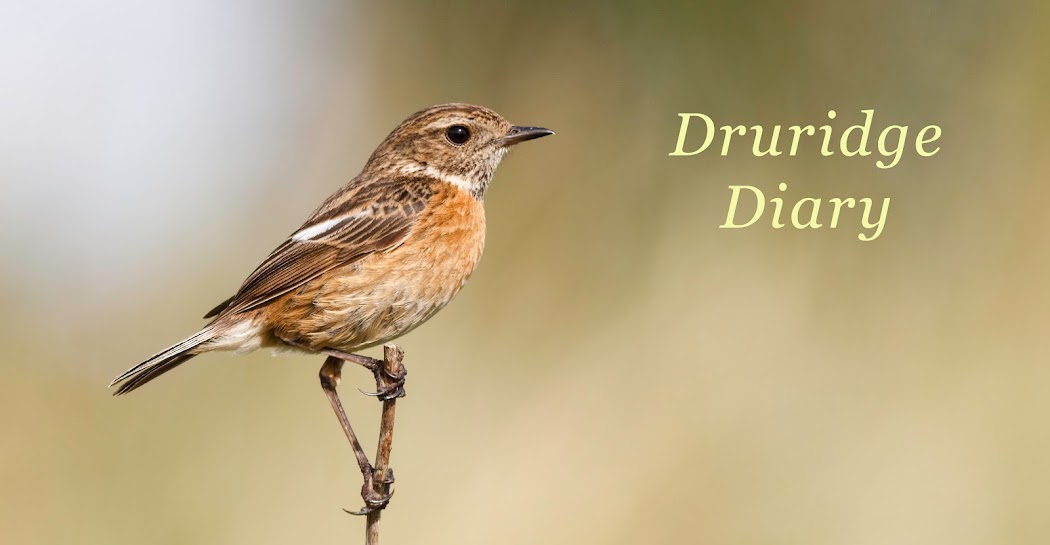
Female stonechat in the dunes

Full list here

Sunday, 24 November 2019

A proper 'back-end day'

Today was a proper 'back-end' day or as the Scots would say 'driech'. Unlike yesterday when it rained non-stop, it didn't really rain today but it wasn't dry if you know what I mean. A day typical of the 'back-end' of the year.

Having been confined to barracks yesterday, by lunchtime today cabin-fever had begun to set in so I headed out for a walk around the patch. It was so grey and with the threat of heavier mizzle, I left the camera at home, so there are no photos on the blog today.

I walked a loop out to the Preceptory, returning by High Chibburn Farm and Druridge. Before I did, I stopped to check the front field at Druridge for geese as a white-fronted geese had been reported earlier. There were no geese but there were two snow buntings in with the beast at the top end of Hemscotthill Links.

Back to my walk - lots of wigeon and teal on the Budge fields with other ducks and a herd of canada geese. The waders were all on the recently resown grass ley beyond, 134 curlew, 149 lapwing and 160 golden plover and three roe deer.

There was little of interest until I go to the farm where five grey partridge flew out. I stopped to chat to Richard the farmer and got on to three yellowhammers in a hawthorn. A scarce bird at Druridge these days and 'new for the year' for me.

Pheasants were everywhere, I estimated 64 on my route but could easily have been double that. Widdrington Farm have been putting them down for the shoot but they seem to favour the coast it seems.

Not much else of note. It's that time of year.

Full list and route here


Sunday, 17 November 2019

Winter WeBS

After what seems like weeks of non-stop rain, it finally dried up today... well almost, which was good as it WeBS count day and I was keen to get out on the patch.

The wildfowl numbers have really built up in the last couple of weeks, especially wigeon, which only numbered four on last months count. There were 363 today with 223 teal and 56 mallard. A female pintail was nice to see.

There were also good numbers of waders with 83 curlew and 56 lapwing. Among them were four ruff and two black-tailed godwit and 12 dunlin flew off during the count. I was hoping the Cresswell long-billed dowitcher might put in another appearance but it hasn't yet.

There was a big flock (for Druridge) of 425 black-headed gulls on the Budge fields when we arrived which had two adult Mediterranean gulls amongst them - they all slowly moved off south into the fields by the time we left to go to the 'other side'...

Before we got there a finch flock moved through the alders by the new 'dwarfs screen'  - lesser redpolls, siskins, goldfinch and three bullfinch - a good record for the patch.

On the other side, it was very quiet - brim full and very brown. A sub-adult great-crested was noteworthy.

As we walked up through the dunes to look at the sea, a flock of 90 or so golden plover flew in-off. There wasn't much of note on the sea (which was a long way out) - a great-northern diver headed north was the highlight.

Full bird list here

This spider was on the perspex window in the hide, which I think is Metellina segmentata which has a common name seemingly - Eurasian Armoured Long-jawed Spider. A new one for me.

Metellina segmentata (I think)

Sunday, 10 November 2019

Hungary for birds

There's been no updates from the patch lately because I've been to Hungary.

We went for a short winter birding trip and a quick mooch around Budapest where we met up with our friend Gerard Gorman for a beer or two and got some guidance for our days of birding. Rather than target species, which I did have two - red-breasted goose and lesser white-fronted goose, it was the 'birding spectacles we were interested in.

The first of these spectacles was the great bustards in Kiskunsag National Park, where we saw a group of over 60 in one field.

Some of the great bustards in Kiskunsag
Then it was on to geese. Both Kiskunsag and Hortobagy National Parks attract huge numbers of Eurasian white-fronted and Eursian greylag geese as well as a LOT of other wildfowl. We weren't blessed with good weather, most of a whole day in Kiskunsag was written off due to rain and when it was raining it was grey and damp. I took hardly any photos and what I did take are silhouettes against a grey sky.

white-fronted geese at Hortobagy
Greylags and a great egret at Hortobagy
The next great spectacle was watching thousands of common cranes coming in to roost at Hortobagy. great long lines of them flying in at dusk - an amazing sight.

Finally, the surreal experience of an urban long-eared owl roost in trees in a residential cul-de-sac int he middle of a large town. We counted at at least 30 individuals in a handful of trees.

One of at least 30 roosting long-eared owls
I managed to see six red-breasted geese after a long walk in to the main fish ponds at Hortobagy but the lesser white-front was literally liking for a needle in a haystack and with poor light it was even trickier.

Raptors were good with plenty of hen harriers and white-tailed eagle, an adult imperial eagle and a couple of saker falcons were great to see.

Anyhoo - back to the patch.

Yesterday (Saturday) I had a quick wander out before the football. Gary Wren had reported a snow bunting on the haul road so I headed for that and met Gary who was watching the very-confiding bird on the northern boundary of the patch.


Snow bunting on the haul road
It wasn't long however, before it was chased north by a dog (literally) and I headed south through the dunes picking up some twite with a roving flock of goldfinch and linnet. A long-tailed tit flock roamed through the dunes and a second flock was by the path to the hides. Not much else to report. Full list here

When I was nearly in to Newcastle on the bus to the match, a report came through of nine waxwings moving south towards tot he Budge screen. I've still not seen waxwing on the patch so was more than a bit gutted but at least the toon managed a win.

Janet and I went for a walk this morning in the vain hope that the waxers might have hung about but as I suspected they'd just been fly-throughs.

There was a group of barnacle geese, maybe 14, with about 300 pinks on the front field, the bushes were quiet however - a few long-tailed tits. We met up with David Elliott and got on to a finch flock which included a bullfinch and a lesser redpoll.


Some of the pinks in the front field
We walked back by via the beach looking for snow buntings, we didn't see any but the sanderlings kept us entertained.


Full list here


Sunday, 20 October 2019

They came from the north

They came from the north... No, not the birds, the birdwatchers.

I gave a talk about my Druridge patch to the north Northumberland Bird Club the other week and they were so impressed (with the patch, not me) that they decided they would make it the next destination for one of their field outings.  When they told me they were coming, I volunteered to show them around.

They arrived yesterday morning - ten of them. Despite the forecast, the morning started off dry and quite calm. I showed them the plantation and the bushes by the entrance where we picked up our first chiffchaffs of the morning with goldcrests and a flock of long-tailed tits. We then headed north along the road. I got quite excited by a fly-over mistle thrush (year tick) and I explained that this one of the great things about patch birding - common species like mistle thrush, collared dove or treecreeper are exciting finds. A great-spotted woodpecker followed the mistler.

A tractor and trailer, full of shooters, passed us, turned around at the turning circle before heading back towards the farm. As we got to the Budge screen and started to admire the large flock (300+) of teal, they arrived in the fields beyond and started shooting pheasants. Up went the teal with most of them heading off to find a quieter pond. I still don't understand how anyone can call pheasant shooting 'sport'..  With nothing much of note on the fields, we continued north towards the path to the Oddie hide. I explained the various habitats on the patch as we went.

Photo: Margaret G
At the start of the path, near the information panel, there were a couple of chiffs associating with a tit flock before they all went mental when a male sparrowhawk shot through.

There was a handful of tufted duck on the big pool and a juvenile great-crested grebe was noteworthy. As we returned back along the path the first raindrops fell. We paused briefly when I thought I heard a yellow-browed warbler but couldn't locate it. By the time we got to the road it was raining heavily and we took the collective decision to call it a day and head back to the cars.

We saw 50 species in just over two hours which isn't bad considering we've had a week of westerly winds. The full list is here.

With strong northerlies overnight and the first little auks being reported from Tyneside, I decided to try a seawatch this morning. It didn't look promising with squally showers making for poor visibility. Thankfully most of the birds were close-in, especially the gannets. I did an hour and failed to find a little auk amongst the passing guillies. Highlights included a drake scaup, seven goosanders, great northern diver, two red-throated divers and four velvet scoters. Full list here

Grim 

Sunday, 13 October 2019

Autumn migration, vizmig and skinny dippers

The pace of migration and birding as tailed-off a little bit since last weekend when easterly winds brought some interesting passerines onto the patch.

The highlight for me was a little influx of lesser whitethroats, which are a really scarce bird at Druridge these days. Janet and I found a couple on the Saturday morning before we went to twitch the hoopoe at Amble links.

Post and pre-work visits on Monday and Tuesday brought the maximum count of lesser-whitethroats to four, including a very pale looking individual which I only saw for seconds before flitted off. On Monday two of the lesser-throats were joined by at least five chiffchaffs one of which one looked and called like a Sibe chiff  tristis.

I added some other Autumn goodies to my list including yellow-browed warbler, bullfinch, greenfinch, siskin, lesser redpoll, brambling, redwing, grey wagtail and fieldfare. A late flurry of swallows and house martins headed south over the same days and there was good passage of skylarks.

The wind turned westerly for the latter part of the week and a work trip meant it was it was Saturday morning before I got back to the patch.

I paused by the 'front field' at Druridge Farm as there were some pink-footed geese, about 300, feeding, but mostly sleeping, there. I scanned them all, but noting unusual stood out, other than couple of neck-collared birds which I couldn't get the full code from. They got up and flew around when a small came over.

Pink-footed geese
In the same field were about 250 golden plover, 280 lapwing and 62 curlew.

Some of the golden plovers
Whilst I was scanning geese, a flock of 31 whooper swans flew south and along with the two in the adjacent rape field, were my first of the autumn. I managed to get some photos as they flew over.

Three adults and two juveniles


Juvenile

Overhead, a near constant stream of common gulls flew west from the sea to agricultural fields - they return each evening at dusk to either roost on the sea or the beach depending on the state of the tide.

One of the common gulls
 No scarce passerines were found, just a chiffchaff or two travelling with the long-tailed tit flock.
Long-tailed Tit
 On the Budge fields there was another flock of 18 whooper swans - 15 adults and three juveniles.

Whooper Swans
 Today started overcast and grey. Janet and I headed down to the patch for just after first light. It felt quite quiet with few passerines moving other than a roving tit flock.

From the plantation, I spotted a large bird flying strongly south just above the dunes - it was an adult ruddy shelduck. I've seen ruddy shelduck on the patch on the patch before but many years ago. I'm not sure where this species stands on the official British list now, I must check...

There were a few cars parked together near the blockhouse which was unusual, by the time we reached the cars there was a group of a dozen or so folk standing around them. As we approached one of them said;

"You're too late"
me - "For what?"
him- "Skinny Dip"
me - "Thank god for that!"
Another chap (very excitedly)  - " We've been in the sea...naked!"
me - "rather you than me!"

They asked us join them next month or on 21st December - we politely declined and wandered on.

It rained heavily just before 9am which was quite handy as we had an appointment with friends and a large breakfast at the Drift Cafe.

I'd completely forgotten it was WeBS day. The rain had eased a little after 5pm so I went back and did my WeBS count -it was pretty grey and miserable and the rain became heavier. The highlights were a little egret and a kingfisher, my second of the year, over the big pool.

My year-list now stands at 156. A few species are still feasible but it ain't gonna be a record-breaker.
Tuesday, 1 October 2019

Seawatching gold

On the back of recentl northerlies I've managed a couple of post-work evening seawatches in the last two days but did I find a crock of gold at the end of the rainbow?


Yesterday evening (17.40 - 18:15) the visibility was better than had been on Sunday evening but the sea was quite quiet. It wasn't a waste of time however, as there was a huge movement of barnacle geese. I counted 307 in different groups - the most impressive was a group of about 85 that I watched coming in-off. Picked up on the horizon, they zig-zagged north and south until they reached land just to the south of me, disappearing behind the dunes. 

The other highlight was a purple sandpiper. Being a bird of the rocky shore they are a very rare bird at Druridge, but conditions were perfect - the top of a high tide when they are pushed off Snab Point or Newbiggin and they head north, probably to the safety of  Coquet Island to sit-out the tide. This was my first patch-record of a 'purp' since 2014.

Tonight (17:20-18.40) was much more productive for seabirds. I thought it was going to be when the first bird I got onto was a bonxie, followed by two groups of manx shearwater with three sooty shears for company.

The kittiwakes, lots of them, were quite far out and the lack of gannets suggested they were even further out again. Other birds were a bit closer, especially some of the arctic skuas and bonxies. Other than the odd manx or two the shearwaters dried-up after the initial flurry. 

A grey plover flew north - another scarce wader for the patch. 

It went a bit quiet after 6pm and a horrible squally shower came through - I hunkered down in the dunes and watched the rainbow until it passed. I had though about heading home, but I'm pleased I didn't. Another heavy shower offshore seemed to push birds in a bit as a couple of bonxies and arctic skuas passed close-by. 

Then, from out of nowhere, two steely-grey juvenile long-tailed skuas appeared above the freshly-arrived raft of gulls on the sea. They swooped and towered above the skyline, quite close in, for a few minutes before heading off south down the bay. My first long-tailed skuas on the patch since 2013. It's often the case that long-tailed skuas will venture much closer to shore than their relatives, I've seen this at Druridge before and at Newbiggin where I've seen them fly behind seawatchers, cutting Church point. 

The light faded quickly soon after and I headed home, cold and wet, but having struck seawatching gold at the end of the rainbow.