Showing posts with label grey partridge. Show all posts

Thursday, 24 December 2020

All Grey

Apologies for the lack of posts recently, it's not that I've not been to the patch, I've been most days, there just hasn't been much to write about.

December is usually a bit spartan but this December seems more so. It's hardly been light enough to bother taking the camera out - sunny days have been few and far between, just day after day of grey and rain.

The wind was out of the north for much of yesterday and strengthened into the evening - strong enough to bring some Little Auks down? - only one way to find out. When I got up this morning it was sleeting hard and just looked miserable, but a check of 'Rain Alarm' suggested a brief window of dry weather from 11ish, which happened to coincide with high tide.

The sleet promptly cleared away at 10:50 and I was set up for a seawatch. The sea was big and the wind still out of the north but it felt quiet - quiet enough to count gulls and auks - mostly unidentifiable dots on the edge of the world but a few came close and the sun had come out providing a really nice light. 

Nice light

About 15 minutes in I picked up a small pale-grey bird, almost looking white in the sunshine, heading north just beyond the breakers, it was disappearing into the troughs but as it drew level I got some good views - it was a Grey Phalarope. This is the third Grey Phalarope I've seen on the patch - and I've always thought how pot-bellied they look, side-on, like a little dove or pigeon - they're a compact little thing too. Virtually white below, with darker-grey upperparts and a really obvious white wing bar on the upper wing. The dark 'eye-mask' stood out in the strong light, I didn't really notice the bill - it must've had one!

It kept going north along the bay, hugging the line just beyond the breakers. I notice that Jonathon Farooqi had one much earlier at Church Point so it's unlikely this was the same bird, unless it stopped-off to feed en route?

Seawatching continued to be quiet in terms of numbers but plenty of variety. I had a skua species heading south, again on the edge of the known world - it was just a shape really, towering constantly as it went south. I thought Pom but more likely a Bonxie as the Newbiggin lads had a few south and Bonxies are usually distant birds at Druridge. Other highlights included both Great Northern and Black-throated Divers and a drake Velvet Scoter with a smattering of Red-throated Divers, Gannets, Kittiwakes etc

I continued until 12:20 when a heavy sleet shower arrived. No Little Auks but the Grey Phal more than made-up for that. Full list here. 

Incoming

Last weekend was a bit frustrating. We'd bumped into Janet's parents just as we were leaving Druridge - they headed off north for a walk. Later in the afternoon, Janet's Dad messaged to say he had seen a male Hawfinch on the fence along the Bridleway north of the turning circle. We spent an hour-and-a-half looking but no joy - it could've been anywhere. Alan knows his birds so little chance of mis-ID. Another patch-tick missed this year. I'll have to insist that he takes his mobile with him when he's on my patch!

Otherwise not much to report - the Water Pipits (up to three) are still on the Budge fields but are difficult to spot, up to two Chiffchaffs are sticking it out but this cold snap might move them on and three Scaup have regularly been seen on the big pool. A few Bullfinches are also hanging about - not a common over-winterer at Druridge.

My year list is now at 178 - is 180 still a possibility? Some wintery weather might be needed.

Here's some photos I've taken since my last post. Happy Christmas everyone.

Sanderling probing for food amongst the froth

I usually don't like 'running' wader photos
Little Grebe on the big pool - one of two

Catching a few fish...


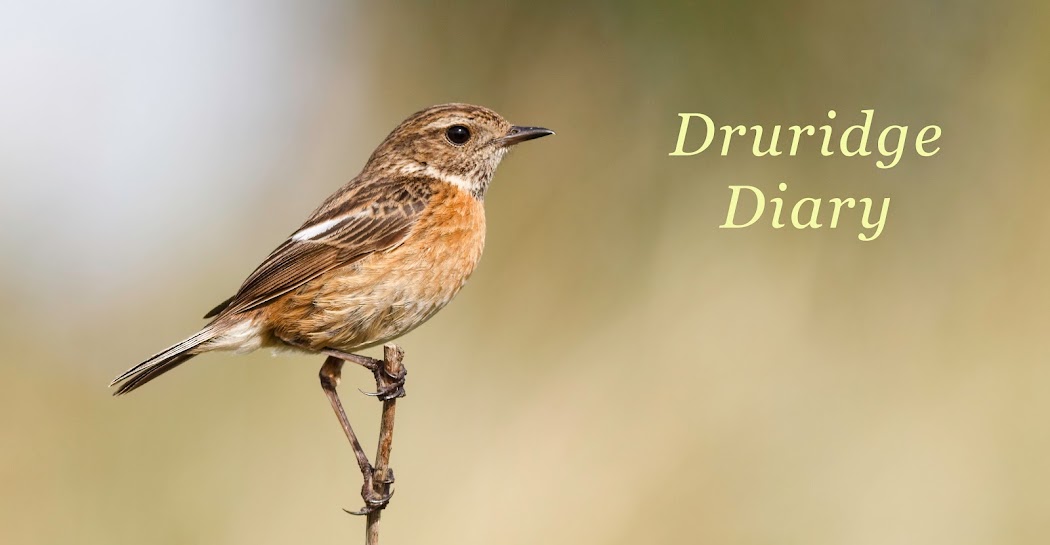
Never get bored of Stonechats

Grey Partridge  - there's been up to 17 in the weedy dunes

Saturday, 22 August 2020

An emergence of butterflies

This morning it was breezy from the south west with sunny spells, I had a walk to the north end of the patch, through the dunes north of the turning circle. The first bit north of the Dunbar burn is owned by the National Trust and the next area is owned by the local farmer. Both areas are grazed with the one to the north grazed much more heavily than the National Trust bit, basically cows are overwintered and supplementary fed on silage. This isn't ideal for dune flora as the feeding and dung enriches the dunes, but, for wintering birds, these dunes are a real mecca. The resultant plants, Mugwort, Fat Hen, Houndstooth and Redshank provide a huge seed resource for finches, buntings and tree sparrows. Additional arable weed seeds brought in with the silage supplement what grows. 

The purist ecologist in me should be horrified, but diversity is everything and these 'wrecked' dunes play an important part in keeping these passerines fed when there is nothing in the surrounding farmland and that is why there are a hundred or so Twite here every winter.

The weedy dunes with mugwort, redshank and fat hen

The birds numbers are already starting to pick up here with 30 Linnet, ten or more Reed Bunting, family parties of Stonechat, Whitethroat and Grey Partridge noted this morning. A single Sedge Warbler was certainly a migrant.

Male Reed Bunting in the Fat Hen

Reed Bunting - This is the best Reed Bunting photo I have ever taken 

A young Stonechat - one of a family part that included three juveniles

He got his eye on this fly - still learning to feed I reckon

The highlight this morning wasn't the birds but the butterflies. As I walked through the dunes, Small Tortoiseshells lifted from everywhere I walked, they all looked really fresh so must have recently emerged, I reckon I saw at least 150 of them in those two areas of dunes alone. Red Admirals, also freshly emerged, were also conspicuous with at least 40 counted. A couple of Meadow Browns and Small Coppers were looking less fresh. 

One of over 150 Small Tortoisehells
Red Admiral - one of about 40-50

I presume this is a local emergence but down on the beach, Small Tortoiseshells were flitting by me from headed inland from the sea.

Onto the beach - it looked wet away to the north

A passing Herring Gull

There was nothing much of note on the sea and the Budge fields were quiet, save for a group of Dunlin and Ringed Plovers. It was too windy for macro photography and I managed one hover with the small camera. 

Hoverfly Helophilus pendulus

This was growing in the one of the cattle feeding areas - It is a Coprinus (Ink Cap family) - I think possibly Coprinopsis narcotica which likes dunged areas.

Sunday, 24 November 2019

A proper 'back-end day'

Today was a proper 'back-end' day or as the Scots would say 'driech'. Unlike yesterday when it rained non-stop, it didn't really rain today but it wasn't dry if you know what I mean. A day typical of the 'back-end' of the year.

Having been confined to barracks yesterday, by lunchtime today cabin-fever had begun to set in so I headed out for a walk around the patch. It was so grey and with the threat of heavier mizzle, I left the camera at home, so there are no photos on the blog today.

I walked a loop out to the Preceptory, returning by High Chibburn Farm and Druridge. Before I did, I stopped to check the front field at Druridge for geese as a white-fronted geese had been reported earlier. There were no geese but there were two snow buntings in with the beast at the top end of Hemscotthill Links.

Back to my walk - lots of wigeon and teal on the Budge fields with other ducks and a herd of canada geese. The waders were all on the recently resown grass ley beyond, 134 curlew, 149 lapwing and 160 golden plover and three roe deer.

There was little of interest until I go to the farm where five grey partridge flew out. I stopped to chat to Richard the farmer and got on to three yellowhammers in a hawthorn. A scarce bird at Druridge these days and 'new for the year' for me.

Pheasants were everywhere, I estimated 64 on my route but could easily have been double that. Widdrington Farm have been putting them down for the shoot but they seem to favour the coast it seems.

Not much else of note. It's that time of year.

Full list and route here


Sunday, 10 February 2019

Signs of spring

In stark contrast to the cold and snow of last weekend it was quite pleasant out and about this morning, mind it was a bit blowy yesterday.

Yesterday we braved the winds later in the afternoon and walked up through the dunes and back along the beach. In the dunes we flushed up a covey of 12 grey partridges, my first of the year here and since the cattle returned. There were up to 2000 pink-footed geese on the fields beyond the haul road - some of them got up and flew over the dunes.

Pink-footed geese over the dunes
Despite being sandblasted, we had fun watching the sanderling being blown sideways along the beach, they were feeding in the sunshine were it came through a gap in the dunes - the same gap the wind came through. A small flock of eight curlew flew over from the sea.


Sanderlings


Two of the Curlew flock
Today we headed inland, first to the Oddie hide were there was little to be seen other than a huge flock of noisy Canada geese.
Canada geese
We continued towards the preceptory where we saw a single yellowhammer on the hedge (there are over 50 in a cover crop only two-fields away). Yellowhammers are hard to come-by these days and are a species that i didn't see last year on the patch. On towards the haul road our souls were lifted by the first singing skylarks of the spring, obviously enjoying the sunshine. There were at least six in the fields either side of the road.  Beyond these fields at least 30 whooper swan and handful of mute swans were grazing, it was impossible to get an accurate count though as some were in a hollow.

I ventured off the patch (I know, it's not like me and I thought I was going to have a nosebleed) for a wander to Chibburn mouth to check the beach levels where we put the fence up for shorebirds in the summer. I didn't hang about though and headed back down the beach and back onto the patch.

Passing Herring Gull

Wednesday, 12 December 2018

Absentee

I've bit a bit of an absentee from the patch recently. With birding limited to weekends and weekends taken up with football and chores it doesn't leave any time for birding. That alongside a knackered computer has meant little activitiy on the blog I'm afraid.

In late November I spent a bit of time in the dunes north of the 'Druridge bushes' which themselves are looking more like twigs after the cattle destroyed them last March. These dunes are part of the farm and are used for over-wintering cattle and as such, are full of all sorts of seed-baring plants which I must try to identify when they are in flower next year ( I recognise mugwort and burdock). The patch boundary is the northern end of the first fenced and farmed dune. Technically these are 'Chibburn Links' rather than 'Druridge Links'.

One of these plants has a small, hard, round seed and the finches, reed buntings and tree sparrows love them - I had flocks of 50+ twite, 100 goldfinch, 40+ reed bunting, 50+ chaffinch and 50+ tree sparrows and a handful of linnet.

Twite

Some of the reed buntings with the small round seeds
Tree Sparrows and chaffinch
As well as the finches, buntings and tree sparrows, these dunes have attracted a lot of grey partridges - My top count was 54 in three coveys with a single covey numbering 28! There is something like in there. I still haven't seen a red-leg this year though...
Grey partridges


The only time I've been back on the patch since was last weekend when a White-billed Diver had been reported just off from the Dunbar Burn - being a full patch tick for me, I was there as soon as it was reported but had no luck. It was reproted again after we left but not by anyone that I know.

We did see a single drake velvet scoter, a dozen red-throated divers and a fly-by adult med gull.

Sunday, 8 January 2017

New year, new list

Another new year, another year list begins on the patch. I sometimes wonder what is the point of a 'year list' - a date in the calendar by which the list is reset, it could be any date I suppose, but most people stick to the calendar year.

What having a year list does do is give the patch birder some motivation to get our onto the patch in those dark January days. It gives a bit of focus to patch-birding, something to aim for when you know you that you are likely to see one or two new species in a year - if you are lucky!

My 2017 year list got off to a slow start. A trip to Islay for Hogmanay meant it was Saturday 7th before I hit the patch. Islay was great trip, it is a great place with lots of interest for the visiting birder and of course it is famous for its whisky...

So Saturday morning it was and I didn't have much time so I concentrated on the bushes, pools and up onto the haul road - I usually like a walk to out the farm in early January but there wasn't time.

In the plantation I was surprised to see a small flock of goldcrests - I am seeing them more in the winter now, once-upon-a-time they were strictly an autumn species at Druridge. There were also blackbirds, song thrush and mistle thrush in the plantation.

Robin
The Budge fields still held plenty of wildfowl including two drake pintail, waders were limited to redshank, curlew and lapwing. A sparrowhawk was perched out on the edge of shelterbelt - my only raptor of the morning and five whooper swan flew south.


Plenty of wigeon on the Budge fields
A siskin was with goldfinches on the path to the Oddie hide and then,ahead of me on the path, I could hardly believe my eyes, three bullfinches! This species is now a patch mega, these were the first partch bullies I Have seen since November 2014.

Bullies!
Out on the haul road, a huge flock of goldfinches, maybe 250, were coming down to bathe in puddles on the road and in the ditch - with them were a few twite, linnet, reed buntings, dunnocks and chaffinches.

Goldfinches bathing in the puddles
One of the chaffinches
In the dunes, a covey of 12 grey partridges were put up by the only other birder I saw (it was birdrace day).

Offshore, the sea was flat calm. There were a couple of shag, ten red-breasted mergansers, a few common scoters and red-throated divers and most excitingly a slavonian grebe - a good January species.

My 2017 year-list now stands at 60 species - not a bad start. Exactly half of the winning tally in the county winter birdrace.

I am doing the Patchwork Challenge again this year and will update my totals as and when.

Friday, 3 April 2015

Good Thursday

I took a day off work yesterday and I'm pleased I did, as the weather today (Good Friday) is awful. It was bright and sunny but the  wind which moved from north-west through north to north-east whilst I was there, was very cold, making it feel like winter.

I set off to Druridge hoping to see some returning migrants..sand martin, black-tailed godwit, garganey, sandwich tern, wheatear maybe? Maybe even some something more scarce like an osprey or ring ouzel?

I was disappointed.

Other than a signing chiffchaff, the only 'migrant' was a smart male white wagtail amongst the beast in the dunes north of the bushes.

There are still about 30 teal and wigeon on the Budge fields and a few shovelers. A single dunlin was 'new-for-the-year' it was with a handful of snipe and a redshank.

Other than canada geese and mute swans, there was only tufted duck and gadwall on the big pool. Nearby, this robin was collecting nesting material - at least the robins think it is spring.

Robin with nesting material
Out in the dunes, the stonechats seemed to be paired up. There was a flock of about 30 linnets in the dunes where the beast are fed, with a few goldfinches and a pair of grey partridges.

female stonechat
About 15 sanderling were on the beach, these could well be returning birds. Offshore, a pair of eiders were a year-tick but there were not terns and I still haven't seen a lesser black-back!

Looking back toward the preceptory, there was a 'kettle' of four buzzards, they soon split off into their respective pairs and parted company.

82 dunlin
83 eider

PWC 2015 Score: 96


Saturday, 8 February 2014

A bit blowey

It was a bit blowey today and I was putting off a visit to the patch, loitering about the house, when I got a message from Dave Elliott about white-fronted geese.

The geese were in the field immediately west of the Budge fields, the shelter-belt doing its job for them. There were about 250 pink-footed geese and at least two Eurasian white-fronted geese amongst them. There may have been more, but viewing conditions were tricky, even from inside the hide!

The female type common scoter is still hanging around on the big pool, five goldeneye were notable as there hasn't been may this winter.

drake goldeneye

I had wander up to the dunes at the north end of the patch and got onto a small gull over the haul road, dark underwings, with no black int he upperwing - an adult little gull. It settled at the back of the haul road flash.

Crap record shot of adult little gull

Whilst I was watching the little gull, I got onto this dunlin hunkered down behind a huge cow shit, seeking shelter from the wind.

Dunlin - seeking shelter behind a big poo!

There were a few skylarks and a couple of reed buntings in the dunes and I flushed half-a-dozen grey partridges. These goldfinches were coming onto the haul road to drink.

Goldfinches coming in to drink


70 white-fronted goose
71 little gull
72 dunlin
73 skylark
74 reed bunting
75 grey partridge

PWC Score 93

Sunday, 3 February 2013

February gets of to a flying start

With the toon at home yesterday and a belated birthday night out on Friday, I only managed one visit to the patch this weekend and that was delayed due to much celebrating last night, after the toon's magnificent victory.

A flock of about 450 pink-footed geese on the filed in front of the hamlet were grilled, they were all pink-foots. In the same field, three male grey partridges were competing for the attentions of a female - quite an impressive display, spring must be in the air.

The Budge fields are holding a lot of water, which has attracted a lot of dabbling ducks and few diving ducks too. Mostly wigeon and teal but also today were mallard, gadwall, shoveler, tufted duck, pintail and pochard. There were singles of each of the latter two, both new for the year list. There were also lots of curlew. On the big pool there were still two long-tailed ducks.

I saw a couple of species that I really didn't expect to see until the autumn today, great-spotted woodpecker and goldcrest. The goldcrest was in with a flock of ten or so long-tailed tits and a great tit. A passing sparrowhawk rattled them a bit!
Long-tailed tit
Elsewhere, at the north end, there was a small flock of mixed finches, mostly twite with linnet and goldfinch and on the beach, a female stonechat poked around amongst the flotsam and jetsam.

A couple of birders had seen a short-eared owl, but I didn't.

So today's effort takes the patch total up to 61 species and 65 points on the patchwork challenge.

49 grey partridge
50 pintail
51 pochard
52 great-spotted woodpecker
53 long-tailed tit
54 great tit
55 goldcrest
56 sparrowhawk
57 linnet
58 twite
59 stonechat
60 mute swan
61 cormorant

Sunday, 3 April 2011

Territory mapping: Visit B

An early start at Druridge this morning for my second mapping visit of the breeding season. A little bit of light rain first thing soon cleared to leave a bright, sunny morning.

Generally, it seemed quieter than ten days ago, which is a little odd. Skylark and meadow pipit numbers are back up to full strength and it was really encouraging to see a pair of stonechats carrying nesting material and at least five pairs of grey partridges and eight singing reed buntings.. Worrying though was the lack of dunnocks (1 singing male) and wrens (two singing males).

male stonechat
female stonechat with nesting material
On the migrant front, two more swallows were logged and at last, three wheatears were added to the list.
one of three wheatears
In the dunes, the common dog violets are flowering amongst the even more common dog shit.

common dog violet
 93 wheatear

Thursday, 30 December 2010

Out like a lamb

The new year didn't really come in like a lion at Druridge and it looks like it might be going out like a lamb....

Probably my last visit of 2010 to the patch and it was very, very quiet. There is a bit of a thaw on, even some green grass showing in places, but the budge fields are still frozen solid, so is the big pool apart from a postage-stamp sized bit of open water which was occupied by bathing gulls. The wigeon and teal stood around it, together, for safety.

Grey partridge are still easy to spot and two coveys of eleven and twenty were at  the north end.

The farmer at High Chibburn has agreed to put up a little owl box in his barns, so I called in there to drop him a box in. I've been seeing a little owl regularly on Druridge Lane and there has been one around the hamlet too, so hopefully they will find the box in the new year.

All going to plan there should be an annual review posted tomorrow before I sign off to celebrate the passing of another year with copious amounts of lager.

Friday, 24 December 2010

Christmas Greetings from a bright, white, Druridge

Not much snow on the land today, but as I slid my way to Druridge today it was certainly snowing offshore from Cresswell.
Dramatic snow storm out to sea (best place for it)
Druridge was white and bright, a crisp, cold day. There wasn't many people about either, though it sure to be busy over the next few days, the road is well dicey near Cresswell Pond so that might have a few people turning back.
Bright and White - Druridge today
I walked along the road via the Budge screen and back along the beach. There were a few thrushes about and I soon had all the common winter thrushes in the bag, including this fieldfare gulping down haws.

fieldfare gulping down berries

There was a large flock of siskins moving through the bushes, feeding on the bountiful alder mast, I counted about 40 and grilled them for redpolls without any luck. There were a few goldfinches in with them though, this one was obviously bored with alder seeds and feasted on a teasel instead.

siskin - one of about 40


Goldfinch - enjoying some teasel seeds

There were still lots of woodcock about, it was almost comical to see several trying to feed in amongst the sheep like the grey partridges were doing not far away, plenty of them too with coveys of 10, 11 and 25.

One of several woodcock in among the sheep

The beach was almost devoid of birdlife sparing a pied wag and a handful of sanderling.

It just leaves me to say "Merry Christmas" to you all and enjoy your festive birding!

I'll be at Druridge for our traditional Christmas Day walk tomorrow, I am not sure the blog will get updated though!