Showing posts with label yellowhammer. Show all posts

Saturday, 1 January 2022

Tradition dictates

Tradition dictates that on my first visit to the patch of the year, I'll find a species that I hadn't seen on the patch in the previous year. This happens most years. And guess what? It happened again today.

I've not seen yellowhammer on the patch since 24th November 2019 so to find a flock of eight in the hedge behind Druridge Farm was a real surprise.  I was beginning to think that they were locally extinct.

Today was unseasonably mild, 12 degrees C, but it was very windy from the SW. Janet and I had a good wander around the patch and managed to see 53 species in total. Highlights included a southbound great northern diver offshore, two woodcock flushed from the bushes, at least 300 Linnet and 200 chaffinch in the dunes and eight stock doves.

There was a lot of people though. It was like a July Sunday with cars abandoned at the site entrance and hundreds of people on the beach. 
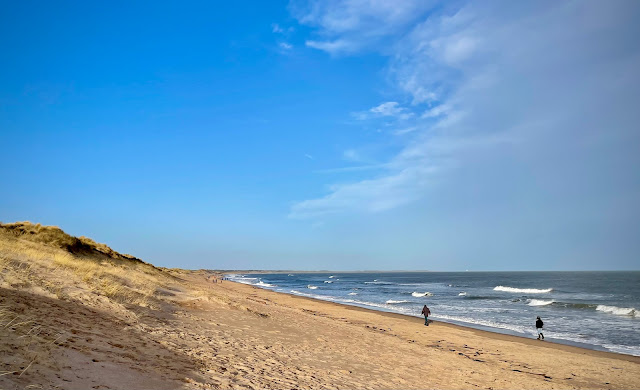
The beach was busier than it looks in this photo!

The ringed plover flock that roosts on the beach at the south of the patch had no chance to settle and just flew back and forth, looking to rest. 
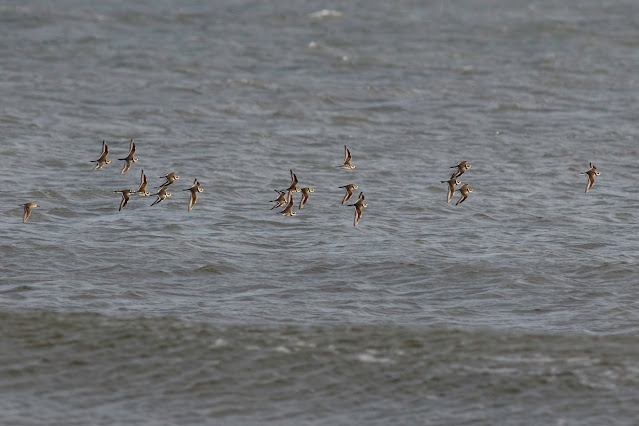
Ringed Plovers looking for somewhere to rest - no chance today.

I finished 2021 on a credible 167 species for the patch, which, given how poor an autumn it was wasn't too bad. Usual autumn stuff like pied and spotted flycatchers, garden warber, yellow-browed warbler, redstart and whinchat all missing from my list.

I also concentrated a bit more on the 5km patch challenge because of covid-lockdown. I saw 191 species within 5km of home which was nine more than the next patches. Ellington is obviously a good place to live if you're a birder. I'll continue with the 5km challenge this year as it does add a bit of variety to my birding.

I'm hoping to keep the blog updated more regularly too. My work/life balance needs some adjustment I think.
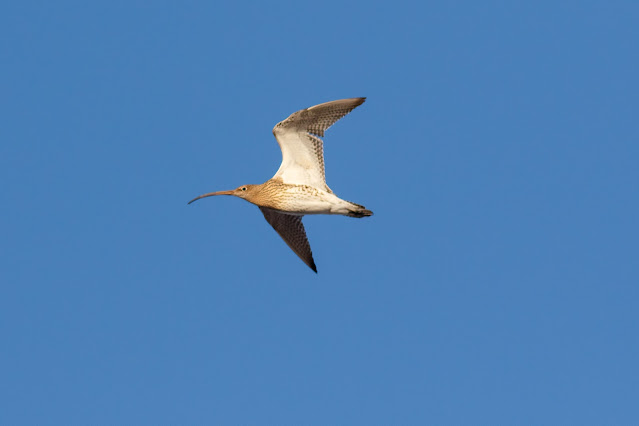
Today's list on eBird


Passing Curlew


Sunday, 24 November 2019

A proper 'back-end day'

Today was a proper 'back-end' day or as the Scots would say 'driech'. Unlike yesterday when it rained non-stop, it didn't really rain today but it wasn't dry if you know what I mean. A day typical of the 'back-end' of the year.

Having been confined to barracks yesterday, by lunchtime today cabin-fever had begun to set in so I headed out for a walk around the patch. It was so grey and with the threat of heavier mizzle, I left the camera at home, so there are no photos on the blog today.

I walked a loop out to the Preceptory, returning by High Chibburn Farm and Druridge. Before I did, I stopped to check the front field at Druridge for geese as a white-fronted geese had been reported earlier. There were no geese but there were two snow buntings in with the beast at the top end of Hemscotthill Links.

Back to my walk - lots of wigeon and teal on the Budge fields with other ducks and a herd of canada geese. The waders were all on the recently resown grass ley beyond, 134 curlew, 149 lapwing and 160 golden plover and three roe deer.

There was little of interest until I go to the farm where five grey partridge flew out. I stopped to chat to Richard the farmer and got on to three yellowhammers in a hawthorn. A scarce bird at Druridge these days and 'new for the year' for me.

Pheasants were everywhere, I estimated 64 on my route but could easily have been double that. Widdrington Farm have been putting them down for the shoot but they seem to favour the coast it seems.

Not much else of note. It's that time of year.

Full list and route here


Sunday, 10 February 2019

Signs of spring

In stark contrast to the cold and snow of last weekend it was quite pleasant out and about this morning, mind it was a bit blowy yesterday.

Yesterday we braved the winds later in the afternoon and walked up through the dunes and back along the beach. In the dunes we flushed up a covey of 12 grey partridges, my first of the year here and since the cattle returned. There were up to 2000 pink-footed geese on the fields beyond the haul road - some of them got up and flew over the dunes.

Pink-footed geese over the dunes
Despite being sandblasted, we had fun watching the sanderling being blown sideways along the beach, they were feeding in the sunshine were it came through a gap in the dunes - the same gap the wind came through. A small flock of eight curlew flew over from the sea.


Sanderlings


Two of the Curlew flock
Today we headed inland, first to the Oddie hide were there was little to be seen other than a huge flock of noisy Canada geese.
Canada geese
We continued towards the preceptory where we saw a single yellowhammer on the hedge (there are over 50 in a cover crop only two-fields away). Yellowhammers are hard to come-by these days and are a species that i didn't see last year on the patch. On towards the haul road our souls were lifted by the first singing skylarks of the spring, obviously enjoying the sunshine. There were at least six in the fields either side of the road.  Beyond these fields at least 30 whooper swan and handful of mute swans were grazing, it was impossible to get an accurate count though as some were in a hollow.

I ventured off the patch (I know, it's not like me and I thought I was going to have a nosebleed) for a wander to Chibburn mouth to check the beach levels where we put the fence up for shorebirds in the summer. I didn't hang about though and headed back down the beach and back onto the patch.

Passing Herring Gull

Tuesday, 17 January 2017

Grey days

Yesterday was supposed to be 'Blue Monday' - the gloomiest day of the year. Well, it was certainly gloomy when I arrived on the patch - overcast and misty with drizzly rain setting in. Today wasn't much better but it was my birthday and the day was brightened up with a little bit of sunshine...

On Sunday I did the WeBS count. Not a great variety species on the Budge fields, but plenty of what was there, particularly wigeon and teal with both species numbering over 400. I couldn't see the ruff that has been recently reported.

The big pool was very quiet, a couple of goldeneye and red-breasted mergansers and then I spotted why... two otters were swimming across the pool from east to west. It's ages since I last saw otter on the patch, probably over two years. These two looked the same size and the way that they were playing when they reached the west shore of the pool suggested they were siblings. This might also explain why coot and moorhen aren't on my year list yet.

Coot killers - record shot of the two otters making their way across the big pool.
On the path to the Oddie hide, one of last weeks bullfinches remained and a weasel legged it from one side to the other. 

female bullfinch feeding on dock seeds
Also of note were over 1000 golden plover on the field by the haul road, 30 sanderling, 18 turnstone and 12 ringed plover on the beach and 150 common scoter offshore.

Yesterday was very grey, Janet joined me for a walk through the patch and up to Chibburn mouth to look for the shorelarks as she hadn't seen them. They weren't to be seen (they were reported today) so we walked back along the beach in the mizzle. 

Today was my birthday. I headed out for walk to Chibburn Preceptory and back via High Chibburn and the cottages. The walk was largely uneventful. House sparrow and stock dove were added to the year list at the farm. The highlight came at the end of my walk, just by the cottages, when I found a little flock of yellowhammers with reed bunting in the isolated hawthorn on the roadside. 

Yellowhammer are a very scarce bird on the patch these days, in fact I only saw one in the whole of last year.
A little bit of sunshine to brighten up a grey day
I am doing the Patchwork Challenge again this year - they have a new fancy-dan website, check it out  - http://patchworkchallenge.com/ I am on 71 species and 78 points. 

I've got the rest of the week off work so might get out again between chores...


Sunday, 31 January 2016

Close...but no cigar

I'd been down to the patch for a couple of hours this morning before heading home via the Country Barn at Widdrington for a pasty. As I was leaving the farm shop, my phone pinged - a message to say that there were two waxwings on the road north of Druridge - Did this mean the haul road? Not much like waxwing habitat that. I panicked a bit - waxwing would be a new bird for the patch.

I phoned the chap who had put out the message and he explained that the birds were just off Druridge Lane. I was there in seconds, leapt out of the car and was put onto the birds, on a wire over the fields, with a lot of starling and fieldfare - great birds but they nor me were on my patch.

I jumped back into the car and headed for the nearest patch boundary, which is just before High Chibburn Farm. But it was no use, I could hardly see the wires for the high hedge, I took my wellies off and climbed onto the car, extending my tripod as far as it could go, but I couldn't pick out the birds. Frustrated I headed back the original spot, but there was no sign of the birds. I ate my pasty and headed home.

Before all of this kerfuffle, I had spent a pleasant couple of hours on the patch. When I arrived there was a short-eared owl hunting along the grass by the road - nice.

I had a walk south through the bushes. I disturbed a small male sparrowhawk from a  fencepost, it flew off causing alarm amongst the long-tailed tits. When I reached the path to the Budge screen, I disturbed the same bird again, this time off the ground, I went to have a look for a kill and found this...

The kill

Not what I was expecting. A woodcock! The bird was minus its head, but I found both mandibles nearby. The sparrowhawk had already had a decent meal of it, but I do hope it returned to finish its lunch. Woodcock would be no problem for a female sprawk, but quite a big bird to handle for small male like this one.

I still need woodcock for my year list...

As I arrived in the Budge screen, a water pipit took off from the right and flew, calling, a short way before settling down to feed.

There is plenty of wildfowl on the Budge fields, particularly wigeon, teal and mallard. There are also about 350 lapwing and a few curlew. Two drake pintail were still there too.

A quick look offshore produced a year-tick in the form of two razorbills but little else. At the farm, yellowhammer was my second patch year tick of the day.

So at the end of January I am on 88 species netting me 102 points in the Patchwork Challenge - not a bad start, but I think February could be a slow month, although I did see some signs of spring today.

Hawthorn bursting in to leaf

Saturday, 4 April 2015

Natural Causes or Suspicious Circumstances?

I had a short wander around the patch yesterday afternoon. I walked back along the beach and made a diversion through the plantation.

My pleasant afternoon was spoiled by this gruesome discovery...


A dead barn owl. It looked as though it had been dead a while, it was quite smelly and I disturbed a sexton beetle when I turned it over. It was a second calender year male and was wearing a BTO ring, it had been ringed by me as a nestling in June 2014 at a nearby farm.

I knew that an owl had been using the plantation as there has been pellets under a tree for a few weeks.

So, what caused its demise? Well it could, of course, be natural causes. It may have also ingested some poison destined for something else or it could have been shot.

This isn't the only owl to die in odd circumstances at Druridge recently.

On 5th May, last year, I caught a long-eared owl in a mist net, an adult female with a brood-patch We received information back from BTO that it had been found at 'Druridge Bay' 12 days later, without a head.


It isn't unusual for mammalian predators to remove heads of prey by shaking them, foxes and dogs for example would do this. What would be unusual, would be for a mammalian predator to catch a long-eared owl. My suspicion was that this bird had been shot. I tried to find out more about the circumstances in which the bird was found, but didn't get anywhere.

Lads with guns are regularly seen at Druridge, mostly after rabbits. Some of them, however, fall in to the 'shoot anything that moves' camp. I've always been reluctant to call the police as, because the incident involves a firearm, they send the armed response team. I have spoken to the local Police wildlife crime officer about this and he encouraged me to give them a call, at least with information.

If you are at Druridge and see lads with guns, give the police a call on 101 and take down as much information as you can. They will be on National Trust or the next-door farmers land and they haven't got permission to be on either.

On a more positive note. There were eight yellowhammers at High Chibburn today in a mixed flock with tree sparrows and reed buntings. I only saw one yellowhammer at Druridge last year.

A sand martin was at Hemscotthill on my way home, but none on the patch yet.

sparrowhawk 84
yellowhammer 85

PWC 2015 Score: 98

Sunday, 27 July 2014

Summer birding

Summer birding can be at a bit slow at Druridge, both in terms of birds and birders, with most of the 'regulars' off hunting butterflies or dragonflies at ne'er previously encountered ponds.

The mud on the Budge fields is keeping me interested, it hasn't turned up anything unusual this week but looks as though it could. Ruff was the best of the bunch mid-week when I also saw my first peregrine of the year, turning up bang on-cue with the returning lapwings. There has been good counts of yellow wagtails this week too.

The swallows in the hides seem to be doing well this year, with broods of three, one and five all fledged another four nearly ready to go. I've managed to ring them all.

The great-crested grebe pair are still persevering on their very late nest.

Stonechats are also doing well. This pair look like they are going to triple-brood
I had a ringing session yesterday but only caught 11 new birds and two retraps. I was very bright with a strengthening easterly wind, so not ideal conditions. There seems to be some drift migration going on as I caught four willow warblers which I don't think were locally bred. I also saw a juvenile yellowhammer by the Dunbar burn, yellowhammer don't breed at Druridge so that one was definitely doing some post-fledging dispersal.

The strangest sight yesterday was an off-white, tinged yellowish, small finch. I didn't have my bins on me, but it stood out like a sore thumb. It was either a escaped canary or an albino goldfinch (seemingly there has been a canary seen recently at Hauxley and Cresswell??). Either way it will soon be sparrowhawk food I fear.

common blue in the dunes

142 peregrine
143 yellowhammer

PWC score 188

Monday, 1 April 2013

Some signs of spring

At last, some signs of spring at Druridge.

First and most important - my first 'proper' migrant - a chiffchaff. It wasn't chiffing or chaffing, just 'wheeting' in the bushes at the far end of the big pool.

Some other signs of spring:

Willow catkins

Coltsfoot in flower

Lambeeees
As well as the chiffchaff, I also added yellowhammer and blue tit to the year-list on my tour of the patch which included a visit to Chibburn Preceptory and High Chibburn Farm.

89 chiffchaff
90 blue tit
91 yellowhammer

Saturday, 4 December 2010

Nice to be back

I was so pleased to get out and go birding today, having fought my way to work and back every day and stuck at home all last weekend it was great to be back on the patch. What made it even better? Quality winter birding!
Cold
To kick off - lots of geese between Druridge and Hemscotthill, approaching 1000 pink-foots with nine pale-bellied brents in with them. I didn't get the scope for out for fear of scaring them, so I didn't get a chance to grill them for any other species.

Pink-footed geese near Druridge Hamlet
I had a good walk around the patch, the most obvious and amazing thing was the number of woodcocks, they were everywhere! I din't need to walk through the bushes, there were four in the willows by the Budge screen, twelve in the pine plantation by the entrance, four in the scabby blackthorns at he north end and even one in the mugwort valley of death. There was shooting going on in the surrounding shelterbelts all day - I wonder if it was woodcock they were after?

The only woodcock  curlew photo I managed to get - I think a fox may have got it first
 Whilst looking for woodcocks to photograph, I saw a stoat prancing about after something, no photo's sadly but great to watch.

The big pool had lots of wildfowl on it, nothing unusual, just common winter ducks, wigeon was the most numerous at 250.
Winter wildfowl on the big pool
There were lots of small birds on the move too. A flock of 50 or so skylarks were put up by a sparrowhawk, 60 twite where in the dunes to the north, two flocks of long-tailed tit and a flock of 55 goldfinch were roving about.
goldcrest on teasel
Nothing of note on the beach other than this gruesome dead grey seal minus its eyes and a peregrine over the dunes.
Not looking good.....

At High Chibburn Farm an incredible 29 yellowhammers were keeping their feet warm on top of the cowsheds and 20 or so skylark fed on spilled grain by the barn.
One of 29 yellowhammer son the roof of the barn at High Chibburn Farm
So not a bad days winter birding - 51 species without even trying.