Showing posts with label bonxie. Show all posts

Saturday, 19 November 2022

Last gasps of autumn

The forecast didn't look too promising for this weekend and I felt like autumn was slipping away without a final finale. However, on Thursday things started to look better, with an easterly and some good seawatching. Instead of seawatching, I was sat in my office in zoom meetings all day.

Friday

As there looked to be a slim chance of a late migrant or two, I took a flyer on Friday afternoon and headed to the patch with Janet. We started with a look on the sea but it was quiet, a bonxie going south, only my second of the year, was the highlight. Not an auk in sight. Janet found a snow bunting on the beach which was a year-tick.

Female snow bunting in poor light

Same bird, different pose

We headed for the bushes, checking the area around the start of the path to the hides first. A female blackcap was a good start. I got onto a small bird flitting about in the branches, above the blackcap - I called 'yellow-browed warbler' to get Janet onto it, but it had flitted off. Even though I had the briefest views - Strong wing-bar and supercillium, pale tips to darker secondary feathers, it wasn't right for a yellow-brow. It was duller than a yellow-browed, almost with a grey cast. Hume's warbler sprang to mind but I needed better views to be sure and Janet needed to see it. I put the news out as 'a probable'.

We didn't have to wait long, as the bird re-appeared to the right and gave tantalizingly brief views as it flitted quickly through the branches. It had a colder, greyer look to it than a YBW, the wing bar and the supercilium were more off-white without yellow tones and the bill and legs appeared to be dark. It hadn't called at this stage, but we were both confident that it was Hume's and put the news out.

A 'bird wave' of tits and goldcrests came through, which also brought a willow tit and chiffchaff to the party. We lost the warbler in the melee, when we refound it, it was further right and it flew and called - a short, sharp two-tone call, not like yellow-browed's more drawn out 'twoo-eeee'. It did this twice before flying off south. 

We suspected it might have gone south with the tit flock, so I headed down towards the Budge hide but couldn't relocate it. Two ruff were on the fields and water rails were calling. We couldn't relocate the warbler by dusk so headed home. I would be back in the morning.

I had a likely Hume's warbler many years ago by the Budge hide. It's in a long-lost notebook and was never submitted, so technically not a new bird for the patch. I've seen three others in the county, at Whitley Bay (2006), Lynemouth Power Station (2002) and East Chevington (2001). 
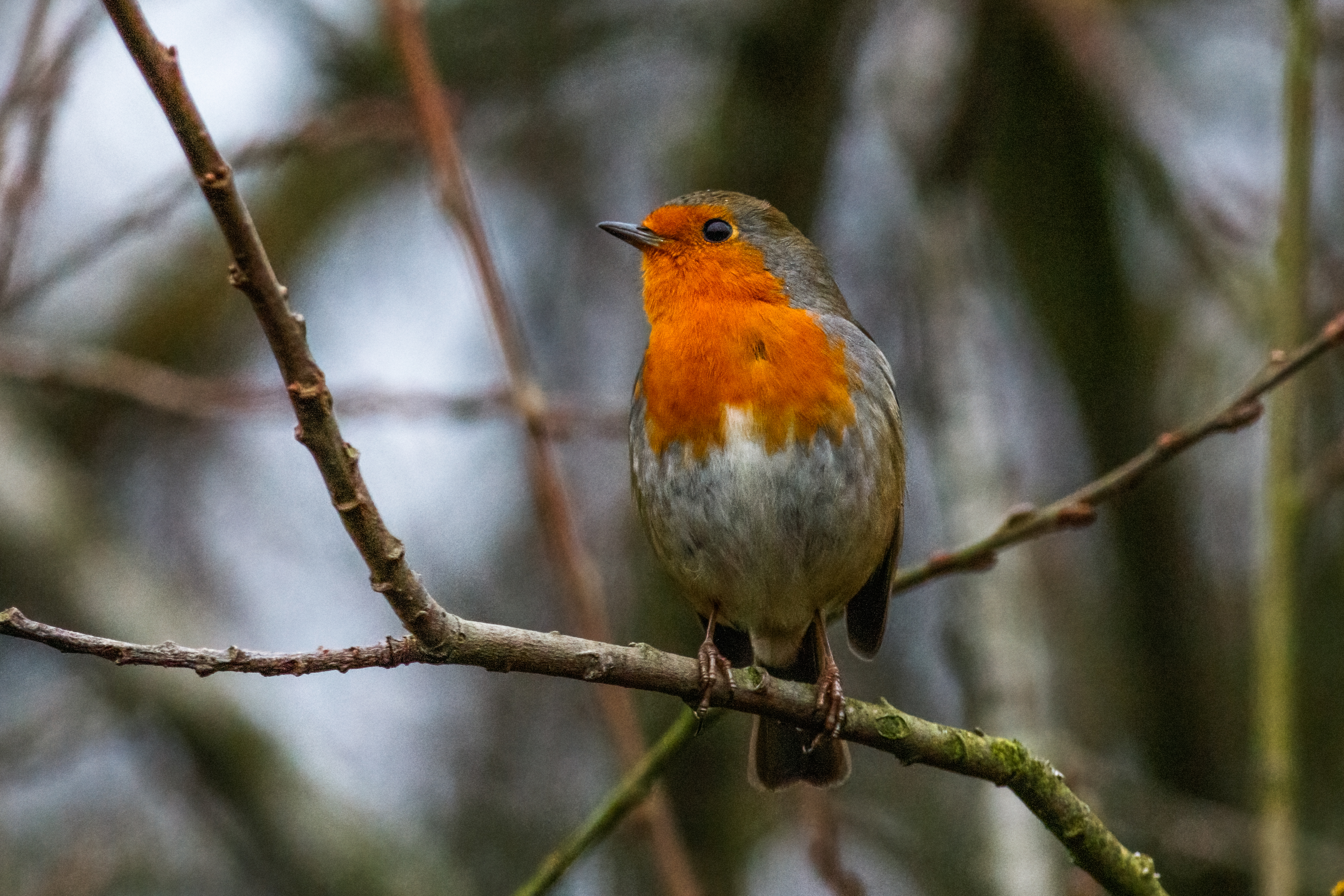
Robin - ever-present and singing a mournful autumn tune

Saturday

I got down to the patch at about 9.30. A handful of birders including Ashington Gary and Paul from Gateshead were loitering on the path but had not seen the bird, I headed north for a look through bushes. Two female long-tailed ducks were on Druridge Pool. With no further sign, I headed south to the Budge hide and checked the bushes there. It was quiet, so I checked the Budge fields and picked up a water pipit on call, which I eventually found feeding on wet grassland to the left of the hide. Bonus!

I wandered north through the bushes, when a tit flock came through and I picked up a firecrest amongst them. Nice. This was my third of the year on the patch! The flock headed south, so I followed them. I called ADMc as I know he likes a firecrest. Andy, Paul, Bob and Steve arrived - the bird was tricky to pin down, but they all got onto it eventually. 

Not sure this photo will make the Annual Report.

Whilst scanning for the firecrest, I found yesterday's Hume's warbler in a big willow. It was really tough to get people on it before it flew north over the path with some long-tailed tits. I found it again in a lower willow but it was lost to view after that and not seen again. I'm not sure how many people saw it - So frustrating!

A treecreeper was added to the day list - a scarce species on the patch.

I think that might be autumn over...


Thursday, 2 September 2021

Still seawatching

Last week I was mostly seawatching. Well, since then, the wind has remained out of the north and I've continued to be 'mostly seawatching'.

I've had two sessions on the patch and two trips to Snab Point for rarer species, just to give myself a better chance of seeing them. 

On Tuesday evening I had a two-hour seawatch from the dunes at Druridge. It started quietly so I decided to count 'everything' - I don't normally do this, because, when you're counting a long string of Gannets, you might just miss a skua or shearwater slipping through. Anyhoo, I did count the Gannets - 977 in two hours, give or take. That's about 500/hour on average. 

Other highlights from Tuesday evening included:

Pale-bellied Brent - 7
Bonxie - 2
Arctic Skua - 1
Roseate Tern - 1
Sooty Shearwater - 2
Manx - 8
and a Grey Heron  - not a common sight on a seawatch.


On Wednesday afternoon, a Fea's type Pterodroma petrel was tracked north up the East Coast. It was due at Newbiggin after 5pm, but I was cutting it fine, leaving the office at ten-to, I headed for Snab Point. I hadn't even got my scope set up when news came through from Church Point. Six minutes later I picked it up about 2/3rds out turning and towering, I got a fella, Dave, who was also there onto it and we watched it for the full three-four minutes it took to pass us and head north into the Bay. Despite the distance, the light was fabulous and the dark 'V' from the wings to the back could be made out as it banked and turned. What a bird! Much better views than the one I saw from Druridge a few years ago. 

This morning, Janet and I were back at Snab Point before work. A juvenile Sabine's Gull had been tracked up the coast. Shortly after being reported at Newbiggin we got onto it, straight out, above the horizon. It was really obvious compared to the Kitti's we'd been watching coming through. A bit of a 'tick and run' - we headed back to work.

This evening I headed back to my dune perch, with a new bit of kit. A foldable camping seat. This one just has a back and base, no legs, so ideal if there is a dune to sit on. I've been standing recently but it's hard work standing for three hours, let alone six or seven. 

It started quiet. There weren't even many Gannets. 

About forty minutes in I picked up a pale-phase Skua to the south, about half way out, the flight was slow and buoyant and I fancied it was a Long-tailed Skua. As it came closer my suspicions were right, a beautiful dusky-grey and white adult long-tailed skua, drew level with me and continued north. What a bird!

It picked up after that, with a couple of Bonxies and Arctic Skuas, and then a group of five Arctic Skuas together at half-five, close-in. Two adult Pomarine Skuas had been tracked north and they promptly came through just before half-six. Nice pale birds complete with spoons. Three little gulls, more Arctic Skuas and four Purple Sandpipers went through.

It had turned into a canny seawatch. I was thinking of going home to make tea when a juvenile Sabine's Gull appeared in the bottom of my scope, filling it. It was close in!

Now this is where my new seat was my undoing...

The Sabine's was in my scope, it landed on the sea, I panicked looking for my phone to try and video it (as it was that close). The phone had fallen onto the sand, as I reached from my new seat for it, it shifted, so did I, and the scope went over. I set it back up but couldn't find the bird.  If I'd been standing up, as I have been for the last year or more, this wouldn't have happened. Frantic scanning of the sea where it was last seen and then, back on my feet with the scope set up properly, a prolonged scan yielded nothing. Gone! F'ing seat!

Two more tracked 'Poms' came through at 19:18 - both adults with spoons and four Little Gulls were on the sea, two adults and two juvs.  


During a quiet spell tonight, I contemplated the pros and cons of modern communications that allow birds to be tracked up the coast. This morning, when the Sabine's Gull was at Tynemouth, I knew I had time for a bowl of Muesli before heading for Snab Point. You can now twitch seabirds. Whilst this undoubtedly means that more people get to see rare seabirds, it does take some of the fun out seawatching. Even though my views of the Sabine's gull at Druridge were brief this evening, before falling off my new seat, I still enjoyed that experience more than the tracked bird at Snab Point this morning which gave prolonged views. 

Tracked birds still need to be found by someone. I love seawatching and still put the hours in when nothing is being seen. It doesn't work if everyone sits at home waiting for Whatsapp to ping. Long-tailed Skuas are my favourite skua (by far) so finding an adult tonight was a real treat, it wouldn't have been the same if I knew it was coming like I did with the Poms. As I said... Pros and cons.

Here's some gulls...

Juvenile Great Black-backed Gull

Adult Common Gull

Adult Great Black-backed Gull


Sunday, 27 September 2020

Some seawatching

 The latter part of the week was dominated by very strong northerly winds - and that  means seawatching.

The wind really picked up on Thursday and into Friday morning but with my diary being full, I only had a brief window on Friday morning, I was in position for 07.25, hunkered down in the dunes as the wind was very strong, it was really busy with Auks, Gannets and Kittiwakes streaming north, a lot of them very close in, too close for some which would be under my scope. Just as I got settled I got onto a group of kittis very close-in and among them was something different - a juvenile Sabine's Gull. If I'd been settled in and concentrating on a single spot it would have been under my scope and I'd of missed it. 

I've never seen a Sabine's gull this close at Druridge before (I have at Church Point when I used to go there) and it was great to see it amongst adult and juvenile kittis for contrast. My first Sabine's since 2014 and my fourth for the patch - all September records in 2007, 2009 and 14. What a great bird!

It remained really busy, with hundreds of birds coming through but I only had an hour or so. Other highlights of my hour were:

Arctic Skua 1

Sooty Shearwater 9

Manx Shearwater 7

Red-throated Diver 1

and two Slavonian Grebes being tossed about on the sea.

Full list here

I had planned a sea watch on Saturday but the wind had strengthened and it was raining and reports from nearby spots weren't tempting me out - I think it was just too windy.

Janet and I had walk around the patch on Saturday evening seeing very little in the still-stormy northerly. 18 Pale-bellied Brents struggled north along the beach, just above the waves and 28 Barnacles went over, high. 

By this morning, the wind had really dropped. We'd opened some hooch that we brought back from Taiwan on Saturday night so I didn't get up early and only made it to the patch at 11am for another seawatch. It seemed quiet, nothing like Friday with few Auks, not Kittis and the Gannets well out. I gave it an hour :-

Sooty Shearwater 2

Manx Shearwater 4

Great Northern Diver 1

Bonxie 1

Barnacle Goose 19 (5N 14S)

Wigeon 27

Bar-tailed Godwit 2

Full list here

I also had ten Swallows, mostly going north! I headed for the bushes. It seemed quite quiet with nothing really calling - a single Chiffchaff was my highlight until I found a tit flock.

Chiffchaff

Here it is calling

It's always worth checking roaming tit flocks as migrant birds often join them like the Yellow-browed Warbler I found with them, a dullish looking bird, then a brighter individual which moved off north, I turned around and saw it or another bright bird - I think there was three but I'll only record two as the second bird could've done a U turn.

From the path by the midget screen, I counted 21 Swallows feeding above the bushes and 17 Barnacle Geese went south. Some waders have returned to the Budge fields at last, six Dunlin and three Redshank - it's a start.

Wednesday, 16 September 2020

What a difference a day makes

Two days couldn't have been more contrasting. Yesterday morning I was walking on the beach in a T shirt at 8am, today it was so cold, the winter coat came out!

The wind switched into the north overnight and the temperature dropped like a stone. A northerly at this time of year normally means seawatching and mid afternoon reports were coming in of Sabine's Gulls and Leach's Petrels from coastal watchpoints  - I was stuck in the office until 17.45. I eventually made it to my dune look-out by 18.05 - the light was poor and the birds were distant. It was getting dark after an hour and I was freezing cold so I quit then.

Highlights -2 Sooty Shearwaters, 1 Bonxie, 4 Manx, 4 Pale-bellied Brent, 27 Teal, 3 Red-throated Divers, 1 Shoveler and 25 Sandwich Terns. An Arctic Skua was harassing Kittiwakes offshore, it even had a go at a large juvenile gull, chasing it very high into the sky before giving up. Three Mediterranean Gulls went South.

There were flocks of Kittiwakes, moving north but stopping to feed, but they were way-out. Not good for Sabine's spotting. There were about 400 Common Scoter still on the sea.

Tonight's full list here

Monday and Tuesday mornings I've had a walk around the patch, both mornings were quite good for vizmig, with Meadow Pipits still dominating. 

In an hour on Monday I counted 328 Meadow Pipits headed south, some stopped to feed, rest and drink. I heard two Tree Pipits amongst them as well as 23 Swallows, 11 Skylarks and 1 Grey Wagtail.

Resting Meadow Pipit

In the dunes beyond the Dunbar Burn, a big finch flock has built up numbering around 180 birds. I estimated 65% Goldfinch and 35% Linnet but it could be 60/40. Yesterday, they were spooked and all got up and six birds flew out from the flock calling - Lesser Redpolls. It was almost as if they'd been roosting with flock overnight.

Young Stonechat

My usual route these mornings takes me north along the road/coal road to the edge of the patch and back along the beach, returning to the car by the road. There's usually not much to see on the beach or sea with just bins, other than the Sanderlings feeding busily along the tideline. The noise of the sea drowns out any vizmig.

I promise this is a colour image - Sanderling feeding on the shore

Red-throated Diver offshore

Mondays list

Tuesdays List

Friday, 28 August 2020

Seawatching and some thoughts on it.

With strong northerlies forecast overnight and early morning I suspected I might be seawatching today especially as I had the day off work. When I woke at 6am it was lashing it down with rain, I turned over and went back to sleep, If I'd had to go to work, I would've got up and gone anyway but I had the luxury of more time.

I eventually arrived at my dune watchpoint at 9am, it was too windy to stand on the dune ridge so I hunkered down in the dunes on a useful perch as I could be sometime.

The first bird I saw was a Bonxie, close in too. There wasn't a lot of action until pretty much the second notable bird I got onto was a skua,  a bit further out than the Bonxie, quite distant. A grey bird against the sea with a more languid tern-like flight - Juvenile Long-tailed Skua! My fifth of the year incredibly. 

It was steady after that, Manx Shearwaters coming through in little groups or singles and a few Sooty Shearwaters including a single group of six together about half-way out. There were a few distant Skuas that went unidentified - that's one of the problems with Druridge but a couple Arctic skuas were closer and one came into the bay to harass terns and a couple more Bonxies came through. A drake Velvet Scoter came in very close, north,  on its own and a group of ten Pale-Bellied Brent were also really close.

By 9.45am I was regretting not getting up earlier, the sky brightened and the sun even threatened to come out and the sea went 'silvery' - not good, anything more than half way out was unidentifiable. I was temped to pack up but visibility improved a bit as a cloud came over so I hung on. I was pleased that I did as the bird of the day, and one of my best seawatching experiences at Druridge happened soon after. 

A bird flew north, close-in and therefore low in my scope-view, so it passed through quickly, but it looked interesting and I tried tracking it through the troughs in the breakers, a shearwater, pale on the undersides but 'dumpy looking'. It was flying really slowly, moving back and forth, passing over and through the scoter flock, looking like it was feeding amongst them. It wasn't a Sooty, it had a pale belly anyway but the jizz was altogether wrong and it didn't have the contrast dark/white of a Manx and it just didn't look right.I was sure it was Balearic Shearwater. It landed among the Scoters briefly, before making a short flight and landing again, it did this three or four times, only landing for a few seconds before taking another short flight.These short flights gave good views when it wasn't in a trough and the dusky underwing, darker 'armpits' and dumpy appearance confirmed my initial ID. Eventually it moved off north, slowly again, feeding as it went. In hindsight I probably could have had a record shot of it, but I was too busy 'enjoying the bird'. This was my fifth Balearic at Druridge but by far the best views I've had of one here and my first since I saw two on 5th September 2013.

By 10:40, the light had really gone. I kept going until 11:05 to get the two-hours in and saw a few more birds including some Teal and a Golden Plover picked up on call just over the breakers, but it was high-tide. 

It was interesting to compare my figures with  headland watchpoints to the north and south of me. Obviously being in the middle of a bay I miss out on birds but I seem to miss out on some species more than others, Bonxies are a good example. I saw five in two hours today, Mark Eaton had 13 at Boulmer, Jack Bucknall had 13 (3 1/2 hours) at St. Mary's and Ben Steel had 19 in two and a half hours at Howick. 

I think powerful birds like Bonxies and to some degree Poms (I didn't see one today) don't drift into the Bay, they just take a straight line from Snab Point to Coquet Island so are too distant for me. I do better for Arctics than some headlands because the terns feeding in the bay draw them in and largely comparable for Long-tailed Skuas which seem to hug the coast more, or even curt off headlands (I've seen them do this at Church Point). Likewise, I do okay for Manx (and today for Balearic) shearwaters but struggle with the bigger Shears, with only one Cory's (in 2005) and no Great Shears ever. 

Despite the disadvantages of being in a bay, I'd swap a dozen of any of those species at Church Point for jut one on the patch. Above all, I love a good seawatch!

Highlights 09:05-11:05 (all N) (Full list here)

Pale-bellied Brent 12 (10N 2S)

Teal 56

Velvet Scoter 1 (drake)

Bonxie 5

Arctic Skua 4

Skua sp 6

Long-tailed Skua 1 (juv)

Golden Plover 1

Sooty Shearwater 11 

Manx Shearwater 24+

Balearic Shearwater 1

Two photos taken as I was packing up.

Adult Lesser Black-backed Gull

and juvenile

Wednesday, 26 August 2020

Unseasonable

The weather this week can best be described as 'unseasonable'. Monday dawned nicely with some sunshine (remember that?) but it didn't last and Tuesday was a complete write-off with torrential rain and gale force winds from the north, which of course at this time of year could produce some good seawatching. Today, the wind was still out of the north and it felt more like November than August. It had dropped a bit by this evening but was still cold.

I was lucky to catch the sunshine on Monday morning before it disappeared (for good?). The sun brought migrant birds and some locals to the sunny edge of the bushes and I counted 12 Willow Warblers and nine Whitehroats including some family parties, Wrens were  also obvious. By the turning-circle there were Reed Buntings, Stonechats, Linnets, Meadow Pipits, a Robin and a Dunnock.

Male Stonechat - all fluffed-up after a good preen

Young Goldfinch on the fence

In the dunes, there were still plenty of the weekends freshly-emerged butterflies. I wonder how many are still alive now? 

Red Admiral - maybe that Stonechat has taken a chunk out of its wing?

Small Tortoiseshell on Mugwort

Less common - a Small Copper

I walked back along the beach and already the clouds intimated what was in store. 

Looking north...

and south

Mondays list

After being stuck at my desk all day in video meetings, I headed out for a seawatch this evening, The wind had dropped and it looked like seabird activity had too going off others' reports from earlier in the day. It wasn't bad for a Druridge seawatch though - I've had worse! Some birds were quite distant. I got onto a Sooty Shearwater almost straight away, flying through the distant pot flags, it was followed by a small group of Manx Shearwaters and then a spoonless Pomarine Skua powered through on the same line as the Sooty.

Another highlight of the afternoon was groups of Brent Geese headed north. The ones I saw I against the sea were all Pale-bellied Brent, I presume the silhouetted birds against the sky were also this race - 67 in total. A couple of Arctic Skuas went north and one hung around to harry passing terns. There was quite a bit if tern activity, I gave up counting them but noted two Roseate amongst the numerous 'commics' and Sandwich terns. 

A nice sight was a bit of a fluke which I could've easily missed. I happened to glance up at the sky from my scope and saw three birds higher in the sky and they weren't gulls - I got the scope onto them, the first two were Bonxies and the third, just behind them was another Pomarine Skua  - an amazing sight to see these three powerful skuas flying together up the Bay. 

Just as I was about to leave, a summer-plumaged Great Northern Diver flew north close in. On the sea, the Scoter flock numbered about 110 and there were three Great-crested Grebes, an Eider and a Red-throated Diver with them.

Full list here

Sunday, 16 August 2020

This week it has been mostly foggy

It's felt more like October than August this week, the cloud, got or mizzle has hardly lifted and neither has the temperature. Sadly, despite the murk and the wind having easterly in it, we didn't have the birds of October. 

It's been mostly misty this week - keeps the crowds away though

I've been down to the patch most days this week, some seawatching, looking for migrants, a bit of ringing and culminating in two 3 hour seawatches today.

I had a bit of lie-in this morning, but when I got up the Whatsapp group had news of Long-tailed Skuas heading north along the coast. About time there was some good seawatching as it's been a damp squib so far this week. I headed for the patch, arriving just after 9am. More messages of Long-tailed Skuas  - failed to connect with any of them, had they gone too far out for me? Lots of Manx Shearwaters, a single Bonxie and Arctic Skua and then at 10:40 a closer Skua, almost coming out of the Bay rather than heading north, a Pomarine Skua, no 'spoons' but a superb bird and close, it headed out into the bay.

I called it a day at 11.30 and headed home for coffee, worried I had missed the Long-tails but happy with my Pom. In the dunes I came across my first Wheatear of the autumn, a moulting juvenile.

Juvenile Wheatear

After lunch I was about to head for the allotment when Dave Dack kindly called me to tell me that more Long-tailed Skuas were heading north. I re-parked the wheelbarrow and jumped in the car and back to the dunes. Another report of five!! yes five Long-tailed Skuas past Snab Point - I didn't see them. I was about to hoy me scope into the sea and take up metal detecting. Then at 4pm I got onto a skua heading north, more bouncy and tern like in flight, it was looking good as it came north, about 2/3rds of the way out. As it drew level with me ID was clinched - Long-tailed Skua, the steely grey of the bird against the sea tied in with the jizz as it flew past, it didn't get very far before landing on the sea off Chibburn Links. After that another L-T Skua was reported with two Arctics from Newbiggin. 24 minutes later I got onto three terns - they were distant mind. It was good to compare 'jizz' though  - the first bird much more buoyant and 'aerobatic' than the two that followed, the cold-steely grey could be picked up at that distance -honest!

Two more Long-tails were reported past Newbiggin Church Point at 17.15. Thirteen minutes later I was watching them, closer than the previous skuas, amongst the pot flags this time. Amazing  - four Long-tailed Skuas. 

At 17.34 a Pomarine Skua went north at Church Point and amazingly exactly ten minutes later I picked it up, powering north. It got here quicker than the Long-tails and Arctics which is surprising when you watch them fly!

Manx Shearwater passage was heavier in the morning than the afternoon and even Gannets were thinner on the ground after lunch. A couple more Bonxies came through and an Arctic Skua was 'resident' in the Bay, harrying terns. 

Black-headed Gull headed north

Six hours well spent!

On Monday my walk produced a flock of 14 Goosander headed north and a pair of juvenile Buzzards over the dunes and perched in the bushes. This Grasshopper Warbler was by the Dunbar Burn.

Grasshopper Warbler skulking as they do

Goosanders headed north

I tried a ringing session on Tuesday morning before work but it was very quiet, I only caught 14 birds and 5 of them were retraps. It was almost as if the resident warblers had mostly cleared out, leaving a few willow warblers behind. Wednesday was very quiet too so I walked back by the beach and saw my first Turnstone of the year when three flew north and Whimbrel called overhead. 

Carrion Crow on the beach
One of 14 Cormorants over
Juvenile Blue Tit in the dune bushes

Seawatching on Friday evening produced a single Sooty Shearwater among a handful of Manx. About 250-300 Common Scoter are hanging around offshore with a few guillemots and couple of  Great-crested Grebes in amongst them. 

The week definitely ended on a high. It looks like the northerly will switch south on Tuesday, I hope we get another one before the winter. 

The easterly winds have deposited huge numbers of Jellyfish on the beach. This is a Lion's Mane Jelly

Tuesday, 1 October 2019

Seawatching gold

On the back of recentl northerlies I've managed a couple of post-work evening seawatches in the last two days but did I find a crock of gold at the end of the rainbow?


Yesterday evening (17.40 - 18:15) the visibility was better than had been on Sunday evening but the sea was quite quiet. It wasn't a waste of time however, as there was a huge movement of barnacle geese. I counted 307 in different groups - the most impressive was a group of about 85 that I watched coming in-off. Picked up on the horizon, they zig-zagged north and south until they reached land just to the south of me, disappearing behind the dunes. 

The other highlight was a purple sandpiper. Being a bird of the rocky shore they are a very rare bird at Druridge, but conditions were perfect - the top of a high tide when they are pushed off Snab Point or Newbiggin and they head north, probably to the safety of  Coquet Island to sit-out the tide. This was my first patch-record of a 'purp' since 2014.

Tonight (17:20-18.40) was much more productive for seabirds. I thought it was going to be when the first bird I got onto was a bonxie, followed by two groups of manx shearwater with three sooty shears for company.

The kittiwakes, lots of them, were quite far out and the lack of gannets suggested they were even further out again. Other birds were a bit closer, especially some of the arctic skuas and bonxies. Other than the odd manx or two the shearwaters dried-up after the initial flurry. 

A grey plover flew north - another scarce wader for the patch. 

It went a bit quiet after 6pm and a horrible squally shower came through - I hunkered down in the dunes and watched the rainbow until it passed. I had though about heading home, but I'm pleased I didn't. Another heavy shower offshore seemed to push birds in a bit as a couple of bonxies and arctic skuas passed close-by. 

Then, from out of nowhere, two steely-grey juvenile long-tailed skuas appeared above the freshly-arrived raft of gulls on the sea. They swooped and towered above the skyline, quite close in, for a few minutes before heading off south down the bay. My first long-tailed skuas on the patch since 2013. It's often the case that long-tailed skuas will venture much closer to shore than their relatives, I've seen this at Druridge before and at Newbiggin where I've seen them fly behind seawatchers, cutting Church point. 

The light faded quickly soon after and I headed home, cold and wet, but having struck seawatching gold at the end of the rainbow. 


Sunday, 29 September 2019

A weekend of two halves

Weather wise, it has definitely been a weekend of two halves. yesterday, if you were in the sun and out of the strong breeze, was very pleasant indeed. Today was cold, wet and windy feeling more like winter than autumn.

Yesterday morning, Janet and I had a nice walk around the patch in the morning sunshine. Butterflies and dragonflies were more prominent than birds however. We started around the plantation where David Elliott put us on to a redstart in the pines, there were a couple of goldcrests and chiffchaffs there too and we also saw the first of many migrant hawkers and speckled wood butterflies.

Migrant Hawker
We headed north along the road as far as the turning circle. Several chiffchaffs were calling and we were being buzzed by more migrant hawkers. I tried to photograph them but failed miserably. On the way back to the car, we called in at the Budge screen. By the path we found this 'white' caterpillar. Neither of us had seen anything like it before so I took some phone-shots. Whilst I was doing so I heard a sharp piercing call overhead and then saw flash of iridescent blue as a kingfisher shot overhead.

white caterpillar
I posted the caterpillar photo on Facebook and it seems to be a parasitic entomogenous or entomopathogenic fungi which thrives in damp conditions and takes over its host. A comma butterfly (rare for Druridge) sat out in the sun as did several red admirals and speckled woods.

Red admiral on brambles 
Comma

Full bird list here


Today was a cold and wet. A northerly wind strengthened throughout the day. I had been house-bound until 4pm when I had to decide - birds or football. Would I go to the local and watch leicester vs Newcastle game or would I try a seawatch. I opted for the latter - thank God - the Toon got beat 5-0.

Seawatching wasn't great either mind, very quiet. A long-tailed skua had been reported from Newbiggin but I didn't pick it out if it came past Druridge. A bonxie (north) and a black-throated diver (south) were the highlights. There were still a few terns, I counted 14 common and seven sandwich.

I gave up after just over an hour to check the bushes. My full list is here

At the start of the path to the Oddie hide a tit flock came through. My first long-tailed tits of the autumn, about 22 of them, were with blue, coal and great tits and a single willow tit. Willow tit is a really rare patch bird nowadays, we used to catch them most autumns but not since 2006.

A yellow-browed warbler and several chiffs were associating with the flock.

On the Budge fields 37 curlew and single snipe and redshank were the only waders and about 80 lapwing were on the tilled field to the west and as I left about 45 barnacle geese flew north.

Full list 

Friday, 28 September 2018

The barnies are back

Today saw a huge influx of barnacle geese into the area and that was reflected in my evening seawatch at Druridge.

These barnacle geese have just arrived from their breeding grounds and most of them are just passing through our area before heading west to the Solway, Scotland or Ireland.


Barnacle geese overhead
I had an early finish from work and was seawatching from 15:40 until 17:40, the wind was variable, out of the South-east when I arrived, moving to ENE before coming back round to S'easterly when I left because we are sat in the middle of a pressure system.

Skeins of barnacle geese from 11 to over a hundred came through, going both north and south. I picked up the biggest flock, of over a hundred birds, right out to sea and watched them come in towards me before veering off north towards the Country park. There was single white bird among them - a leucistic individual, There were two leucistic barnacle geese at Lindisfarne last winter.

The in-coming flock of barnacle geese with the leucistic bird out-front
The light was fantastic and away from the geese, the seawatch started well with a distant sooty shearwater headed north. I had to wait for over an hour for another and a third, much closer bird followed it. Two arctic skuas flew south close-in, followed by a bonxie, looking gingery in the evening sunshine. Another arctic skua was harrying a kittiwake just offshore.

Manx shearwaters drifted through, mostly singles and not numerous. A black-throated diver went north and there were a few red-throated divers both heading north and on the sea. A few ducks were noted with small groups of common scoter, wigeon and two tufties.
First-winter Herring Gull

Seawatching totals (15:40-17:40)


Barnacle Geese c157 N and c185 S
Sooty Shearwater 3 N
Arctic Skua 3 (2 South and 1 lurking)
Bonxie 1 S
Red-throated Diver 6N and 6 on the sea
Black-throated diver 1N
Manx Shearwater 8N
Wigeon 9N
Sandwich Tern 16 (all S)
Commom Tern 4N
Common Scoter 20N
Fulmar 1 S

Sunday, 19 June 2016

Juvvies

There's been no blogging for while as I have been away to the Scottish Highlands for a few days. We stayed in a cottage in Glen Cassley - about as remote as it gets! No wifi, no mobile phone signal and no TV but there were greenshanks nesting at the end of the garden, dunlin and snipe displaying and an osprey pair just up the glen.

Being a coastal type, I was spoilt for choice with Handa Island, Lochinver and the Coigach to the west and the Dornoch firth and Loch Fleet to the east. We didn't make it north to the Kyle of Tongue, but did spend a couple of hours in Thurso which was long enough. Unfortunately my camera refused to read or write to any memory cards after day two so I don't have many photos.

The view up the glen to Ben More Assynt

Home for the week - the neighbours popped by to say hello! 
Bonxie

Another Bonxie on Handa Island

Pale Arctic Skua on Handa

Him'n'her - Arctic Skuas on Handa
Back to Druridge this morning and a bit of ringing. I caught mostly juvenile birds including family parties of wren, willow warbler and great tit and a few young robins.

The great tit family was interesting, there were 10 birds in the net, nine juveniles and an adult - the whole brood and dad! The adult male was a retrap. I first caught him in July 2010 when he was fresh juvenile himself - he hasn't gone far in six years, but is obviously doing well. I've only caught him on two other occasions - in October 2011 and June 2013.

We also caught an adult stonechat today. Although stonechat is a common species at Druridge, we rarely catch many as they tend to stick to the dunes, any we do catch are usually wandering juveniles.

2nd year male stonechat
You can see from this photo that this is a second-year bird, the fringing on some of the crown feathers is the give-away here.

There seems to be a few more lapwing on the Budge fields now. I presume that these are returning birds that have failed to raise chicks - which is the story on the Budge fields this year, despite many sitting birds, there are hardly any chicks. The cold and wet spell a couple of weeks ago did for many ground nesters.

The swallows in the hides aren't faring any better with only one occupied nest.

Sunday, 21 September 2014

Risky strategy paid off

As reports came in of a Fea's Petrel being tracked up the north-east coast this afternoon, I got twitchy and had to make a tricky decision. Do I go to a good seawatching spot such as Newbiggin or Snab Point and give myself a better chance of connecting with a lifer, or do I stay loyal to the patch and hope I can see it there.

I decided to go to Druridge. To be honest, the decision was easily made but I was aware that it was a risk. When I set off the bird had only just gone past Seaham, so I had plenty of time.

Not long after I was set up I had an unexpected bonus, an adult Sabine's gull was flying around offshore, about half-way to the pot flags, I watched if for a good three minutes as it zigzagged in a generally southerly direction, before it flew south-east into the gloom. I tipped off Neil and Tom and Snab. 

A few minutes later, what I presume was the same bird, an adults Sabs, flew north, again not very far out at all. A fantastic start and only my second ever patch Sabine's gull, the first was back in 2009.

I was joined on the dune by Alan Hall, as news came through of the Fea's northerly passage. A risky strategy for Alan too. So news in came in from Newbiggin and shortly after from Tom and Janet at Snab. What seemed like an age passed, and then two manx shearwaters came through, as I watched them, I saw another bird bank and tower quite high with a different jizz all together. It looked quite a bit bigger, the dark, almost black wings, looked really obvious when it banked and turned - it did this twice before dropping down. I was struggling to get Alan onto it though, there were too many black and double-black flags (we should have been more organised with hindsight and made sure we were on the same flags).

I lost it behind a wave and couldn't re-find it after re-positioning my scope.

I was gutted for Alan, but delighted to have seen it myself. These 'tracked' seabirds certainly get the adrenaline going.

It was followed by a sooty shearwater, the first of five that I saw. I continued to seawatch until after six o'clock but it had really tailed off after five.

Red-throated diver 4S, 3N
Sabine's Gull one adult southeast then north
Pale-bellied brent 4N
Manx Shearwater 8N
Fea's Petrel (1620ish) N
Sooty Shearwater 5N
Bonxie 1N
Arctic Skua 1N
Velvet Scoter 1 drake with flock, 1S with smaller flock
Dark-bellied Brent 5N
GC Grebe 1N
harbour porpoise 2

So Fea's takes the patch list to 236

I took Friday off work as it looked like the easterly winds were going to end. I had planned to ring from first thing, but the heavy, almost drizzle-like, fog persisted until mid-morning. I tramped the bushes, but it felt very quiet, almost as if there had been overnight clear-out. Pied flycatcher was all of note. 

I put some nets up by 11am, but only caught 12 birds. Hardly worth the effort.

158 grey wagtail
159 Sabine's Gull
160 FEA'S PETREL
161 sooty shearwater

PWC Score 247

Wednesday, 20 August 2014

Seawatching - a great hobby?

I've squeezed two short sea-watches in after work over the last two evenings.

Birds were few and far-between on both. I saw none of the 'big' shearwaters that the those without proper jobs have this week, not even a sooty.

I did manage a fully-spooned pom tonight, about 2/3 of the way out but in good light. That light deteriorated rapidly at 1930 and I packed in by 1950, just after a single bonxie went north.

Last night was even quieter. Highlights....

Tuesday 19th 1830-1930

Arctic Skua 3
Fulmar 20+
Ruff - four on beach

Wednesday 20th 1830-1950

Manx shearwater 32
Fulmar 78
Pomarine Skua 1 (1920)
Bonxie 1

On my way down from the dunes, there was mega-panic among the hirrundines as a juvenile hobby went north-west amongst them, just over the bushes then the big pool.

148 pomarine skua
149 hobby

PWC Score = 210

Sunday, 29 June 2014

Broken Windows

First, an apology for the lack of blog activity. I decided, as Microsoft had stopped supporting Windows XP, that I should upgrade to Windows 7. Can't be that tricky can it?

It was.

I am back online now and my data has been restored, I hope....

So, since my last post, I have managed to ringing sessions. There aren't many photos I'm afraid as i was ringing on my own.

On Sunday 22nd I had a good session and caught 35 birds, 30 of them were new and the rest re-traps and a controlled reed bunting. It was nice to finally catch some juvenile warblers (blackcaps, willow warbler and whitethroat). I caught eight willow warblers, three of them were juveniles, the rest adults, which makes me think there has been second wave of arrivals. An adult swallow was something we don't catch at often at Druridge.

There were six spoonbills on the Budge fields on Sunday morning, which was amazing to see and certainly my site record count.

During the last week, other highlights have been the steady build up of the scoter flock offshore, which now numbers circa 500 birds. On Tuesday night there was at least one drake velvet scoter among them. Another amazing sight was on Thursday evening when a flock of over 7000 starlings were feeding around the Budge field and the adjacent recently cut silage field - there's gotta be a pink one among them, surely?

A funny moment was when a roe deer walked across the field and lifted a group of 500 or so starling, it got such a shock, making it jump backwards, it then looked up and watched the birds fly off before proceeding, with caution.

I had another ringing session on Friday morning, catching 34 birds. Another swallow, this time a juvenile, was different. Strangely, I caught three juvenile coal tits, which is odd because I've not seen any adult coal tits at Druridge this year and these were very recently fledged. All I can assume is that they have come from the shelterbelt where the herons live?

juvenile coal tit  - but where has it come from?
Today's highlights were four spoonbill, 18+ black-tailed godwits and ten snipe on the Budge mud and a distant female marsh harrier. 

I tried a seawatch this evening, I only gave it an hour or so because it was really cold in a force 4-5 northerly. About 19 manx shearwaters went north and there were either three or five arctic skuas (two might have doubled back and been counted twice). It was good for close gulls again...

black headed gull
herring gull
There were two juvenile reed buntings on the boardwalk tonight.


juvenile reed buntings
I'll end with this little sequence from Seahouses harbour on Wednesday, when I watched a cormorant wrestle with and eventually swallow a large flatfish.


136 bonxie
137 coal tit

PWC Score 180