Showing posts with label black-headed gull. Show all posts

Thursday, 31 December 2020

It's been a funny sort of year...

Well that's 2020 over and done with. Whilst it's been a awful year for most people due to the ongoing Coronavirus pandemic it's actually been quite a good year for birds on the patch. 

Despite the 'hard-lockdown' that kept me away from the patch for the best part of two months I've smashed my personal year list total, which has stood at 174 for a while now and has been achieved in three years, with a total of 179 species for 2020.

So why such a good year this year?

I only added two new species to my patch list year (Great Reed Warbler in June and Blyth's Reed Warbler in October) so it wasn't lots of new species (like 2017) that did it. Even though it caused me to stay away from the patch for nearly two months, I think COVID-19 has been indirectly responsible for the higher list. Working from home due to the outbreak has given me more time on the patch and as the saying goes 'Time spent in the field = birds'. I hardly missed a morning in the summer and autumn, reverting to lunchtime visits as the days shortened. Add a good autumn and some superb seawatching sessions to more time on the patch and there you have it!

I know that I've missed at least three species - Hoopoe during lockdown that would've been a patch tick, Cattle Egret which I saw at Bells Farm as I drove home from the patch and should've turned around for and a Great Egret which briefly appeared on the Budge fields. A chap called Harrison on eBird has recorded five species that I've not seen in 2020 - A Jay(!!) and three Collared Doves in July, two Yellowhammers in June and Cetti's Warbler and Bearded Tit in March - the latter would be a patch tick for me and is overdue. 

I've busted a gut since I finished work for Christmas to reach 180 but I'm happy with 179. Missing species this year include Collared Dove (for the second year), Merlin, Yellowhammer, Storm Petrel and Grey Plover amongst the commonly occurring species.

As well as the two additions, other rare/scarce highlights have included Tundra Bean Goose, Black-necked Grebe, Balearic Shearwater, Long-tailed Skua (several),  White-rumped Sandpiper, Pectoral Sandpiper, Grey Phalarope, Sabine's Gull and Lapland Bunting.

I've had two long sessions on the patch in the last couple of days, covering it all. I think there's been a cold-weather movement which has resulted in an influx of thrushes - I had a record count of 14 Mistle Thrushes in the field north of the Coal Road yesterday and a couple this morning by the farm. Fieldfares were in the bushes this morning and there's more Song Thrushes about too. 

Mistle Thrush at Druridge Farm
Male Blackbird, feeding in the gloom by the Budge hide.

After seeing very few Pink-footed Geese during December, suddenly there are lots. Janet and I saw at least 5-6000 in one group this morning, circling around before coming in to land in the fields behind Bell's Pond. Tonight from the dunes, at least 5000 flew south and 3-3500 flew north (there may have been some recirculation but there are a lot of geese about. 

Some of the pink-foots coming in to land this morning - they literally filled the sky

The light was stunning at times today, between spells of cloud and some crispy, cold days have provided some nice photo opportunities to end the year. 

Artistic like - silhouetted curlews and wind turbines

And without the turbines
Looking west across the Big Pool this morning
Looking south down the Bay this evening

Looking east across the Big Pool yesterday

Drake Goldeneye taking off

In-coming Curlew

Black-headed Gull in stunning light this evening.

And here is the sun setting over the patch for the last time this year. It just remains for me to wish you everyone who reads this a healthy and happy 2021 - and good birding! Tomorrow it starts all over again.

The sun sets on 2020 from Druridge Links

Sunday, 22 November 2020

Winter birding

The last of the Blackbirds from the huge invasion earlier in the month are hanging on, making their way through the remaining Hawthorn berries are the last remnant of Autumn. Otherwise it feels like winter. 

Wintering duck numbers have started to build up on the Budge fields, with Wigeon numbering about 160 but there's fewer Teal. The big pools is virtually bereft of life, I've not seen one, but I fancy there's an Otter about which will deter wildfowl from settling.

Elsewhere on the patch the 'front field' at Druridge Farm is attracting big flocks of Lapwing and Golden Plover with a maximum of 560 and 320 respectively this week. Scanning through plover flocks - proper winter birding. 

Some of the Golden Plover flock this morning

I took Thursday off work on the strength of a strengthening northerly wind which ended up as a bit of a damp squib - it came from the right place, just not for long enough. Me decision paid-off though as my flexi-day-off meant I could go to Amble to see the (American) Buff-bellied Pipit that was found the previous day. Janet and I joined a few hardy-souls at first light and after an hour or so of searching, the bird was re-found on the beach giving the assembled (socially-distant) twitchers good views. A new bird for Northumberland and the Western Palearctic for me.

Heavily-cropped shot of the Buff-bellied Pipit
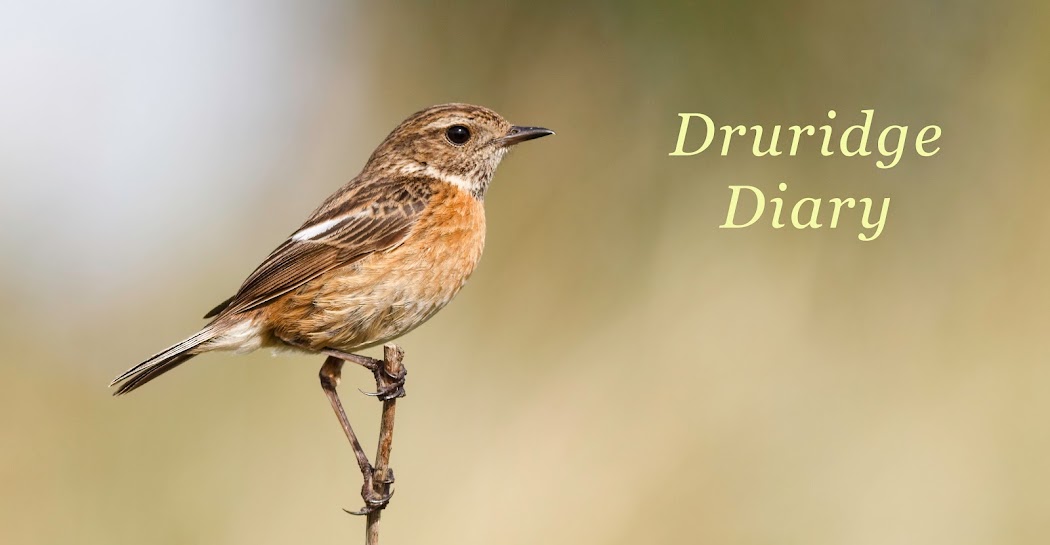
Female-type Stonechat at Amble
Rock Pipit

I did go seawatching in the afternoon from 1pm to dusk. A Black-throated Diver headed north was new for the year (176), other highlights were two Velvet Scoter north and a lovely Sooty Shearwater, really close in nice light, through the breakers, before heading off north. There was decent auk passage, a few Gannets and Kittiwakes including a single flock of 37 of the latter. Full list here.

Seawatching was quiet so I was distracted by these horses

Janet and I walked the length of the patch and back on both Saturday and Sunday morning. Highlights include a Snow Bunting over, 110 Twite in the dunes (they were on the beach on Friday when it was quieter), Great-spotted Woodpecker and a late Chiffchaff which was calling like mad in the bushes - a nice reminder of Autumn.

Black-headed Gull on the sea today
Guillemot on the sea
Red-throated Loon on the sea

I'm changing my work regime from tomorrow to make better us of the daylight hours so my weekday patch visits will be at lunchtime until February. 

Some more winter birds from this week...

male Stonechat

Wren

Friday, 10 July 2020

A bit of this and that

I've done a bit of this and a bit of that this week - seawatching, ringing and looking for wee beasties.

On Monday evening I had a look on the sea - lots of terns feeding now with  Roseate Terns being particularly noticeable - given that there are at least 129 pairs on Coquet Island that makes perfect sense. From my vantage point in the dunes I can also look the other way and from there I saw three different barn owls successfully hunting for food for their growing broods, one or more probably two cuckoos in the dunes and a short-eared owl. The latter has been reported between the Pools and Chevington and is now keeping the 'toggers' happy. If felt autumnal  - the gull roost on the beach is starting to pick up and I had my first Great Black-backs of the autumn.

List here

On Wednesday morning I got up at 04.30 and set some nets up to ring. I had to get back for work by mid-morning so only put up four nets. The catch was mostly warblers - a mixture of adults and juveniles. I did catch a juvenile Coal Tit, Coal Tits are normally birds of autumn and winter here but I know that they have bred in the plantation this year. A good breeding record.

I caught 37 birds including retraps, warbler numbers were:

Blackcap  - 2 Juvenile 4 adult
Whitethroat - 2 Juvenile
Willow Warbler - 3 adult
Chiffchaff - 2 juvenile
Reed Warbler - 4 adults (2 retraps)
Sedge Warbler - 4 adult, 1 juvenile
Grasshopper warbler - 1 juvenile

Cuckoos, short-eared owl and barn owls were still about.

Between net rounds I tried to photograph some digger wasps on the fence posts

Digger wasp Crabro cribrarius - A male, you can make out the enlarged plates on the forelegs
Last night I had half an hour looking for hovers and bugs before the light went and an hours seawatch. Two Cory's shearwater had been tracked up the Yorkshire coast yesterday but hadn't been seen north of Seaham, still worth a look I thought. Highlights were:

Manx Shearwater - 30,  all north in groups of up to 10
Arctic Skua - one roaming around harrying terns
Whimbrel - 1 north
Curlew - 2 'in-off'
Common Scoter - a raft of about 750 birds off Chibburn Links

Distant arctic skua
black-headed gull
The 'toggers' were out in force for the cuckoo and short-eared owl.

List here

Some macro shots from last night

Small skipper (Thymelicus sylvestris)
Marmalade hoverfly Episyrphus balteatus


Hoverfly Eristalis pertinax on ragwort
Potato Mirid - Closterotomus norwegicus


Spiny Sheildbug - Picromerus bidens


Leucozona lucorum

Scorpionfly species - a female Panorpa sp.

Friday, 28 February 2020

Late February update

There hasn't been a blog update for a while for two reasons; firstly, I've not managed to get down to the patch very much and secondly, there hasn't bee much to report when I have been there. As storm after storm have chased each other across the Atlantic bringing bands of heavy rain and gale force winds it hasn't been conducive to birding.

Recent highlights have included three, sometimes four Eurasian white-fronted geese, which seem to be hanging around with the Canada geese or the feral greylags. 

The week before last a drake (American) green-winged teal was reported from the Budge fields, I tried a couple of times to see it but without luck, it may well have been there but Storm Dennis was lashing the reserve and the teal were all cowering behind rushes for shelter. ADMc also found a female Garganey - seemingly only the second winter record for the County!

Last Sunday I was down on the patch for dusk. An impressive arrival of (mainly) common gulls came in from the west and settled on the sea, the tide was well in. By the time I left, I (conservatively) estimated 2500 had gathered on the sea or on the beach.

On Thursday afternoon I went up to Chibburn Mouth to see if the beach is going to be suitable for fencing for terns this year - it has potential. On my way north I counted about 82 twite in the dunes amongst the cattle to the north of the turning circle.

Some of the 82 twite in the dunes
I returned by the beach as the sun dipped behind the dunes. Black-headed gulls and passing red-breasted mergansers entertained me on my way. 

Drake red-breasted merganser headed north


At the mouth of the Dunbar Burn, the water has taken a northerly route, cutting away at the face of the dune and making progress along the beach impossible without wellies or a diversion to the cycleway bridge. I opted to use the concrete blocks as giant stepping stones, which could have been disastrous with a tonne of camera around my neck.

Giant stepping stones
On the 'other side' a passerine was scouring the edge of the water for food - bins on it - a snow bunting! I sat on a bit of concrete and waited for the bird to make it's way along the shore from the shadows into the late evening sunshine and it duly obliged.

In the shadows

Beautiful 'golden-hour' light on the snow bunt


My presence didn't phase the snow bunting and I took dozens of shots and could've taken more but frostbite had set in. Back into the dunes, the sun had dropped as had the temperature, 2 degrees, feeling colder in the stiffening wind. I was freezing after spending half an hour with the snow bunting but the cold didn't deter two brave girls who were in the sea  - in bikinis! Nutters.

Nutters!
Things got stranger as I headed for the Budge fields, with what appeared to be a scantily-clad girl in some kind of glamour shoot... It's a strange place Druridge. 

Wigeon in flight as dusk

Monday, 29 April 2019

The wanderer returns

I was back on the patch yesterday to do a belated WeBS count after returning from a birding trip to the Greek island of Lesvos in the early hours of the morning - how's that for dedication?. A wood sandpiper had been reported which I was keen to see despite this being easily the most common wader on Lesvos with up to 100 in one place.

This is a photo from Lesvos, not Druridge. Lesvos more than lived up to my expectations, it was a great place with excellent birding and I hope to be back there someday.

Wood Sandpiper at Kalloni salt pans on Lesvos
I did see the wood sandpiper on the Budge fields and it was nice to get it on the WeBS count. There wasn't much to count with most of the wintering duck departed and very few waders. Frustratingly five whimbrel flew over, looked like landing but carried on north.

There was a constant background noise of singing warblers - all new in since I left other than chiffchaff. Blackcap, willow, whitethroat, sedge, grasshopper in the dunes by the blockhouse, lesser whitethroat by the Oddie hide and reed warbler in the reedbed.

Also new for the year was this nice fresh speckled wood butterfly

Fresh Speckled Wood - iPhone shot. 
Tonight, prompted by the report of a little tern on the beach, I had a wander up to Chibburn Mouth to check its suitability for fencing to protect shorebirds and it looks good!

On the way there, goldfinches, linnets and skylarks were all in song in the dunes.

Goldfinch (I only spotted the ring when I looked at the photos)
Linnet
Skylark on the haul road
 A lapwing pair in the fields by the haul road had four tiny furball-like chicks scampering around. I hope they all get to fledge! I walked back by the beach, there was no little terns to be seen but a sandwich tern was feeding offshore and this black-headed gull was nicely lit by the evening sun against the dunes.

Black-headed gull 

Sunday, 15 July 2018

Terns

Yesterday morning I had a plan. That plan was to go to Cresswell and try some rockpool photography with the new macro lens. I' writing a beach guide for work and I'm short of a few rockpool photos so I thought I'd give it a go, but I'd have a quick look in at the patch first.

My first stop was the dunes for a look on the sea, as I scanned the foreshore I noticed lots of gulls and terns feeding in a pool on the edge of the tideline and it reminded me of photographing terns in a small pool back in 2013. I had to investigate...

Two hours and one and a half 16GB CF cards later, I headed home.

The pool had attracted over 200 black-headed gulls and hundred or so terns of three, maybe four, species (I didn't get any arctic tern photos). Here are the results...

This sandwich tern was colour ringed. It's a green ring with either EJO or EJD on it. I've not looked it up yet.
Sandwich tern in 'angel pose'

Mid-air acrobatics - I think this Sandwich tern was having a shake after an unsuccessful dive 
I've always wanted to photograph a tern just before it goes into the water...
Lift-off from an unsuccessful dive  - I love the energy in this shot
Common tern in angle pose


Common terns with  fish
Rozza
Stunning bird! Roseate tern
Profile view  - Roseate tern

And not to forget the gulls in this tern-fest...

Adult Herring gull
Black-headed gull

There's hundreds more photos...

I eventually got down to Cresswell this morning to photograph the rockpools with mixed results which I'll try and put on here later in the week. This excursion meant I was doing my WeBS count at 8.30pm tonight, The Pectoral sandpiper is still on the Budge fields, with two greenshank, two ruff and a handful of snipe and redshank (someone had a wood sandpiper later which I didn't see). On the big pool, teal and wigeon are returning and two molting pochards were a rare sight. Two adult Med gulls were on the beach.