Showing posts with label ruff. Show all posts

Monday, 21 March 2022

March WeBS

We arrived back from a week away in Cornwall (and a brief visit to the Somerset Levels) yesterday evening, twitching the long-staying belted kingfisher in Lancashire on the way home. It was my first time birding in Cornwall and I really enjoyed it. The Avalon Marshes were pretty spectacular too. We saw some good species including Kumlien's gull, yellow-legged gull, firecrest, ring ouzel, chough (13 from our accommodation was the peak count), black restarts, rosy starling and black-necked grebes.

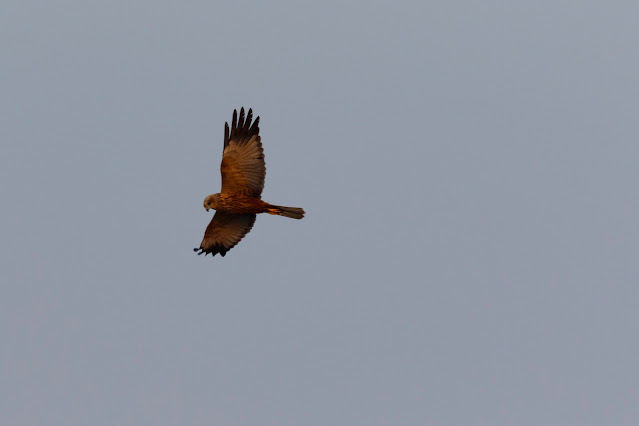
I was back on the patch before work this morning to do the WeBS Count. There was plenty to count on the Budge fields which were full of birds. Wigeon was the numerous duck species with 257 counted. I'd just finished counting what I thought was them all, when this male marsh harrier appeared over the pools and scattered everything. It was soon apparent that there were a lot more wigeon than I had originally counted, so I had to start again.
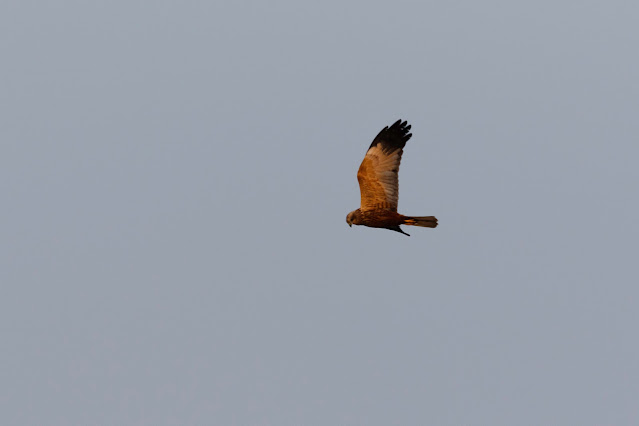

Male marsh harrier in the morning sunshine

Looking for food

A decent count of 35 shoveler and a single pale-bellied brent goose was on the fields before flying north. 
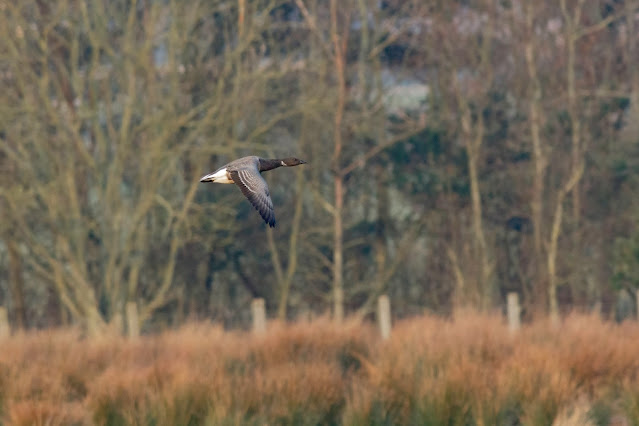
Pale-bellied brent goose

Avocet had been reported from the patch whilst I was away in Cornwall but there were none this morning. Five ruff, three black-tailed godwit, 31 curlew and 17 snipe were notable. There was no sign of the jack snipe that's been around for a few days. 

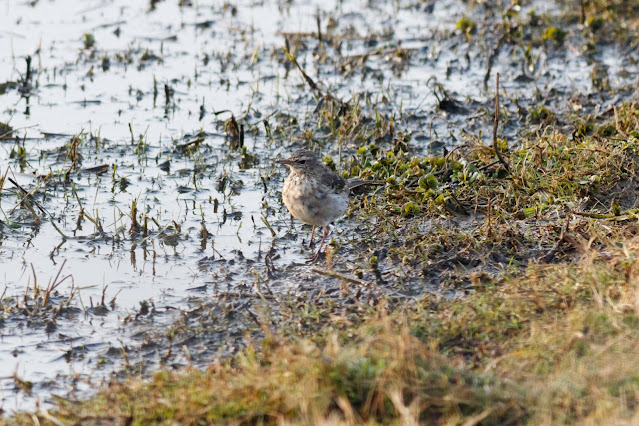
From the little hide I picked up the water pipit that's been seen over the weekend. It had either bee bathing or walking through the frosty grass as it looked a bit bedraggled. It's starting to look a bit 'pinky' on the breast I think.
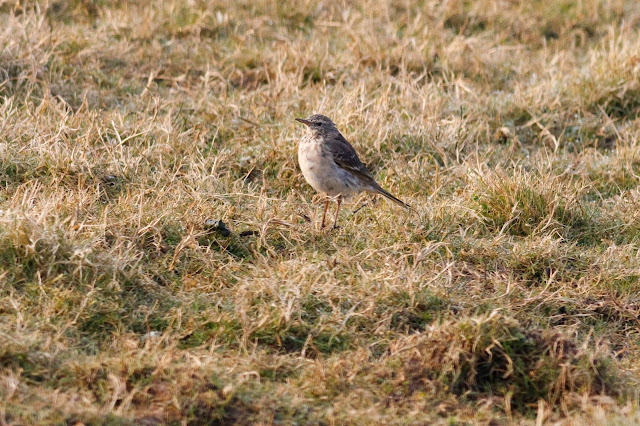
Water pipit
Looking a bit bedraggled

Chifchaff was the only migrant passerine 'new in' and two siskins by the Budge hide were notable for late March. 

Wednesday, 8 September 2021

Back to VizMigging

The wind moved into the west which brought an end to exciting seawatches. It's since turned south-s'easterly which can be good for VizMigging  -visible migration - which for me means observing and counting birds on their autumn migration from a single vantage point. I'm normally in Tarifa at this time for the most spectacular VizMig in western Europe, it wasn't to be this year...

Instead, my vantage point was the 'big dune' at Druridge this morning. No flocks of Honey Buzzards, Short-toed Eagles or White Storks but a great vantage point at the innermost part of the bay which funnels coasting birds in to one point. I only had an hour or so before work from 7.30am to 8.30am. The wind was light and the skies were clear.

Typical view of a passing Meadow Pipit

Meadow Pipits and Swallows were piling through as I arrived and continued to do so. House and Sand Martins came through in lower numbers with only a few Skylarks and Pied/White Wagtails. A few waders included 2 Ruff, Greenshank, Black-tailed Godwit and four Snipe. 

The final tally for one hour was:

Barn Swallow - 557

Meadow Pipit - 288

House Martin - 36

Sand Martin - 14

Skylark - 4

Pied/White Wagtail - 2

The last couple of evenings have been warm, sunny and calm and I've had a couple of brief looks on the sea. Yesterday I photographed a wader coming in-off, it flew over my head as I photographed (I nearly went-over backwards) and had me stumped at first. Any guesses what it is?

Out of context wader

The Scoter flock numbers around 350 but is always changing, last night there were two Great-crested Grebes with them, tonight two Tufted Duck. The flock is constantly changing and requires regular scrutiny if a 'Surfy' is to be found. 

Tonight I had two treats, an aerial battle between an Arctic Skua and a young Sandwich Tern and a beautiful sunset. An adult and juvenile Roseate tern were nice as it won't be long until they're gone. 

Let battle commence
 
Off they go

Sunset, that's the Simonside Hills behind the turbines. 

Sunday, 25 April 2021

New arrivals

On Tuesday evening Janet and I wander up to the Preceptory and back. No new arrivals but at least 200 Sand Martins over the Budge Fields with the usual waders, one Yellow and two White Wagtails and Wheatear were also on the fields from the little hide. 

A schoolboy error on Wednesday morning though. I got up early intending to my third territory mapping visit before work but when I arrived at Druridge the wind was strong, about 20mph from the North East and gusty - too windy for a survey so I abandoned and headed for the little hide where it would be sheltered.

The highlight was a male Ruff, coming into breeding plumage, strutting it's stuff in front of the hide. 

Ruff - getting it's ruff

This Ruff was one of three, otherwise there was nothing new to report from the Budge fields. The light was nice and both Gadwall and Shoveler came close into hides.

Drake Shelduck

Gadwall Pair

Chiffchaff in the morning sunshine

I finally got my survey done before work on Friday. The map looked a bit busier with at least 13 singing Willow Warblers and both Sedge Warbler and Whitethroat were new for the year. Blackcaps were noted at three locations. 

Also of note was Wheatear in the dunes and eight Twite including some in full song from the top of as tree. Meadow Pipits, Linnets and Reed Buntings were plentiful in the dunes and three Grasshopper Warblers were reeling there. 

Meadow Pipit in a dune bush

Shelducks are numerous on the Budge fields and in the dunes, giving some nice 'fly-bys'  - I estimated 24 in total.

Male Shelduck

Tufted Duck between the turbines


Nesting Canada Goose with a stick through it's bill - wonder if this is a fashion statement?

This morning Janet and I had wander around the hides. On the Budge fields, two Whimbrel, two male Yellow Wagtails, one White Wagtail, 14 Avocet, three Ruff and five Pintail were noteworthy. There wasn't much on the big pool but a Snipe was feeding just in front of the Oddie Hide. 

Common Snipe

A single Reed Warbler was singing in the reedbed which was new for the year and Sedge and Whitethroat were back in greater numbers. Janet went off horse-riding and I had a look on the sea, it was quiet though with no new terns, but plenty of Sandwich feeding just offshore. 13 Red-throated Divers were mostly in breeding plumage and a raft of 24 Guillemot were loafing on the sea. Twite are still around, 'commuting' along the dunes

I spent the rest of the morning trying to photograph hoverflies and bees on the path to the hides. They'll get their own post later when I've identified them. Meanwhile here's a 7-Spot Ladybird. 

7-Spot Ladybird

Sunday, 18 April 2021

Slow start to Spring

Spring is coming to Druridge, but slowly. A prolonged spell of wintery weather with very cold, frosty nights and cold but dry days seems to have held things up a bit and newly arrived migrant birds seem thin on the ground. 

Willow Warblers and Blackcaps arrived on Patch earlier in the week, both species were singing from the bushes on my morning walk on Thursday. A White Wagtail was on the Budge fields too.

Skylark in full song

On Friday,  a 'Blue-headed' Wagtail was reported from the Budge fields in the afternoon. I called by on my way home from work, there was no sign of the Blue-headed Wagtail but a bright 'bog-standard' Yellow Wagtail was nice and new for the year as was a single Whimbrel, flying north, calling. 

Four Ruff, 19 Black-tailed Godwit, 15 Snipe and 21 Curlew were on the Budge fields.

On Saturday morning I went looking for Wheatears and Ring Ouzels, no luck with either or with any other new arrivals for that matter. Still some wintering birds though, including 45 Twite - including eight high in the tree tops by the Budge Screen, signing - most odd!

'I hear them singing on the wire' - Male Barn Swallow

Most of Friday's Black-tailed Godwits had moved on, leaving just three, there were five each of Ruff and Avocet. A Grasshopper Warbler called briefly whilst I was chatting to ADMc. 

Offshore winter met summer again with 19 Red-throated Divers still on the sea and six Sandwich Terns feeding.

No visits to the patch today - I was getting a needle stuck in my arm so that Bill Gates can track my every move.


Male Goldfinch by the turning circle

Sunday, 3 January 2021

Wet Wet Wet

There is probably no eighties band that I detest more than Wet Wet Wet but those three words are a good description of what it was like on the patch today after, yet more, overnight rain. It was also windy and cold.

Once the rain stopped, we headed out and headed north - from the car with a plan to cut through the dunes onto the beach at the top of the patch. As we crossed the Dunbar Burn we got a blast of icy air from the sea and changed our minds, heading inland instead along the 'Coal Road'  towards Chibburn Preceptory. 

Looking North-east from High Chibburn with water everywhere

The farmland was very wet, the track to the farm was flowing like a stream and the Dunbar Burn was at full bore. We didn't see a lot of birds. 69 Curlew were on winter cereals and a small flock of 26 Chaffinch were feeding by the wood. Three Red-legged Partridges were new for the year (NFY).

Great and Coal Tits were on the feeders at the Druridge Farm Cottages and also 'NFY' as was Mark Eaton and Sam the dog who we 'year-ticked' on our return to the car. 

There was no sign of the Water Pipits in the hinterland or on the Budge fields but I guess there's plenty of Water Pipit habitat everywhere at the moment. The four Ruff that have been flitting between the Budge Fields and Widdrington Moor Lake were back, hanging out with some redshanks on one of the few dry bits.

Today's full list

Sunday, 1 November 2020

October slips into November

 As October slips into November, Autumn slips into winter and we all slip back into Coronavirus lockdown the chance of finding an autumnal patch mega slip away too.

With a strong s'westerly wind today we had a taste of what's to come, winter birding at Druridge feels like a slog sometimes. Once the leaves and berries have gone from the trees there's nothing to hold passerines and it often takes a long, cold snap to bring much change. 

Making the most of the clocks going back and an extra hour of daylight before work, I've been out on the patch every morning before work this week. Mostly just checking the bushes with the occasional wander through the dunes north of the turning circle. It's been windy from the west or south-west since last weekend and gloomy so little to report and even fewer photos!

Monday

Still a lot of pink-foots with 1900 in the front field. A small influx of thrushes with Blackbird being notable in number (13) and a Great-spotted Woodpecker. Some finch movement with eight Crossbill going south, 12 Lesser Redpolls could've been local birds. Full list 

Tuesday

Two Ruff were on the 'Front Field' with 330 Golden Plovers and 180 Lapwing. 18 Whooper Swans flew south in two groups. These were the start of an obvious influx - I counted 67 over Warkworth Links later in the morning. 

Whoopers, south bound in a row

In the bushes near the turning circle I saw two Brambling, both males, my first of the year.  Full list

Wednesday

About 1450 Pink-foots flew south and five Whooper Swans. My first Fieldfares of the year in came in over the dunes, calling as they headed straight inland, they are such powerful thrushes, if these had been redwings they would've made immediate landfall after crossing the North Sea. As winter visitors arrived, summer stragglers headed south - two late Swallows and a Lesser Whitethroat flitted through the bushes with Long-tailed-Tits. Full list

Thursday

Finches were quite obvious this morning with at least 45 Siskin, 12 Lesser Redpolls, 90 Goldfinch and 11 Chaffinch in the bushes. 15 Whooper Swans landed on the big pool, the resident Mute Swan cob took immediate offence and spent 15 minutes chasing them around the pool, as soon as they settled somewhere he would fly at them, wings held out to make him look bigger, in the end the Whoopers had had enough and flew off south. Some Northumbrian welcome to our winter visitors that! Full List 

Friday

There were about 1300 Pink-foots in the Front field this morning. Three Fieldfare came over as I walked through the dunes north of the turning circle. There is still a big finch flock in the dunes with Reed Bunting and Tree Sparrows but I've not seen (or heard) the Twite with them yet that others have. They are mobile mind and the Goldfinches have moved more into the bushes, feeding on Alder cones. It was nice to bump into ADMc for a catch-up. Full list

Saturday

Janet and I had a good walk around the patch. 27 Fieldfares came 'in-off' including a single group of birds. It was very windy and we didn't see much more of note. Full list

Spindrift
It was so windy, it blew these people's feet off!

With reports of more Fieldfares and some seawatching, I went back in the afternoon for a look on the sea at high-tide. I started going through the Scoter flock and soon had my first Fieldfares - it was amazing to see them flying over the Scoters and following them until they made landfall. They were the first of 138 that I counted, they were still coming in when I left as darkness fell - Amazing! That was just what I saw, in two hours, looking in one direction in an eight-mile bay. How many must've come in?

There were smaller thrushes too, Blackbird and Redwing being identifiable until the decreasing light made them just shapes. A group of 14 Starling came in too, lower than the thrushes, flying just over the water. 

There were two Velvet Scoter with about 600 Commons and strangely 10 Shoveler on the sea, one drake, the rest of them looked like ducks and they had two Teal in tow. Otherwise 15 Red-throated Loons, two Kittiwake and handful of Auks were noteworthy. Full List

My best attempt at photographing in-bound Fieldfares.

Sunday

Janet and I braved the wind once more, between the bands of rain. The highlight was a Lesser Whitethroat. A November Lesser Whitethroat - you don't get many of them! This year has been far and away my best year for Lesser Whitethroats at Druridge, they bred, which is rare and autumn passage has been the best ever. Full list

Roe Doe. There are so many Roe Deer at Druridge now.

Pink-footed Goose on it's own. A rare sight!

Monday, 13 July 2020

Head down

It's that time of year again...

Rather than looking up into the sky or even into the canopy of the bushes, my head is down, looking at flower heads and grasses in search of invertebrates. I do enjoy the challenge of identifying these tiny insects and spiders but it takes time and patience,  I have precious little of either.

On Saturday evening Janet and I had wander around the patch. There were at least 40 Black-tailed Godwits on the Budge fields, most of them look like icelandica race birds and five Ruff including a juvenile, there was also Little Ringed Plover and a handful of Dunlin.  At least one of the cuckoos was still present and there were plenty of 'toggers' lined up along the road all taking the same photo - we left them to it and went looking for bees and hovers but it was a bit late in the day. We did find some more of the funky caterpillars of Depressaria daucella which are starting to build their cocoons. We summoned Tom Tams away from the Cuckoo as we knew he was keen to see them as they aren't a commonly recorded moth in the county.

Depressaria daucella Caterpillar building its cocoon in cow parsley

We had some adult moths and butterflies and other stuff. I'll put Sunday's sightings on here tomorrow hopefully.

Male Syrphus sp hoverfly
Beautiful China Mark moth (Nymphula nitidulata)
Common Blue butterfly (female)
Potato Mirid Closterotomus norwegicus
Yellow Shell moth (Camptogramma bilineata)
Small skipper (Thymelicus sylvestris)
Field grasshopper 

Friday, 10 July 2020

Dodging showers

Janet and I headed to the patch for some fresh air after work today. It was fresh n'all  - 13 degrees, it was sunny when we arrived and there were a few hovers around as we wandered up to the little hide but the sky was black all around us - rain was on the way.

An adult Water Rail was showing nicely on the muddy edge from the little hide, just too far away for photos but this Hare was in range as it scampered away. A big flock of dunlin and other waders swirled around in the distance towards the Budge screen that would need a closer look.

Brown Hare - legging it across the field
The sky darkened further as we headed back towards the road and eventually we had to make a dash for the shelter of the car as the heavens opened. From the car we could see one of the juvenile Common Cuckoos, that has been much coveted by the photographers lately, sat on the fence, before it dropped in closer onto a Ragwort plant where it gobbled up several Cinnabar moth caterpillars.

Juvenile Common Cuckoo taking Cinnabar moth caterpillars from Ragwort
The rain got heavier and the Cuckoo flew even closer to the road and our car and at one point was too close for my 400mm lens - 3.5m.

Here it is, un-cropped, on the edge of being in focus.

Cuckoo!
Once the rain eased we headed for the Budge screen to scrutinise the waders. There were five Ruff, four adult males and a juvenile bird and an amazing 45 Dunlin - all adults. One can only assume, as no juveniles are present,  that these are failed breeders heading south? There were 14 Black-tailed Godwits - at least eight of them were assignable to the icelandica race and the others were a good fit. A Little Ringed Plover and three Little Gulls were nice to see.

The Budge fields have been the best for breeding waders for as long as I can remember. Lapwing have done well, despite heavy losses to Corvids and Herons. There have been at least two successful broods of Redshank and Avocet is a new breeding species. The first brood of Avocets are nearly adult-size now and will fledge but the second brood is now only one very small chick. It looked incredibly cute tonight though, in the mud, with it's little up-turned bill. The adults seemed to be paying it little regard though - waders are crap parents.

I think a combination of a very wet winter which suppressed the marginal vegetation, followed by an incredibly dry spell (lockdown) along with the grazing by the six ponies has created the prefect sward height... maybe not for Snipe though which are pretty-much absent this spring.

Full list here

Monday, 29 June 2020

Vizmig and the two bird theory

I've tried a bit of viz-migging this week, but probably missed the vizmig highlight of the year today - a huge southerly movement of swifts, with thousands of birds logged at east coast hot-spots including 28,0000 at Hummanby Gap. I hadn't anticipated it so didn't get down to the patch until lunchtime, by the time I did there were still lots of swift headed south but nothing like the numbers reported earlier.

After reports of crossbill movements, I positioned myself on the big dune at 5.30am on Wednesday morning. When I arrived on site, there were 11 siskins feeding on the alders before moving north. I estimated about another 100+ siskins, all moving south in small groups of 15-25 until 7.30am. Nothing like the 6500 Tom Tams had at Tynemouth and no crossbills - my target for the morning.

I tried for crossbills on another two mornings but no joy.The meadow pipits kept me entertained though and fly-through little egrets on two mornings were welcome sightings of scarce bird this year. The big dune is a good place to scan the budge fields and I picked up both wood and green sandpipers from there.

Meadow pipit song-flighting from the big dune
In the bay, the common scoter flock reached a peak of about 1400 birds midweek. On Friday, I abandoned viz-mig and had walk north and south. A family group of pied wags entertained me at the Dunbar burn and a new moth...

New moth - Pammene aurana (there were at least eight of them)
One of the pied wag youths
New hoverfly for the patch Cheilosia illustrata - one of the bumblebee mimics (iPhone photo)
As is typical, the weather deteriorated just in time for the weekend. I manged a wander between showers on Saturday morning and it was nice to catch up with Bob Biggs and ADMc. Waders from the Budge included  four, maybe five ruff including gingery, black and white/cream coloured birds, 19 black-tailed godwits (most or all Greenland race birds), two knot, two ringed plover and two dunlin. A female marsh harrier was my first since lockdown and an adult cuckoo shot through the dunes - northbound.

Today, Janet and I had a walk to the hides, mostly looking for hoverflies but we found the four spoonbills, that have commuted between Cresswell Pond and the Budge fields, feeding on the doughnut pool from the little hide.

Four spoonbills- an they were all awake!
mating common blue damselflies
This evening, news came through of a female pied flycatcher near the Budge screen. Pied Fly is a scarce bird in any year at Druridge, unheard of in June, so worth a look before the footy I thought.

Graham Sorrie reported north of the path to the screen-hide. The first bird I got my bins on was a spotted flycatcher.

Spotted Flycatcher
I knew Graham wouldn't have mistaken spotted fly for pied, but for two flycatchers of any species to be at Druridge in June would be mega rare, but I couldn't rule out the two-bird theory and I was right not to as shortly after that a female pied flycatcher appeared on the same edge. My first pied fly since 2014!

Pied flycatcher
I'm not sure what is going on here. Is this early returning birds or very late northerly migrants? Someone on Twitter sent me a link to a wind map and a report of high temperatures and forest fires in Arctic Siberia - which is worrying in itself but might explain these birds?