Showing posts with label water pipit. Show all posts

Saturday, 19 November 2022

Last gasps of autumn

The forecast didn't look too promising for this weekend and I felt like autumn was slipping away without a final finale. However, on Thursday things started to look better, with an easterly and some good seawatching. Instead of seawatching, I was sat in my office in zoom meetings all day.

Friday

As there looked to be a slim chance of a late migrant or two, I took a flyer on Friday afternoon and headed to the patch with Janet. We started with a look on the sea but it was quiet, a bonxie going south, only my second of the year, was the highlight. Not an auk in sight. Janet found a snow bunting on the beach which was a year-tick.

Female snow bunting in poor light

Same bird, different pose

We headed for the bushes, checking the area around the start of the path to the hides first. A female blackcap was a good start. I got onto a small bird flitting about in the branches, above the blackcap - I called 'yellow-browed warbler' to get Janet onto it, but it had flitted off. Even though I had the briefest views - Strong wing-bar and supercillium, pale tips to darker secondary feathers, it wasn't right for a yellow-brow. It was duller than a yellow-browed, almost with a grey cast. Hume's warbler sprang to mind but I needed better views to be sure and Janet needed to see it. I put the news out as 'a probable'.

We didn't have to wait long, as the bird re-appeared to the right and gave tantalizingly brief views as it flitted quickly through the branches. It had a colder, greyer look to it than a YBW, the wing bar and the supercilium were more off-white without yellow tones and the bill and legs appeared to be dark. It hadn't called at this stage, but we were both confident that it was Hume's and put the news out.

A 'bird wave' of tits and goldcrests came through, which also brought a willow tit and chiffchaff to the party. We lost the warbler in the melee, when we refound it, it was further right and it flew and called - a short, sharp two-tone call, not like yellow-browed's more drawn out 'twoo-eeee'. It did this twice before flying off south. 

We suspected it might have gone south with the tit flock, so I headed down towards the Budge hide but couldn't relocate it. Two ruff were on the fields and water rails were calling. We couldn't relocate the warbler by dusk so headed home. I would be back in the morning.

I had a likely Hume's warbler many years ago by the Budge hide. It's in a long-lost notebook and was never submitted, so technically not a new bird for the patch. I've seen three others in the county, at Whitley Bay (2006), Lynemouth Power Station (2002) and East Chevington (2001). 
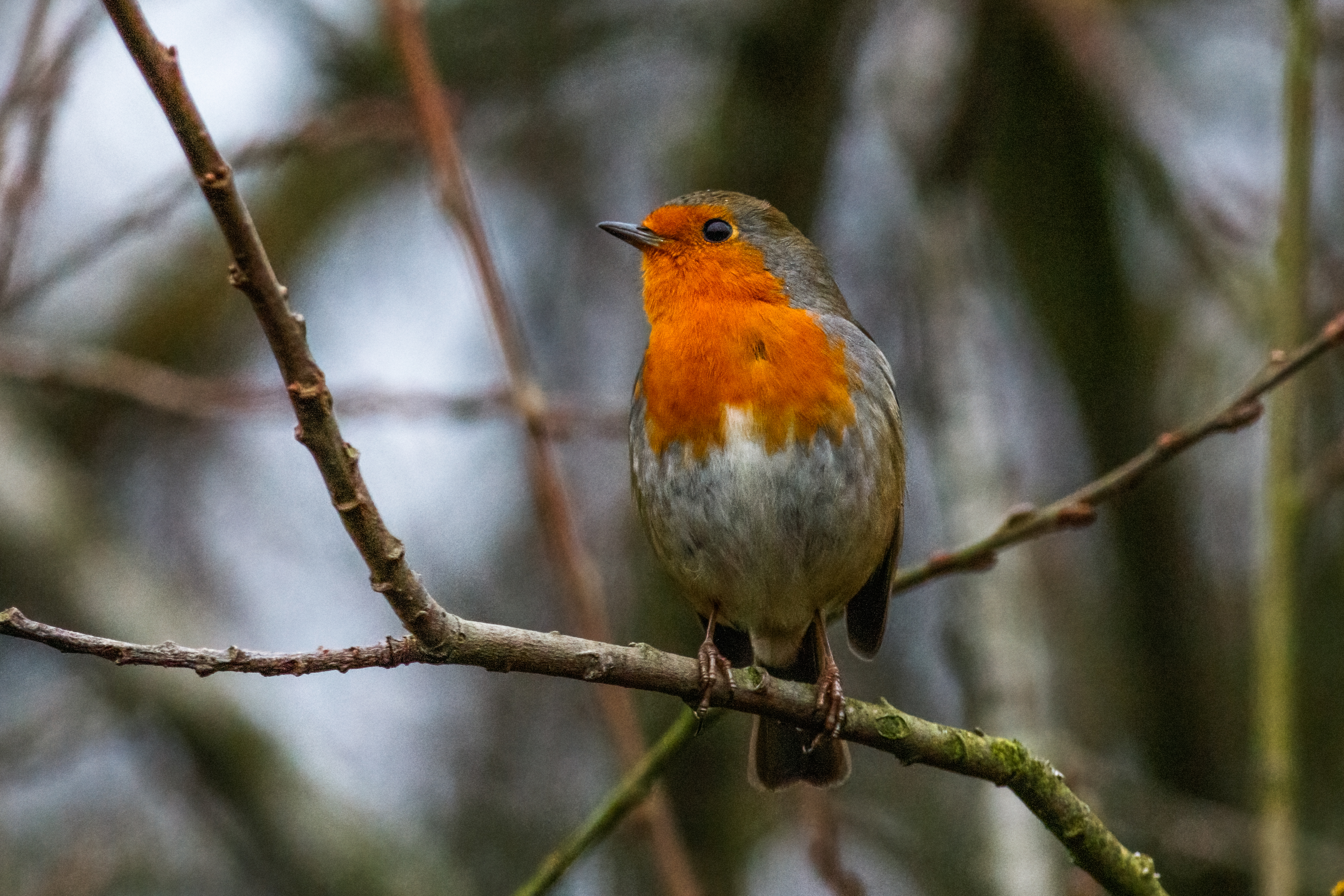
Robin - ever-present and singing a mournful autumn tune

Saturday

I got down to the patch at about 9.30. A handful of birders including Ashington Gary and Paul from Gateshead were loitering on the path but had not seen the bird, I headed north for a look through bushes. Two female long-tailed ducks were on Druridge Pool. With no further sign, I headed south to the Budge hide and checked the bushes there. It was quiet, so I checked the Budge fields and picked up a water pipit on call, which I eventually found feeding on wet grassland to the left of the hide. Bonus!

I wandered north through the bushes, when a tit flock came through and I picked up a firecrest amongst them. Nice. This was my third of the year on the patch! The flock headed south, so I followed them. I called ADMc as I know he likes a firecrest. Andy, Paul, Bob and Steve arrived - the bird was tricky to pin down, but they all got onto it eventually. 

Not sure this photo will make the Annual Report.

Whilst scanning for the firecrest, I found yesterday's Hume's warbler in a big willow. It was really tough to get people on it before it flew north over the path with some long-tailed tits. I found it again in a lower willow but it was lost to view after that and not seen again. I'm not sure how many people saw it - So frustrating!

A treecreeper was added to the day list - a scarce species on the patch.

I think that might be autumn over...


Monday, 21 March 2022

March WeBS

We arrived back from a week away in Cornwall (and a brief visit to the Somerset Levels) yesterday evening, twitching the long-staying belted kingfisher in Lancashire on the way home. It was my first time birding in Cornwall and I really enjoyed it. The Avalon Marshes were pretty spectacular too. We saw some good species including Kumlien's gull, yellow-legged gull, firecrest, ring ouzel, chough (13 from our accommodation was the peak count), black restarts, rosy starling and black-necked grebes.

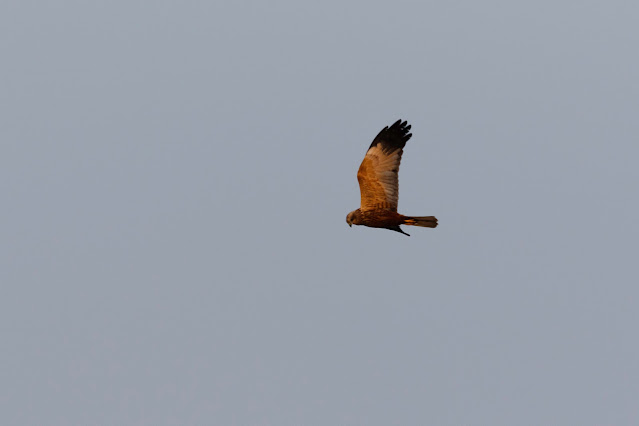
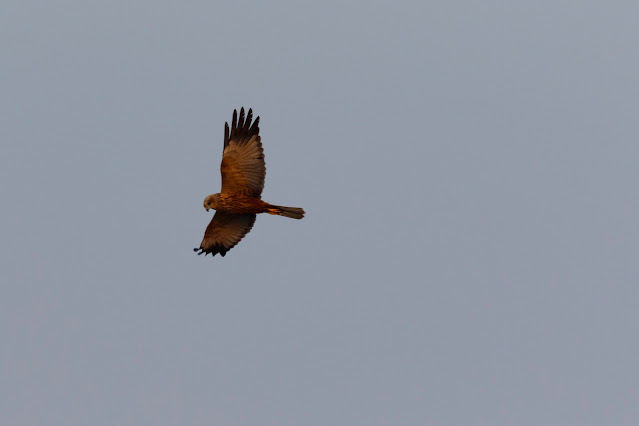
I was back on the patch before work this morning to do the WeBS Count. There was plenty to count on the Budge fields which were full of birds. Wigeon was the numerous duck species with 257 counted. I'd just finished counting what I thought was them all, when this male marsh harrier appeared over the pools and scattered everything. It was soon apparent that there were a lot more wigeon than I had originally counted, so I had to start again.


Male marsh harrier in the morning sunshine

Looking for food

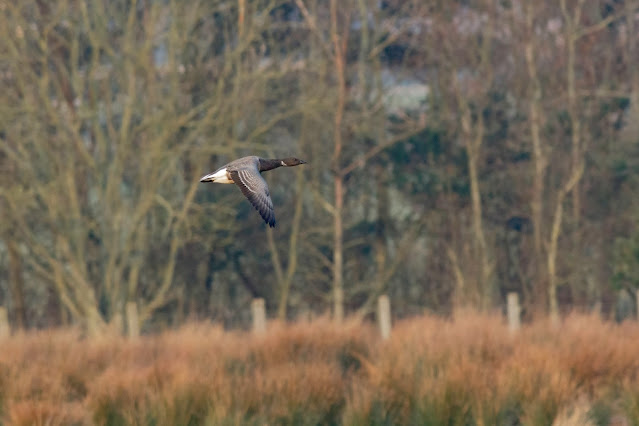
A decent count of 35 shoveler and a single pale-bellied brent goose was on the fields before flying north. 

Pale-bellied brent goose

Avocet had been reported from the patch whilst I was away in Cornwall but there were none this morning. Five ruff, three black-tailed godwit, 31 curlew and 17 snipe were notable. There was no sign of the jack snipe that's been around for a few days. 

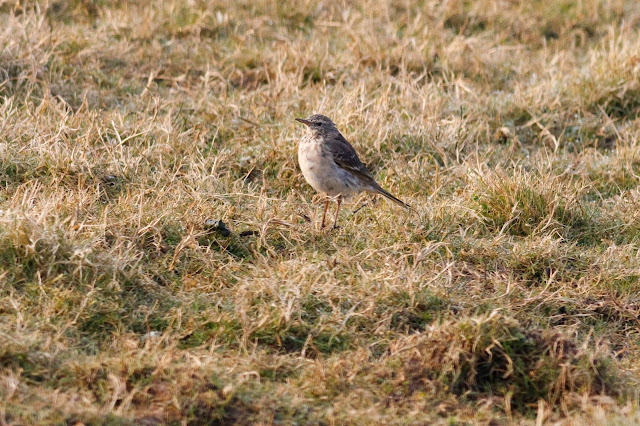
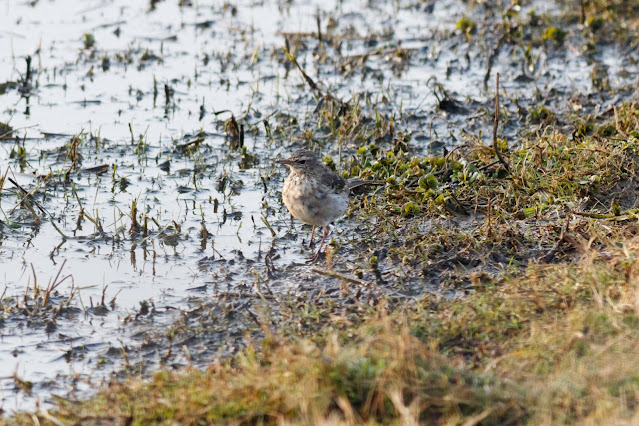
From the little hide I picked up the water pipit that's been seen over the weekend. It had either bee bathing or walking through the frosty grass as it looked a bit bedraggled. It's starting to look a bit 'pinky' on the breast I think.

Water pipit
Looking a bit bedraggled

Chifchaff was the only migrant passerine 'new in' and two siskins by the Budge hide were notable for late March. 

Sunday, 27 December 2020

A goose for Christmas?

A goose for Christmas? Why not?

Two days late - but that doesn't matter.

With my patch year-list perilously close to 180, Janet and I set off this morning with the intention of a walk around by the farm in search of Yellowhammer - a species that has evaded me all year. We didn't reach the farm - a flock of geese stopped us in our tracks.

Some of the flock

There was a huge flock of Pink-footed Geese in the 'Front Field' at Druridge - "there must be something different among that lot" I said, and we pulled over - scope out. It was a bitterly cold wind, cold enough to bring a tear to the eye! 

I started scanning through the geese, which Janet estimated numbered about 2000, until I got onto a different bird, with thick orange legs and I immediately thought Bean goose - but which one? I went to get Janet and my phone from the car and lost the bird, another 300 geese arrived. Another 25 minutes of searching through them, I found it again, I got better, but brief views of the orange legs (most definitely orange, I've seen Pink-foots with  'orangey' or 'orangish' legs - these were pure orange - and thick.), head and bill shape and bill colour. The bird looked thick-necked and a bit more bull-headed than the pinks but the colour on the bill was definitely more orange than pink and it extended down to the gape. I was pretty-sure this was a Taiga Bean Goose and attempted some digi-scoped shots just before the bird sat down and promptly went to sleep with it's head under it's wing. I put the news out on the chance I was right.

Orange-legged bird on right (digi-scoped)
Orange-legged bird at top - note thick orange legs but 'thick neck, bull-head'
Orange-legged bird left of central group, but again, looks thick-necked. Not so obvious on this pic but colour in bill was more orange than pink, but bill not the right shape for Taiga Bean

Graham Sorrie arrived and it was still asleep and then the Farooqi boys arrived. The bird woke up and Jonny got straight to work on it, he thought that the bill-shape didn't look right and neither did the tail, which was very much a 'Pink-footed' tail. Taiga Bean was ruled out and were looking at an odd Pink-foot with very orange legs, a shorter, thicker neck and orange in the bill but everything else about seemed to fit Pink-foot.

Jonny started scanning the flock and soon picked out another orange-legged bird, this time it was a Bean - but of the Tundra variety. The bird came very close but my photos were rubbish - this is the best I could do. 

Tundra Bean 'arse-on' showing tail pattern and thick orange legs.

Everyday is a school-day when you're birding. A quick look at photos on the Macaulay Library when I got home confirmed the bill-shape and tail were wrong for Taiga Bean, but an interesting bird nonetheless. 

I did get a walk around the farm this afternoon without a Yellowhammer to be seen. 

It was a nice walk though, in the late afternoon sunshine. The sky looked ominous a couple of times but it stayed dry.

Ominous

Six Mistle Thrush were in the fields by the Coal Road and both Redwings and Fieldfare in the Hawthorns by the farm. Near the Preceptory, two Water Pipits were feeding in a wet corner next to the Dunbar Burn, before flying off, calling. Presumably two of the birds from the nearby Budge fields.

Fieldfare at High Chibburn
The Budge fields, with a flock duck, and the dunes from the 'other side'

There was still some light when I got back to the car, so I had a look on the sea. Gulls were pouring in from the land to roost on the sea, Black-headed and Common, but as they settled I scanned through and counted at least nine Mediterranean Gulls amongst them - there could've been many more as gulls were still arriving but he light was going. I estimated 3200 in total by the time I left.

Tundra Bean Goose takes the year-list to 179. Tomorrow I shall be mostly scoping the chimney pots and TV aerials at Widdrington Village for Collared Doves. 

Thursday, 24 December 2020

All Grey

Apologies for the lack of posts recently, it's not that I've not been to the patch, I've been most days, there just hasn't been much to write about.

December is usually a bit spartan but this December seems more so. It's hardly been light enough to bother taking the camera out - sunny days have been few and far between, just day after day of grey and rain.

The wind was out of the north for much of yesterday and strengthened into the evening - strong enough to bring some Little Auks down? - only one way to find out. When I got up this morning it was sleeting hard and just looked miserable, but a check of 'Rain Alarm' suggested a brief window of dry weather from 11ish, which happened to coincide with high tide.

The sleet promptly cleared away at 10:50 and I was set up for a seawatch. The sea was big and the wind still out of the north but it felt quiet - quiet enough to count gulls and auks - mostly unidentifiable dots on the edge of the world but a few came close and the sun had come out providing a really nice light. 

Nice light

About 15 minutes in I picked up a small pale-grey bird, almost looking white in the sunshine, heading north just beyond the breakers, it was disappearing into the troughs but as it drew level I got some good views - it was a Grey Phalarope. This is the third Grey Phalarope I've seen on the patch - and I've always thought how pot-bellied they look, side-on, like a little dove or pigeon - they're a compact little thing too. Virtually white below, with darker-grey upperparts and a really obvious white wing bar on the upper wing. The dark 'eye-mask' stood out in the strong light, I didn't really notice the bill - it must've had one!

It kept going north along the bay, hugging the line just beyond the breakers. I notice that Jonathon Farooqi had one much earlier at Church Point so it's unlikely this was the same bird, unless it stopped-off to feed en route?

Seawatching continued to be quiet in terms of numbers but plenty of variety. I had a skua species heading south, again on the edge of the known world - it was just a shape really, towering constantly as it went south. I thought Pom but more likely a Bonxie as the Newbiggin lads had a few south and Bonxies are usually distant birds at Druridge. Other highlights included both Great Northern and Black-throated Divers and a drake Velvet Scoter with a smattering of Red-throated Divers, Gannets, Kittiwakes etc

I continued until 12:20 when a heavy sleet shower arrived. No Little Auks but the Grey Phal more than made-up for that. Full list here. 

Incoming

Last weekend was a bit frustrating. We'd bumped into Janet's parents just as we were leaving Druridge - they headed off north for a walk. Later in the afternoon, Janet's Dad messaged to say he had seen a male Hawfinch on the fence along the Bridleway north of the turning circle. We spent an hour-and-a-half looking but no joy - it could've been anywhere. Alan knows his birds so little chance of mis-ID. Another patch-tick missed this year. I'll have to insist that he takes his mobile with him when he's on my patch!

Otherwise not much to report - the Water Pipits (up to three) are still on the Budge fields but are difficult to spot, up to two Chiffchaffs are sticking it out but this cold snap might move them on and three Scaup have regularly been seen on the big pool. A few Bullfinches are also hanging about - not a common over-winterer at Druridge.

My year list is now at 178 - is 180 still a possibility? Some wintery weather might be needed.

Here's some photos I've taken since my last post. Happy Christmas everyone.

Sanderling probing for food amongst the froth

I usually don't like 'running' wader photos
Little Grebe on the big pool - one of two

Catching a few fish...


Never get bored of Stonechats

Grey Partridge  - there's been up to 17 in the weedy dunes

Sunday, 6 December 2020

What a pipit!

I was seawatching from the dunes this morning when a message came through on the Whatsapp group to say that Tariq Farooqi was watching one, maybe two Water Pipits from the Budge hide. Seawatching had been quiet so I headed straight there, Tariq was still there but wasn't seeing the birds. Shortly after I got there, a pipit flew - calling, like a water pipit. We got onto it just in front of the hide and watched it for a few minutes before all hell-broke loose when a Sparrowhawk arrived and scattered everything before flying off with a Starling. 

Yesterday, Janet and I were at the timber screen when I heard a pipit calling and I said 'that sounds like Water Pipit'  - we never saw it, then the hailstones came down and we headed home - probably was!

Water Pipit is my 177th species for the year on the patch and my first on the patch since March 2018. They became reasonably common for a couple of years on the Budge fields and then nothing...

I've done a couple of seawatches this weekend - both were pretty quiet. Today a couple of Great Northern Divers went north as did 26 Red-throats including a group of 15! Two Velvet Scoters were with the scoter flock and two flew north and there was a good count of 124 Sanderling on the beach. Two Great Northern Divers went through yesterday too, one in each direction.

No photos this week, it's been too dark!

The vocal Chiffchaff was still calling by the wooden screen this morning and through the week. A December Chiffchaff is always nice. 

Sunday, 31 January 2016

Close...but no cigar

I'd been down to the patch for a couple of hours this morning before heading home via the Country Barn at Widdrington for a pasty. As I was leaving the farm shop, my phone pinged - a message to say that there were two waxwings on the road north of Druridge - Did this mean the haul road? Not much like waxwing habitat that. I panicked a bit - waxwing would be a new bird for the patch.

I phoned the chap who had put out the message and he explained that the birds were just off Druridge Lane. I was there in seconds, leapt out of the car and was put onto the birds, on a wire over the fields, with a lot of starling and fieldfare - great birds but they nor me were on my patch.

I jumped back into the car and headed for the nearest patch boundary, which is just before High Chibburn Farm. But it was no use, I could hardly see the wires for the high hedge, I took my wellies off and climbed onto the car, extending my tripod as far as it could go, but I couldn't pick out the birds. Frustrated I headed back the original spot, but there was no sign of the birds. I ate my pasty and headed home.

Before all of this kerfuffle, I had spent a pleasant couple of hours on the patch. When I arrived there was a short-eared owl hunting along the grass by the road - nice.

I had a walk south through the bushes. I disturbed a small male sparrowhawk from a  fencepost, it flew off causing alarm amongst the long-tailed tits. When I reached the path to the Budge screen, I disturbed the same bird again, this time off the ground, I went to have a look for a kill and found this...

The kill

Not what I was expecting. A woodcock! The bird was minus its head, but I found both mandibles nearby. The sparrowhawk had already had a decent meal of it, but I do hope it returned to finish its lunch. Woodcock would be no problem for a female sprawk, but quite a big bird to handle for small male like this one.

I still need woodcock for my year list...

As I arrived in the Budge screen, a water pipit took off from the right and flew, calling, a short way before settling down to feed.

There is plenty of wildfowl on the Budge fields, particularly wigeon, teal and mallard. There are also about 350 lapwing and a few curlew. Two drake pintail were still there too.

A quick look offshore produced a year-tick in the form of two razorbills but little else. At the farm, yellowhammer was my second patch year tick of the day.

So at the end of January I am on 88 species netting me 102 points in the Patchwork Challenge - not a bad start, but I think February could be a slow month, although I did see some signs of spring today.

Hawthorn bursting in to leaf

Monday, 25 January 2016

A few new January birds

I've been down to the patch a couple of times post. No photos though, it's just been too dull.

I had a nice dusk visit on 20th, it was nearly dark when I left at 16.15. Highlights were two ruff and eight dunlin on the Budge fields and flock of about 15 fieldfare flying over and into the bushes, quite often a species I have to wait until autumn for.

Standing at the Budge screen, I heard a water pipit calling, but I couldn't find it, I think it was overhead. There were also three drake pintail still present.

On Sunday, I took look one look at the number of people at the Budge screen and gave it a dodge. I had a quick look offshore, but it was very quiet other than a flock of about 40 scoters flying south which included five velvet scoters!

This morning was quite warm, but the strong southerly wind and overcast skies made it feel colder. And there very few people about - which is good.

There are still plenty geese about though. The majority, a flock of over 3000 pink-feet, were over by Low Chibburn somewhere - they lifted and settled gain after a light aircraft flew over. A smaller group of about 350 came down into the fields west of the Budge - there were at least five European white-fronts and five barnacles with them.

I saw three species I wouldn't normally expect in January:

Greenfinch - one on the feeders, a species I wouldn't normally expect until the big post-breeding flocks of finches arrive in late summer - the presence of feeders has dramatically increased the number of finches, tree sparrows and reed buntings overwintering at Druridge.

Shelduck - normally a February arrival (there were two on New Years Eve - not a species I would expect in December at all).

Stock Dove - Two on the Budge fields - again a February/March bird

My other year-tick today was little owl - thanks to Dave Elliott for the tip-off

From the Budge screen, I picked up a very large (must have been female) peregrine sat on a fencepost beyond the Haul Road way over towards Low Chibburn Farm. The drake scaup was still on the big pool.

My year list now stands at 86 species and 99 points for the Patchwork Challenge.


Sunday, 10 January 2016

2016 - a week in.

As regular readers of this drivel/quality writing will know, I rarely get out birding on New years Day, in fact I don't normally surface until about 3rd January.

This New Year was different. Nothing to do with resolutions, which I never stick to anyway (like updating this blog more regularly), I was laid-low with manflu on New Years Eve and stayed at home. So, there was me, fresh as a daisy, out on the patch on New Years Day.

It was nice to get some air into the lungs and for once it wasn't raining or windy (it didn't last). Janet and I had a good walk around the patch, through the fields to the preceptory and back by the farm and cottages. I managed to see 63 species in a little over two hours, which ain't bad.

Highlights included water pipit, drake scaup (different bird to the hybrid Aythya I and others have seen), twite, whooper swan, pochard and black-tailed godwit.

I've only been back twice since then. Yesterday I popped down for an hour so, a short-eared owl heading south from Druridge Farm, before dropping into the grass field was rather nice as were the covey of eight grey partridge in the dunes opposite.

A water rail was calling from the small pond behind the feeders, clearly audible from the Budge screen - it was still there when I drove home, mooching around the vegetation. Two whooper swans were on the very wet Budge fields. I am pleased to see the Budge fields so wet, it will suppress grass growth and encourage the ponies to eat things they wouldn't normally, like soft rush.

Offshore yesterday, I picked up a slavonian grebe, not far beyond the breakers. There were also two red-throated divers and  handful of mergs and scoters.

Today, I did a drive-by. Jonathan Farooqi had reported ten dark-bellied brents in the fields off the haul road. So, on our way back from Amble market, we called in to see them.

I am back in the Patchwork Challenge this year. After ten days I am on 68 species for 77 points.

After last years total were added to my spreadsheet, my annual species count, based on  all records since 2008 works out at 160.125 species per year - so last years 161 was bang-on average.


Thursday, 31 December 2015

Left it late for a full patch tick!

I left it a bit late to squeeze another patch tick in this year but a long-billed dowitcher flying around the patch before heading back to its favoured Cresswell pond this morning was a very welcome addition to the patch list. Not the greatest views, I wished I had seen it on the deck, but it still counts.

A big thank you to Jonathon Farooqi for the tip-off that it was there.

My second patch list addition of the year following September's fantastic red-footed falcon. This takes the patch list up to 238.

Jonathon had also found a couple of water pipits on the Budge fields, they were joined by a third for a while. These are the first water pipits I have had on the patch in eight years, the last ones being in front of the Oddie hide and along the haul road.

The dowitcher and water pipits take my year list up to 161 species. Not a disaster, but not great.


This snip from my spreadsheet shows the last eight years totals from the patch. Maybe 2013 and 2014 were just exceptional years...

So what did I miss?

The obvious omissions from this years list include

Salvonian Grebe - six out of the last eight years
Grey Plover -  5/8
Bonxie  - 7/8 (the first year I not recorded bonxie!)
Redstart and Pied Fly - 4/8
Garden warbler - 6/8
Lesser whitethroat - 6/8
Bullfinch - 5/8

Also of note today was an odd duck that I still can't make my mind up about. It was with the pochards and looked like an Aythya. At first I thought it might have some shoveler in it, as the head was green and the bill looked long and spatula shaped. The more I looked at it, the more I ruled out shoveler - although the bill was very long and flatish

The head shape was right for scaup and the colour looked good. The bird seemed to show some reddish brown on the front and under the tail - in certain light. I still think it is a hybrid - probably scaup x pochard - but it could be a first winter drake scaup in moult. I'll need to have a better look.

Well, that's it from me for 2016. Not sure when I'll get back to the patch, but when I do, I hope that dowitcher is there.