Showing posts with label ADMc. Show all posts

Saturday, 19 November 2022

Last gasps of autumn

The forecast didn't look too promising for this weekend and I felt like autumn was slipping away without a final finale. However, on Thursday things started to look better, with an easterly and some good seawatching. Instead of seawatching, I was sat in my office in zoom meetings all day.

Friday

As there looked to be a slim chance of a late migrant or two, I took a flyer on Friday afternoon and headed to the patch with Janet. We started with a look on the sea but it was quiet, a bonxie going south, only my second of the year, was the highlight. Not an auk in sight. Janet found a snow bunting on the beach which was a year-tick.

Female snow bunting in poor light

Same bird, different pose

We headed for the bushes, checking the area around the start of the path to the hides first. A female blackcap was a good start. I got onto a small bird flitting about in the branches, above the blackcap - I called 'yellow-browed warbler' to get Janet onto it, but it had flitted off. Even though I had the briefest views - Strong wing-bar and supercillium, pale tips to darker secondary feathers, it wasn't right for a yellow-brow. It was duller than a yellow-browed, almost with a grey cast. Hume's warbler sprang to mind but I needed better views to be sure and Janet needed to see it. I put the news out as 'a probable'.

We didn't have to wait long, as the bird re-appeared to the right and gave tantalizingly brief views as it flitted quickly through the branches. It had a colder, greyer look to it than a YBW, the wing bar and the supercilium were more off-white without yellow tones and the bill and legs appeared to be dark. It hadn't called at this stage, but we were both confident that it was Hume's and put the news out.

A 'bird wave' of tits and goldcrests came through, which also brought a willow tit and chiffchaff to the party. We lost the warbler in the melee, when we refound it, it was further right and it flew and called - a short, sharp two-tone call, not like yellow-browed's more drawn out 'twoo-eeee'. It did this twice before flying off south. 

We suspected it might have gone south with the tit flock, so I headed down towards the Budge hide but couldn't relocate it. Two ruff were on the fields and water rails were calling. We couldn't relocate the warbler by dusk so headed home. I would be back in the morning.

I had a likely Hume's warbler many years ago by the Budge hide. It's in a long-lost notebook and was never submitted, so technically not a new bird for the patch. I've seen three others in the county, at Whitley Bay (2006), Lynemouth Power Station (2002) and East Chevington (2001). 
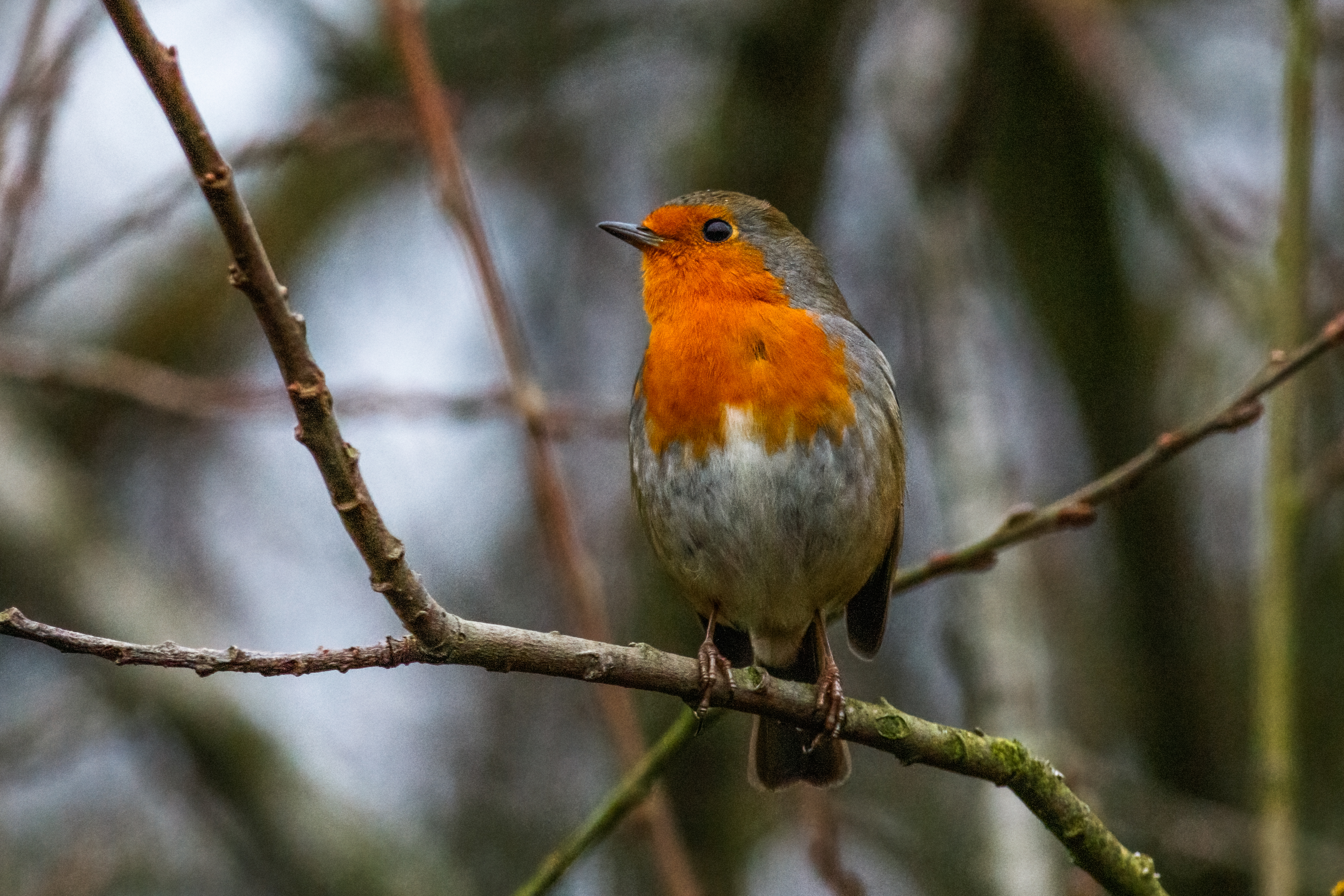
Robin - ever-present and singing a mournful autumn tune

Saturday

I got down to the patch at about 9.30. A handful of birders including Ashington Gary and Paul from Gateshead were loitering on the path but had not seen the bird, I headed north for a look through bushes. Two female long-tailed ducks were on Druridge Pool. With no further sign, I headed south to the Budge hide and checked the bushes there. It was quiet, so I checked the Budge fields and picked up a water pipit on call, which I eventually found feeding on wet grassland to the left of the hide. Bonus!

I wandered north through the bushes, when a tit flock came through and I picked up a firecrest amongst them. Nice. This was my third of the year on the patch! The flock headed south, so I followed them. I called ADMc as I know he likes a firecrest. Andy, Paul, Bob and Steve arrived - the bird was tricky to pin down, but they all got onto it eventually. 

Not sure this photo will make the Annual Report.

Whilst scanning for the firecrest, I found yesterday's Hume's warbler in a big willow. It was really tough to get people on it before it flew north over the path with some long-tailed tits. I found it again in a lower willow but it was lost to view after that and not seen again. I'm not sure how many people saw it - So frustrating!

A treecreeper was added to the day list - a scarce species on the patch.

I think that might be autumn over...


Sunday, 18 April 2021

Slow start to Spring

Spring is coming to Druridge, but slowly. A prolonged spell of wintery weather with very cold, frosty nights and cold but dry days seems to have held things up a bit and newly arrived migrant birds seem thin on the ground. 

Willow Warblers and Blackcaps arrived on Patch earlier in the week, both species were singing from the bushes on my morning walk on Thursday. A White Wagtail was on the Budge fields too.

Skylark in full song

On Friday,  a 'Blue-headed' Wagtail was reported from the Budge fields in the afternoon. I called by on my way home from work, there was no sign of the Blue-headed Wagtail but a bright 'bog-standard' Yellow Wagtail was nice and new for the year as was a single Whimbrel, flying north, calling. 

Four Ruff, 19 Black-tailed Godwit, 15 Snipe and 21 Curlew were on the Budge fields.

On Saturday morning I went looking for Wheatears and Ring Ouzels, no luck with either or with any other new arrivals for that matter. Still some wintering birds though, including 45 Twite - including eight high in the tree tops by the Budge Screen, signing - most odd!

'I hear them singing on the wire' - Male Barn Swallow

Most of Friday's Black-tailed Godwits had moved on, leaving just three, there were five each of Ruff and Avocet. A Grasshopper Warbler called briefly whilst I was chatting to ADMc. 

Offshore winter met summer again with 19 Red-throated Divers still on the sea and six Sandwich Terns feeding.

No visits to the patch today - I was getting a needle stuck in my arm so that Bill Gates can track my every move.


Male Goldfinch by the turning circle

Sunday, 1 November 2020

October slips into November

 As October slips into November, Autumn slips into winter and we all slip back into Coronavirus lockdown the chance of finding an autumnal patch mega slip away too.

With a strong s'westerly wind today we had a taste of what's to come, winter birding at Druridge feels like a slog sometimes. Once the leaves and berries have gone from the trees there's nothing to hold passerines and it often takes a long, cold snap to bring much change. 

Making the most of the clocks going back and an extra hour of daylight before work, I've been out on the patch every morning before work this week. Mostly just checking the bushes with the occasional wander through the dunes north of the turning circle. It's been windy from the west or south-west since last weekend and gloomy so little to report and even fewer photos!

Monday

Still a lot of pink-foots with 1900 in the front field. A small influx of thrushes with Blackbird being notable in number (13) and a Great-spotted Woodpecker. Some finch movement with eight Crossbill going south, 12 Lesser Redpolls could've been local birds. Full list 

Tuesday

Two Ruff were on the 'Front Field' with 330 Golden Plovers and 180 Lapwing. 18 Whooper Swans flew south in two groups. These were the start of an obvious influx - I counted 67 over Warkworth Links later in the morning. 

Whoopers, south bound in a row

In the bushes near the turning circle I saw two Brambling, both males, my first of the year.  Full list

Wednesday

About 1450 Pink-foots flew south and five Whooper Swans. My first Fieldfares of the year in came in over the dunes, calling as they headed straight inland, they are such powerful thrushes, if these had been redwings they would've made immediate landfall after crossing the North Sea. As winter visitors arrived, summer stragglers headed south - two late Swallows and a Lesser Whitethroat flitted through the bushes with Long-tailed-Tits. Full list

Thursday

Finches were quite obvious this morning with at least 45 Siskin, 12 Lesser Redpolls, 90 Goldfinch and 11 Chaffinch in the bushes. 15 Whooper Swans landed on the big pool, the resident Mute Swan cob took immediate offence and spent 15 minutes chasing them around the pool, as soon as they settled somewhere he would fly at them, wings held out to make him look bigger, in the end the Whoopers had had enough and flew off south. Some Northumbrian welcome to our winter visitors that! Full List 

Friday

There were about 1300 Pink-foots in the Front field this morning. Three Fieldfare came over as I walked through the dunes north of the turning circle. There is still a big finch flock in the dunes with Reed Bunting and Tree Sparrows but I've not seen (or heard) the Twite with them yet that others have. They are mobile mind and the Goldfinches have moved more into the bushes, feeding on Alder cones. It was nice to bump into ADMc for a catch-up. Full list

Saturday

Janet and I had a good walk around the patch. 27 Fieldfares came 'in-off' including a single group of birds. It was very windy and we didn't see much more of note. Full list

Spindrift
It was so windy, it blew these people's feet off!

With reports of more Fieldfares and some seawatching, I went back in the afternoon for a look on the sea at high-tide. I started going through the Scoter flock and soon had my first Fieldfares - it was amazing to see them flying over the Scoters and following them until they made landfall. They were the first of 138 that I counted, they were still coming in when I left as darkness fell - Amazing! That was just what I saw, in two hours, looking in one direction in an eight-mile bay. How many must've come in?

There were smaller thrushes too, Blackbird and Redwing being identifiable until the decreasing light made them just shapes. A group of 14 Starling came in too, lower than the thrushes, flying just over the water. 

There were two Velvet Scoter with about 600 Commons and strangely 10 Shoveler on the sea, one drake, the rest of them looked like ducks and they had two Teal in tow. Otherwise 15 Red-throated Loons, two Kittiwake and handful of Auks were noteworthy. Full List

My best attempt at photographing in-bound Fieldfares.

Sunday

Janet and I braved the wind once more, between the bands of rain. The highlight was a Lesser Whitethroat. A November Lesser Whitethroat - you don't get many of them! This year has been far and away my best year for Lesser Whitethroats at Druridge, they bred, which is rare and autumn passage has been the best ever. Full list

Roe Doe. There are so many Roe Deer at Druridge now.

Pink-footed Goose on it's own. A rare sight!

Sunday, 4 October 2020

Top Banana

Today had promise.

A northerly moving into the east yesterday evening with heavy rain overnight and it's October - Janet and I were on the patch for first light. We thought about ringing but decided just to go birding instead. 

We started at the entrance to the reserves with the idea of doing the plantation and working our way north from there. Before we even got to the plantation, we checked the small clump of bushes by the entrance - the Elderberry is always good for a Sylvia warbler.

The sun hadn't hit the bushes when I got onto a non-descript warbler, moving low through the base of the bushes. A phylosc was soon ruled out and we stated to eliminate other species on the limited views we had and decided it was an un-streaked acro - but which one? The bird hopped up onto a branch in the first rays of sunshine and I fired off a couple of shots. One of the photos showed the bird with head and tailed held high and I remembered Punkbirders description of Blyth's Reed Warblers having this 'Banana shape'. 

First views just as the sun hit the bushes (ISO 3200!) - Classic Blyth’s Reed posture. You could stick a Fyfe’s sticker on it and sell it for 39p.

We working on the other features when ADMc and Ashington Gary turned up, another opinion was welcome and we agreed that the bird look good for Blyth's Reed Warbler. I got a couple more record shots in better light as it skulked about the low vegetation, never more than a meter from the ground. The bird was 'colder' than Eurasian reed , sandy white underparts and olivey-brown, but not warm, upperparts and the tertials were plain. 

This record-shot shows the shape and colour better as well as short primary-projection, supercillium extending behind the eye and 'grey' leg colour

This photo shows the two-toned bill colour and supercillium as well as the colour of the breast and flanks

Whilst I was birding the plantation, Janet saw the Blyth's Reed come right out onto a umbellifer stem and gave the 'tcheck' call. It wasn't heard to call before that.

What a bird! And it finally puts to rest the bird Janet and I saw back on the 5th October 2013which we were convinced was Blyth's Reed but we never got enough to clinch it.  A new bird for the patch then taking my total to 251 and the second addition this year after another rare acro - Great Reed Warbler.

We headed north checking all of the bushes from the Plantation to the Dunbar Burn. Goldcrests (110+) and Robins (45+) were the most numerous species. We also noted

Yellow-browed Warbler  - 7 (conservative estimate allowing for double-counting)

Chiffchaff - 2

Garden Warbler - 1

Blackcap -8

(Eurasian) Reed Warbler- 1

Siskin - 5

Dunnock - 12

Redwing -1

Song Thrush - 8

One of over 100 Goldcrests 

One of seven Yellow-browed Warblers

And another Yellow-browed Warbler

This photo shows the central crown-strip which some Yellow-brows show

One of five Siskins

Record-shot of the Eurasian Reed Warbler

Also of note was the almost constant calls of Skylark overhead and several skeins of Barnacle Geese with an under-count of 107 over and a single Swallow.

Barnies over

Plenty of these feckers this autumn...

Yesterday,  Janet and I braved the rain and birded the patch in rough conditions. We did from the Plantation to the Dunbar Burn. Top bird was Treecreeper in the Plantation  - only my sixth for the patch and my fist not from a net! Also of note were:

Long-eared Owl - sat on the fence opposite the Little Hide in the rain

Swallow -2

Pink-footed Geese - 1550

Yellow-Browed Warbler - 1

This evening I headed back to the patch, for high-tide to check out the Scoter flock for a possible sub-adult male Surf Scoter reported yesterday. It was impossible with a massive sea and the Scoters being well beyond the breakers. Some gull photos will follow later this week, but here is one to whet the appetite. Three Swallows were feeding in the lee of the dunes. 

Just a tempter for later in the week


Friday, 6 March 2020

Could it be spring?

Could it be Spring?

It felt like it this afternoon but down on the patch first thing it was a cold and frosty start. -1 degrees C but hardly a breeze and a lovely white frost.

Frosty start
Despite the cold, spring was in the air for the stonechats as they chased each other around the turning circle and for the skylarks who sang out above my head. Towards Chibburn lapwings were tumbling - it is spring y'know!

One  the stonechats - pausing for a while before resuming his courtship
Out in the fields about 780 pink-footed geese grazed - it's still winter...

I continued down to the Budge screen where it was nice to catch up with ADMc who was counting the grey herons, he'd got to 29 which is an impressive count for the patch and might indicate a good breeding season ahead - they'll be on eggs soon.

The other 'Budge' highlights included the three almost resident ruff, one of which is very lucky to be still with us. Andy called out a peregrine speeding low, north, it flushed the waders and ducks before gaining some height to stoop on one of the ruff, the ruff darted left and avoided being breakfast.

The three ruff coming back in to land - one of them very lucky to be there!
There weren't many wader s on the Budge in contrast to Saturday when there 153 redshank, 16 dunlin and 53 curlew.

One of Saturday's 153 redshank
In the fields beyond the Budge were more geese, pink-foots mostly but a scan through them produced three Eurasian white-fronts. Disturbed by something, all of the geese got up and estimated 1000 or so, added to my 780 earlier by the haul road,  I jotted down 'c1700'.

Shoveler numbers are still good - I estimated 41.

With chores to do I, I left Andy chatting to Marty Anderson and headed home. One of my more enjoyable chores was to clean out and check our 30 or so tree sparrow boxes at Ellington Pond Nature Reserve. Two water rails weren't put out by my presence and chased each other around the pond-margins squealing like pigs!


Two views of carrion crows
Coot from Saturday

Sunday, 24 March 2019

First migrants - but some good birds missed

This weekend saw my first visits to the patch this month.

It was nice to catch up with ADMc on Friday morning at the Budge screen, it was sunny and quite warm and felt like spring. Seven ruff  at the back of the field were newly arrived and spanking male wheatear was out on the grass in front of us. 15 Black-tailed godwits, 3 dunlin and over 90 curlew were notable.

In the bushes near the big pool, I disturbed a water rail and my first 'patch' chiffchaff was calling.

On Saturday evening, Janet and I had a wander through the dunes to the north of the Dunbar burn. In the bushes before we set off north, six reed buntings were feeding on willow catkins. No sign of the red kite that had been seen earlier on the patch  - a species that still eludes me.

In the dunes there was a mixed flock of finches and buntings which included about 12 twite, six reed buntings, eight chaffinch and 18 linnet with some goldfinches. The grey partridges have split up form their large coveys now and are now paired up. A pair of stonechats were perched up near the Dunbar burn - the male singing sweetly in the afternoon sunshine.

In the fields beyond the haul road there were at least 40 lapwing with many displaying birds. Several juveniles fledged successfully from this field last year so, being site faithful, they've come back. beyond them, in the fields a bit further away, were about 110 swans - there were certainly both mute and whooper in the herds but with only bins, it was impossible to say how many of each. We stopped by the Budge screen on the way home and watched a pair of pintail on the Budge pools.

Today was WeBS count day, I didn't do the count until late afternoon as we were out this morning doing a willow tit survey for RSPB. Our tetrad was west of Ellington, taking in the Linton Burn and Warkworth Lane Ponds and we were amazed to find two pairs of willow tits.

Whilst we were out reports came through of a glaucous gull and great egret on the Budge fields. I've not seen a glaucous gull on the patch for over 10 years so I would have loved to have seen that - it didn't hang around and was tracked up the coast. The pain of a patch birder...

There were no waders on the Budge fields at all. There are still decent counts of wigeon (119) and teal (92). The pintail pair were still present and a count of 47 shoveler was impressive. Two pair of red-breasted merganser looked smart on the big pool and a pair of great crested grebes look settled.

Now migration has kicked-off I'm going to adjust my work-life balance and get down to the patch a bit more often!


Sunday, 17 February 2019

Yankee teal

There's been good numbers of teal at Druridge since I got back from Taiwan and I've been scanning through them for green-winged teal.

I was working at home on Tuesday when a message came through to say that Andy McLevy had found a green-winger on the Budge fields - A lunchtime twitch was in order and I saw the bird.

It was still there today, making it onto my WeBS list - but we only saw it briefly from the south facing hide and too far for photos and then it disappeared into the flock of 406 regular Eurasian teals.

As well as a good teal count there were over 260 wigeon, 130 curlew and 15 grey heron and a single black-tailed godwit. A pair of oystercatchers were new for the year.

Green-winged teal occur, on average evry three years or so at Druridge. Some of them stay for a long time whlist others are day-birds and they're off. At the minute, the American  green-winged teal Anas carolinensis is considered as seperate species to 'our' teal by the IOC but not by eBird who mainly follow Clements taxonomy. So it could easily get 'lumped' again...
In the meantime it's on my list

This will probably be the highest duck count of the year as numbers will start to decrease soon as birds begin to head north.

Wednesday, 18 October 2017

Un-bee-lievable!

I thought about calling in to the patch this morning on my way to work, but I decided against it and went straight to the office. I'm at my desk and check my phone to find a message 'Bee-eater, Druridge Pools, 0820-0920 per RBA'

Bugger, I thought, if only I'd gone...

Then another message 'Bee-eater still at Druridge'

Bugger it! I've got plenty of flexi-time in the bank and I've got evening meetings until 8.30pm, my seat was still spinning as I headed down the stairs. Despite being held up by old duffers doing 30mph I got to Druridge in good time, but had just missed a fly-by by a few minutes...Would that be it?

A good crowd was gathered on the path to the hides where the bird was last seen - the tension was unbelievable! Then ADMc appeared with news that the bird was heading our way. Peering over the top of the bund, distant views were had of a bee-eater hawking over the fields beyond the big pool, until it disappeared towards the bushes by the turning circle. 

Alan Jack and I decided to head that way and this is what greeted us in the single ash tree by the turning circle...
a bloody bee-eater


It was like being back in Spain! 

A good crowd had gathered to watch it, it sat for ages in the top of the ash tree before flying off and hawking for insects over the dunes, picking prey off the tops of bushes before landing out of site and I had to reluctantly leave it and head back to work.  It is a juvenile, told from the pale colour of the mantle and the amount of chestnut brown in the wing being limited.Surely this is one of the 'Chevington two' from the weekend?


heavily cropped shot
 What an amazing bird, a first for the patch and a first for me in Northumberland. I've seen the breeding birds in the UK and thousands in Europe, I've even ringed them in Malta, but this is still probably the best bird I've seen on the patch.

And what an amazing year I'm having on the patch. With no more effort than usual, I've seen eight new species this year already - it is tricky to see two or three new species a year usually.

European Bee-eater takes my patch list to 248 species.

Sunday, 20 August 2017

Hard to spot crake


In case you missed it, it's been Birdfair weekend down at Rutland Water. I'm normally there with my work, in fact I haven't missed a Birdfair since 1999... until this year that is. It was becoming like groundhog day, same people,  same places, same conversations... So I took a year off.

Quite often, when I've been down at the fair, there's been a fall of birds on the east coast, so it is about right that the year I don't go we have wall-to-wall strong south-westerlies. It wasn't all bad though, I took Friday off work and we were lounging about at home when a message came through that ADMc was watching a spotted crake in front of the little hide at Druridge. I was quickly on the scene and saw the bird for all five seconds through my bins before it darted left into thick grasses and wasn't seen again until much later that evening, by which time i was in the pub. Piss-poor views but enough to year-tick it.

Luckily it was picked up again this afternoon by Hector and I had much better views, brief as they were though as it crossed open ground between the clumps of soft rush.

This is my third 'patch' spotted crake. My first was in September 2002 which was found by Steve Taylor on the edge of the big pool. My second was found, but not identified, by a photographer who has snapped it on the old boardwalk in April 2013, it hung around for a week or so.

Offshore this afternoon there were 10+ red-throated divers, many still with red-throats, three arctic skuas but little else of note.

These butterflies were on the path...

Wall on knapweed

Peacock on teasel
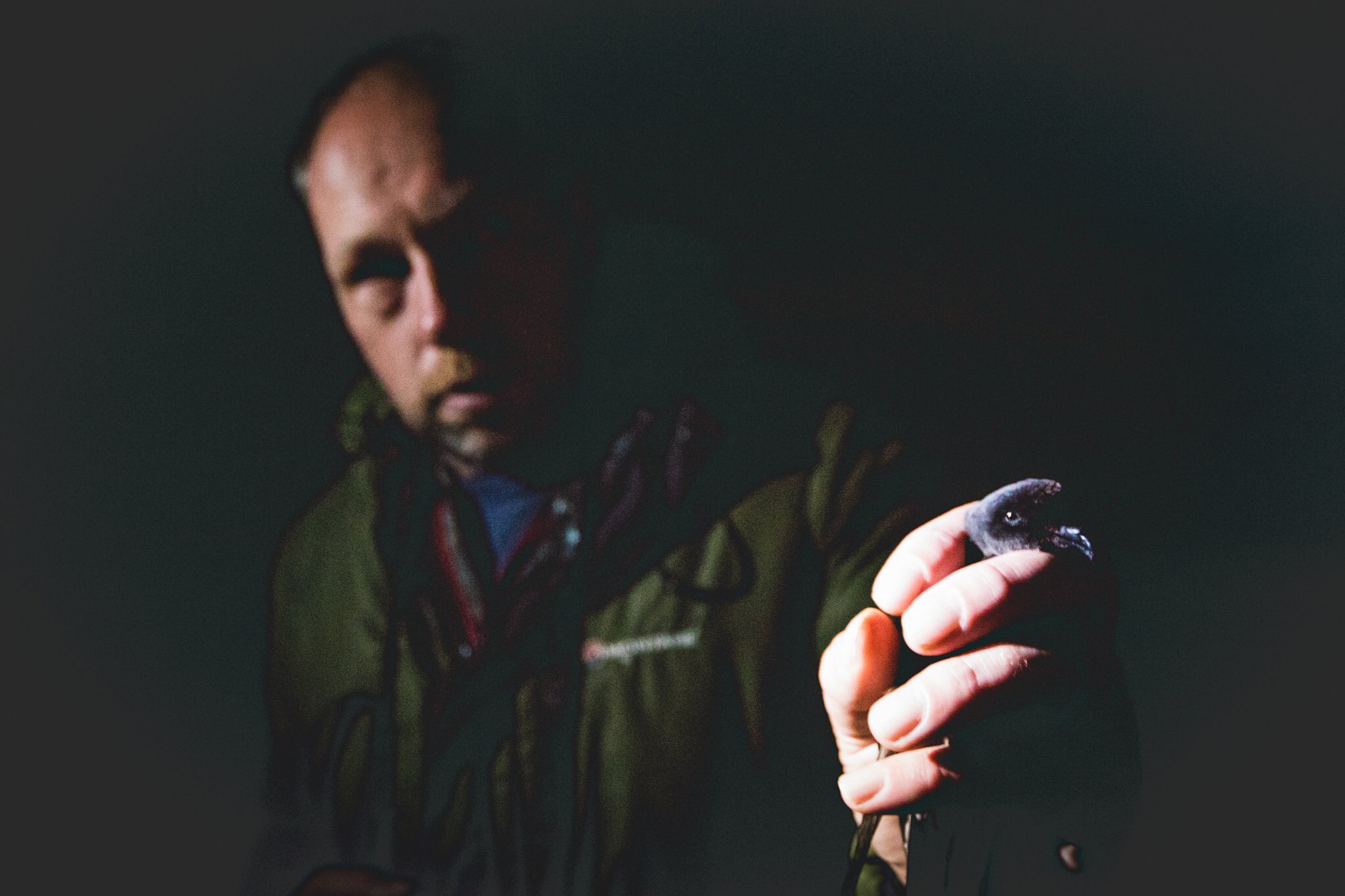
We did some nocturnal ringing last Saturday for storm petrels. We caught one at 11.25pm - our earliest ever catch so we hoped for great things but it wasn't to be, it was another two and a half hours before we caught the second and final bird of the night. A few folk came down for a look, so it was nice to share these amazing little birds with them. Thanks to Cain Scrimgeour for this photo - if I had known I was in the shot, I might have smiled :-)

Storm petrel (Photo: Cain Scrimgeour)

Monday, 28 March 2016

More like winter than spring

Maybe it is just because I have just come back from Cuba, but I thought this weekend felt more like winter than spring. Even on Friday, which was certainly the best day of the weekend, it still felt like winter at Druridge and the lack of any migrants reinforced my thinking.

Cuba was excellent - great birding in a really interesting country. Cuban tody stood out as 'bird of the trip'. I will sort some photos and put them on Flickr soon and might even get around to writing a trip report.

Cuban Tody
Good Friday was my first visit back to the patch. It wasn't that good... although I did add a few common species to the year list - meadow pipit, kittiwake, eider, snipe, great crested grebe and oystercatcher. There were still four pintail on the Budge fields, a female scaup on the big pool and seven whooper swans on the front field.

No proper migrants were seen.

Despite the forecast of a southerly airflow for today, the wind was plumb out the north first thing, moving through to a strong and very cold nor'westerly later. Any migrant with thoughts of self preservation will of headed back south. So, I only added lesser black-backed gull to my year list. 

Interestingly, Andy McLucky reported a red kite over the Budge fields this morning  - a long-overdue addition to the Druridge patch list. This takes the patch list (my own sightings with any other published sightings) to 259 species. I've seen 238 of them. I would like to think I will add red kite to my own list this year. I might post a list of the things I haven't seen on here at sometime.

For this year, I am on 99 species. Hopefully I will add something else before the month ends, but unlike most of the birdwatchers in Northumberland, I am back at work tomorrow.


Monday, 18 May 2015

Back for a stint

There has been no blog updates for a while as I have been in Spain for a week. We started in Valencia and headed down in to Castilla-La Mancha to the La Mancha wetlands where we saw lots of these:

Flamingoes at Laguna Larga
Next we headed to Sierra de Andujar in search of lynx, it was unseasonably hot which meant we didn't see lynx or many birds. We did see lots of these:

Azure-winged magpie at Sierra de Andujar
We finished the trip checking out saline lagoons and salt pans on the Murcia/Alicante coasts. it was interesting to see the breeding little terns there, making their scrapes on the banks between the salt pans.

Little tern at Las Salina de San Pedro del Pinatar, Murcia
It was also interesting to see some passage waders coming through including a lot of curlew sandpipers, little stints and even turnstone.

It wasn't long until I would see little stint again..

Back to reality on Sunday morning, back to Druridge to the WeBS count in the freezing wind. There was crowd of folk in the Budge screen when I got there, I thought it was a twitch! A drake garganey and two wood sandpipers were soon pointed out and four little egrets were out on the fields - canny start to the count!

Soon after ADMc had left to look for a little stint at Cresswell, Bob Biggs picked up three small waders in flight, over the fields, which appeared to head off over the big pool. They hadn't, as I soon picked them up on the mud, two dunlin and a little stint. Little stint is a bit of rarity at Druridge, I've only seen them in three of the last eight years.

I had a quick visit to the Budge fields tonight. One of the wood sandpipers was still there and a little ringed plover was out on the mud.

115 little stint
116 little ringed plover

PWC Score 141