Showing posts with label little stint. Show all posts

Sunday, 15 May 2022

Putting in a stint or five for the WeBS count

Well, I didn't expect to finish my WeBS count this morning by adding FOUR Temminck's Stints to it - but that's what happened!

John Day, an RSPB friend from Bedfordshire and his pal Darren joined us at Druridge this morning, they are up here for a weekends birding. When we joined them just after 7am they'd already seen more species than you can see in a month in Bedfordshire!

It was WeBS count day, so I counted the ducks whilst they enjoyed watching spoonbill, little stint, avocets, pintail, dunlins, lapwing chicks and other nice species. Little stint was new for the year so I was already happy with that. Count done and all three hides checked we headed back to the cars. They were off to the Harthope Valley whilst Janet and I opted for a look on the sea. Seeing very little, I checked my phone to see a missed call from Steve Holliday, and a text message - 'four Temminck's Stint in front of Budge Screen'. Seemingly they'd just dropped in. 

We called John and Darren who were still faffing at their car and rushed to the hide, where, thankfully, the four birds could be seen on the edge of the pool. The four of them stuck pretty-close together and fed frantically along the muddy edge. I always think the 'gait' of Temminck's is quite diagnostic, they almost creep on their 'knees' as if their legs are set too far back on their bodies. They were chased by a redshank a couple of times, and then, without cause or warning, they were off, zig-zagging at first before flying off high and directly north. Steve and I thought that this might be a record count of this species for the County? These were my first patch Temminck's since two were on a pool by the coal haul road back in 2013. 

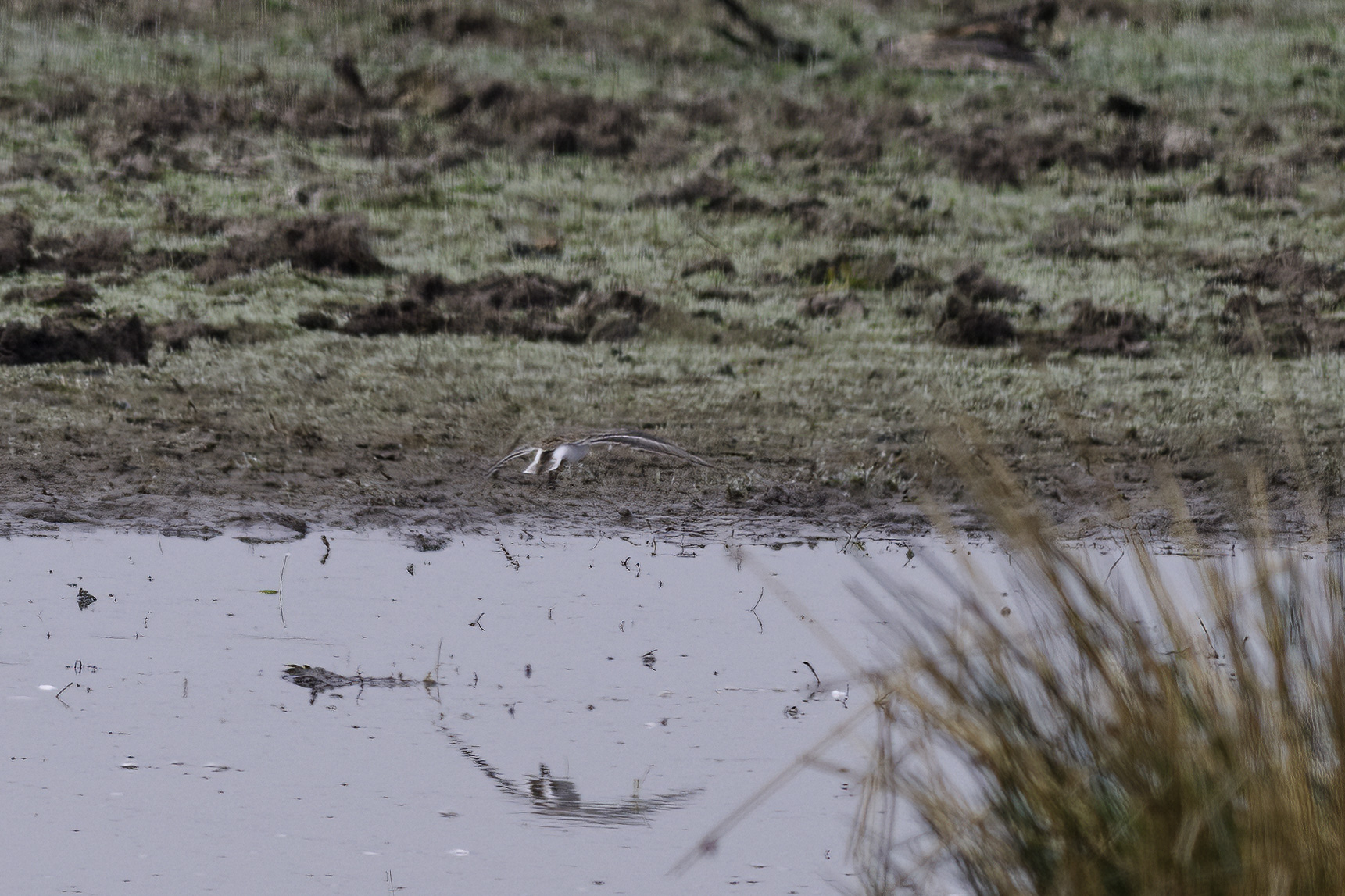
Record shot  - just to prove there were four!

A slightly better shot of two of them

And one flying off

A very pleasant end to a morning's birding. Big thanks to Steve H for the tip-off.

The Budge Fields are looking fab at the moment. Despite the relatively dry spring, the water levels remain very high, something has changed with the hydrology of the site this winter I think. Birds are dropping in all the time, not long after we left a wood sandpiper was reported. The 'Channel' wagtail that I found on Friday was seen again today.

Here are a few more pics from the last couple of days.


Proud parent on guard

And here's the reason why!

You can see why barn swallows were called bluebirds!

Spoonbills are now a common spring and summer species on the patch

Pochard are increasingly uncommon - the four that are on site at the moment are most unusual nowadays
The geese took a dislike to two roe deer who wandered through the pool. Roe deer are on the increase, almost plague-proportions these days.

My Druridge patch year-list is now on 130 and my 5km from home list is on 157. 

Sunday, 23 August 2020

Little of note on WeBS count

The birds of note on the WeBS count this morning were both little - firstly Little Stint which was among the Dunlin flock, my second of the year on the patch after seeing a bird in the spring. There was also single Little Gull, a second calendar year bird in front of the little hide. Otherwise it was pretty quiet, a handful of Dunlin and five Black-tailed Godwits on the Budge fields with the Stint and no sign of the Black-necked Grebe that had been on Druridge Pool earlier in the week. 

Walking between the hides, the bushes seemed very quiet too, I suspect they will remain that way until we get a bit of east in the wind. 


Saturday, 30 May 2020

Unlocked

Well, the COVID-19 restrictions were lifted a couple of weeks ago (not a wise move in my opinion). You would have thought I would have headed straight for the patch as soon as I could - but this wasn't the case. I was reluctant to go and waited a few days, until Monday 18th, before my first tentative visit.

When I did go, it felt odd - almost like I was doing something wrong. I've quite enjoyed exploring my new (very) local patch, rediscovering places I used to knock around as kid and probably first developed a love of the outdoors and wildlife, abandoning my re-found patch for Druridge felt like cheating. So after my first visit I returned to the local haunts for a few days.

Obviously there was a lot of new birds for the year - chiffchaff was the only warbler I saw before lockdown, now they are all back and the hirrundines, swifts and seabirds. 

I didn't take my camera on my first few visits - again it felt as if I should be exercising, not taking photos. I missed a lovely Greenland wheatear posing nicely on a post and a yellow wag on the budge fields. 

The Budge fields are looking great at the moment, but are drying up quickly in this dry weather (the driest May since the 50's seemingly) and have attracted a good selection of waders, on 19th I had greenshank, avocet, little stint, ruff, knot and black-tailed godwit. On Friday the wader list also included three curlew sandpiper, two little-ringed plover and a bar-tailed godwit. A drake garganey was also on the Budge fields.

I normally avoid Bank Holidays at Druridge. I headed out early on Bank Holiday Monday and left before the masses descended. A red-legged partridge, a scarce visitor to the patch, was on the Budge fields - I hope they remain scarce otherwise we'll lose our greys.

red-legged partridge - an unwelcome year-tick

30-40 swifts were feeding just over the bushes along with black-headed gulls, taking advantage of the St. Mark's Flies. 

Swifts - difficult to photograph


Black-headed gull -  hawking insects amongst the bushes

On Thursday and Friday I took two days off work to set up the ringing the site. I only put three nets up on each day but still caught 48 new birds, a few retraps and single control blue tit. We didn't ring at all last year because of family circumstances, so any retraps were at least two years old.

Warblers dominated, mostly adults showing signs of breeding but I did catch a recently fledged juvenile chiffchaff. A couple of grasshopper warblers and a lesser-whitethroat were nice to catch - the latter, a female with a brood patch, are not a common breeding species here. 

Lesser whitethroat  - a rare breeding species at Druridge

On Friday, a spoonbill was on the Budge fields first-thing and, weirdly, 22 barnacle geese. There had been lots of fly-over feral goose flocks, mostly Canadas. I can only presume these barnacles were feral rather than 'wild' migratory birds?

 A flock of greylags over - lots of flocks of feral geese passing through


When things were quieter in the nets, I had a chance between checks to photograph some critters. I found my first red and black froghopper at Druridge a couple of years ago - there were dozens of them on Thursday and Friday. A coloniser from the south, like speckled wood butterflies. 

Red and black froghopper- Cercopsis vulnerata

I also photographed this beetle:

Red-headed Cardinal Beetle (Pyrochroa serraticornis) 

Red-headed Cardinal Beetle (Pyrochroa serraticornis)  - a new one for me. It looks like another southern species establishing here. I saw three or four over the two days whilst checking nets. According to the NBN atlas the most northerly record St. Mary's Island and iNaturalist has couple of sightings locally but nothing as far north as Druridge. 

There were a few butterflies on the wing including large skipper and small heath. There were also dozens of blue-tailed damselfy.

Small Heath

Blue-tailed damselfly (female)

Blue-tailed damselfly

I left at about 1.30pm on Thursday and the road was jammed with cars - Friday was worse. I was using our southern nets so it was more obvious but as I drive home, it was gridlock - a single track road with cars parked on both sides and wazzocks not giving way. Cars were parked almost continuously from Druridge to Cresswell - I've not seen this before, even on August Bank Holiday Monday. I can only presume these people are usually in the Metro Centre or the pub... 

Chaos


Monday, 18 May 2015

Back for a stint

There has been no blog updates for a while as I have been in Spain for a week. We started in Valencia and headed down in to Castilla-La Mancha to the La Mancha wetlands where we saw lots of these:

Flamingoes at Laguna Larga
Next we headed to Sierra de Andujar in search of lynx, it was unseasonably hot which meant we didn't see lynx or many birds. We did see lots of these:

Azure-winged magpie at Sierra de Andujar
We finished the trip checking out saline lagoons and salt pans on the Murcia/Alicante coasts. it was interesting to see the breeding little terns there, making their scrapes on the banks between the salt pans.

Little tern at Las Salina de San Pedro del Pinatar, Murcia
It was also interesting to see some passage waders coming through including a lot of curlew sandpipers, little stints and even turnstone.

It wasn't long until I would see little stint again..

Back to reality on Sunday morning, back to Druridge to the WeBS count in the freezing wind. There was crowd of folk in the Budge screen when I got there, I thought it was a twitch! A drake garganey and two wood sandpipers were soon pointed out and four little egrets were out on the fields - canny start to the count!

Soon after ADMc had left to look for a little stint at Cresswell, Bob Biggs picked up three small waders in flight, over the fields, which appeared to head off over the big pool. They hadn't, as I soon picked them up on the mud, two dunlin and a little stint. Little stint is a bit of rarity at Druridge, I've only seen them in three of the last eight years.

I had a quick visit to the Budge fields tonight. One of the wood sandpipers was still there and a little ringed plover was out on the mud.

115 little stint
116 little ringed plover

PWC Score 141


Tuesday, 1 October 2013

A trio of waders

A brief visited to the patch tonight after work netted me a trio of waders. A tip-off about two little stints from Scotland Gate's second best wildlife tour leader* had me heading for the Oddie hide. Straight from work in shirt and smart(ish) strides and only carrying my bins was not the best approach, especially as martin was leaving, with his scoped I hoped to borrow, as I walked towards the hide.

I soon picked up four waders on the far bank, two were dunlins, two were smaller, presumably the little stints. I couldn't year-tick them on these views, they could have been anything... Luckily they were spooked and one of them, along with the two dunlins landed on the shore in front of the hide, but not for long, before they all flew back tot he far side. As I was closing the shutters to leave, I spied a wader still on the shore, something new though, a juv curlew sandpiper, which must've just pitched in. It was 2009 the last time I saw either of these species on the patch, 2009 was a golden year for waders at Druridge as the Budge fields had been well grazed and there was mud for much of the year.

The third wader species was added to the year list I walked through the weedy dunes at the north end looking for ground dwelling species. I saw three waders fly onto the fields where the flash pond used to be, further inspection showed them to be grey plovers. They didn't hang around though, flying off north towards East Chev. Not an annual species at Druridge so another nice addition to the year list.

There were no passerines of note tonight, despite me giving the weedy dunes a good thrashing.

155 little stint
156 curlew sandpiper
157 grey plover

157 is the average year-list total for Druridge so, October going to plan, this could be a record-breaking year (that's jinxed it).

* Scotland Gate's best wildlife tour leader is of course Martin's wife, Sarah!