Showing posts with label robin. Show all posts

Saturday, 19 November 2022

Last gasps of autumn

The forecast didn't look too promising for this weekend and I felt like autumn was slipping away without a final finale. However, on Thursday things started to look better, with an easterly and some good seawatching. Instead of seawatching, I was sat in my office in zoom meetings all day.

Friday

As there looked to be a slim chance of a late migrant or two, I took a flyer on Friday afternoon and headed to the patch with Janet. We started with a look on the sea but it was quiet, a bonxie going south, only my second of the year, was the highlight. Not an auk in sight. Janet found a snow bunting on the beach which was a year-tick.

Female snow bunting in poor light

Same bird, different pose

We headed for the bushes, checking the area around the start of the path to the hides first. A female blackcap was a good start. I got onto a small bird flitting about in the branches, above the blackcap - I called 'yellow-browed warbler' to get Janet onto it, but it had flitted off. Even though I had the briefest views - Strong wing-bar and supercillium, pale tips to darker secondary feathers, it wasn't right for a yellow-brow. It was duller than a yellow-browed, almost with a grey cast. Hume's warbler sprang to mind but I needed better views to be sure and Janet needed to see it. I put the news out as 'a probable'.

We didn't have to wait long, as the bird re-appeared to the right and gave tantalizingly brief views as it flitted quickly through the branches. It had a colder, greyer look to it than a YBW, the wing bar and the supercilium were more off-white without yellow tones and the bill and legs appeared to be dark. It hadn't called at this stage, but we were both confident that it was Hume's and put the news out.

A 'bird wave' of tits and goldcrests came through, which also brought a willow tit and chiffchaff to the party. We lost the warbler in the melee, when we refound it, it was further right and it flew and called - a short, sharp two-tone call, not like yellow-browed's more drawn out 'twoo-eeee'. It did this twice before flying off south. 

We suspected it might have gone south with the tit flock, so I headed down towards the Budge hide but couldn't relocate it. Two ruff were on the fields and water rails were calling. We couldn't relocate the warbler by dusk so headed home. I would be back in the morning.

I had a likely Hume's warbler many years ago by the Budge hide. It's in a long-lost notebook and was never submitted, so technically not a new bird for the patch. I've seen three others in the county, at Whitley Bay (2006), Lynemouth Power Station (2002) and East Chevington (2001). 
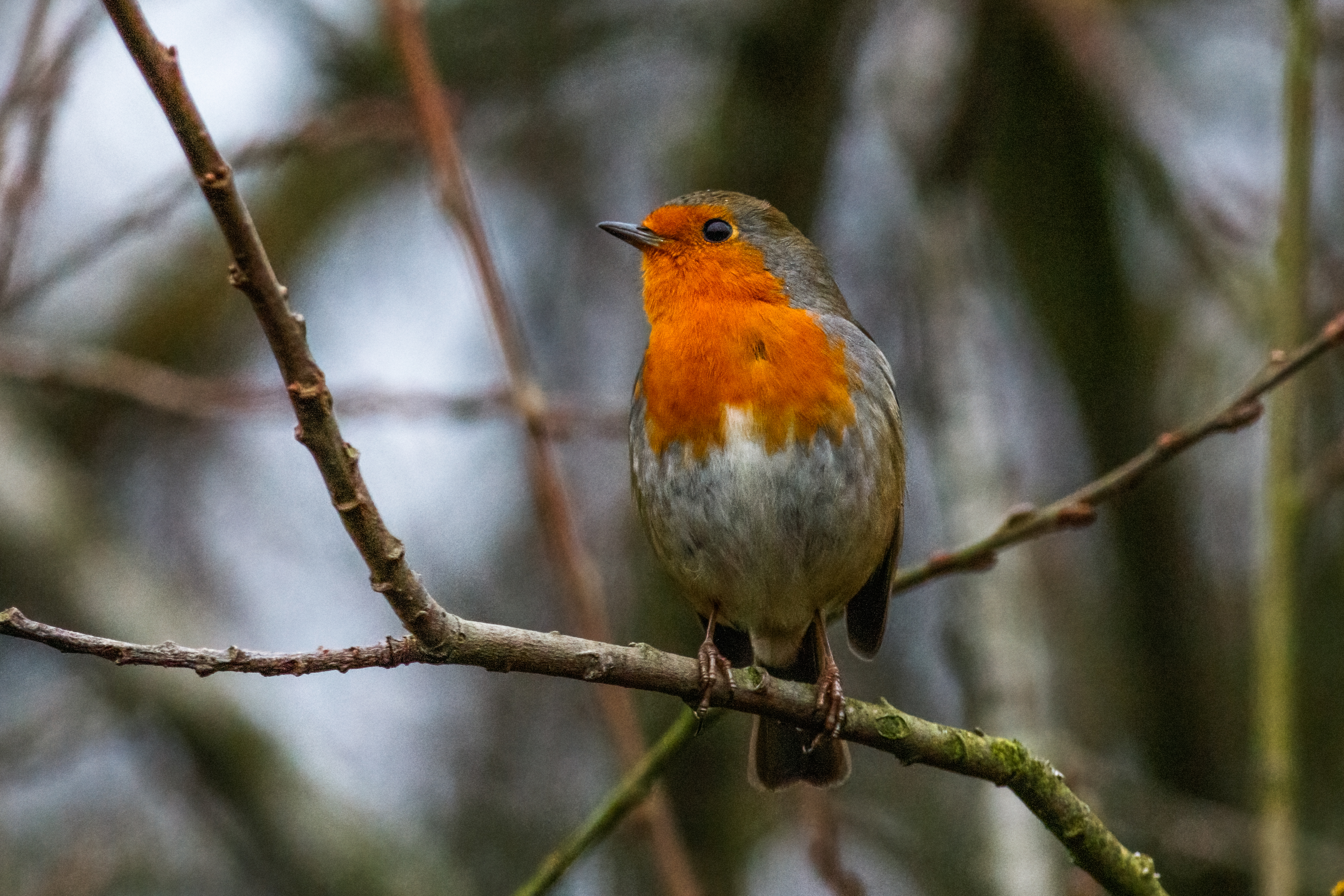
Robin - ever-present and singing a mournful autumn tune

Saturday

I got down to the patch at about 9.30. A handful of birders including Ashington Gary and Paul from Gateshead were loitering on the path but had not seen the bird, I headed north for a look through bushes. Two female long-tailed ducks were on Druridge Pool. With no further sign, I headed south to the Budge hide and checked the bushes there. It was quiet, so I checked the Budge fields and picked up a water pipit on call, which I eventually found feeding on wet grassland to the left of the hide. Bonus!

I wandered north through the bushes, when a tit flock came through and I picked up a firecrest amongst them. Nice. This was my third of the year on the patch! The flock headed south, so I followed them. I called ADMc as I know he likes a firecrest. Andy, Paul, Bob and Steve arrived - the bird was tricky to pin down, but they all got onto it eventually. 

Not sure this photo will make the Annual Report.

Whilst scanning for the firecrest, I found yesterday's Hume's warbler in a big willow. It was really tough to get people on it before it flew north over the path with some long-tailed tits. I found it again in a lower willow but it was lost to view after that and not seen again. I'm not sure how many people saw it - So frustrating!

A treecreeper was added to the day list - a scarce species on the patch.

I think that might be autumn over...


Friday, 21 October 2022

Strokes of luck

Several strokes of luck led to a full-fat patch tick today  -  Pallas's leaf warbler

Firstly  - I decided to take today off work today instead of next Friday

Secondly - When news broke of a Radde's Warbler at Newbiggin-by-the-Sea and Wood lark at Newton, I stuck to my plan and birded the patch

Thirdly - I bumped into Darren Woodhead and his son Corin.

I set out, as planned, to bird the patch, I was there for 7.40 and it was just light but foggy. I followed my usual plan of attack, to work the bushes by the entrance and the plantation before heading north.

Not long out of the car, I got onto a classic Siberian (tristis) chiff, grey above, green in the wings and off-white below, not warm at all. And it called a thin 'toot'.

Two birders, that I'd not seen before, arrived shortly after me and started birding the plantation. They also had a sibe, when I went into the plantation, it also called - 'toot'  - two birds (?). They were on a yellow-browed warbler. Darren and Corin Woodhead from Lothian. I recognised Darren - and now I know from where - I've often admired his artwork on my annual trips to Birdfair.

record shot of Yellow-browed warbler


Yellow-browed warbler

I spent the next hour or so in the plantation with repeated views of the yellow-browed, lots of crests, robins, wrens and a steady trickle of skylarks overhead and a group of c25 siskin south. Four brambling dropped in and fed for a while. 

Brambling

Back at the 'entrance bushes' I was watching a yellow-browed when a second bird called from the sycamore at the plantation- two. Redwings came in overhead. News broke of a Radde's warbler at Newbiggin - I ignored it. 

I moved up to the middle plantation, where Darren and Corin were scouring the trees. I joined them, Darren and I were looking through the pines and sycamores, but Corin was watching the scattered scrub to the north and exclaimed suddenly  'Pallas's'!

mega-cropped record shot of Pallas's leaf warbler in flight -  6400 ISO

We got straight onto it - a Siberian gem, flitting around a crab apple tree. A patch tick for me and a great find for Corin. We enjoyed the bird for a good while before it flitted off. ADMc and others joined us, Whilst scouring the goldcrests for the Pallas's, I got briefly onto a firecrest, thankfully it showed on and off for the next 30 minutes, as did the the Pallas's. Another yellow-browed warbler was calling in the bushes to the north. 

Further north I found another firecrest in a small flock of crests and tits behind the Budge hide. 

Up at the path to the hides, by the timber screen, a 'bird wave' passed through with a long-tailed tit flock. There were at least five chiffchaffs around that area. This one has me stumped though - not a classic Sibe, I thought, too 'warm' but also too brown for a bog standard collybita. I know that Sibe's can be variable though and light plays a huge part.  It didn't call. Not sure on this one...

'brown' chiff
same bird
'Bog-standard Chiff'

I heard a lapland bunting calling, it passed overhead behind three skylarks, all going south. A flock of about 18 lesser redpoll fed in the alders and I found a few more siskin further north before I headed home. 

lots of these miserable-looking birds 


and these
a few of these

This afternoon, I acquiesced and went to the Ash Lagoon Banks at Newbiggin to look for the Radde's. No luck there, although others claimed it, but a roosting long-eared owl was worth the trip and new for the5km2 patch. 

I'll be back out again tomorrow. 

Sunday, 4 October 2020

Top Banana

Today had promise.

A northerly moving into the east yesterday evening with heavy rain overnight and it's October - Janet and I were on the patch for first light. We thought about ringing but decided just to go birding instead. 

We started at the entrance to the reserves with the idea of doing the plantation and working our way north from there. Before we even got to the plantation, we checked the small clump of bushes by the entrance - the Elderberry is always good for a Sylvia warbler.

The sun hadn't hit the bushes when I got onto a non-descript warbler, moving low through the base of the bushes. A phylosc was soon ruled out and we stated to eliminate other species on the limited views we had and decided it was an un-streaked acro - but which one? The bird hopped up onto a branch in the first rays of sunshine and I fired off a couple of shots. One of the photos showed the bird with head and tailed held high and I remembered Punkbirders description of Blyth's Reed Warblers having this 'Banana shape'. 

First views just as the sun hit the bushes (ISO 3200!) - Classic Blyth’s Reed posture. You could stick a Fyfe’s sticker on it and sell it for 39p.

We working on the other features when ADMc and Ashington Gary turned up, another opinion was welcome and we agreed that the bird look good for Blyth's Reed Warbler. I got a couple more record shots in better light as it skulked about the low vegetation, never more than a meter from the ground. The bird was 'colder' than Eurasian reed , sandy white underparts and olivey-brown, but not warm, upperparts and the tertials were plain. 

This record-shot shows the shape and colour better as well as short primary-projection, supercillium extending behind the eye and 'grey' leg colour

This photo shows the two-toned bill colour and supercillium as well as the colour of the breast and flanks

Whilst I was birding the plantation, Janet saw the Blyth's Reed come right out onto a umbellifer stem and gave the 'tcheck' call. It wasn't heard to call before that.

What a bird! And it finally puts to rest the bird Janet and I saw back on the 5th October 2013which we were convinced was Blyth's Reed but we never got enough to clinch it.  A new bird for the patch then taking my total to 251 and the second addition this year after another rare acro - Great Reed Warbler.

We headed north checking all of the bushes from the Plantation to the Dunbar Burn. Goldcrests (110+) and Robins (45+) were the most numerous species. We also noted

Yellow-browed Warbler  - 7 (conservative estimate allowing for double-counting)

Chiffchaff - 2

Garden Warbler - 1

Blackcap -8

(Eurasian) Reed Warbler- 1

Siskin - 5

Dunnock - 12

Redwing -1

Song Thrush - 8

One of over 100 Goldcrests 

One of seven Yellow-browed Warblers

And another Yellow-browed Warbler

This photo shows the central crown-strip which some Yellow-brows show

One of five Siskins

Record-shot of the Eurasian Reed Warbler

Also of note was the almost constant calls of Skylark overhead and several skeins of Barnacle Geese with an under-count of 107 over and a single Swallow.

Barnies over

Plenty of these feckers this autumn...

Yesterday,  Janet and I braved the rain and birded the patch in rough conditions. We did from the Plantation to the Dunbar Burn. Top bird was Treecreeper in the Plantation  - only my sixth for the patch and my fist not from a net! Also of note were:

Long-eared Owl - sat on the fence opposite the Little Hide in the rain

Swallow -2

Pink-footed Geese - 1550

Yellow-Browed Warbler - 1

This evening I headed back to the patch, for high-tide to check out the Scoter flock for a possible sub-adult male Surf Scoter reported yesterday. It was impossible with a massive sea and the Scoters being well beyond the breakers. Some gull photos will follow later this week, but here is one to whet the appetite. Three Swallows were feeding in the lee of the dunes. 

Just a tempter for later in the week


Thursday, 10 September 2020

Mystery bird - everyday is a schoolday

Everyday is a schoolday, well today was certainly a schoolday for me. 

Picture the scene...

I arrive early at Druridge, the sun has just come up over the sea, so it's not over the dunes yet and it's gloomy still. I step out of the car and hear a bird singing from the bushes - I think I recognise it, but I'm not sure and certainly can't put a species to it. I go and investigate,  I can't record it because the voice recorder app on my phone hasn't updated or something - typical.  the song was almost Sylvia warbler like, but 'jangly' and metallic like a corn bunting. The bird is still deep in cover. 

Something flies out of the willow and lands close by,  I fire off a few shots but it's not properly light - ISO 3200 so not great. I'm still stumped. Looks like a dumpy warbler with thick pink legs, Cetti's have thick pink legs...but it wan't right for Cetti's. I was still stumped, so I sent a very poor BoC shot to a couple of people. It never showed again and stopped singing a soon as the sun came out. I continued on.

I downloaded the photos this evening and lightened them up a bit. Not a Cetti's - that's for sure. Was it a Locustella warbler? It looked un-streaked and the pink legs and song threw me off the trail. Was it a warbler at all, could it be a Sprosser? Some of it looked right for Sprosser, some didn't. I sent the photos to Mike Carr and Neil Osbourne to see if they could help. 

Mystery Bird
A different angle

We chewed over the possibility of Sprosser but something didn't look right but what was it? Neil went back to Locustella, on closer examination of the photo, some of the coverts appear to have dark centers and Grasshopper Warblers can have pink rather than orange-pink legs. Did the gloom just make it look dark and what about that song?

Neil eventually nailed it with a song from Xeno Canto - which is exactly what I heard - a sub-song of a juvenile Grasshopper Warbler, I've never heard this before. Here is a link to the song https://www.xeno-canto.org/579804 - it's worth a listen.

As they say, you live and learn, especially in birding. Big thanks to Mike and Neil for their help.

There were a lot of Chiffchaffs this morning on the sunny edge of the bushes, I counted at least 12 between the path and the Dunbar Burn. There was also Reed Warbler, Whitethroat and Blackcap and two Spotted Flycatchers

One the many Chiffchaffs
And another looking at a fly

Reed Warbler

One of two Spotted Flycatchers

There was less viz-mig than previous mornings but the Meadow Pipit passage increased as the morning went on (I left at 08.30 with a count of 58) and a single Tree Pipit went over. Hardly any hirrundines though and most of the Swallows were local birds. 

There were a lot of birds around the new-ish ditch by the Dunbar Burn, using the fence as a perch. Meadow Pipits were stopping to drink and bathe and they were joined by a single juvenile Whinchat, Linnets, Goldfinches, Skylark, Reed Buntings and Stonechats. Worth watching this ditch I reckon, it could get a Bluethroat.

This Robin was enjoying the early sunshine - I've read that they do this rid themselves of parasites. 

Robin - enjoying the sun

Full list here

More photos...

Small White

Speckled Wood

Kestrel over

Sunday, 23 September 2018

A surprise catch

We were ringing birds at Druridge this morning.  It was the same day as the North-East Skinny Dip at the Country Park and we had the dippers 'on call' as we put our nets up and they went into to the sea - It must have been cold as the calls were all high-pitched!

On a day dominated by tits, we were very surprised to catch this in one of our mist nets.

Adult female barn owl
Janet and I were extracting a robin when we heard a bird, which sounded like a woodpigeon, crashing through the bushes behind us. Out of the corner of my eye I saw a bird hit the net a bit further along from where we stood, expecting it to be a woodpigeon, I was very surprised to see a barn owl in the net! It was quickly extracted and taken back to the car to be ringed.

Sasha the trainee with the barn owl
It was an adult (probably in it's third calendar year) and a female - you can tell this from the dark spots on the breast and flanks (this one is very spotty - they are variable). We've caught a few long-eared owls in mist nets at Druridge but never a barn owl.

Between 0630 and midday, we caught 33 birds, mostly tits, including a blue tit which we ringed as juvenile in September 2014, canny for a blue tit. We also controlled (caught a bird that had been ringed elsewhere) a robin and a blue tit. The blue tit will probably be local, but it will be interesting to see where the robin has come from.

Controlled Robin
We also caught our first goldcrest of the autumn, chiffchaff, whitethroat, blackcap, dunnock, and reed bunting.

Common Whitethroat
Between about 8 and 10 am there was steady stream of skylarks headed south but only single figures of meadow pipits. This kestrel was feeding nearby but I only managed to get 'arse-on' shots of it.

Kestrel - arse-on
I went back down to the patch in the evening, prompted by some seawatching reports from elsewhere in the county. I arrived at 6pm and stayed until just before 7, leaving in time to catch The Archers on Radio 4. Seawatching totals from 1800-1850 were (all north)

Manx Shearwater 41
Pomarine Skua 1 adult
Velvet scoter 1 drake
Sooty Shearwater 3
Red-breasted Merganser 5 (south)
Sandwich tern 3
Wigeon 3
Gannet 200+
Shag 1
Cormorant 3
Guillemot 3

and 7 red-throated diver on the sea

By the time I left there were upwards of 3000 gulls on the beach between Druridge and Chibburn Mouth, mostly common and black-headed.

Just waiting for some easterlies now...

Wednesday, 19 September 2018

Annual migration

I've been away from the patch for the last couple of weeks on my near-annual migration to Tarifa in southern Spain to witness the spectacle that is the raptor migration across the Straits of Gibraltar as birds of prey from Europe travel south to Africa for winter.

Conditions were very good for the birds for the first half of the trip, with tens of thousands of birds passing through but high - like hayflies as Alan Gilbertson describes them. These were mostly honey buzzards and black kites with short-toed eagles, booted eagles, Egyptian vultures, sparrowhawks and griffon vultures. When the wind blows, which it does a lot in the Straits, the birds drop lower (especially in the Levante wind from the East which could blow them into the Atlantic) bringing them closer to the observers and photographers who are also there in great numbers.

As well as raptors there are migrating storks, waterbirds and passerines alongside the resident birds in the peninsula.

This photo sums up Tarifa for me, on the good days they just keep coming at you...

A group of black kites migrating through Tarifa
There are hundreds more photos to sort which I will eventually get onto my Flickr account.

We've had news from the BTO about a robin we ringed in July last year, it was still in juvenile plumage when we caught it so will have hatched at Druridge. Sadly it was found dead last week in Redcar, where presumably it had taken up residence. Even though Robin is the second-most commonly caught bird by us at Druridge, this is the first ever recovery we've had.

The BTO have also released the annual ringing report for 2017 which you can find on their website.

The report gives ringing totals by species and area and list notable recoveries of birds including a report of a Leach's Petrel we caught in in July 2016 at Druridge (read about it here) which was already ringed, having been caught on Inner Farne two tears earlier. The same bird was caught again on Inner Farne in July 2016, ten days before we caught it at Druridge and it was caught again in July 2017 way up at Sumburgh in the Shetland Islands. Recoveries like this give us a fantastic insight into the movements of these seabirds. Here are the details:

BX91489 Adult 29-07-2014    Inner Farne, Farne Islands: 55°36'N 1°40'W (Northumberland)
Caught by ringer 01-08-2014    Inner Farne, Farne Islands: 55°36'N 1°40'W (Northumberland)   0km   0y 0m 3d
Caught by ringer 20-07-2016    Inner Farne, Farne Islands: 55°36'N 1°40'W (Northumberland)   0km   1y 11m 21d
Caught by ringer 30-07-2016    Druridge Links: 55°15'N 1°34'W (Northumberland)   40km   S   2y 0m 1d
Caught by ringer 26-07-2017    Sumburgh: c. 59°51'N 1°17'W (Shetland)   473km   N   2y 11m 27d


Sunday, 8 January 2017

New year, new list

Another new year, another year list begins on the patch. I sometimes wonder what is the point of a 'year list' - a date in the calendar by which the list is reset, it could be any date I suppose, but most people stick to the calendar year.

What having a year list does do is give the patch birder some motivation to get our onto the patch in those dark January days. It gives a bit of focus to patch-birding, something to aim for when you know you that you are likely to see one or two new species in a year - if you are lucky!

My 2017 year list got off to a slow start. A trip to Islay for Hogmanay meant it was Saturday 7th before I hit the patch. Islay was great trip, it is a great place with lots of interest for the visiting birder and of course it is famous for its whisky...

So Saturday morning it was and I didn't have much time so I concentrated on the bushes, pools and up onto the haul road - I usually like a walk to out the farm in early January but there wasn't time.

In the plantation I was surprised to see a small flock of goldcrests - I am seeing them more in the winter now, once-upon-a-time they were strictly an autumn species at Druridge. There were also blackbirds, song thrush and mistle thrush in the plantation.

Robin
The Budge fields still held plenty of wildfowl including two drake pintail, waders were limited to redshank, curlew and lapwing. A sparrowhawk was perched out on the edge of shelterbelt - my only raptor of the morning and five whooper swan flew south.


Plenty of wigeon on the Budge fields
A siskin was with goldfinches on the path to the Oddie hide and then,ahead of me on the path, I could hardly believe my eyes, three bullfinches! This species is now a patch mega, these were the first partch bullies I Have seen since November 2014.

Bullies!
Out on the haul road, a huge flock of goldfinches, maybe 250, were coming down to bathe in puddles on the road and in the ditch - with them were a few twite, linnet, reed buntings, dunnocks and chaffinches.

Goldfinches bathing in the puddles
One of the chaffinches
In the dunes, a covey of 12 grey partridges were put up by the only other birder I saw (it was birdrace day).

Offshore, the sea was flat calm. There were a couple of shag, ten red-breasted mergansers, a few common scoters and red-throated divers and most excitingly a slavonian grebe - a good January species.

My 2017 year-list now stands at 60 species - not a bad start. Exactly half of the winning tally in the county winter birdrace.

I am doing the Patchwork Challenge again this year and will update my totals as and when.

Friday, 18 November 2016

It's a record breaker!

2016 has been a record-breaking year on the patch - I have seen more species on  the patch in 2016 than any previous year.

Sundays hen harrier - my first on the patch since before 2002, took this year's species tally to 172, beating the previous record of 171 set in 2013 and repeated in 2014.

I am not sure what has made this year so special as despite the very good autumn for passerines, I didn't see many unusual species for autumn - firecrest being an exception. It has been a good year for waders with broad-billed sandpiper new for the patch and good year birds like jack snipe and pectoral sandpiper - grey plover and Temminck's stint where the only real 'missers'.

I missed a few regulars though - spoonbill (recorded annually since 2010), pomarine skua (one miss since 2009), garden warbler and bullfinch. I suppose there is still time for a little auk, purple sand, long-tailed duck, rock pipit or even a white-winged duck to further boost the tally.

Last Sunday was my first day back on the patch after a nine-day trip to Fuerteventura. I was watching these on the saturday morning.

Cream-coloured Courser
It was really nice to see a hen harrier back on the patch. I was loathed to mention it's presence on here, but as they are all over social media there is nothing to lose. The photos show this to be a juvenile - the dark secondaries on the underwing being a tell-tale sign.

Juvenile hen harrier being mobbed by a crow


I did the WeBS count on Sunday too. There were a lot more wigeon and teal than when I left for Fuerteventura and the snipe numbers had increased to 18 (at least - although a passing hen harrier helps to get an accurate count). Three little egret and 18 black-tailed godwit gave the count a hint of summer. There were three nice red-breasted mergansers on five goldeneye on the big pool.

Good numbers of lapwing and duck on the Budge Fields
There has also been an obvious recent influx of blackbirds as there were many of them feeding up on hawthorn berries. Two greenfinches (a scarce species at Druridge) in the willows by the entrance were the first of the autumn and there were still plenty of robins about.

Robin
Today, a hen harrier passed through briefly and a female sparrowhawk was causing havoc on the Budge fields. I had a walk through the bushes, there were still plenty of blackbirds on the berries. This fella was watching me, watching him, through the fence.

The inquisitive Mr Fox 
At the top end, I inadvertently flushed a roosting long-eared owl. It flew from it's perch, straight at me - it's bright orange eyes looking straight at me, before it back-flipped and flew off north. I wonder if it is a recent arrival?