Showing posts with label white wagtail. Show all posts

Monday, 3 May 2021

More surveys

Saturday dawned  - the new month of May. I didn't expect to be scraping thick ice from my car windscreen in May but that's exactly what I had to do at 6am before heading Druridge for my fourth territory mapping visit. 

As well as the cold start, a wintery shower passed through as I arrived, I sat in the car and let it pass. Once cleared, the sun came out and it was quite pleasant but there were dark clouds on the horizon.

The cold weather has blocked a few arrivals I think, other than Reed Warblers, of which there a few singing away in the small patch of Phragmites in the corner of the big pool, warbler numbers are pretty-much what they were seven days ago with the addition of an extra Grasshopper Warbler maybe.

There are three scarce breeding species at Druridge already this year:

I've already mentioned the Long-tailed Tits, they are now feeding young. One of the adults is ringed, almost certainly by us last Autumn. I can't remember the last breeding Lottis at Druridge.

There is also a male Song Thrush that has been singing his heart out for at least four weeks. I'm assuming that if he hadn't attracted a mate by now, he would've been off and that she is sitting on eggs somewhere. Again, I can't recall Song Thrush breeding at Druridge.

And thirdly, a new find. A pair of Great Tits gathering nesting material. Great Tit isn't an uncommon species on the patch, but not as a breeder. They are hole-nesters and the trees and bushes aren't really old enough to have developed holes yet. They have bred in boxes around the farm and in the buildings at High Chibburn before.

I think this shows that the narrow belt of scrub is maturing and attracting different species. Lesser-Whitethroat and Bullfinch both bred last year. 

I managed to dodge the showers. The only new bird for the year was a single House Martin.

Male Reed Bunting - common in  the dunes
A white hen Pheasant - she's been around a while and is nesting in the middle of the grass field north of the big pool - I assume she thinks she is camouflaged?
Cock pheasant

My second survey was the Breeding Waders of Wet Meadows Survey for BTO. It is all a bit odd,  as the big pools is mapped as suitable (!!), but the field to the north, which is a wet(ish) meadow isn't. And then, most of East Chevington Reserve is included, again with no wet meadows.

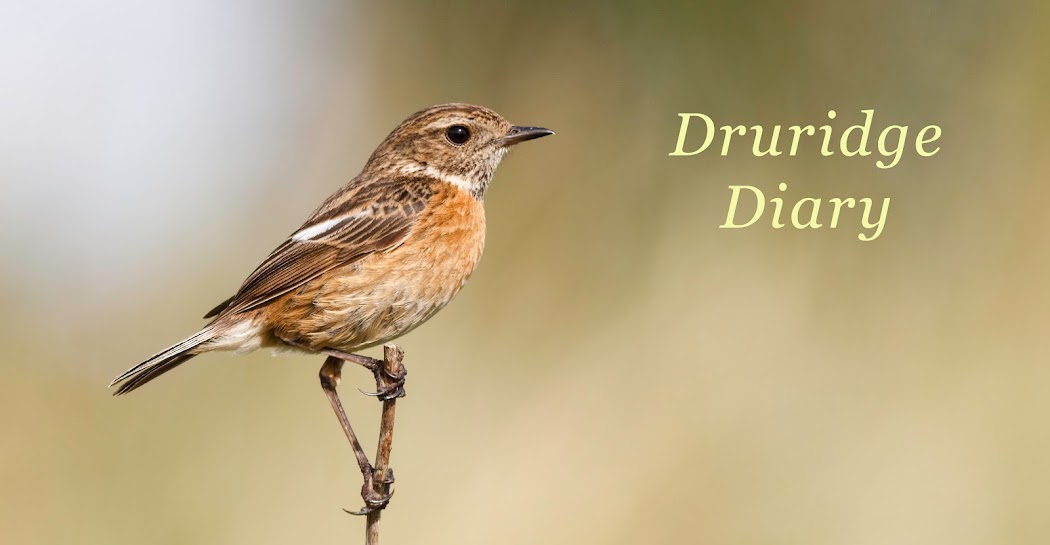
Female Stonechat along the Coal Road
Still about 20 Twite about in the dunes, with pink rumps on show!
A migrant - White Wagtail

Anyhoo, I did what I could and found a my first Lapwing chicks of the year. As I write this, the rain is lashing down, it's blowing a gale and it's freezing. I wish them well!

Finally, this weekend is the City Nature Challenge. ERIC the local records centre is coordinating CNC for the North East of England again. I really enjoyed last years event and got stuck in, submitting lots of records (including my first ashy mining bees and the northernmost in England at the time). This year, a combination of chores and shocking weather has meant less records submitted from me. Others have done well though. 

Monday, 2 May 2016

At last... a change in the weather

This weekend brought a change in the weather,  something more resembling the spring-like conditions we should be expecting. That-said there were some vicious hail storms coming through until this evening.

Leading up until Sunday, conditions were decidedly wintery and not conducive to birding or I am sure, for our newly arrived migrants, a bit of a shock!

Snow storm approaching
The conditions, alongside an important football match to attend meant little time for birding the patch, although the Bank Holiday Monday gave me an opportunity today. The two visits that I did manage brought a little flurry of species that were new for the year. Yesterday I saw fulmar, sandwich tern, ringed plover and grasshopper warbler (one reeling by the path to the hides last night) and today brought whimbrel (several flying over and eight coming in to land ahead of a hail storm), goosander and whitethroat.

There was a pair of red-breasted merganser on the big pool. Sadly the goosander was distant and in direct sunshine.

Red-breasted merganser pair
Drake red-breasted merganser having a stretch
This white wagtail was on the Budge fields - apologies for the heavily cropped pic.

White wagtail  - apologies for the heavily cropped pic

Finally, we had interesting news of a ringing recovery this week. A first-winter male siskin that we caught at Druridge on 16th November 2014, our last ringing session of that year, was caught by ringers in Warsop in Nottinghamshire on April 9th. A distance of 228 kilometres.

My year list now stands at 116 species.

Friday, 3 April 2015

Good Thursday

I took a day off work yesterday and I'm pleased I did, as the weather today (Good Friday) is awful. It was bright and sunny but the  wind which moved from north-west through north to north-east whilst I was there, was very cold, making it feel like winter.

I set off to Druridge hoping to see some returning migrants..sand martin, black-tailed godwit, garganey, sandwich tern, wheatear maybe? Maybe even some something more scarce like an osprey or ring ouzel?

I was disappointed.

Other than a signing chiffchaff, the only 'migrant' was a smart male white wagtail amongst the beast in the dunes north of the bushes.

There are still about 30 teal and wigeon on the Budge fields and a few shovelers. A single dunlin was 'new-for-the-year' it was with a handful of snipe and a redshank.

Other than canada geese and mute swans, there was only tufted duck and gadwall on the big pool. Nearby, this robin was collecting nesting material - at least the robins think it is spring.

Robin with nesting material
Out in the dunes, the stonechats seemed to be paired up. There was a flock of about 30 linnets in the dunes where the beast are fed, with a few goldfinches and a pair of grey partridges.

female stonechat
About 15 sanderling were on the beach, these could well be returning birds. Offshore, a pair of eiders were a year-tick but there were not terns and I still haven't seen a lesser black-back!

Looking back toward the preceptory, there was a 'kettle' of four buzzards, they soon split off into their respective pairs and parted company.

82 dunlin
83 eider

PWC 2015 Score: 96


Tuesday, 8 April 2014

Early visit

I managed a quick pre-work visit to the patch this morning.

It was cold, quite bright though, but the westerly wind picked up before I left. I spent half-an-hour scouring the northern dunes, where the beast are, looking for wheatears, without success. I did see two white wagtails, my first of the spring, but no other migrants. A fly-through stock dove was a year-tick.

Next I tried viz-migging from the big dune, the cold wind made my eyes water, not much fun. I did scan the Budge fields from there for garganey, again, no luck. Yesterday's gypo goose was on the fields to the north of the big pool, I let Tom C know so that he could twitch it, which he did.

Before Tom arrived, I had a look through the dunes for nests, none found, but stonechats, linnets and reed bunting all looking promising. As I walked back to the big dune to catch up with Tom, a swallow flew north overhead.

104 stock dove

PWC Score 128


Friday, 19 April 2013

Six for the ton!

Ton up at Druridge.

Six new species today brings the Druridge year-list up to 100. Not bad considering I only managed a brief pre-work visit and an hour-or-so after work.

This morning I racked up three new species in a minute - as I got out of the car a swallow flew overhead calling, then a willow warbler sang from the wood and a grasshopper warbler reeled briefly before disappearing. A good start I thought to myself.

Within another two minutes I had a drake garganey flying around the Budge fields before coming into land - satisfied with my lot I headed for work.

This evening, one of the first birds I saw as I headed for the Haul Road Flash was a male wheatear perched on mound of shit - nice! The flash is starting to dry up, I hope it pulls in a decent bird before it does, it looks good for something to drop in. This evening there 51 dunlin,13 ringed plover and a white wagtail there.

The cold SSE wind was staring to bite, so I only managed a quick look offshore, enough to see my first sandwich terns of the year.

So that brings the Patchwatch competition total to 116. This weekend can only bring more migrants, though car shopping might get in my way.

95 swallow
96 willow warbler
97 grasshopper warbler
98 garganey
99 wheatear
100 sandwich tern

Thursday, 5 April 2012

More migrants, oddities and owls

I took the afternoon off work today and headed for the patch. It was a beautiful sunny afternoon but the westerly wind was biting cold.

A couple more migrants were added to the list. Firstly sand martin, six days after the first (and only) swallow, I noted at least three sand martins over the dunes. I also saw a white wagtail on the Budge fields, another first for the year. The white wag was too distant for a photo, but this female pied wagtail wasn't.
pied wagtail

A great-spotted woodpecker flushed from the bushes by the little hide was an oddity and presumed coasting migrant? Great-spots are usually an autumn bird at Druridge, being seen from August onwards with occasional influx of 'big fellas' from the continent. A spring record is very rare.

Other things of note included a monster count of gadwall - 25 of them! Most of them were grazing the adjacent pasture like wigeon. There were two pairs of pintail on the Budge fields. There's also been an influx of linnets and reed buntings this week. A few chiffchaffs are singing now but no willow warblers yet.

male reed bunting at the 'Druridge bushes'

Highlight of the afternoon though went to a very obliging short-eared owl. There's still one or two hanging around the patch and they're a real treat to watch. I picked this one up in the dunes first.
Short-eared owl - hunting in the dunes
It caught a big vole and sat on this post for a while before sitting in cover devouring its prize.
Short-eared owl with a chunky vole

 It then moved off a short way and sat on this nearby post, right next to the road, presumably digesting the vole, most of which was gulped down in one go. The wrens, robins and blue tits fussing around didn't seem to faze it.

Add caption


93 sand martin
94 great-spotted woodpecker

Friday, 6 May 2011

The smell of rain and herons

At last, some rain. You'll not hear me saying that very often but I think we are all glad there has finally been some. I love the smell of rain when it falls after a period of dry weather. I bumped into ST, we had to cower in the hides dodging the showers. We were rewarded with three wood sandpipers on the Budge fields, another wader remains unidentified but was probably a ruff.

Once the rain eased,  the temperature rose to 18 degrees C, I had a wander around the bushes in the hope of migrant or two. Nothing in the bushes, but seven wheatears and two white wagtails looked newly arrived.

I got wet again this evening. We had another go at ringing the herons in the colony. Eight nests this year (ten in 2010), with three looking to have failed.
Smelly! grey heron young being ringed
We ringed three out of four in one nest (the runt was too small) and a single big juvenile in another. In nest number three, four young were still too small and nest number five, they were too big, legging it out across the branches, this lot will be fledged soon. The smell of herons is quite distinctive and hangs on you for ages in contrast to the sweet smell of the rain this morning.

There'll be no posts for a week or so now, all will be revealed.....