Showing posts with label year list. Show all posts

Saturday, 1 January 2022

Tradition dictates

Tradition dictates that on my first visit to the patch of the year, I'll find a species that I hadn't seen on the patch in the previous year. This happens most years. And guess what? It happened again today.

I've not seen yellowhammer on the patch since 24th November 2019 so to find a flock of eight in the hedge behind Druridge Farm was a real surprise.  I was beginning to think that they were locally extinct.

Today was unseasonably mild, 12 degrees C, but it was very windy from the SW. Janet and I had a good wander around the patch and managed to see 53 species in total. Highlights included a southbound great northern diver offshore, two woodcock flushed from the bushes, at least 300 Linnet and 200 chaffinch in the dunes and eight stock doves.

There was a lot of people though. It was like a July Sunday with cars abandoned at the site entrance and hundreds of people on the beach. 
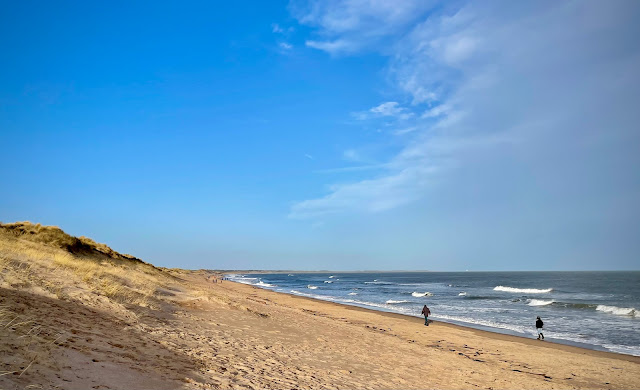
The beach was busier than it looks in this photo!

The ringed plover flock that roosts on the beach at the south of the patch had no chance to settle and just flew back and forth, looking to rest. 
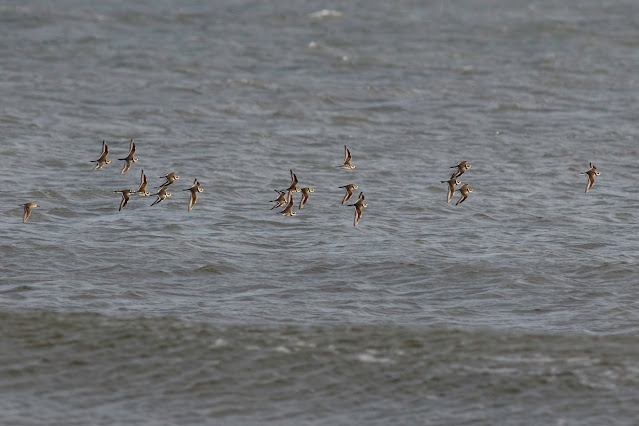
Ringed Plovers looking for somewhere to rest - no chance today.

I finished 2021 on a credible 167 species for the patch, which, given how poor an autumn it was wasn't too bad. Usual autumn stuff like pied and spotted flycatchers, garden warber, yellow-browed warbler, redstart and whinchat all missing from my list.

I also concentrated a bit more on the 5km patch challenge because of covid-lockdown. I saw 191 species within 5km of home which was nine more than the next patches. Ellington is obviously a good place to live if you're a birder. I'll continue with the 5km challenge this year as it does add a bit of variety to my birding.

I'm hoping to keep the blog updated more regularly too. My work/life balance needs some adjustment I think.
Today's list on eBird


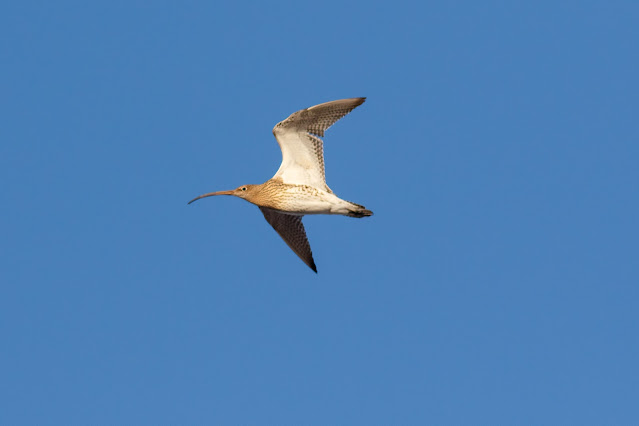
Passing Curlew


Saturday, 2 January 2021

Following tradition (sort of...)

Tradition dictates that on the 1st January each year (or my first visit to the patch) I see a species that I didn't see in the previous year. It probably doesn't happen that often but it feels as though it does. 

I nearly followed tradition this year - it was the 2nd of January rather than the 1st. 

I saw a respectable 52 species yesterday in two visits on New Years Day, but nothing I hadn't seen in the previous year. Some good January species included Mistle Thrush (13 still in the fields), Bullfinch and Goldcrest on our morning walk and  Mediterranean Gull, Black-throated Diver and Kittiwake on an evening seawatch. The other New Year tradition at Druridge was upheld with near-naked people thinking it a good idea to go into the sea...

No gold at the end of this rainbow but some good species for the year

This morning dawned a colder, greyer day with sleety-snow falling. We didn't have an early start, checking the farm first and adding a flock of nine Redwing and 12 Fieldfare to the list and then setting out on our walk at11.15am, north, into the bitingly-cold wind. We found the finch flock in the dunes, Twite (120), Goldfinch, Linnet, Chaffinch and a few Reed Buntings and Skylarks in the dunes. We headed back along the beach, seeing nothing of note.

Cold and grey with snow clouds on the horizon

As we approached the car, news came through of a Shorelark north of Hemscotthill Farm. Worth a look I thought...

Birdguides reported it in the field immediately south of the patch boundary, which is in a fodder crop and is being stripped-grazed by beast. I got onto a handful of skylark in the fodder-stubble, but the light was against me so I headed south a bit - off-patch, for better light. I soon found the Shorelark feeding in among the Skylarks, but of course, I had to go back onto the patch to see it from there. 

This was my first Shorelark since 2014 when one was on the dunes north of the Dunbar Burn, pursued by photographers. 

Later, an Egyptian Goose was reported from the pool nearer to the farm, but it had gone when I returned in the afternoon.

I had another short seawatch as the wind was in the north. Black-throated Diver was still on the sea and a single Great Northern Diver flew north as did a single Gannet. Auks passage was steady and one with an all-black head stood out from the others, I photographed it  - a Guillemot in breeding plumage already, Stewart Sexton reported that he'd seen a few today.

The highlight of evening seawatches either side of Christmas has been the gull roost. From dusk, no earlier than 3.30pm, gulls arrive in flocks from the fields to the west to roost on the sea - thousands of them! It's a steady passage until dark when there are over 4000 gulls on the sea, about 150m offshore. They're all Black-headed and Common Gulls (about 65-70% BHG, 35-30% CG) with the odd Herring and I've seen up to ten Med Gulls - there could be dozens more as it's impossible to go through them before the light fades - an amazing spectacle. 

I could see the Starling murmuration at Chevington from my dune-top perch, another great spectacle. 

A good start to 2021 with 68 species over two days.  Effort will ease-off when I go back to work next week but it looks as though home-working will be the norm for some time, which gives me more opportunities.

Thursday, 31 December 2020

It's been a funny sort of year...

Well that's 2020 over and done with. Whilst it's been a awful year for most people due to the ongoing Coronavirus pandemic it's actually been quite a good year for birds on the patch. 

Despite the 'hard-lockdown' that kept me away from the patch for the best part of two months I've smashed my personal year list total, which has stood at 174 for a while now and has been achieved in three years, with a total of 179 species for 2020.

So why such a good year this year?

I only added two new species to my patch list year (Great Reed Warbler in June and Blyth's Reed Warbler in October) so it wasn't lots of new species (like 2017) that did it. Even though it caused me to stay away from the patch for nearly two months, I think COVID-19 has been indirectly responsible for the higher list. Working from home due to the outbreak has given me more time on the patch and as the saying goes 'Time spent in the field = birds'. I hardly missed a morning in the summer and autumn, reverting to lunchtime visits as the days shortened. Add a good autumn and some superb seawatching sessions to more time on the patch and there you have it!

I know that I've missed at least three species - Hoopoe during lockdown that would've been a patch tick, Cattle Egret which I saw at Bells Farm as I drove home from the patch and should've turned around for and a Great Egret which briefly appeared on the Budge fields. A chap called Harrison on eBird has recorded five species that I've not seen in 2020 - A Jay(!!) and three Collared Doves in July, two Yellowhammers in June and Cetti's Warbler and Bearded Tit in March - the latter would be a patch tick for me and is overdue. 

I've busted a gut since I finished work for Christmas to reach 180 but I'm happy with 179. Missing species this year include Collared Dove (for the second year), Merlin, Yellowhammer, Storm Petrel and Grey Plover amongst the commonly occurring species.

As well as the two additions, other rare/scarce highlights have included Tundra Bean Goose, Black-necked Grebe, Balearic Shearwater, Long-tailed Skua (several),  White-rumped Sandpiper, Pectoral Sandpiper, Grey Phalarope, Sabine's Gull and Lapland Bunting.

I've had two long sessions on the patch in the last couple of days, covering it all. I think there's been a cold-weather movement which has resulted in an influx of thrushes - I had a record count of 14 Mistle Thrushes in the field north of the Coal Road yesterday and a couple this morning by the farm. Fieldfares were in the bushes this morning and there's more Song Thrushes about too. 

Mistle Thrush at Druridge Farm
Male Blackbird, feeding in the gloom by the Budge hide.

After seeing very few Pink-footed Geese during December, suddenly there are lots. Janet and I saw at least 5-6000 in one group this morning, circling around before coming in to land in the fields behind Bell's Pond. Tonight from the dunes, at least 5000 flew south and 3-3500 flew north (there may have been some recirculation but there are a lot of geese about. 

Some of the pink-foots coming in to land this morning - they literally filled the sky

The light was stunning at times today, between spells of cloud and some crispy, cold days have provided some nice photo opportunities to end the year. 

Artistic like - silhouetted curlews and wind turbines

And without the turbines
Looking west across the Big Pool this morning
Looking south down the Bay this evening

Looking east across the Big Pool yesterday

Drake Goldeneye taking off

In-coming Curlew

Black-headed Gull in stunning light this evening.

And here is the sun setting over the patch for the last time this year. It just remains for me to wish you everyone who reads this a healthy and happy 2021 - and good birding! Tomorrow it starts all over again.

The sun sets on 2020 from Druridge Links

Sunday, 15 November 2020

A record-breaking year

Five Scaup flew south during my afternoon seawatch today - nothing unusual there, but these Scaup were a year-tick, 175 for the year and a new patch record!

The previous record of 174 was first set in 2016 and matched again in 2017 and I've been stuck on 174 since 28th October this year. This year has been a record-breaker for a lot of patch-workers and year-listers, it has been a good autumn which will have helped but for me, it's been the COVID restrictions and working from home that have made the difference, despite missing two months on the patch between March and May (and a Hoopoe)

Since lockdown was eased and I could get back to the patch, I've hardly missed a day. Working from home means I can get out for a walk on the patch before work. If I was going into the office, I'd have to have a shower, iron a shirt, have breakfast and commute to the office. Nowadays, I finish birding, grab a slice of toast and switch my computer on. Taking a walk before work also makes me ready for work more than crawling out of bed and straight to work would. I'm not looking forward to next week (or maybe the week after) when it's too dark before work and I switch to lunchtime walks but at least I'll still be on the patch. 

There's still a few possible species and 180 could be achievable?

Black-throated Diver, Little Auk, Water Pipit, Yellowhammer, Collared Dove, Spotted Redshank as well as outsiders like a white-winged gull, Bean goose, Green-winged Teal, Great Egret or even a Waxwing are possible.

Also on my seawatch today I had a dark juvenile Pomarine Skua headed south, A November Pom! It was beautifully-lit in nice light about half way out, the low sun making it look a bit gingery, more like an Arctic but the deep wingbeats, powerful flight and pot-bellied all pointed to Pom. Med Gull, a few Gannets and good count of 26 Red-throated Loons was also notable. 

There has been a good high-tide gathering of Ringed Plovers on the beach opposite the plantation lately, Janet and I counted 41 yesterday and there were about 30 today. The beach was so busy with people and dogs, they could hardly land before being pushed back out, but they always returned to the same place. Seawatch list

Some of the ringed plover on the beach on Saturday

It was also WeBS today, it was quiet though with very few waders or ducks - 163 Wigeon was a canny count   - full list here. 

Birding has moved into winter mode - other than a few Blackbirds and Redwing hanging on, the last-gasps of autumn, it feels like winter now. 

It's been good for Bullfinch this week and this year in general. Three females fed by the road earlier in the week and we had three males beyond the hides today - so that's six different bullies.

Sorry for the lack of photos, it's been so dark in the mornings I've not taken any, other than this dead eel on the beach. 

Dead Eel

The forecast for the tail-end of the week looks like strong northerly winds coming right out of the Barents Sea. I feel a seawatch coming on. 

Thursday, 2 January 2020

Two things are guaranteed...

Two things are usually guaranteed on New Years Day on the patch:

1) I will see a species that I didn't see in the previous year. Over the years this list has included merlin, peregrine and slavonian grebe amongst others. This year it was pochard.

Two drake pochards heading south
I half-expected it to be long-tailed duck as one was reported on New Years Eve and it was LTD I was looking for when I saw the two drake pochards on the big pool.

2) Some mentalists will be in the sea

Brrrrr
At least this girl kept her bikini top on, the two in 2018 didn't!

New Years Day was beautiful day and Janet and I had a good wander around the patch, taking in the big pool, Budge fields, bushes, sea and dunes to the north and saw 56 species - not a bad start to the year list. Other than the two pochards, other highlights were two velvet scoters flying south offshore, 60 twite in the dunes, a goldcrest (very rare in winter), a pair of pintail, a kestrel (first since July!), 250 golden plover and two of the four ruff from last week. We scanned through the pink-footed geese in the front field but couldn't find the white-fronts.

Busier than a summer day
By the time we headed home just before 2pm, the place was rammed, everyone and their dog(s) had descended on Druridge Bay. When we left, we had to queue to get out because people had parked on both sides of the road, leaving no room for cars to pass. It was like August Bank Holiday Monday!

Link to eBird list for NYD

Today was colder with a stiff breeze from the SW. I quickly checked through the geese (still no white-fronts) and the Budge fields where the four ruff had returned and had been joined by a dunlin. I also added blue tit and shelduck to the year list

List from today

Tuesday, 31 December 2019

End of the year, end of the decade

The sun sets on the last day of the decade at Druridge Pools
The end of the year, the end of the decade...

Despite being out of action for pretty-much all of May and June this year and having done no ringing at all, it's been a reasonable year on the patch.

One, hopefully two, new species were added to the patch list. The first was Cattle Egret on 6th May , the second is a bit more dodgy - Baikal Teal.

It first showed up at East Chevington on 3rd June and overnight moved to Druridge Pools where it remained until at least 7th July. Rare wildfowl are always treated with some caution by the rarities panels, given the number that are kept in captivity and that 'jump the fence'.  If it does get accepted, it will be my 250th species for the patch.

I finished the year on 162 species - the worst year since 2015 but very much related the lack of observer effort. Notable missing species include (last seen and number of years in last ten in brackets ):

Garganey (2018 - 9/10)
Pochard (2018 - 9/10)
Long-trailed Duck (2018 - 6/10)
Slavonian Grebe (2018 - 8/10)
Hobby (2015 -6/10)
Little Stint (2018 5/10)
Turnstone (2018 9/10)
Little Gull (2018 6/10)
Little Auk (2018 5/10)
Long-eared Owl (2018 7/10)
Short-eared Owl (2018 8/10)
Spotted Flycatcher (2018 5/10)
Whinchat (2016 7/10)

Other highlights included  - Bewick's Swan (fist since 2002), Long-tailed Skua (first since 2013), Marsh Warbler (first since 2013), Red-backed shrike (male) - first since 2008 and Willow Tit (first since 2000),

If I had time, I could've done some jazzy stats for the last ten years but I haven't.

I've been on the patch every day over day over Christmas but I failed to add anything new to the list. I'm off out now curry but will be back on the patch tomorrow to kick of the 2020's and year list.

Thanks for reading this drivel over the last year and sorry it's been a bit patchy.

All the best for 2020!

Sunday, 30 December 2018

End of another year

Well, I'll not make it back to the patch again this year, so it's time to reflect on a very average 2018 at Druridge.

On the birding front it's been relatively quiet year after an amazing 2017 which saw no fewer than eight new species added to the patch list, no new species were added in 2018 - the first year that's ever happened.

A half decent seawatch which added red-necked grebe, little auk and grey plover to the list made up for an otherwise uneventful autumn. With no easterlies until late November, there were no falls of migrants to speak of and very little passage which meant more common passage migrants like redstart, pied and spotted flycatcher and whinchat weren't recorded.

Other passerine species missing from the 2018 list include yellowhammer, bullfinch, greenfinch, snow bunting, and tree pipit (usually seen on viz mig). It was quite a good year for waders with only temminck's stint and jack snipe missing from the likely candidate list.

We've ringed less birds than any previous year this year as well. The 'beast from the east' storm in April did for many of the resident passerines, completely wiping out wrens with no pairs recorded this year. We had very few chances to ring in the autumn because of the weather. We did manage to ring some storm petrels on the beach and had the nice surprise of a Leach's petrel too.

The winter has been unseasonably mild again, with temperatures in the mid-teens on some days. This has meant species usually associated with cold weather haven't been recorded, like yellowhammer and red-legged partridge.

The patch bird list for 2018 was 167, which is an average total based on the last few years but well behind the 174 totals from 2107 and 2016.

It'll be late January before I'm back on the patch so Happy New Year to you all and thanks for reading.

Here's some photos from the last few days of the year.

Cormorant in flight

A group of whooper swans in flight over the patch

Carrion crow

Mute swan taking off from the big pool

Tuesday, 10 October 2017

Tick and run

I was in a meeting up at Lindisfarne this morning when I got a message to say that there was a red-necked phalarope at Druridge Pools. With a full diary for the rest of the day it was looking unlikely that I would get to see it. My meeting finished just after 1pm and I had to be at another in Morpeth by 2.30pm... As long as I didn't get held up on the A1 it was do-able.

I was walking along the path to the hides at 1.45, no sweat...

I bumped into Stewart and John on the path, they pointed the phalarope out of over the bund and I headed to the hide for better views. It was waltzing about on the pool to the right of the little hide when I got there, picking invertebrates of the surface of the water. I hate a 'tick and run' but I didn't have much time to stay and watch it for long but I did manage a snip of phone-scoped video as a record.


The phalarope was found by Janet Dean so well done to her. 

2017 has been an incredible year for new birds on the patch, the phalarope being the seventh addition to the patch list and the third in four days. 

2017 so far...


The phalarope brings the patch list up to 247 - if we have a good tail-end to the autumn 250 this year could be feasible...


Sunday, 8 January 2017

New year, new list

Another new year, another year list begins on the patch. I sometimes wonder what is the point of a 'year list' - a date in the calendar by which the list is reset, it could be any date I suppose, but most people stick to the calendar year.

What having a year list does do is give the patch birder some motivation to get our onto the patch in those dark January days. It gives a bit of focus to patch-birding, something to aim for when you know you that you are likely to see one or two new species in a year - if you are lucky!

My 2017 year list got off to a slow start. A trip to Islay for Hogmanay meant it was Saturday 7th before I hit the patch. Islay was great trip, it is a great place with lots of interest for the visiting birder and of course it is famous for its whisky...

So Saturday morning it was and I didn't have much time so I concentrated on the bushes, pools and up onto the haul road - I usually like a walk to out the farm in early January but there wasn't time.

In the plantation I was surprised to see a small flock of goldcrests - I am seeing them more in the winter now, once-upon-a-time they were strictly an autumn species at Druridge. There were also blackbirds, song thrush and mistle thrush in the plantation.

Robin
The Budge fields still held plenty of wildfowl including two drake pintail, waders were limited to redshank, curlew and lapwing. A sparrowhawk was perched out on the edge of shelterbelt - my only raptor of the morning and five whooper swan flew south.


Plenty of wigeon on the Budge fields
A siskin was with goldfinches on the path to the Oddie hide and then,ahead of me on the path, I could hardly believe my eyes, three bullfinches! This species is now a patch mega, these were the first partch bullies I Have seen since November 2014.

Bullies!
Out on the haul road, a huge flock of goldfinches, maybe 250, were coming down to bathe in puddles on the road and in the ditch - with them were a few twite, linnet, reed buntings, dunnocks and chaffinches.

Goldfinches bathing in the puddles
One of the chaffinches
In the dunes, a covey of 12 grey partridges were put up by the only other birder I saw (it was birdrace day).

Offshore, the sea was flat calm. There were a couple of shag, ten red-breasted mergansers, a few common scoters and red-throated divers and most excitingly a slavonian grebe - a good January species.

My 2017 year-list now stands at 60 species - not a bad start. Exactly half of the winning tally in the county winter birdrace.

I am doing the Patchwork Challenge again this year and will update my totals as and when.

Monday, 25 January 2016

A few new January birds

I've been down to the patch a couple of times post. No photos though, it's just been too dull.

I had a nice dusk visit on 20th, it was nearly dark when I left at 16.15. Highlights were two ruff and eight dunlin on the Budge fields and flock of about 15 fieldfare flying over and into the bushes, quite often a species I have to wait until autumn for.

Standing at the Budge screen, I heard a water pipit calling, but I couldn't find it, I think it was overhead. There were also three drake pintail still present.

On Sunday, I took look one look at the number of people at the Budge screen and gave it a dodge. I had a quick look offshore, but it was very quiet other than a flock of about 40 scoters flying south which included five velvet scoters!

This morning was quite warm, but the strong southerly wind and overcast skies made it feel colder. And there very few people about - which is good.

There are still plenty geese about though. The majority, a flock of over 3000 pink-feet, were over by Low Chibburn somewhere - they lifted and settled gain after a light aircraft flew over. A smaller group of about 350 came down into the fields west of the Budge - there were at least five European white-fronts and five barnacles with them.

I saw three species I wouldn't normally expect in January:

Greenfinch - one on the feeders, a species I wouldn't normally expect until the big post-breeding flocks of finches arrive in late summer - the presence of feeders has dramatically increased the number of finches, tree sparrows and reed buntings overwintering at Druridge.

Shelduck - normally a February arrival (there were two on New Years Eve - not a species I would expect in December at all).

Stock Dove - Two on the Budge fields - again a February/March bird

My other year-tick today was little owl - thanks to Dave Elliott for the tip-off

From the Budge screen, I picked up a very large (must have been female) peregrine sat on a fencepost beyond the Haul Road way over towards Low Chibburn Farm. The drake scaup was still on the big pool.

My year list now stands at 86 species and 99 points for the Patchwork Challenge.


Sunday, 17 January 2016

And now...the NEWS

Ages ago I volunteered to do NEWS - or the BTO's Non Estuarine Waterbird Survey  and my section is the Hemscotthill Burn to Chibburn Mouth - 90 % inside my patch.

I did my survey on Friday lunchtime (it has to be done three hours either side of low tide), it was bright and clear but cold. The first birds I saw were two mistle thrush, a welcome year tick. whilst I was looking at some twite and surveying the sea for waterbirds, the pink-footed goose flock that had been in the filed in front of the cottages, had been disturbed and flew overhead and out to sea before coming back over to return to the same field. I was a bit slow in getting me phone out to video them going overhead. There was a single barnacle goose amongst them.

Pink- footed geese

Just beyond the big dune, I stopped to count some gulls and check the sea for birds. As I was scanning a diver flew through my scope - I immediately ruled out red-throated diver (it was close in and looked black and white and it's head was fled straight out and wasn't going 'up and down' as it flew) but it wasn't heavy enough for great-northern - it was a black-throated diver. A rare visitor to the patch and my first since 2014.

Two sanderlings were the only waders I recorded. This is telling of the numbers of dogs now using Druridge Bay I reckon - disturbance is one of things BTO ask us to record.

Today I was back on the patch to do my usual WeBS count for BTO. I stopped first at the edge of the patch to have scan through pink-footed geese flock that were still in the field.
Pick a bean goose out of that lot
As I scanned, a big female sparrowhawk came through and perched on the fence. Tin Tin and Sacha joined me for a bit and we picked out barnacle and some white-fronted geese, there were at least six and all were Eurasian white-fronts. We had a water pipit over, calling.

Some visiting birders from Teesside got onto a peregrine and there was at least three buzzards about. ADMc joined me for a bit, just as he was leaving I got onto a goose with thick, stocky, orange legs. It wasn't one of the WFGs and the bill looked for bean - but the flock was disturbed and moved together into a huddle and I lost 'my bird'. I'll go back tomorrow when I have more time.

Onto my WeBS. The Budge fields were completely frozen so only six black-headed gulls to record. A water pipit was showing well in front of the screen.

Robin on the path to the Oddie hide
Onto the Big pool, the canada/greylag flock had moved from the fields onto the pool and the four barnacle geese were still amongst them but no Greenland white-fronts. The drake scaup was still present, but no sign of the hybrid Aythya and ten pochards are still there.

Little Grebe

My year list stands at 76 species and my PWC score is 88 with the addition of a few 'two-pointers' in the last couple of days.


Sunday, 10 January 2016

2016 - a week in.

As regular readers of this drivel/quality writing will know, I rarely get out birding on New years Day, in fact I don't normally surface until about 3rd January.

This New Year was different. Nothing to do with resolutions, which I never stick to anyway (like updating this blog more regularly), I was laid-low with manflu on New Years Eve and stayed at home. So, there was me, fresh as a daisy, out on the patch on New Years Day.

It was nice to get some air into the lungs and for once it wasn't raining or windy (it didn't last). Janet and I had a good walk around the patch, through the fields to the preceptory and back by the farm and cottages. I managed to see 63 species in a little over two hours, which ain't bad.

Highlights included water pipit, drake scaup (different bird to the hybrid Aythya I and others have seen), twite, whooper swan, pochard and black-tailed godwit.

I've only been back twice since then. Yesterday I popped down for an hour so, a short-eared owl heading south from Druridge Farm, before dropping into the grass field was rather nice as were the covey of eight grey partridge in the dunes opposite.

A water rail was calling from the small pond behind the feeders, clearly audible from the Budge screen - it was still there when I drove home, mooching around the vegetation. Two whooper swans were on the very wet Budge fields. I am pleased to see the Budge fields so wet, it will suppress grass growth and encourage the ponies to eat things they wouldn't normally, like soft rush.

Offshore yesterday, I picked up a slavonian grebe, not far beyond the breakers. There were also two red-throated divers and  handful of mergs and scoters.

Today, I did a drive-by. Jonathan Farooqi had reported ten dark-bellied brents in the fields off the haul road. So, on our way back from Amble market, we called in to see them.

I am back in the Patchwork Challenge this year. After ten days I am on 68 species for 77 points.

After last years total were added to my spreadsheet, my annual species count, based on  all records since 2008 works out at 160.125 species per year - so last years 161 was bang-on average.


Thursday, 31 December 2015

Left it late for a full patch tick!

I left it a bit late to squeeze another patch tick in this year but a long-billed dowitcher flying around the patch before heading back to its favoured Cresswell pond this morning was a very welcome addition to the patch list. Not the greatest views, I wished I had seen it on the deck, but it still counts.

A big thank you to Jonathon Farooqi for the tip-off that it was there.

My second patch list addition of the year following September's fantastic red-footed falcon. This takes the patch list up to 238.

Jonathon had also found a couple of water pipits on the Budge fields, they were joined by a third for a while. These are the first water pipits I have had on the patch in eight years, the last ones being in front of the Oddie hide and along the haul road.

The dowitcher and water pipits take my year list up to 161 species. Not a disaster, but not great.


This snip from my spreadsheet shows the last eight years totals from the patch. Maybe 2013 and 2014 were just exceptional years...

So what did I miss?

The obvious omissions from this years list include

Salvonian Grebe - six out of the last eight years
Grey Plover -  5/8
Bonxie  - 7/8 (the first year I not recorded bonxie!)
Redstart and Pied Fly - 4/8
Garden warbler - 6/8
Lesser whitethroat - 6/8
Bullfinch - 5/8

Also of note today was an odd duck that I still can't make my mind up about. It was with the pochards and looked like an Aythya. At first I thought it might have some shoveler in it, as the head was green and the bill looked long and spatula shaped. The more I looked at it, the more I ruled out shoveler - although the bill was very long and flatish

The head shape was right for scaup and the colour looked good. The bird seemed to show some reddish brown on the front and under the tail - in certain light. I still think it is a hybrid - probably scaup x pochard - but it could be a first winter drake scaup in moult. I'll need to have a better look.

Well, that's it from me for 2016. Not sure when I'll get back to the patch, but when I do, I hope that dowitcher is there.

Sunday, 15 November 2015

Forecasters wrong again...

The weather forecasters got their predictions wrong for this weekend. Heavy rain from yesterday lunchtime (it rained at 4pm) which would last until the early hours of Monday. It rained over-night but there's hardly been a drop since.

Even our local WeBS organiser sent an advisory message out yesterday to recorders not to take risks in the weather. The only risk today came from wearing too many layers and over-heating. Light winds increased but it was 15 degrees C, dry, and quite pleasant.

Perfect weather for WeBS counting. Whilst I was counting from the Budge screen, a couple arrived and we chatted about the long-billed dowitcher that has been at Cresswell (and briefly at Druridge...grrr) for the last few days. They told me the tale of seeing it two weeks ago on the Budge fields but weren't confident of the identification (they knew it was something different), so they didn't say anything.

I encouraged them, that if they should find anything 'different' again, to let someone know. We all get things wrong, me especially, and we are always learning. That bird could have easily moved on and nobody would have seen it, let alone at Druridge.

My disappointment was soon gone when I picked up a female merlin sat out on the Budge field, it seemed to pull apart some prey before flying over and landing on a post for a while. My first merlin at Druridge for a long while.

Shortly after that a splendid short-eared owl put on a good show for us, quartering the fields in front of the hide. It was also right next to the path when I went to the Oddie hide - of course I had left my camera behind because of the forecast of rain. 29 whooper swan flew south.

Four pochard were still on the big pool (I saw them yesterday). My first record of pochard this year, they are certainly very uncommon at Druridge nowadays.

Yesterday I walked back along the beach, looking for snow buntings, which I didn't see. I did see a swallow though, a male, feeding over the dunes and beach. There were still plenty of insects about in this spell of warm weather. November 14th is very late for swallow and is my latest patch sighting. I have had a later 'Druridge Bay' record with one on 4th December many years ago, flying north at Chibburn Mouth.

Pochard and merlin put me on 156 for the year, which is very disappointing. If I don't see anything else new, this will be my worst year on the patch since 2012 and my second-worst since 2005. There are still some possibilities - snow bunting, white-fronted goose, brent goose, black redstart, bullfinch, red-legged partridge...maybe even the dowitcher will come back. That would be nice!


Wednesday, 31 December 2014

Pura Vida

I was back on the patch today after a three-week birding trip to Costa Rica.

Not the most colourful of species, but clay-coloured thrush is the national bird of Costa Rica 

We had a fantastic time, seeing lots of great birds in brilliant, friendly and very beautiful country. As they would say in Costa Rica  - Pura Vida!

Some photo's might appear on Ipin's Birding Trips at some stage..if I ever catch up.

Back to reality today though, back on the patch, hoping for one more addition to he patch year-list. I tramped around the whole patch and of note were;

a small flock of goldcrest in the bushes (good winter record)

a dog otter, showing really well on the big pool

a woodcock in the plantation

and, a pair of pintail on the Budge fields

So nothing new added to the year list leaving me on 171 species, the same total as last year. As ever, some species that I would have expected were missed, notably:

garden warbler
merlin
scaup
cuckoo
grey plover

I did see five new species in 2014, which is way more than I would have predicted:

Egyptian goose in April

Woodchat Shrike in May

Stilt Sandpiper in August

Stilt Sandpiper - Image (c) Ian Fisher
Wood Warbler in August

Fea's Petrel in September

These 2014 additions take my patch list to a respectable 236 species.

I've enjoyed the Patchwork Challenge again this year, a good bit of harmless fun.

So all in all, a very good year on the patch. I would love to see another five new species in 2015...surely a red kite at least?

I wish all of my readers a very happy, prosperous and bird-filled 2015!

Happy New Year!


Tuesday, 11 November 2014

Patch year listing

So, I'm now now on 171 species for the patch this year, matching last years total and there are still some species that I have a reasonable chance of seeing, namely:

Scaup - seen in six out of the last six years (6/6)
Merlin (5/6)
Grey plover (5/6)
Goosander (4/6)
Little owl (3/6)

With some outsiders including smew, rock pipit, treecreeper, kingfisher and the two white-wingers - Iceland and glaucous gulls.

I've missed some species I've no chance of seeing now including cuckoo (6/6), garden warbler (6/6), redstart (4/6), little tern (4/6) and barnacle goose (3/6).

It has been the best year for patch-ticks for ages, with five in total, which I would never have predicted;

Egyptian goose
Woodchat shrike
Wood warbler
Stilt sandpiper and
Fea's petrel

I have got records going back to beyond 2001 other than for two months in 2007 due to misplaced notebook. One of these winter nights I will add them to my spreadsheet.

I am out of action for much of December so have only four weeks left on the patch this year. 175 would be nice....

Tuesday, 31 December 2013

Perseverance pays off

With the wind howling and light mizzle falling at home this morning, it would have been very easy to say "Sod it", not go down to the patch and find something better to fill my day. After all the likelihood of a year-tick was slim.

But no, I thought, it's your last chance, get yersel out. I decided on grand tour of the patch, starting at the bushes then down to the Oddie hide and a good chinwag with Ian Douglas. Then I headed inland, for the Preceptory. I sneaked in, walking over some fresh barn owl pellets and caught a little owl sneaking out from one of the chimney stacks, it flew out to perch on the fence. A very unexpected year-tick.

Ian Douglas and I had just been discussing how poor an owl year it was.

My route then took me down to the farm, where there was a decent flock of chaffinches but nothing else among them and back towards the cottages.

A final quick scan of the Budge fields revealed nothing new and the rain had started to lash down, so I headed for home without my usual look at the sea.

So the year ended on a bit of a highlight with my 171st species for the patch for the year, the best year I've had for at least the last six. I can't put my finger on why the year has been so good. I eventually got most of the common waders, despite passage being slack, there was no real 'falls' of the autumn so I missed stuff like redstart. Seawatching was canny at times so that would have helped, but we caught and ringed less birds than any previous year.. All in all though, an above average year.

So the highlights...

The greatest highlight was catching and ringing a breeding pair of marsh warblers and then seeing fledged young later. We had to keep this to ourselves at the time for obvious reasons. If accepted, this will be the first confirmed breeding record for the County.

Marsh warbler (male)
Three new species were added to the list.

The first was nightjar back in May, which you can read about here. Nighjtar was a species I hadn't even considered might occur at Druridge.

The second species to be added was Jay. Long awaited and I didn't even find it myself, but thanks to Roger and Dave.

The final species was belter, not found by me, but by Martin Kitching. Subalpine warbler, later confirmed as being of the 'eastern' race and hopefully split very soon.

I've really enjoyed my year on the patch again. I'll not be starting over again tomorrow as I am off to West Bromwich Albion. Maybe on the 2nd....

Thanks for reading over the last year and all the best for 2014!

171 Little Owl

Monday, 2 January 2012

A good start to 2012

January 1st

I very rarely do any birding on New Years Day. Usually because of a severe hang-over or football or both. This New Years Day was different. I was our partying the night (and morning) before but still managed to make it down to Druridge albeit with a bit of a thick-head a good-deal of queasiness. I only had an hour though as we had another party to get to.

Highlight of the morning was a short-eared owl quartering the Budge fields and bunds. The wintering chifchaff seen in late December was still hanging around the willows by the Little hide, making an early appearance on the year-list. There were good numbers of duck on the Budge fields, including at least three drake pintail.

Little of interest on the pool, other than a water rail which was poking around the edge of the phragmites bed. A buzzard flew over, quite low, heading south.

I ended the day on 35 species. Not bad for an hours work with an hangover.

January 2nd

I felt a bit more chipper this morning. I did have a lie-in though so didn't make it to Druridge until 1ish.

I started with a look on the sea, 2 snow buntings flew north calling, a good start! A pair of eiders and a group three red-breasted mergansers were added to the year-list.

Next, to the Budge screen. I picked up a large wader on the far side, feeding amongst the grass by the fence that wasn't a curlew. When it emerged it revealed itself as a black-tailed godwit. A rare species in winter in Northumberland and especially at Druridge Pools. Without looking through my notes and lists, I think this may be my first winter patch record for blackwit.

Despite the strengthening and very cold westerly wind I decided a hike around the extremities of the patch was in order. I set off for High Chibburn Farm via the hamlet. At the feeding station at the cottages, tree and house sparrows are added to the list with goldfinch. At the farm, there were 19 collared doves, once a very rare species at Druridge, this wintering flock is nice to see. Also at High Chibburn were a flock of about 50 curlew with redshanks, in the same field as a covey of 12 grey partridge, which were later flushed by a sparrowhawk.

Low Chibburn Preceptory with a flock of lapwing and starling in front
Another view of the preceptory
I got blown along the haul road, seeing very little. A walk through the bushes didn't produce a woodcock but in the willows by the bridge, yesterdays chiffchaff was still calling. This might be of interest to any winter bird-racers who are out next Saturday. Obviously, if I had been bird-racing next weekend (we've got Blackburn at home in the cup so I'll not be) I would have suppressed this!

So, 58 species by the 2nd of January. Not a bad start. It's going to be a hard-slog from now until the end of March, when the first migrants return though.

I hope to a review of 2011 in the next couple of days.

1 red-throated diver
2 guilliemot
3 common scoter
4 black-headed gull
5 common gull
6 sanderling
7 cormorant
8 pied wagtail
9 short-eared owl
10 carrion crow
11 herring gull
12 grey heron
13 chiffchaff
14 stonechat
15 blue tit
16 teal
17 wigeon
18 mallard
19 lapwing
20 curlew
21 shoveler
22 kestrel
23 tufted duck
24 coot
25 goldeneye
26 mute swan
27 water rail
28 skylark
29 song thrush
30 redshank
31 magpie
32 pintail
33 pheasant
34 buzzard
35 pink-footed goose
36 red-breasted merganser
37 great-black backed gull
38 eider
39 snow bunting
40 black-tailed godwit
41 snipe
42 chaffinch
43 redwing
44 tree sparrow
45 house sparrow
46 collared dove
47 feral pigeon
48 jackdaw
49 sparrowhawk
50 grey partridge
51 meadow pipit
52 woodpigeon
53 mistle thrush
54 wren
55 moorhen
56 rook
57 goldfinch 
58 starling 

Monday, 3 January 2011

A New Year, same old patch...

Back on the patch today for the first time this year.

Birding on new years days is never really an option for me and with the Toon away to Wigan yesterday today was my first chance to get out.

I did promise a short report of 2010, I ran out of time on NYE, too busy preparing tapas and making  my 'Captain Chaos' outfit. It might still happen.... Amazingly last years bird species total was exactly the same as 2009  - 157! One short of 158 in 2008 and well short of my best ever total of 168. Two new species were added to the patch list, great-white egret back in April and red-legged partridge on Christmas Day.

Hopefully 2011 will bring a few more patch ticks, there are still some commoner species I still need such as bluethroat, pallas's warbler, icterine warbler, wood warbler and tree pipit.

Today, the 2011 list got of to a fair start given the very cold weather we have been experiencing. It was still cold at Druridge with a biting NW wind, the ponds and fields still frozen. I walked up to the Preceptory and down to High Chibburn and back via the hamlet.

A quick look on he sea produced five nice drake red-breasted mergansers in full summer garb and a single red-throated diver. Passerines were thin on the ground, with the winter thrushes present last week apparently retreated back inland, robin, dunnock and wren also notable by their absence.

My first raptor of the year was a buzzard, out from the back of the big pool, I caught up with Bob Biggs and he picked up a distant peregrine on the patch boundary - nice one Bob!

Other good patch birds to get the list rolling were stock dove, woodcock (still plenty about), long-tailed tit, yellowhammer (still good numbers on the roof of the farm) and collared dove, once a rare bird at Druridge, have now taken up residence at the farm.

Rabbit and hare were the only mammals of the day.

here's the list:


1 shag
2 red-breasted mersander
3 cormorant
4 guilliemot
5 sanderling
6 carrion crow
7 herring gull
8 great black-backed gull
9 common gull
10 black-headed gull
11 teal
12 wigeon
13 red-throated diver
14 curlew
15 redshank
16 starling
17 skemmie pigeon
18 mallard
19 grey partridge
20 greylag goose
21 stock dove 
22 long-tailed tit
23 common buzzard
24 lapwing
25 rook
26 pheasant
27 blackbird
28 magpie
29 chaffinch
30 yellowhammer
31 coal tit
32 collared dove
33 blue tit
34 house sparrow
35 moorhen
36 mistle thrush
37 pied wagtail
38 oystercathcer
39 woodpigeon
40 tree sparrow
41 great tit
42 dunlin
43 woodcock
44 peregrine
45 pink-footed goose