Well, I didn't expect to finish my WeBS count this morning by adding FOUR Temminck's Stints to it - but that's what happened!
John Day, an RSPB friend from Bedfordshire and his pal Darren joined us at Druridge this morning, they are up here for a weekends birding. When we joined them just after 7am they'd already seen more species than you can see in a month in Bedfordshire!
It was WeBS count day, so I counted the ducks whilst they enjoyed watching spoonbill, little stint, avocets, pintail, dunlins, lapwing chicks and other nice species. Little stint was new for the year so I was already happy with that. Count done and all three hides checked we headed back to the cars. They were off to the Harthope Valley whilst Janet and I opted for a look on the sea. Seeing very little, I checked my phone to see a missed call from Steve Holliday, and a text message - 'four Temminck's Stint in front of Budge Screen'. Seemingly they'd just dropped in.
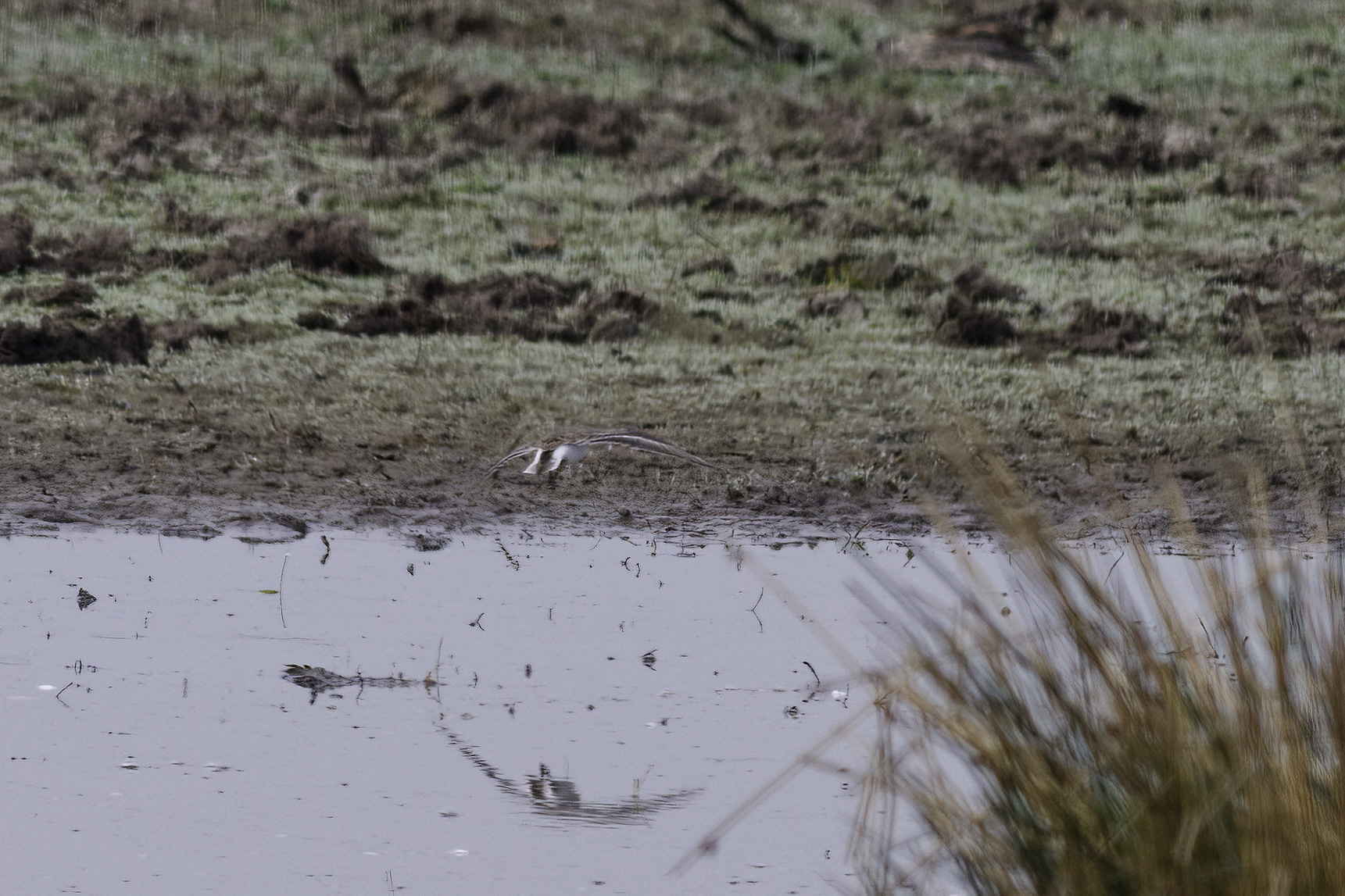
We called John and Darren who were still faffing at their car and rushed to the hide, where, thankfully, the four birds could be seen on the edge of the pool. The four of them stuck pretty-close together and fed frantically along the muddy edge. I always think the 'gait' of Temminck's is quite diagnostic, they almost creep on their 'knees' as if their legs are set too far back on their bodies. They were chased by a redshank a couple of times, and then, without cause or warning, they were off, zig-zagging at first before flying off high and directly north. Steve and I thought that this might be a record count of this species for the County? These were my first patch Temminck's since two were on a pool by the coal haul road back in 2013.
Record shot - just to prove there were four!
A slightly better shot of two of them
And one flying off
A very pleasant end to a morning's birding. Big thanks to Steve H for the tip-off.
The Budge Fields are looking fab at the moment. Despite the relatively dry spring, the water levels remain very high, something has changed with the hydrology of the site this winter I think. Birds are dropping in all the time, not long after we left a wood sandpiper was reported. The 'Channel' wagtail that I found on Friday was seen again today.
Here are a few more pics from the last couple of days.
Proud parent on guard
And here's the reason why!
You can see why barn swallows were called bluebirds!
Spoonbills are now a common spring and summer species on the patch
Pochard are increasingly uncommon - the four that are on site at the moment are most unusual nowadays
The geese took a dislike to two roe deer who wandered through the pool. Roe deer are on the increase, almost plague-proportions these days.
My Druridge patch year-list is now on 130 and my 5km from home list is on 157.
After heavy rain and cold northeasterly winds on Friday/Saturday morning Janet and I went out to look for migrant passerines at Druridge on Saturday morning. We stopped at the Budge Screen first and finally caught up with some Little Gulls and thethunbergii (grey-headed) Yellow Wagtail. With two Wood Sandpipers, a pair of Garganey, a Knot, two bar-tailed and three Black-tailed Godwits among the supporting cast we would have been happy to leave it at that.
We wandered north along the bushes and onto the haul road. It was there, where we were alerted to a large bird flying north pursued by five or six Lapwings. The Lapwings wouldn't have bothered going that high for a gull, so bins onto it and it showed it to be an Osprey! It was heading steadily north and soon lost to sight over East Chevington.
Osprey heading north pursued by Lapwings (heavy crop)
This is my first patch Osprey since at least 1996 - it was so long ago, the record is in a long-gone paper notebook.
We didn't find any noteworthy migrants passerines, not even a Wheatear. There were hundreds of hirrundines and the Swifts were flying very low. The sun came out briefly later and brought out some insects.
Common Cardinal Beetle
Male Andrena sp of bee
Large Red Damselfy (female)
22-Spot Laydybird
Cheilosia sp of Hoverfly -STOP PRESS - Roger Morris thinks this is C. bergenstammi
Green NettleWeavil
Sphaerophoria sp of hoverfly - the females can't be identified to species by photographs
Red and Black Froghopper
Today was WeBS count day. Highlights were five Little Gulls, one Med Gull and a single Drake Garganey. Wood Sandpiper and Ruff had been reported but we didn't see them. The Grey-headed Wagtail was gone but there were two flavissima.
Drake Tufted Duck - without the orange eye, this could be monochrome photo
We walked to Chibburn mouth to check on my fence and walked back along the beach seeing very little along the way - only a handful of Sandwich Terns.
One of the Sandwich Terns
Spoonbill looking miserable on the Budge fields earlier in the week
I squeezed a quick hours walk around the patch before work this morning, just up to the turning circle and south as far as the Budge screen but compared to recent mornings it was like someone had turned the volume down.
There were still a few warblers singing - willow, chiffy and sedge, the odd wren and meadow pipits and reed bunting in the dunes but otherwise birds have fallen silent. A song thrush (a scarce breeder at Druridge) hadn't got the memo and belted out his repetitive song the whole time I was there.
Even at 8am there were plenty of butterflies on the wing - large skippers, ringlets, speckled woods and red admirals as well as lots of blue-tailed damselflies.
large skipper
Speckled wood - looking a bit worn now
Ringlet
There were a few of these latticed heath moths basking in the sunshine too.
latticed heath
Other than the aforementioned warblers and stuff, a family party of magpies were making a row up by the turning circle and 40-50 swifts fed low, just over the bushes. As I headed south a little egret flew over and from the Budge screen there were two spoonbills, fast asleep as usual. There were also at least 20 black-tailed godwits, most of which were the islandica subspecies. A couple of ringed plover fed on the mud.
Little egret headed north overhead
As I headed for home a grasshopper warbler piped-up from the dunes and started to reel. It's not quite autumn yet.
I've tried a bit of viz-migging this week, but probably missed the vizmig highlight of the year today - a huge southerly movement of swifts, with thousands of birds logged at east coast hot-spots including 28,0000 at Hummanby Gap. I hadn't anticipated it so didn't get down to the patch until lunchtime, by the time I did there were still lots of swift headed south but nothing like the numbers reported earlier.
After reports of crossbill movements, I positioned myself on the big dune at 5.30am on Wednesday morning. When I arrived on site, there were 11 siskins feeding on the alders before moving north. I estimated about another 100+ siskins, all moving south in small groups of 15-25 until 7.30am. Nothing like the 6500 Tom Tams had at Tynemouth and no crossbills - my target for the morning.
I tried for crossbills on another two mornings but no joy.The meadow pipits kept me entertained though and fly-through little egrets on two mornings were welcome sightings of scarce bird this year. The big dune is a good place to scan the budge fields and I picked up both wood and green sandpipers from there.
Meadow pipit song-flighting from the big dune
In the bay, the common scoter flock reached a peak of about 1400 birds midweek. On Friday, I abandoned viz-mig and had walk north and south. A family group of pied wags entertained me at the Dunbar burn and a new moth...
New moth - Pammene aurana (there were at least eight of them)
One of the pied wag youths
New hoverfly for the patch Cheilosia illustrata - one of the bumblebee mimics (iPhone photo)
As is typical, the weather deteriorated just in time for the weekend. I manged a wander between showers on Saturday morning and it was nice to catch up with Bob Biggs and ADMc. Waders from the Budge included four, maybe five ruff including gingery, black and white/cream coloured birds, 19 black-tailed godwits (most or all Greenland race birds), two knot, two ringed plover and two dunlin. A female marsh harrier was my first since lockdown and an adult cuckoo shot through the dunes - northbound.
Today, Janet and I had a walk to the hides, mostly looking for hoverflies but we found the four spoonbills, that have commuted between Cresswell Pond and the Budge fields, feeding on the doughnut pool from the little hide.
Four spoonbills- an they were all awake!
mating common blue damselflies
This evening, news came through of a female pied flycatcher near the Budge screen. Pied Fly is a scarce bird in any year at Druridge, unheard of in June, so worth a look before the footy I thought.
Graham Sorrie reported north of the path to the screen-hide. The first bird I got my bins on was a spotted flycatcher.
Spotted Flycatcher
I knew Graham wouldn't have mistaken spotted fly for pied, but for two flycatchers of any species to be at Druridge in June would be mega rare, but I couldn't rule out the two-bird theory and I was right not to as shortly after that a female pied flycatcher appeared on the same edge. My first pied fly since 2014!
It's been a while since my last blog post. My excuse for this tardiness was a two-week trip to Finland and Norway and an ailing computer that now struggles with big RAW files.
I'll hopefully have some Finland and Norway photos processed soon and up on Flickr. But here is a video of me enjoying my 'summer holiday'.
Summer in Varanger
I've managed a few visits to the patch since I got back, but have been busy catching up with work, the garden and chores. A combination of the above and changeable weather has meant no ringing yet.
On 18th June There were 18 black-tailed godwit on the Budge fields - having been away, I was trying to work out whether these were late birds headed north, early returning birds or loafing non-breeders - I suspect the latter.
Barn owls from nearby farms are being seen regularly, hunting in the dunes and grass fields and attracting their share of photographers. A cuckoo in the dunes has also attracted attention.
Offshore, there have been some good rafts of scoter, but these have often been distant. A few manx shearwaters have been noted passing-by.
NWT have been busy getting their new Hauxley Discovery centre ready to open (well worth a visit just for the building) so I helped them out by strimming in front of the hides. It was a very warm evening and I sweated buckets! Hopefully the photographers will appreciate it, I know that the resident swallows will.
Strimming
On 20th June there were two avocets on the Budge fields - still an uncommon visitor to Druridge Pools despite their increasingly colonisation of South East Northumberland.
On 22nd whilst checking the heronry, a male marsh harrier passed through - my first on the patch this year. A pair of curlews had a chick or chicks in the silage field. I knew it was going to be cut, so alerted the farm who looked out for them.
This weekend, I saw my first patch roseate terns of the year, with at least two feeding offshore on Saturday, a few manx went through too.
An early morning visit on Sunday was nice, through cold and blustery - we've had our summer I think. I was kitted out in a jumper and fleece jacket (and was still cold). I wandered up onto the dunes for a look on the sea and there, strolling, nay marching, along the beach, was a bloke who was completely starkers. A braver man than me.
There were at least 200 swift feeding behind the bushes, taking advantage of the shelter they afforded from the strong wind.
On the Budge fields, it felt autumnal with little-ringed plover and wood sandpiper. Three spoonbills were also on the fields - doing what spoonbills do best, sleeping.
Sleeping Spoonbills
The warmer weather of last week had obviously brought a few butterflies out - there were lots of ringlets, red admirals, speckled woods, large skippers and meadow browns in the shelter of the bushes. There were also common blue and blue-tailed damselflies on the wing.
Speckled Wood
Ringlet
Large skipper
Red Admiral
Common blue damselfly
Blue-tailed damselfly
Two collared doves headed north were a year tick.
In the evening, the LRP and wood sand were still on the Budge along with 18 black-tailed godwits and there were now at least 300 swifts feeding in the lea of the bushes.
Life has been pretty hectic lately, so much so I haven't been able to update my blog. Since the last post I finally caught up with a patch RING OUZEL on Saturday . The bird had been reported two days earlier by a visiting birder in the dunes to the north , I had two brief chances to look for it on the Thursday but couldn't find it. After another couple of hours on the Friday I finally found it in what remains of the Druridge bushes (the cows have hammered them lately). No photos unfortunately as it was a skulker.
On 10th April a spoonbill arrived and was joined later by a second bird.
Since then I have been visiting the patch whenever I get a second. As I was away to Jersey for a long weekend last week, Saturday brought a flurry of year ticks. First off was this reeling grasshopper warbler - so much for being a skulking species, this one hadn't read the rulebook, it's been singing from this fence for three days!
It was amazing to watch at close hand, it's entire body vibrating when it was reeling.
Next up was a drake green-winged teal on the Budge fields. This bird had been around for a day or two, so it was nice to catch up with it - mind it took some finding! Other highlights on the Budge fields were three to four ruff, an amazing 28 whimbrel - which flew off when the cows arrived, a stunning brick-red bar-tailed godwit and a few blackwits. Also new for the year was sedge warbler, little owl and common tern.
Little Owl
On Sunday I had a quick around through the dunes to the north looking for migrants - it was very windy but a count of 15-20 wheatear in the grazed dunes was impressive.
One of the wheatears
This poor hedgehog must have investigated the pipe socket that is by the turning circle and drowned itself or decided it couldn't face a bank holiday weekend at Druridge and did itself in.
Suicide?
Today the wind was a bit lighter but still out of the east making it feel cold. I headed for the Budge screen and bumped into Peter Williams of Patchwork Challenge fame. Peter picked out the wood sandpiper that arrived yesterday. Also of note were at least five ruff, two of which were starting to look a bit dapper, a handful of blackwit and a single dunlin. No sign of the green-winger.
I mentioned cows earlier - four have arrived on the Budge fields and the timing couldn't be better for the breeding and passage waders so 'Well done' to NWT. (seemingly, according to the local farmer they had been released last week but had escaped - anyway it is good to see them.
One of the 'Druridge four'
I've got another couple of busy weeks ahead of me but hopefully I'll find time for a visit to the patch.
Whilst I was trundling up the A1 on the way to work on Monday spoonbill watchers at Druridge reported not one, but two species that would've been full patch ticks for me.
Firstly Alan Curry had a red kite flying through - A species that I have been predicting as my next patch tick for ages and still am - see left hand column of this blog.
Secondly a red-rumped swallow - tracked down from East Chevington and seen by several birders seemingly.
Red kite has been recorded on the patch before (28th March 2016) but as far as I am aware red-rumped swallow is a new bird for the Druridge patch - taking the overall patch list to 264 species.
Well I was at Druridge early this morning and it certainly paid off when a scan of the waders turned up a STILT SANDPIPER!
Here's the tale..
I bumped into fellow patcher Dave Elliott on the way into the Budge screen (you have to be up very early to beat Dave), he was telling me of a wader that he had seen yesterday but wasn't sure about as the light was terrible...it could have been stilt sandpiper or it could have been a wood sandpiper, he wasn't committal.
I started scanning the mud and amongst the snipe was something different, it was arse-on at first, then it raised it's tail to reveal strong barring on the underside and the dark centres to the feathers stood out really well. We didn't need to see any more - Stilt Sandpiper - the bird that was at Cresswell Pond until Thursday had turned up on my patch. Patch mega!
crappy iPhone-scoped shot of the Stilt Sandpiper.
We had really good views of it for a while, Dave went off to check the rest of his gigantic patch and it slipped off into the rushes. Then one of the Chevington marsh harriers turned up and scattered everything, including the curlews and spoonbills and there was no sign of the stilt sand for nearly 20 minutes. The marsh harrier had another go at it re-appeared back on the mud and was seen on and off for the rest of the day and was enjoyed by a good number of birders.
marsh harrier arrives....
....and causes havoc
This bird is the second record for Northumberland, the first being two years ago on the Stringers patch at Newton. I saw that bird and only one other, ever, in Texas.
This is the second new patch bird this year after May's woodchat shrike, taking the patch list to 234. Seemingly, as this bird was re-found, it counts as find for the patchwork challenge, thus netting me a whopping 15 points.
Elsewhere on the patch three little egrets were on the edge of the shelterbelt, one of them was the colour ringed bird DE had at Chevington, the other two were juveniles. They relocated to the big pool soon after.
Juvenile little egret. The yellow/green legs and yellow tinge to the lores as well as being 'fluffy' give it away as a juvenile.
Also on the big pool was LRP and common sandpiper. This stunning red admiral brightened up the track.
red admiral
Druridge version of oxpeckers
So what chance of another patch tick this year. Well, I reckon so and my money is on red kite.