Showing posts with label pale-bellied brent goose. Show all posts

Monday, 21 March 2022

March WeBS

We arrived back from a week away in Cornwall (and a brief visit to the Somerset Levels) yesterday evening, twitching the long-staying belted kingfisher in Lancashire on the way home. It was my first time birding in Cornwall and I really enjoyed it. The Avalon Marshes were pretty spectacular too. We saw some good species including Kumlien's gull, yellow-legged gull, firecrest, ring ouzel, chough (13 from our accommodation was the peak count), black restarts, rosy starling and black-necked grebes.

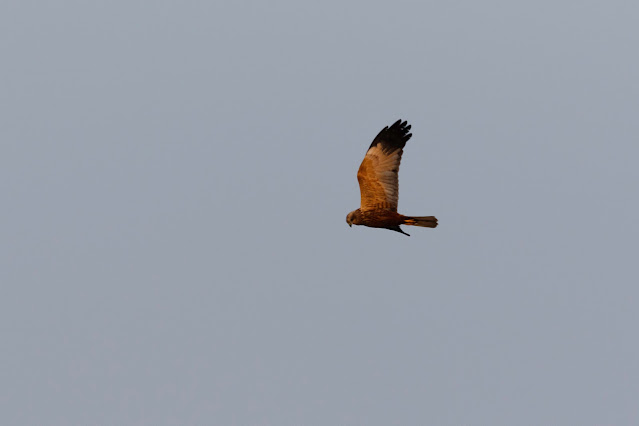
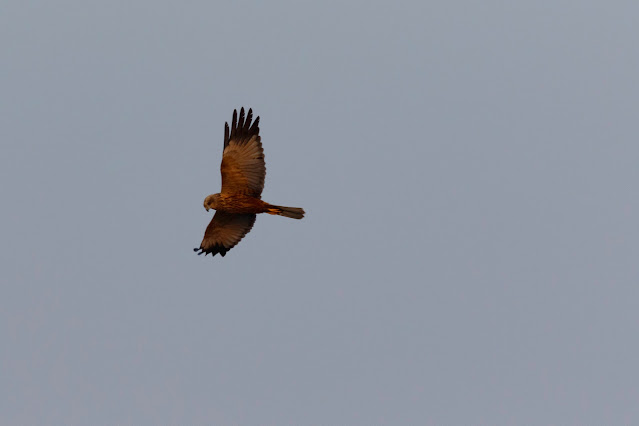
I was back on the patch before work this morning to do the WeBS Count. There was plenty to count on the Budge fields which were full of birds. Wigeon was the numerous duck species with 257 counted. I'd just finished counting what I thought was them all, when this male marsh harrier appeared over the pools and scattered everything. It was soon apparent that there were a lot more wigeon than I had originally counted, so I had to start again.


Male marsh harrier in the morning sunshine

Looking for food

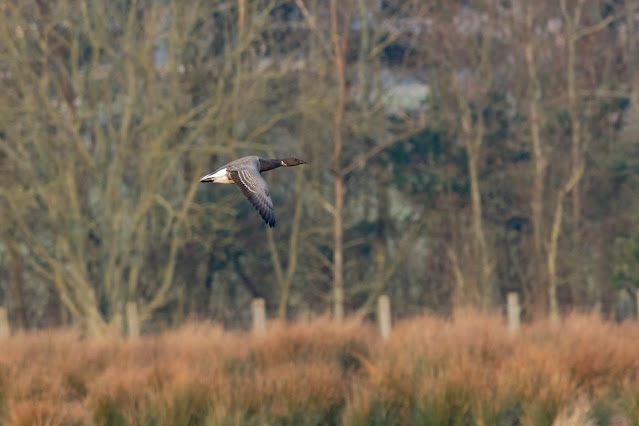
A decent count of 35 shoveler and a single pale-bellied brent goose was on the fields before flying north. 

Pale-bellied brent goose

Avocet had been reported from the patch whilst I was away in Cornwall but there were none this morning. Five ruff, three black-tailed godwit, 31 curlew and 17 snipe were notable. There was no sign of the jack snipe that's been around for a few days. 

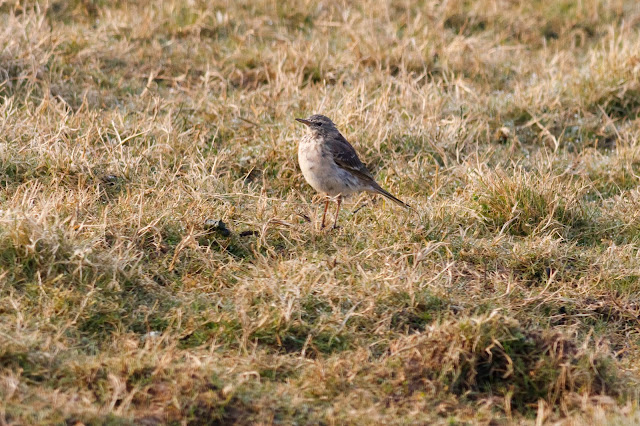
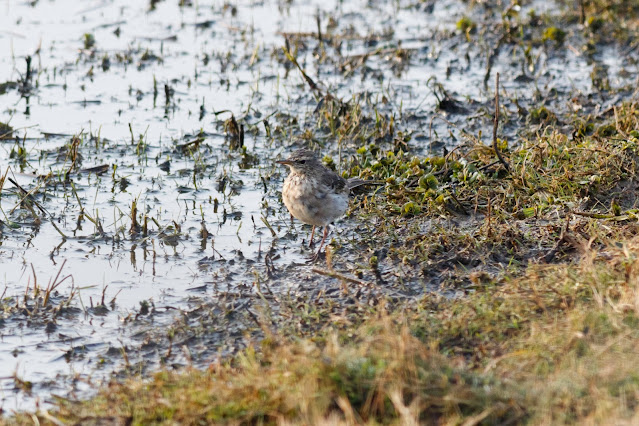
From the little hide I picked up the water pipit that's been seen over the weekend. It had either bee bathing or walking through the frosty grass as it looked a bit bedraggled. It's starting to look a bit 'pinky' on the breast I think.

Water pipit
Looking a bit bedraggled

Chifchaff was the only migrant passerine 'new in' and two siskins by the Budge hide were notable for late March. 

Monday, 30 August 2021

Mostly Seawatching

 This week I've mostly been seawatching.

With the wind switching to the north for most of the week, I've been seawatching at every opportunity, I've even abandoned Druridge for Snab Point a couple of times for rarer species.

It all started last Sunday, I had an evening seawatch, the wind was NE but light but it was a good start.

Arctic Skua 2

Bonxie 2

Little Gull 1

Roseate Tern 3

Sooty Shearwater 1

Manx Shearwater 11

Two Velvet scoter with 460 Common.

Young Gannet

On Tuesday evening the seawatching was quiet but the light was amazing and it was nice to just watch the common species. A juvenile Black Tern going north was a nice year-tick.

Oystercatchers in evening sunlight - a mix of adults and juveniles.

Curlew in silhouette

On Thursday another evening seawatch was more productive. 12 Manx and four Sooty Shearwaters, a Great Norther Diver in summer plumage, four Roseate Terns and four Bonxies.

On Friday evening, the wind had dropped but was still NE and it was overcast. 18 Pale-bellied Brent Geese headed north were my first of the year on the patch. Seemingly the same group were in Norfolk the previous day. 

Northbound - Pale-bellied Brents

A few Sooty and Manx Shearwaters, five Bonxies and two Arctic Skua, as I was about to head home when I got onto a distant shearwater. On jizz, before side-on views,  I thought 'Balearic' - the flight was too languid for Manx. It was distant and and the already poor light was fading fast (19:20) - it probably was Balearic but I wouldn't want to claim it.

Cormorant 

On Sunday morning reports came through of a Balearic Shearwater headed north past Whitburn. I decided, rather than risk not seeing it at Druridge I would go to Snab Point, still inside my 5km Patch. News came from Newbiggin that the bird had gone past Church Point, we waited, and waited. 40 minutes passed, two angling boats that had been offshore motored north, Ashington Gary suggested the shearwater might be behind them, I scanned wit the scope and there it was, some way departing boats. It was distant but gave good views, showing a 'dark' armpit, but not a very dark 'smudgy mark'  - jizz was more Balearic than Manx but it looked different. 

Photos and videos taken at Whitburn show this bird to be atypical for Balearic and it certainly looks like many photos of Yelkouan Shearwater. One for the experts...

An amazing number of Med Gulls, at least 75, were on the beach in Lynemouth Bay. A Greenshank on the beach there was nice. I like Snab Point, it's nice to see some rocky shore species. 

One of the Meds

The wind was still out of the north this morning, it was cold and raining when I arrived on the patch. I headed for the Budge hide rather than the dunes. The Spoonbill was still there but little else so I braved a seawatch. 

The showers kept coming, they were light, but squally, and the visibility was awful. Two Pale-bellied Brent went through, followed by ten more and a single bonxie. Another squally shower, and from inside the bay, through the murk, a shearwater came through, again I thought Balearic, again, because of the poor light, not enough to clinch it. I was more certain of this closer bird than Friday's mega distant bird. A single Manx followed it shortly afterwards and I was more certain the first bird was a Balearic but I'll not be submitting it. Another shower loomed so I gave up and went home.

I was back out at Snab Point later for another north-bound Balearic that didn't make it much beyond Newbiggin, where it stopped for lunch. I did the same.

One of the resident Fulmars at Snab - much closer than the passage birds


Juvenile Arctic Skua

Same bird as above

Sunday, 27 September 2020

Some seawatching

 The latter part of the week was dominated by very strong northerly winds - and that  means seawatching.

The wind really picked up on Thursday and into Friday morning but with my diary being full, I only had a brief window on Friday morning, I was in position for 07.25, hunkered down in the dunes as the wind was very strong, it was really busy with Auks, Gannets and Kittiwakes streaming north, a lot of them very close in, too close for some which would be under my scope. Just as I got settled I got onto a group of kittis very close-in and among them was something different - a juvenile Sabine's Gull. If I'd been settled in and concentrating on a single spot it would have been under my scope and I'd of missed it. 

I've never seen a Sabine's gull this close at Druridge before (I have at Church Point when I used to go there) and it was great to see it amongst adult and juvenile kittis for contrast. My first Sabine's since 2014 and my fourth for the patch - all September records in 2007, 2009 and 14. What a great bird!

It remained really busy, with hundreds of birds coming through but I only had an hour or so. Other highlights of my hour were:

Arctic Skua 1

Sooty Shearwater 9

Manx Shearwater 7

Red-throated Diver 1

and two Slavonian Grebes being tossed about on the sea.

Full list here

I had planned a sea watch on Saturday but the wind had strengthened and it was raining and reports from nearby spots weren't tempting me out - I think it was just too windy.

Janet and I had walk around the patch on Saturday evening seeing very little in the still-stormy northerly. 18 Pale-bellied Brents struggled north along the beach, just above the waves and 28 Barnacles went over, high. 

By this morning, the wind had really dropped. We'd opened some hooch that we brought back from Taiwan on Saturday night so I didn't get up early and only made it to the patch at 11am for another seawatch. It seemed quiet, nothing like Friday with few Auks, not Kittis and the Gannets well out. I gave it an hour :-

Sooty Shearwater 2

Manx Shearwater 4

Great Northern Diver 1

Bonxie 1

Barnacle Goose 19 (5N 14S)

Wigeon 27

Bar-tailed Godwit 2

Full list here

I also had ten Swallows, mostly going north! I headed for the bushes. It seemed quite quiet with nothing really calling - a single Chiffchaff was my highlight until I found a tit flock.

Chiffchaff

Here it is calling

It's always worth checking roaming tit flocks as migrant birds often join them like the Yellow-browed Warbler I found with them, a dullish looking bird, then a brighter individual which moved off north, I turned around and saw it or another bright bird - I think there was three but I'll only record two as the second bird could've done a U turn.

From the path by the midget screen, I counted 21 Swallows feeding above the bushes and 17 Barnacle Geese went south. Some waders have returned to the Budge fields at last, six Dunlin and three Redshank - it's a start.

Friday, 28 August 2020

Seawatching and some thoughts on it.

With strong northerlies forecast overnight and early morning I suspected I might be seawatching today especially as I had the day off work. When I woke at 6am it was lashing it down with rain, I turned over and went back to sleep, If I'd had to go to work, I would've got up and gone anyway but I had the luxury of more time.

I eventually arrived at my dune watchpoint at 9am, it was too windy to stand on the dune ridge so I hunkered down in the dunes on a useful perch as I could be sometime.

The first bird I saw was a Bonxie, close in too. There wasn't a lot of action until pretty much the second notable bird I got onto was a skua,  a bit further out than the Bonxie, quite distant. A grey bird against the sea with a more languid tern-like flight - Juvenile Long-tailed Skua! My fifth of the year incredibly. 

It was steady after that, Manx Shearwaters coming through in little groups or singles and a few Sooty Shearwaters including a single group of six together about half-way out. There were a few distant Skuas that went unidentified - that's one of the problems with Druridge but a couple Arctic skuas were closer and one came into the bay to harass terns and a couple more Bonxies came through. A drake Velvet Scoter came in very close, north,  on its own and a group of ten Pale-Bellied Brent were also really close.

By 9.45am I was regretting not getting up earlier, the sky brightened and the sun even threatened to come out and the sea went 'silvery' - not good, anything more than half way out was unidentifiable. I was temped to pack up but visibility improved a bit as a cloud came over so I hung on. I was pleased that I did as the bird of the day, and one of my best seawatching experiences at Druridge happened soon after. 

A bird flew north, close-in and therefore low in my scope-view, so it passed through quickly, but it looked interesting and I tried tracking it through the troughs in the breakers, a shearwater, pale on the undersides but 'dumpy looking'. It was flying really slowly, moving back and forth, passing over and through the scoter flock, looking like it was feeding amongst them. It wasn't a Sooty, it had a pale belly anyway but the jizz was altogether wrong and it didn't have the contrast dark/white of a Manx and it just didn't look right.I was sure it was Balearic Shearwater. It landed among the Scoters briefly, before making a short flight and landing again, it did this three or four times, only landing for a few seconds before taking another short flight.These short flights gave good views when it wasn't in a trough and the dusky underwing, darker 'armpits' and dumpy appearance confirmed my initial ID. Eventually it moved off north, slowly again, feeding as it went. In hindsight I probably could have had a record shot of it, but I was too busy 'enjoying the bird'. This was my fifth Balearic at Druridge but by far the best views I've had of one here and my first since I saw two on 5th September 2013.

By 10:40, the light had really gone. I kept going until 11:05 to get the two-hours in and saw a few more birds including some Teal and a Golden Plover picked up on call just over the breakers, but it was high-tide. 

It was interesting to compare my figures with  headland watchpoints to the north and south of me. Obviously being in the middle of a bay I miss out on birds but I seem to miss out on some species more than others, Bonxies are a good example. I saw five in two hours today, Mark Eaton had 13 at Boulmer, Jack Bucknall had 13 (3 1/2 hours) at St. Mary's and Ben Steel had 19 in two and a half hours at Howick. 

I think powerful birds like Bonxies and to some degree Poms (I didn't see one today) don't drift into the Bay, they just take a straight line from Snab Point to Coquet Island so are too distant for me. I do better for Arctics than some headlands because the terns feeding in the bay draw them in and largely comparable for Long-tailed Skuas which seem to hug the coast more, or even curt off headlands (I've seen them do this at Church Point). Likewise, I do okay for Manx (and today for Balearic) shearwaters but struggle with the bigger Shears, with only one Cory's (in 2005) and no Great Shears ever. 

Despite the disadvantages of being in a bay, I'd swap a dozen of any of those species at Church Point for jut one on the patch. Above all, I love a good seawatch!

Highlights 09:05-11:05 (all N) (Full list here)

Pale-bellied Brent 12 (10N 2S)

Teal 56

Velvet Scoter 1 (drake)

Bonxie 5

Arctic Skua 4

Skua sp 6

Long-tailed Skua 1 (juv)

Golden Plover 1

Sooty Shearwater 11 

Manx Shearwater 24+

Balearic Shearwater 1

Two photos taken as I was packing up.

Adult Lesser Black-backed Gull

and juvenile

Wednesday, 26 August 2020

Unseasonable

The weather this week can best be described as 'unseasonable'. Monday dawned nicely with some sunshine (remember that?) but it didn't last and Tuesday was a complete write-off with torrential rain and gale force winds from the north, which of course at this time of year could produce some good seawatching. Today, the wind was still out of the north and it felt more like November than August. It had dropped a bit by this evening but was still cold.

I was lucky to catch the sunshine on Monday morning before it disappeared (for good?). The sun brought migrant birds and some locals to the sunny edge of the bushes and I counted 12 Willow Warblers and nine Whitehroats including some family parties, Wrens were  also obvious. By the turning-circle there were Reed Buntings, Stonechats, Linnets, Meadow Pipits, a Robin and a Dunnock.

Male Stonechat - all fluffed-up after a good preen

Young Goldfinch on the fence

In the dunes, there were still plenty of the weekends freshly-emerged butterflies. I wonder how many are still alive now? 

Red Admiral - maybe that Stonechat has taken a chunk out of its wing?

Small Tortoiseshell on Mugwort

Less common - a Small Copper

I walked back along the beach and already the clouds intimated what was in store. 

Looking north...

and south

Mondays list

After being stuck at my desk all day in video meetings, I headed out for a seawatch this evening, The wind had dropped and it looked like seabird activity had too going off others' reports from earlier in the day. It wasn't bad for a Druridge seawatch though - I've had worse! Some birds were quite distant. I got onto a Sooty Shearwater almost straight away, flying through the distant pot flags, it was followed by a small group of Manx Shearwaters and then a spoonless Pomarine Skua powered through on the same line as the Sooty.

Another highlight of the afternoon was groups of Brent Geese headed north. The ones I saw I against the sea were all Pale-bellied Brent, I presume the silhouetted birds against the sky were also this race - 67 in total. A couple of Arctic Skuas went north and one hung around to harry passing terns. There was quite a bit if tern activity, I gave up counting them but noted two Roseate amongst the numerous 'commics' and Sandwich terns. 

A nice sight was a bit of a fluke which I could've easily missed. I happened to glance up at the sky from my scope and saw three birds higher in the sky and they weren't gulls - I got the scope onto them, the first two were Bonxies and the third, just behind them was another Pomarine Skua  - an amazing sight to see these three powerful skuas flying together up the Bay. 

Just as I was about to leave, a summer-plumaged Great Northern Diver flew north close in. On the sea, the Scoter flock numbered about 110 and there were three Great-crested Grebes, an Eider and a Red-throated Diver with them.

Full list here

Sunday, 22 November 2015

From the north

The wind came right out of the north on Friday and through to today, bringing a blast of  proper winter weather after a spell of unseasonably mild weather of late.

The northerly had come from way up north - classic weather to bring some northern specialities down, so obviously a seawatch was in order.

I timed my seawatch with the rising tide, giving me more chance to get some good waders pushed off the rocks by the advancing tide. It was bitterly cold, but as the wind had swung around out of the NNW I managed to find a little shelter in the dunes.

No sooner had I set up my scope when I had the first of many little auks headed north. There was a steady passage of these fantastic little birds throughout the morning. Mostly in small groups, all headed north. Many were very close in, flying between the breaking waves on the shore. At one point I had a 'mixed flock' of two purple sandpipers, two dunlin and two little auk flying up the shore.

It was great to get purple sandpiper on the list for the year, the light was nice so they really stood out from the dunlin.

Other highlights were two great northern divers (sadly no black-throated passed me), an adult little gull flying south, two groups of three long-tailed duck, two velvet scoter and a drake scaup. A flock of 25 twite flew north along the dunes.

Seawatching totals 1120-1250:

little auk 173
goldeneye 24
cormorant 2
little gull 1 (S)
guillemot 34
red-throated diver 3
dunlin 6
long-tailed duck 6
wigeon 49
red-breasted merganser 3
great northern diver 2
pale-bellied brent 3
velvet scoter 2
purple sandpiper 4
kittiwake 80+
common gull 10+
scaup 1
pintail 1
twite 25

Today I had to work, but popped down to Druridge for the last of the light at 3pm. I intended on doing a seawatch but the light was nice and there was some close-by gulls so I did some gull photography instead.

Between gulls I did note long strings of kittiwakes  headed north and some sizeable stings of guillemot. There were a few little auks, but nothing like yesterday and a couple of RTD.

Adult common gull


First-winter herring gull 
Arty gull photo
Second-winter great-black-backed gull. Check out the obvious white tip to the bill
Snowy sky over Cresswell - I'm pleased it missed me!
Nice wintry sky at dusk
Pink-footed geese coming in at sunset
 My seawatch brought me a little haul of year-ticks - brent goose, scaup and purple sandpiper (my first on the patch for six years!) taking my total to 159 which is well down on the last few years. Still a chance of one or two more species before New Year...

Sunday, 21 September 2014

Risky strategy paid off

As reports came in of a Fea's Petrel being tracked up the north-east coast this afternoon, I got twitchy and had to make a tricky decision. Do I go to a good seawatching spot such as Newbiggin or Snab Point and give myself a better chance of connecting with a lifer, or do I stay loyal to the patch and hope I can see it there.

I decided to go to Druridge. To be honest, the decision was easily made but I was aware that it was a risk. When I set off the bird had only just gone past Seaham, so I had plenty of time.

Not long after I was set up I had an unexpected bonus, an adult Sabine's gull was flying around offshore, about half-way to the pot flags, I watched if for a good three minutes as it zigzagged in a generally southerly direction, before it flew south-east into the gloom. I tipped off Neil and Tom and Snab. 

A few minutes later, what I presume was the same bird, an adults Sabs, flew north, again not very far out at all. A fantastic start and only my second ever patch Sabine's gull, the first was back in 2009.

I was joined on the dune by Alan Hall, as news came through of the Fea's northerly passage. A risky strategy for Alan too. So news in came in from Newbiggin and shortly after from Tom and Janet at Snab. What seemed like an age passed, and then two manx shearwaters came through, as I watched them, I saw another bird bank and tower quite high with a different jizz all together. It looked quite a bit bigger, the dark, almost black wings, looked really obvious when it banked and turned - it did this twice before dropping down. I was struggling to get Alan onto it though, there were too many black and double-black flags (we should have been more organised with hindsight and made sure we were on the same flags).

I lost it behind a wave and couldn't re-find it after re-positioning my scope.

I was gutted for Alan, but delighted to have seen it myself. These 'tracked' seabirds certainly get the adrenaline going.

It was followed by a sooty shearwater, the first of five that I saw. I continued to seawatch until after six o'clock but it had really tailed off after five.

Red-throated diver 4S, 3N
Sabine's Gull one adult southeast then north
Pale-bellied brent 4N
Manx Shearwater 8N
Fea's Petrel (1620ish) N
Sooty Shearwater 5N
Bonxie 1N
Arctic Skua 1N
Velvet Scoter 1 drake with flock, 1S with smaller flock
Dark-bellied Brent 5N
GC Grebe 1N
harbour porpoise 2

So Fea's takes the patch list to 236

I took Friday off work as it looked like the easterly winds were going to end. I had planned to ring from first thing, but the heavy, almost drizzle-like, fog persisted until mid-morning. I tramped the bushes, but it felt very quiet, almost as if there had been overnight clear-out. Pied flycatcher was all of note. 

I put some nets up by 11am, but only caught 12 birds. Hardly worth the effort.

158 grey wagtail
159 Sabine's Gull
160 FEA'S PETREL
161 sooty shearwater

PWC Score 247

Saturday, 8 March 2014

Still like winter

Despite the news claiming that temperatures would hit 15 degrees today, it still felt very much like winter at Druridge this morning. 

Ornithologically, it still felt like winter too, other than for a singing skylark. Still pink-footed geese in the fields, big flocks of goldfinches in the dunes and good numbers of curlew about.

So no 'real' spring migrants on the patch yet. My earliest ever wheatear at Druridge was on March 10th (2010), so it's not too early for something to turn up.

As well as a good walk about today, I also called in after work yesterday. Ian Fisher had tipped me off about a pale-bellied brent goose in with the pinks in the front field and it was till there yesterday.

I had a look on the sea, there were 100's of black-headed and common gulls, but I couldn't pick anything unusual out amongst them, as I walked back along the beach, five snow buntings flew over, calling. It was gone five o'clock but still plenty of light, they flew north and kept going.

Today, I had a good trudge around. The pale-bellied brent was still in with the pinks. On the Budge fields, there are still lots of wigeon and teal and the grey herons are looking very smart and are building their nests.The highlight here was five black-tailed godwits.

I had a wander onto the Haul Road. The flash pools here are looking good, but I don't think they'll hold water much longer at this rate. There were seven ringed plover and a couple of redshank today.

85 brent goose
86 snow bunting
87 ringed plover

PWC score 106