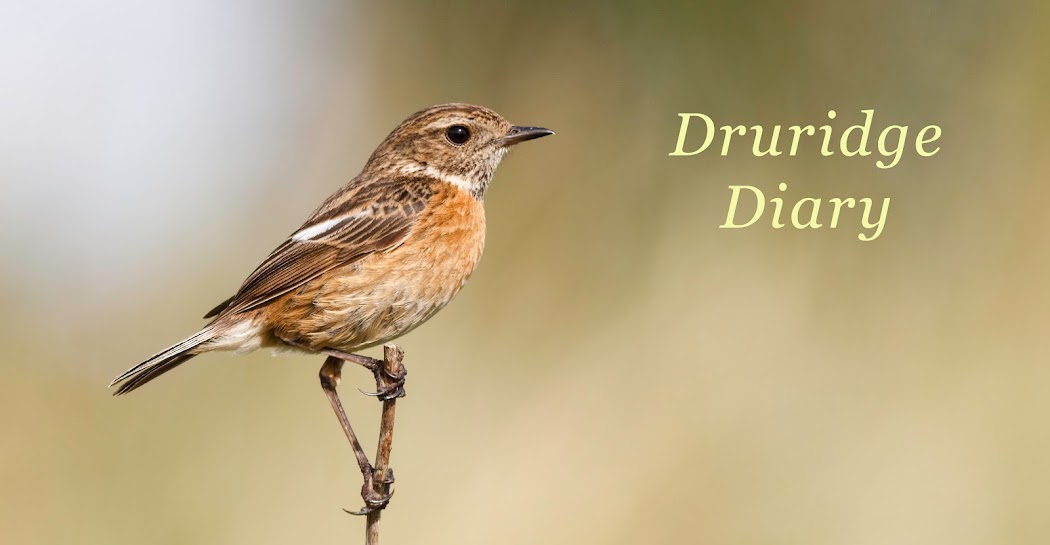
Showing posts with label red admiral. Show all posts

Wednesday, 26 August 2020

Unseasonable

The weather this week can best be described as 'unseasonable'. Monday dawned nicely with some sunshine (remember that?) but it didn't last and Tuesday was a complete write-off with torrential rain and gale force winds from the north, which of course at this time of year could produce some good seawatching. Today, the wind was still out of the north and it felt more like November than August. It had dropped a bit by this evening but was still cold.

I was lucky to catch the sunshine on Monday morning before it disappeared (for good?). The sun brought migrant birds and some locals to the sunny edge of the bushes and I counted 12 Willow Warblers and nine Whitehroats including some family parties, Wrens were  also obvious. By the turning-circle there were Reed Buntings, Stonechats, Linnets, Meadow Pipits, a Robin and a Dunnock.

Male Stonechat - all fluffed-up after a good preen

Young Goldfinch on the fence

In the dunes, there were still plenty of the weekends freshly-emerged butterflies. I wonder how many are still alive now? 

Red Admiral - maybe that Stonechat has taken a chunk out of its wing?

Small Tortoiseshell on Mugwort

Less common - a Small Copper

I walked back along the beach and already the clouds intimated what was in store. 

Looking north...

and south

Mondays list

After being stuck at my desk all day in video meetings, I headed out for a seawatch this evening, The wind had dropped and it looked like seabird activity had too going off others' reports from earlier in the day. It wasn't bad for a Druridge seawatch though - I've had worse! Some birds were quite distant. I got onto a Sooty Shearwater almost straight away, flying through the distant pot flags, it was followed by a small group of Manx Shearwaters and then a spoonless Pomarine Skua powered through on the same line as the Sooty.

Another highlight of the afternoon was groups of Brent Geese headed north. The ones I saw I against the sea were all Pale-bellied Brent, I presume the silhouetted birds against the sky were also this race - 67 in total. A couple of Arctic Skuas went north and one hung around to harry passing terns. There was quite a bit if tern activity, I gave up counting them but noted two Roseate amongst the numerous 'commics' and Sandwich terns. 

A nice sight was a bit of a fluke which I could've easily missed. I happened to glance up at the sky from my scope and saw three birds higher in the sky and they weren't gulls - I got the scope onto them, the first two were Bonxies and the third, just behind them was another Pomarine Skua  - an amazing sight to see these three powerful skuas flying together up the Bay. 

Just as I was about to leave, a summer-plumaged Great Northern Diver flew north close in. On the sea, the Scoter flock numbered about 110 and there were three Great-crested Grebes, an Eider and a Red-throated Diver with them.

Full list here

Saturday, 22 August 2020

An emergence of butterflies

This morning it was breezy from the south west with sunny spells, I had a walk to the north end of the patch, through the dunes north of the turning circle. The first bit north of the Dunbar burn is owned by the National Trust and the next area is owned by the local farmer. Both areas are grazed with the one to the north grazed much more heavily than the National Trust bit, basically cows are overwintered and supplementary fed on silage. This isn't ideal for dune flora as the feeding and dung enriches the dunes, but, for wintering birds, these dunes are a real mecca. The resultant plants, Mugwort, Fat Hen, Houndstooth and Redshank provide a huge seed resource for finches, buntings and tree sparrows. Additional arable weed seeds brought in with the silage supplement what grows. 

The purist ecologist in me should be horrified, but diversity is everything and these 'wrecked' dunes play an important part in keeping these passerines fed when there is nothing in the surrounding farmland and that is why there are a hundred or so Twite here every winter.

The weedy dunes with mugwort, redshank and fat hen

The birds numbers are already starting to pick up here with 30 Linnet, ten or more Reed Bunting, family parties of Stonechat, Whitethroat and Grey Partridge noted this morning. A single Sedge Warbler was certainly a migrant.

Male Reed Bunting in the Fat Hen

Reed Bunting - This is the best Reed Bunting photo I have ever taken 

A young Stonechat - one of a family part that included three juveniles

He got his eye on this fly - still learning to feed I reckon

The highlight this morning wasn't the birds but the butterflies. As I walked through the dunes, Small Tortoiseshells lifted from everywhere I walked, they all looked really fresh so must have recently emerged, I reckon I saw at least 150 of them in those two areas of dunes alone. Red Admirals, also freshly emerged, were also conspicuous with at least 40 counted. A couple of Meadow Browns and Small Coppers were looking less fresh. 

One of over 150 Small Tortoisehells
Red Admiral - one of about 40-50

I presume this is a local emergence but down on the beach, Small Tortoiseshells were flitting by me from headed inland from the sea.

Onto the beach - it looked wet away to the north

A passing Herring Gull

There was nothing much of note on the sea and the Budge fields were quiet, save for a group of Dunlin and Ringed Plovers. It was too windy for macro photography and I managed one hover with the small camera. 

Hoverfly Helophilus pendulus

This was growing in the one of the cattle feeding areas - It is a Coprinus (Ink Cap family) - I think possibly Coprinopsis narcotica which likes dunged areas.

Sunday, 29 September 2019

A weekend of two halves

Weather wise, it has definitely been a weekend of two halves. yesterday, if you were in the sun and out of the strong breeze, was very pleasant indeed. Today was cold, wet and windy feeling more like winter than autumn.

Yesterday morning, Janet and I had a nice walk around the patch in the morning sunshine. Butterflies and dragonflies were more prominent than birds however. We started around the plantation where David Elliott put us on to a redstart in the pines, there were a couple of goldcrests and chiffchaffs there too and we also saw the first of many migrant hawkers and speckled wood butterflies.

Migrant Hawker
We headed north along the road as far as the turning circle. Several chiffchaffs were calling and we were being buzzed by more migrant hawkers. I tried to photograph them but failed miserably. On the way back to the car, we called in at the Budge screen. By the path we found this 'white' caterpillar. Neither of us had seen anything like it before so I took some phone-shots. Whilst I was doing so I heard a sharp piercing call overhead and then saw flash of iridescent blue as a kingfisher shot overhead.

white caterpillar
I posted the caterpillar photo on Facebook and it seems to be a parasitic entomogenous or entomopathogenic fungi which thrives in damp conditions and takes over its host. A comma butterfly (rare for Druridge) sat out in the sun as did several red admirals and speckled woods.

Red admiral on brambles 
Comma

Full bird list here


Today was a cold and wet. A northerly wind strengthened throughout the day. I had been house-bound until 4pm when I had to decide - birds or football. Would I go to the local and watch leicester vs Newcastle game or would I try a seawatch. I opted for the latter - thank God - the Toon got beat 5-0.

Seawatching wasn't great either mind, very quiet. A long-tailed skua had been reported from Newbiggin but I didn't pick it out if it came past Druridge. A bonxie (north) and a black-throated diver (south) were the highlights. There were still a few terns, I counted 14 common and seven sandwich.

I gave up after just over an hour to check the bushes. My full list is here

At the start of the path to the Oddie hide a tit flock came through. My first long-tailed tits of the autumn, about 22 of them, were with blue, coal and great tits and a single willow tit. Willow tit is a really rare patch bird nowadays, we used to catch them most autumns but not since 2006.

A yellow-browed warbler and several chiffs were associating with the flock.

On the Budge fields 37 curlew and single snipe and redshank were the only waders and about 80 lapwing were on the tilled field to the west and as I left about 45 barnacle geese flew north.

Full list 

Sunday, 30 September 2018

Butterflies and bugs

Normally in July and early August, even the most avid birdwatchers sometimes turn to butterflies, dragonflies, bugs and even flowers to keep themselves occupied at the end of summer while they wait for autumn migration to start, this is especially evident on the local Whatsapp grape vine with reports of all sorts of things outnumbering posts about birds. I am no different, I spent my spare time in the summer trying out the macro lens on any insect I could find.

But as soon as the first waders arrive back from the arctic and whinchats are back on the coast, they re-focus their attentions back to birds...usually.

Today was the last day of September and autumn migration should be in full swing, the bushes should be alive with chiffchaffs, goldcrests and maybe, something more exciting. This morning I had two hours to spare on the patch and found myself not grilling the bushes for warblers but photographing butterflies and dragonflies - it was like July!

A run of wall-to-wall westerlies has resulted in very few birds arriving on our shores. There has been the odd report - a wryneck on the Farnes, hoopoe on Holy Island and a black restart or two. At Druridge,  a wren was a highlight after seeing none since the beast from the east and a single chiff was 'wheeting; from the bushes. Things aren't going to improve, with continued westerlies forecast for the next two weeks at least.

The only noteworthy migrants were more barnacle geese flying over.

Barnacle geese headed north
It was amazing to seeing dozens of speckled wood butterflies, I could see over twenty from one spot this morning. A lot of the butterflies are looking a bit worn now but there was a nice fresh small copper today, which I failed to photograph.

Male migrant hawker

Two speckled wood butterflies on rosehips

Speckled wood

Red admiral on ragwort

Sunday, 5 July 2015

Blackcap - To Biarritz...and back!

I've got some really interesting news of a returning blackcap, but first a round-up of the weekend on the patch.

On Friday evening there, autumn wader passage was underway with a greenshank and ruff on the Budge fields, an avocet and a single black-tailed godwit were also present and an adult little egret was feeding.

Adult little egret feeding on Budge fields
A grasshopper warbler was 'reeling' from the umbellifers on the dune-back opposite the path to the Budge screen - it was still reeling today from 5am to midday!

Offshore, there were at least five roseate terns fishing, which isn't surprising given that there are over 100 pairs nesting on nearby Coquet Island. I also saw my first Arctic skua of the year, harrying the terns.

Red admiral
There are a lot more butterflies on the wing now that summer has arrived. Ringlet, small skipper, meadow brown, wall, red admiral, small tortoiseshell, speckled wood were all seen and,today, my first dark-green fritillaries of the year.

As it rained for much of yesterday morning, I put my patch-visit off until the evening. On the edge of the patch, between Bell's farm and the plantation, I stopped to watch some swift passage - a steady stream of these early migrants headed south. Whilst scanning them, a strikingly dark swallow flew past me. I watched it for while, it was male, but the underparts were much more chestnut/orange than any other barn swallow I've seen. It almost reminded me of the North American race, but it had a good, dark breast-band. It was certainly a striking bird, but I don't think it was anything other than a darker than average rustica.

A 'bog-standard' swallow taking a feather to line it's nest
On the Budge fields there were 28 black-tailed godwit and yesterdays ruff and a new ringed plover. A male marsh harrier flew in and started hunting over the Budge field, scattering some duck and lapwings.

male marsh harrier hunting over the Budge fields
Also of note were five large shoveler youngsters. I've seen this on previous years at Druridge, where a female shoveler will turn up late in the summer with well-grown young. I am not sure if these birds were capable of flight, but they were nearing adult size, so they probably were.

Today, I got up early and put some nets up to ring birds. I didn't catch much, I presume a lot of the warblers are sat tight on second broods. I caught 14 new birds, all but two of which were juveniles. I would have expected to have caught more young warblers (I caught two backcaps and a chiffchaff), I think the prolonged cold spring and erratic storms may have done for some first broods.

Between net-rounds I had a scan from the dunes and picked up a small falcon flying west. I automatically assumed it would be a kestrel, but when I put my bins on it I was surprised to see a fine adult hobby. It had a small bird of some species in its talons (maybe a sand martin, there were a lot of them), it continued west over the bushes and turned south with it's prey, maybe looking for somewhere suitable to deal with it?

So, to the story of the blackcap. I retrapped a female breeding blackcap today, which we ringed as a juvenile last year. This got me thinking about thinking about the blackcap that we ringed that ended up in France (read the story here http://ipinswildlifeblog.blogspot.co.uk/2015/02/the-french-connection.html ) and whether it may have come back, so I checked our retraps for the year and it has!

Y540945 was ringed as a juvenile male on the 27th August by me and James Common, we caught it again on the 5th September. On 25th September it was caught by a ringer 1251km in Landes near Biarritz in France.

Looking at our retraps for this year I discovered that Y540945 has returned! I caught it on 9th June as breeding male. This is the first time we have ever had a long-distance migrant trapped elsewhere other than Druridge, return to our site. Isn't migration amazing!

130 greenshank
131 Arctic skua
132 hobby

Sunday, 28 September 2014

Westerly Woes

A settled high pressure with westerly winds has meant that this weekend has been a lot more sedate than last weekend was.

Sedate = boring. Bring back the easterlies please.

It felt like summer at Druridge yesterday morning. There were lots of butterflies out, mostly red admirals and speckled woods with a single dark-green fritillary which must have been off a second hatching?

Red admiral on whitebeam berries
Speckled wood

These drake gadwall thought it was spring - chasing a duck around for five minutes or more.
Birding was very quiet, robins, wrens, dunnocks and chiffs most notable in the bushes. Overhead, skylarks were moving south throughout the morning with a sprinkling of meadow pipits and swallows.

There was a hint of winter though, pink-footed geese are back.

Pink-foots, headed south
Today was even warmer, but more cloudy. I could only manage some evening birding, by which time, the wind had dropped to almost nothing. It was high tide, so I had a look on the sea, hoping for some fly-by waders, pushed off the rocks.

There was an incredible 71 divers in the bay, but all I could pick out was red-throats. In amongst them were five red-breasted mergansers and a great-crested grebe.

In common with elsewhere, Druridge has had an influx of little gulls, not an impressive count in comparison with other sites, but there were about 12-15 which is good for Druridge. Most of them were distant, with a feeding frenzy of bigger gulls, well offshore.

I had a really frustrating episode with a gull, when I picked it up in my scope, it was heading south and it didn't deviate from it's course, it didn't bank or turn once, just kept on going. What I saw, and its jizz, was good for a juvenile sabines, but I will never know.

At dusk, the two juvenile kestrels that have been hanging about were joined by a third. I got a couple of pics before it go too dark, after I abandoned photography due to bad light, they put on a great display over the dunes in front of me, tussling with each other.


juvenile kestrels at dusk

Sunday, 7 September 2014

Bit of ringing, bit of birding

Friday off work meant a long weekend for me, I put my day off to good use and put some nets up.

It was really calm and a thick sea-fret was in, although it was a 'hanging' fret rather than a 'wetting' one, which was good for ringing.

I only had three nets up and caught and 45 birds, seven of which were retraps. We caught a few passage migrant warblers, mostly chiffchaffs and blackcaps with lesser whitethroat, sedge warbler and willow warbler adding to the diversity. We also caught seven goldcrests, the first of the autumn.

Meadow pipit passage was evident on Friday and for the rest of the weekend along with a few skylarks. A great-spotted woodpecker was noted flying through as were a whimbrel and 4 ruff with some lapwings.

The weather forecasts for Friday night to Saturday morning were all over the place. They all predicted rain, but differed in how long it would last. It was clear by dawn, so I was out looking for migrants. I started in the plantation, with a spotted flycatcher and a 'hippo' type warbler, which I had the briefest of views of and was never seen again despite and hour and a half spent in the pines searching for it. It appeared to be a compact warbler, slightly larger than willowchiff, warm buffy brown above and on the flanks, off-white-grey on the underside. That is all I got on it.

I gave up on it and went to check the bushes elsewhere. Lots of goldcrests, robins, chiffchaffs and whitethroats were flitting about. On the fence by the entrance there were two wheatears, they were later joined by a whinchat, which was my second of the morning. I was beginning to think I might miss whinchat this year then two come along at once (I saw two more at Snab Point later in the day).

wheatears on return passage
Skylarks and meadow pipits were going south all morning.

This morning, I went to ring a brood of barn owls. This is a second brood from a pair that has already fledged a brood of four. There were five of them, with quite a size difference, this one being the largest.

young female barn owl (you can see how spotty she is), the biggest of five from a second brood.

Today was also WeBS count day. Highlights were a good count of moorhen (17) and little grebe (16). This evening there were 16 red-throated divers in the bay, many in breeding plumage still. there are still red admiral and lots of speckled wood butterflies on the wing, the latter being the commonest butterfly at Druridge which was not even noted here until 2006. Migrant hawkers and common darters were about too.

red admiral
common darter on a bramble leaf
153 spotted flycatcher
154 whinchat

PWC Score 217

Sunday, 10 August 2014

WeBS Waders and a wasted opportunity

I'm a bit gutted. Druridge was 'hotching' with warblers today, I should have had the nets up for a ringing session but I didn't...."Why?" I hear you ask.

Well, all of the weather forecasts for this morning was for heavy rain by 9am, some forecasting it earlier. So, based on that we decided not to ring. When did the rain finally arrive? After lunch - typical! 

I did my WeBS count this morning instead. Just as I got the scope set up in the Budge screen hide, a big female sparrowhawk put everything up, so I headed for the other hides and met this unlikely double-act on the way.
Scarce and rare visitors to patch
One of them admitted to not being to the pools for at least three years, the other couldn't remember how long it was. Rarer than barred warblers at Druridge, the pair of them! Nice to see them though, don't leave it so long next time!

By the time I got to the little hide, the waders had settled back down. Two, maybe three wood sandpipers, one green sandpiper (which alluded me yesterday), one greenshank and three common sandpipers with several dunlin and over 25 snipe.

Other WeBS highlight were a good count of 191 mallard, 14 little grebe, two little egret and the pair of nesting great-crested grebes.

Cormorant from the Oddie hide
Yesterday there were five greenshanks, a calling green sandpiper, two wood sands and a single common sandpiper. There were also dozens of visiting birders, from Tyneside, Cumbria and even yorkshireland! Despite the little hide being full to capacity for much of the morning, it didn't deter the swallows from feeding their rapidly growing chicks.

Swallow feeding young in the little hide
Butterflies on the wing over the weekend included wall, red admiral, meadow brown, painted lady, peacock, comma and small copper.

painted lady
Head on - a rarely photographed view of a red admiral
Dragonflies have been very scarce at Druridge this year, but not elsewhere seemingly...odd?

Female common darter in the plantation
On Thursday night/Friday morning we had another go at catching storm petrels on the beach, with moderate success, catching three. Two of them were already ringed, which isn't a bad thing, catching them again helps to increase our understanding of this species.

Finally, just to show that we get a better class of vandal at Druridge...


Seemingly Maria was there too.

147 Green sandpiper

PWC Score 207

Sunday, 3 August 2014

Mega Patch Tick

The early bird catches the worm, so they say.

Well I was at Druridge early this morning and it certainly paid off when a scan of the waders turned up a STILT SANDPIPER!

Here's the tale..

I bumped into fellow patcher Dave Elliott on the way into the Budge screen (you have to be up very early to beat Dave), he was telling me of a wader that he had seen yesterday but wasn't sure about as the light was terrible...it could have been stilt sandpiper or it could have been a wood sandpiper, he wasn't committal.

I started scanning the mud and amongst the snipe was something different, it was arse-on at first, then it raised it's tail to reveal strong barring on the underside and the dark centres to the feathers stood out really well. We didn't need to see any more - Stilt Sandpiper - the bird that was at Cresswell Pond until Thursday had turned up on my patch. Patch mega!

crappy iPhone-scoped shot of the Stilt Sandpiper.

We had really good views of it for a while, Dave went off to check the rest of his gigantic patch and it slipped off into the rushes. Then one of the Chevington marsh harriers turned up and scattered everything, including the curlews and spoonbills and there was no sign of the stilt sand for nearly 20 minutes. The marsh harrier had another go at it re-appeared back on the mud and was seen on and off for the rest of the day and was enjoyed by a good number of birders.

marsh harrier arrives....
....and causes havoc
This bird is the second record for Northumberland, the first being two years ago on the Stringers patch at Newton. I saw that bird and only one other, ever, in Texas.

This is the second new patch bird this year after May's woodchat shrike, taking the patch list to 234. Seemingly, as this bird was re-found, it counts as find for the patchwork challenge, thus netting me a whopping 15 points.

Elsewhere on the patch three little egrets were on the edge of the shelterbelt, one of them was the colour ringed bird DE had at Chevington, the other two were juveniles. They relocated to the big pool soon after.

Juvenile little egret. The yellow/green legs and yellow tinge to the lores as well as being 'fluffy' give it away as a juvenile.

Also on the big pool was LRP and common sandpiper. This stunning red admiral brightened up the track.

red admiral
Druridge version of oxpeckers
So what chance of another patch tick this year. Well, I reckon so and my money is on red kite.

Patch List 234

Year List 145

PWC Score 205