Monday, 17 February 2014

Unprecedented

I didn't get down to Druridge today, some of us have got proper jurbs....

Other birders did though, as an alert from Birdguides at lunchtime told of a black-throated diver on the Budge fields. How odd after my red-throated diver there yesterday.

Ian Fisher called me later to say he was watching the black-throat and it was in front of the little hide and he was photographing it.

black-throated diver (c) Ian Fisher
And yes, before you ask, the diver I saw yesterday was definitely a red-throated diver. So two divers on the Budge Fields in two days. The word unprecedented is over-used, but on this occasion it'll do nicely!

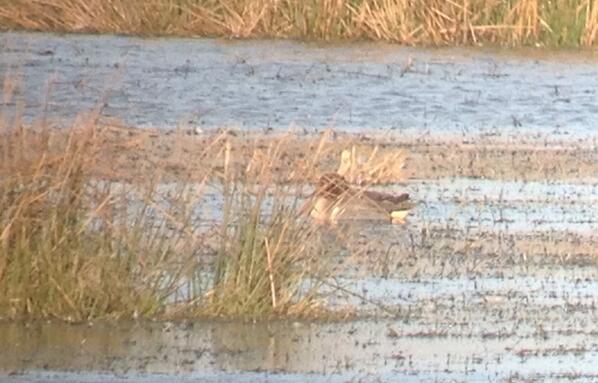
Ian also saw a female long-tailed duck on the big pool. This looked liked the same bird that I saw close in offshore yesterday.

long-tailed duck (c) Ian Fisher
Thanks to Ian for the pics.

Sunday, 16 February 2014

WeBS count

Today was count day and there was lots to count. The Budge fields were lifting with birds. Lapwing were by far and away the most numerous species (apart from starlings which don't count for WeBS), with 495 give or take a few each way. Interestingly, there were no redshanks or curlews today, the only other wader was snipe. This might be a record lapwing count, I will need to interrogate my database.

Teal numbered 157 and wigeon 126 (dropped int he last week or so). Bird of the morning went to a red-throated diver on the Budge fields of all places. This was a first for me, I've seen them on the big pool a few times but never on the fields. It flew off before I could photograph it, only to land on the big pool, until a passing police helicopter scared it away from there too.

Also of note; a pair of pintail on the Budge fields, the long-staying common scoter on the big pool and a pair of red-breasted merganser.

Off shore, there was a really close long-tailed duck of note.

Yesterday I had a quick look on the sea at high-tide. It was a big tide and the waves were lapping up to the base of the dune. I picked up a couple of turnstone flying south, they joined about 18 others on the beach - 20 turnstone is definitely a patch record count.

Offshore, there was drake velvet scoter.

83 snipe
84 turnstone

PWC score = 102


Sunday, 9 February 2014

Flighty

It was still blowing a hooley today and as a result everything seemed to be a bit flighty at Druridge.

I had a walk up to the Preceptory, the pink-footed geese were lifted off the fields by a passing tractor and didn't settle again. Whilst they got up a pair of marsh harriers had put everything up on the Budge fields and then flew towards the far, the male settling on the filed the geese had vacated for a while.

Pink-footed Geese
There were thousands of starlings skimming the fields and hedges in big flocks, before settling for a while. This flock had a bathe in a small pool.


About 80 fieldfare were also roaming about the damp fields.The Preceptory was bird-free.

Back towards the cottages, a buzzard was being mobbed by a couple of crows. As it got closer, It looked quite long-winged and I noticed really obvious pale patches in the upperwing which got me interested so I fired off a few shots. It was just a common buzzard, but an interesting bird.Variable things, Buzzards.

Buzzard


There are still two pintail on the Budge fields and the common scoter is still on the big pool. Also of note was two woodcock flushed from the bushes, my first of the winter.

76 long-tailed tit
77 woodcock
78 canada goose
79 marsh harrier
80 fieldfare
81 buzzard

PWC score 100

Saturday, 8 February 2014

A bit blowey

It was a bit blowey today and I was putting off a visit to the patch, loitering about the house, when I got a message from Dave Elliott about white-fronted geese.

The geese were in the field immediately west of the Budge fields, the shelter-belt doing its job for them. There were about 250 pink-footed geese and at least two Eurasian white-fronted geese amongst them. There may have been more, but viewing conditions were tricky, even from inside the hide!

The female type common scoter is still hanging around on the big pool, five goldeneye were notable as there hasn't been may this winter.

drake goldeneye

I had wander up to the dunes at the north end of the patch and got onto a small gull over the haul road, dark underwings, with no black int he upperwing - an adult little gull. It settled at the back of the haul road flash.

Crap record shot of adult little gull

Whilst I was watching the little gull, I got onto this dunlin hunkered down behind a huge cow shit, seeking shelter from the wind.

Dunlin - seeking shelter behind a big poo!

There were a few skylarks and a couple of reed buntings in the dunes and I flushed half-a-dozen grey partridges. These goldfinches were coming onto the haul road to drink.

Goldfinches coming in to drink


70 white-fronted goose
71 little gull
72 dunlin
73 skylark
74 reed bunting
75 grey partridge

PWC Score 93

Sunday, 2 February 2014

Yank Teal

I finally managed to see the green-winged teal today, it turned up at Druridge whilst I was in Sri Lanka but I've missed it on two visits.

It was on the Budge fields, spending its time alone, away from the other teal. This is the first Druridge record since 2011, another long-staying drake.

Embedded image permalink
iPhone-scoped drake green winged teal
The Budge fields are still holding decent numbers of wildfowl, including about 20 shoveler, a single pintail and a shelduck. Shelduck are normally a February addition to the list, so this one is quite early. There were also two black-tailed godwits.

The female type common scoter was back/still on the big pool, but little else of note.

I had a half-hour look on the sea. There are still lots of red-throated divers and an unusually high count of over 50 guillemots. I'm not sure why there are so many guillemots in the Bay this winter. Amongst the guillies and divers there was a red-necked grebe, great-crested grebe and a first-winter drake velvet scoter (which was on its own, well away from the main scoter flock). There were a couple of kittiwakes feeding offshore.

63 shelduck
64 green-winged teal
65 moorhen
66 greylag goose
67 velvet scoter
68 great crested grebe
69 kittiwake

PWC Score 85 Points

Sunday, 26 January 2014

That's dedication!

Despite having only been back in the country for less than three hours, despite having been travelling for over 30 hours with virtually no sleep and despite the sleet, icy winds and a temperature of only 3 degrees centigrade I still went down to the patch this afternoon to look for a reported green-winged teal. How's that for dedication?

The Yankee teal wasn't at Druridge, seemingly it was on Chevington's south pool.

The cold conditions of Druridge came as a bit of a shock having just spent the last two weeks on a birding trip to Sri Lanka, with an average daytime of temperature of around 30 degrees.

Singing Indian pitta in Kitugula Forest
We had an excellent trip, seeing all of the 33 endemic species of bird and most of the sought-after near endemics as well as good selection of mammals including several Asian leopard.

I've got the long dark nights of February to play around with photos and I will, eventually, post a full report and photos on my birding trips blog.

In the meantime, I'll be checking the Budge fields for the green-winged teal. No new species were seen today, but the drake pintail were showing well in front of the hide. My camera was still packed.....

Saturday, 11 January 2014

A bit of a wander roond the patch

I had a bit of a wander to the far flung ends of the patch today.

After seeing twite and pied wag on the dunes to the south, my route took me firstly to the Oddie hide, but not before I had stopped to look at a lone whooper swan on the Budge fields. Initially the big pool looked empty (for some reason when the pool is full (the outflow is blocked with flotsam and jetsam) there are never any birds on it - an edge thing?) other than a handful of tufted duck and teal, then a long-tailed duck popped up in the middle of the pool. Then, when I scanned the seaward side, a red-throated diver had appeared. It didn't hang around long before it flew off towards the south.


red-throated diver. A rare visitor to the big pool
My route then took me to the preceptory, which was owl-free, and then down to High Chibburn Farm where a flock of 200 or so golden plover lifted off the fields. At the farm  house sparrow, collared dove and dunnock were added to the year list. At the cottages, tree sparrows and a great tit were coming to the feeders.
Low Chibburn Preceptory

In front of the cottages, a skein of over 2000 pink-footed geese dropped in. I scanned them later in the scope, they were all pink-feets.

Whiffling
Pink-footed geese settled for a graze
Four pintail were on the Budge fields and two black-tailed godwits with the usual teal, wigeon and shoveler.

Offshore there were at least 77 red-throated divers in the bay, among them was a red-necked grebe, a good patch bird. Also on the sea were at least 25 guillemots and a couple of razorbills, mergansers and shags. A single sanderling was on the beach.

40 chaffinch
41 twite
42 pied wagtail
43 rook
44 gadwall
45 grey heron
46 jackdaw
47 golden plover
48 dunnock
49 house sparrow
50 woodpigeon
51 tree sparrow
52 great tit
53 collared dove
54 pintail
55 red-necked grebe
56 shag
57 cormorant
58 razorbill
59 red-breasted merganser
60 sanderling
61 eider
62 whooper swan

PWC score 74