Sunday, 28 October 2012

Dovekies, a patch record and the 'Bush of Plenty'

I managed two visits to the patch this weekend

Saturday

Saturday's highlights were out to sea. An afternoon visit once the worst of the weather had passed, I went straight to the dunes for a look on the sea, little auks had been much reported and I was keen to see some, I wasn't disappointed.

I saw four, probably five 'dovekies' in an hour, one of them was really close, just beyond the breakers. These were my first little auks on the patch in five years! This doesn't mean there hasn't been little auk passage in the last five years, just that I have aversion to standing on the dunes in freezin cold north-easterly to look for them.

Other highlights from my one hour seawatch were seven pochard flying north and a great-northern diver on the sea. Gannets were scarce, shag numbered seven and there were a few kittiwakes.

Away from the sea a patch record was broken, for the maximum pheasant count in a visit. A huge tally of 31 of gormless individuals in a stubble field in front of High Chibburn Farm, they must've been on by shooting somewhere nearby. A small flock of 12 golden plover were by the haul road flash with 2 bar-tailed godwit.

Sunday

I had a good bash around the patch today, it was grey, cold and miserable and the birding reflected the day. This silhouette of curlews sums the day up.

grey skies with two curlews
The outstanding highlight was a merlin, lifting a flock of starling of the fields by the haul road flash before bombing on through the dunes and out of sight. Passerines had been thin on the ground until I got to the 'Bush of Plenty'!

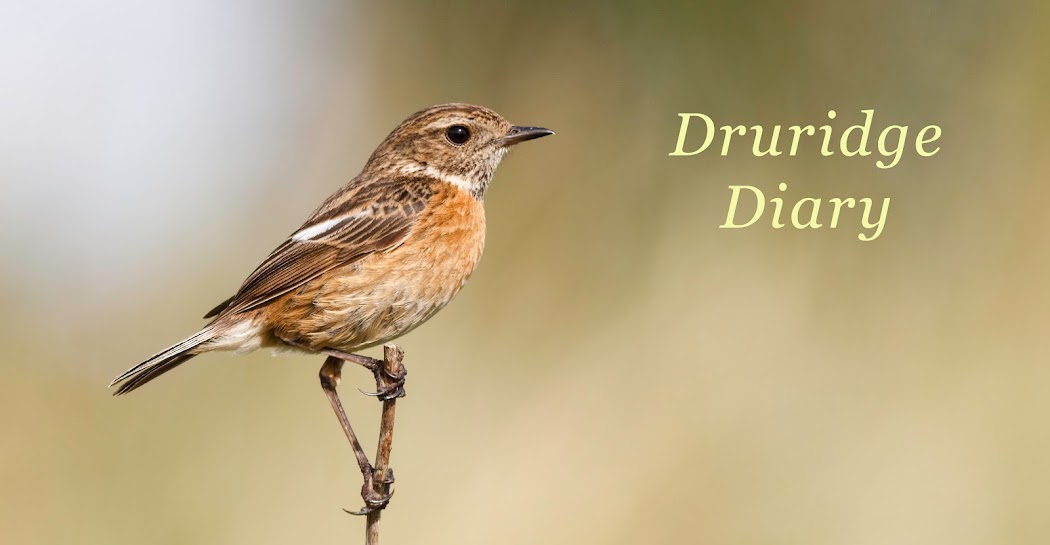
A small, somewhat isolated bush by the fence on the edge of dunes. Hardly worth a second glance normally, but there was stonechat perched on-top, always worth a check for a sibe.

Stonechat 

It was soon joined by a male stonechat, then a chiffchaff popped out, pursued by a great tit, giving it some grief. A wren soon appeared, followed by two dunnocks and a robin. They thought this mediocre bush too small for them all and flitted over the road to make way for a couple of meadow pipits and another stonechat. This small, innocuous hawthorn bush had just about doubled my passerine tally and shall, from this day hence, be known as the 'Bush of Plenty'.

145 little auk
146 pochard

Monday, 22 October 2012

More thrushes

I took today off work on the strength of the weather forecast, hoping for a good fall of birds. There was fall, but it was pretty-much limited to thrushes.

I arrived at Druridge just after eight, still slightly hung-over after having too many Abbott ales watching the derby game in the pub, and redwings were coming in off the sea overhead, in small flocks of about 50. Maybe four or five of these little flocks came in whilst I was around the entrance. Some of them heading straight for cover in the willows or plantation, the majority flying straight over.

In the bushes there were many blackbirds, more redwings and a few song thrushes. A handful of fieldfares were seen too, though this more powerful thrush seems to keep going, dropping in much further inland.

There was no obvious arrival of smaller birds with goldcrest numbers no more than Saturday. There were a few grey-looking robins that looked newly arrived. Bird of the morning was a short-eared owl which I disturbed from the bushes by the big pool, it flew off, into the trees in the western corner of the pool.

Other highlights were a few snipe coming in and five bar-tailed godwits on the flash.

I had a good thrash around the patch on Saturday morning too. Janet was out-of-action so no ringing this weekend. Still a few lesser redpolls lingering, two great-spotted woodpeckers, three coal tits, a chiffchaff and blackcap were new arrivals.

Skeins of pink-footed geese flew over most of the morning and this  common newt dodged death on the road (I rescued it from certain death)

Lizard Smooth or Common Newt

A slavonian grebe was the highlight on the sea where there were also 22 red-throated divers and a great-crested grebe.

Greenfnch isn't a common bird at all at Druridge so I was very surprised to count about 40 of them in a mixed flock with an equal number of goldfinches, roaming about the dunes.

Sunday, 14 October 2012

WeBS count

We decided to ring at Lynemouth sewage works this morning, a bad idea. All of the weekends migrants seemed to have moved through, we only caught six birds for our efforts.

Ringing in the morning meant that it was afternoon visit to the patch to do my WeBS count, which proved to be as disappointing as the morning's ringing session. For some reason, when the big pool is brim-full, like it was today, birds avoid it. Obviously species like teal and wigeon like an edge where they can get out graze, but the diving ducks also seem to avoid it when it is full. So the highlight of the count was six whooper swans, which soon flew off, finding Druridge to be to their disliking

Two of the whooper swans
Off they go. One of them is sporting a yellow ring. Even blown up it is difficult to make out the code, I'll send it to  WWT anyway.

Despite the arrival of six cows on the Budge fields, they haven't made a mark on the tall vegetation yet, there could've been cranes and storks out there, you wouldn't see them! . There were some curlew visible in front of the Budge screen and a juvenile and adult little grebe on the big pool.

curlew on the Budge fields

juvenile little grebe
In the bushes a few cresties were moving through and a chiffchaff 'wheeted', otherwise it was quiet. A look on the sea didn't bring my hoped-for grey phalalrope so I headed home.

WeBS count

curlew 12
mallard 8
coot 9
teal 10
whooper swan 8
little grebe 2
wigeon 2


Saturday, 13 October 2012

Ringing Demo

A long time ago, we were asked if we'd do a ringing demonstration at Druridge for ERIC volunteers. To be honest, we had forgotten all about it until Steve Lowe reminded us during the week. We would have probably ringed at Druridge this morning anyway, but having to do the demo made sure we did.

The session stated well, before the group turned up we had caught a treecreeper. In fact we caught it before the net was properly up. This is only the third treecreeper we have ever caught at Druridge, so it was nice to catch it.

treecreeper
The group turned up shortly after and waited patiently whilst we checked the nets and we returned from our net-round with a good catch to show them. 

The assembled group
The highlight for us was a yellow-browed warbler, the first one we have ever caught at Druridge. The assembled group were amazed that this little bird had come from Siberia to arrive at Druridge, that said, they were equally impressed with the blue tits that were taking the skin from my fingers.

yellow-browed warbler
We caught 18 lesser redpolls today, not a species we normally catch a lot of at Druridge. They appeared to be feeding on the seeds of meadowsweet. Most of them were this years' juveniles, this one caught Janet's eye when she extracted, nothing unusual, just some leucism. 

leucistic lesser redpoll
Interestingly, yesterdays' fall of thrushes had virtually cleared out, we only caught three blackbirds and two song thrushes.

We caught 59 new birds and 5 retraps in total. Not bad for a bright and breezy morning with westerly winds.

Six cows have appeared on the Budge fields. Too little, too late,  but it is encouraging to see them, hopefully they'll be here to stay.

Ringing totals

treecreeper 1
long-tailed tit 11
goldcrest 7 (1)
great tit 1
song thrush 2
blackbird 3
dunnock 1 (1)
chiffchaff 1
wren 2 (1)
robin 2 (1)
lesser redpoll 18
yellow-browed warbler 1
blue tit 6 (1)
goldfinch 1
blackcap 1
siskin 1

143 treecreeper

Friday, 12 October 2012

From the east

My decision to take a day off work after a look a the weather forecast paid off today. No patch-ticks, but a yellow-browed warbler and a big fall of thrushes were well worth the effort.

I was down on the patch at 7.30am, it was still quite gloomy, small groups of redwings were coming in off the sea and there were lots of blackbirds in the bushes. In the pine plantation by the entrance, sixty blackbirds were pushed through from the dunes, by a dog-walker with a now-empty dog.

Small groups of thrushes continued to come in off the sea for a couple of hours, before easing off by 9ish. Many of the redwings seemed to keep going, the majority of birds in the bushes were blackbirds. There were a few song thrushes and three fieldfare in the bushes and a single mistle thrush at High Chibburn Farm.

Highlight of the day though was yellow-browed warbler. I was just about to give up for the day, deciding to check the bushes by the Budge Screen on my way out and I am glad I did. A stripy eastern gem was flitting about the willows, calling as it went about with some goldcrests. I lost it for a while after it had a stand-off with a robin. It came back, but never close enough for a photo so I had to make do with these long-tailed tits.


Other highlights were a whinchat and three chiffchaffs amongst the regular finches and tits.

This was my first yellow-brow since the autumn of 2009 and only the second in the last five years...nice!

141 fieldfare
142 yellow-browed warbler

Sunday, 30 September 2012

End of September...

The last day of September, Autumn is slipping away into winter and my year-list for the patch is well down on what it should be.

On Wednesday I did pre and post-work visits to the patch. On Wednesday morning, there had been an obvious overnight arrival of common migrants, song thrush were the most numerous with 50-60 passing through. There were ten+ redstart, lesser and common whitethroats, garden warbler  15+ blackcap, ten+ chiffchaff, two willow warbler and eight or more goldcrest. Also newly arrived were a party of eight lesser redpolls and six siskin.

lesser whitethroat

Most frustrating though was the one that got away. A bunting, facing me, with a pale, almost white belly but with strong streaking on the flanks, it turned it's head to show orangey-brown cheeks then promptly flew off, never to be seen again. I would bet my mortgage it was a little bunting but I didn't get enough on it to be sure. I didn't catch up with the little bunting that Janet caught in 2005.

Also of note was another bonxie, flying east from the land towards the sea, my second of the week and a steady passage of skylarks still passing overhead and this roe deer which was not shy at all.

roe deer
By Wednesday afternoon there had been a clear-out. Only two or three song thrush remained and no redstarts, everything had moved on. Bob Biggs had a knot on the flooded fields in front of the cottages which was year-tick.

Today was quiet as I dodged the showers. There were still six redpolls hanging about and a few chiffchaffs. Two grey plover flying west, calling, were also of note. There were hundreds of dragonflies on the wing today, especially in sheltered areas of tall vegetation.

It rained again so I thought I would call at Cresswell Pond to have a look at the Long-billed Dowitcher that had been reported but when I got there and saw 15 cars at the end of the track I kept going.

Am I getting old and grumpy? I used to enjoy the 'craic' in the Cresswell Pond Hide on a Sunday morning, now the thought of a hide full of other birders makes me run the other way. Has birding (and birders) changed or it just me?

136 lesser whitethroat
137 redstart
138 lesser redpoll
139 knot

Tuesday, 25 September 2012

Interesting warbler

I was on the patch early yesterday (Monday) evening. Conditions were not conducive to birding, the wind was very strong and blustery from the east then north east and it was showery. Nevertheless I checked some of the more sheltered areas of the patch, around the budge screen, on the west side of the shelterbelt and the track to the hides.

It was obvious that no significant arrival of birds had taken place. Even with the fact that most birds would be cowering in cover, there wasn't much about, a few goldcrests, chiffchaffs, chaffinches and tits.

Checking the westward side of the shelterbelt I came across a warbler which immediately struck me as being different. It was hopping around the base of a small willow, the jizz of the bird struck me as odd. It had a long, bright supercillium, stretching nearly onto the nape, it looked like a phyllosc, but which one?

I fired off some crap record shots, in my panic, forgetting to zoom in, so these are very cropped.


The strong supercillium was obvious as was the dark eye-stripe, the legs appeared to be pink-orange, the bill was horn coloured above, pink-orange on the lower mandible and appeared shorter and stubbier than chiffchaff bill. It was generally yellow below and a darker olive green above. There was contrast between the olivey-green mantle and darker wings, the flight feathers were darker but appeared to have pale fringes. It never called.

Viewing conditions were awful and to be honest I wasn't sure what I was looking at, but it was interesting.....My initial thoughts, given the strong supercillium were of dusky or Radde's, but I thought it was too early for them, wasn't it? I had ruled out Dusky and was thinking Radde's, but this bird didn't have the ochre-orange undertail that the bird we caught a couple of years ago had.

I met up with Dave Elliott and we went back to look for the bird with no luck. When I got home and looked at the photo's I was more confused and after a chat with Stewart had ruled out Radde's and dusky. So a couple of shots were emailed to some birders who know a lot more than me about such things.

The consensus appears to be that it is a willow warbler, probably of one of the eastern races, acredula or yakutensis. It certainly isn't one of the cold-grey acredula forms or 'Eversmann's willow warbler'....

In doing some research I looked for other potential eastern phyllosc's that could occur here as vagrants. Tickell's leaf warbler Phylloscopus affinis kept leaping out at me as being very similar, in many ways, to my warbler  - although it didn't look quite right either, my mind wandered into the realms of fantasy....P. affinis has a similar range (both breeding and wintering) to Hume's leaf warbler, so if one was ever to turn up in the western palearctic, you would expect it would in November.

Unless we catch the bird at the weekend, we will never know what it is and then it wouldn't be straight forward...

It's all been an interesting exercise and I know a lot more about 'eastern' willow warblers and Tickell's leaf warblers that I did before.

It's still raining outside. Druridge was virtually cut-off at lunchtime today, the road to Cresswell was flooded and the road to Widdrington was just passable. I am going to try to get to the patch tomorrow morning before work if I can, to hopefully see and more importantly hear this bird again. There may well be some other migrants to see too.