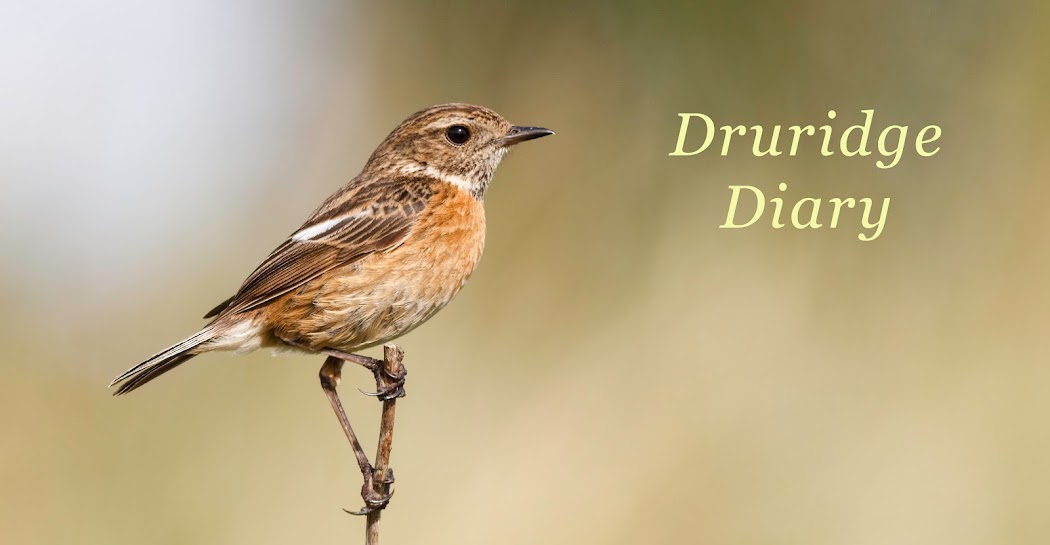
Sunday, 31 May 2020

Trying to avoid the crowds

I was keen on a look around the patch today in the hope that these south-easterly winds might have brought in a red-backed shrike or a rosefinch but I knew, based on the last few days that Druridge would be swamped with people and be very unpleasant.

I spent the afternoon checking barn owl boxes nearby (they seem do be doing well by the way) and waited until after five o'clock to head for the patch.

When I arrived, I feared the worse. Cars parked in places I've never seen cars parked before between Cresswell and Druridge and at the entrance to the reserves, they weren't parked, they were abandoned. The folk who live at Druridge obviously fed up and had taken matters into their own hands with barrier tape and cones - who can blame them?

Once you got 200m beyond the entrance, not even as far as the Budge screen, the cars thinned out and beyond the blockhouse, hardly any. My theory is this;

the people we are seeing on the coast right now are not our usual visitors. These people have never been here before, they usually spend Saturday or Sunday in the pub or at the Metro Centre. They don't know there is another kilometre of roadside parking beyond the entrance so take just abandon their car wherever they can. They also presume, that it's okay to stack their rubbish (which they've taken the time to bag-up and carry as far as their car) by the already full bin because obviously someone from the council will be along soon to clear it away like they do on Northumberland Street in Newcastle. 

Why bins in rural areas don't work

Rant over.

I wandered the bushes and through the dunes checking any likely shrike bushes or rosefinch without joy. The Budge fields were literally drying up before my eyes.

The budge fields drying up before my eyes

From the end of one of net-rides, I looked out over the Budge fields, the light was crap, into the evening sunshine when a grey heron, oblivious to me, came in to land just beyond the fence. I fired a few shots off and I am pretty pleased with the result - not technically brilliant but I like the atmosphere of it. (And I love the out-of-focus lapwing behind it)

Coming in to land
I found plenty of meadow pipits and reed buntings in the dunes - I think the lock-down was good for them - shame it didn't last. A coupe of pairs of whitethroats and stonechats were also active.

Reed Bunting with hungry mouths to feed

One of several pairs of whitethroats

One of two singing male stonechats

The weather looks to change next week which hopefully might bring about a change in human and avian visitors to the patch?

Saturday, 30 May 2020

Unlocked

Well, the COVID-19 restrictions were lifted a couple of weeks ago (not a wise move in my opinion). You would have thought I would have headed straight for the patch as soon as I could - but this wasn't the case. I was reluctant to go and waited a few days, until Monday 18th, before my first tentative visit.

When I did go, it felt odd - almost like I was doing something wrong. I've quite enjoyed exploring my new (very) local patch, rediscovering places I used to knock around as kid and probably first developed a love of the outdoors and wildlife, abandoning my re-found patch for Druridge felt like cheating. So after my first visit I returned to the local haunts for a few days.

Obviously there was a lot of new birds for the year - chiffchaff was the only warbler I saw before lockdown, now they are all back and the hirrundines, swifts and seabirds. 

I didn't take my camera on my first few visits - again it felt as if I should be exercising, not taking photos. I missed a lovely Greenland wheatear posing nicely on a post and a yellow wag on the budge fields. 

The Budge fields are looking great at the moment, but are drying up quickly in this dry weather (the driest May since the 50's seemingly) and have attracted a good selection of waders, on 19th I had greenshank, avocet, little stint, ruff, knot and black-tailed godwit. On Friday the wader list also included three curlew sandpiper, two little-ringed plover and a bar-tailed godwit. A drake garganey was also on the Budge fields.

I normally avoid Bank Holidays at Druridge. I headed out early on Bank Holiday Monday and left before the masses descended. A red-legged partridge, a scarce visitor to the patch, was on the Budge fields - I hope they remain scarce otherwise we'll lose our greys.

red-legged partridge - an unwelcome year-tick

30-40 swifts were feeding just over the bushes along with black-headed gulls, taking advantage of the St. Mark's Flies. 

Swifts - difficult to photograph


Black-headed gull -  hawking insects amongst the bushes

On Thursday and Friday I took two days off work to set up the ringing the site. I only put three nets up on each day but still caught 48 new birds, a few retraps and single control blue tit. We didn't ring at all last year because of family circumstances, so any retraps were at least two years old.

Warblers dominated, mostly adults showing signs of breeding but I did catch a recently fledged juvenile chiffchaff. A couple of grasshopper warblers and a lesser-whitethroat were nice to catch - the latter, a female with a brood patch, are not a common breeding species here. 

Lesser whitethroat  - a rare breeding species at Druridge

On Friday, a spoonbill was on the Budge fields first-thing and, weirdly, 22 barnacle geese. There had been lots of fly-over feral goose flocks, mostly Canadas. I can only presume these barnacles were feral rather than 'wild' migratory birds?

 A flock of greylags over - lots of flocks of feral geese passing through


When things were quieter in the nets, I had a chance between checks to photograph some critters. I found my first red and black froghopper at Druridge a couple of years ago - there were dozens of them on Thursday and Friday. A coloniser from the south, like speckled wood butterflies. 

Red and black froghopper- Cercopsis vulnerata

I also photographed this beetle:

Red-headed Cardinal Beetle (Pyrochroa serraticornis) 

Red-headed Cardinal Beetle (Pyrochroa serraticornis)  - a new one for me. It looks like another southern species establishing here. I saw three or four over the two days whilst checking nets. According to the NBN atlas the most northerly record St. Mary's Island and iNaturalist has couple of sightings locally but nothing as far north as Druridge. 

There were a few butterflies on the wing including large skipper and small heath. There were also dozens of blue-tailed damselfy.

Small Heath

Blue-tailed damselfly (female)

Blue-tailed damselfly

I left at about 1.30pm on Thursday and the road was jammed with cars - Friday was worse. I was using our southern nets so it was more obvious but as I drive home, it was gridlock - a single track road with cars parked on both sides and wazzocks not giving way. Cars were parked almost continuously from Druridge to Cresswell - I've not seen this before, even on August Bank Holiday Monday. I can only presume these people are usually in the Metro Centre or the pub... 

Chaos


Thursday, 26 March 2020

Covid not Corvids

Well it looks as though it might be sometime before I get back onto the patch. With the Covid-19 pandemic forcing the country into lockdown current restrictions prevent me from driving to my patch. It doesn't seem to prevent the masses of dog-walkers who still think it's okay to drive down there to empty their dogs.

I've not been on my bike for a couple of years, but I might have to get it sorted so I can bike down to Druridge - obviously being sensible and not using hides and keeping as safe distance from everyone.

In the meantime I'm pottering around, taking short walks from home which has been quite nice. All around our house are fields and wooded denes where you can walk for hours be unlucky to meet others. It's been nice to see woodland birds that I don't usually see like jays, nuthatches and willow tits. Strangely no great-spotted woodpeckers though... but sadly, plenty of grey squirrels.

I did get to the coast this morning by walking down to Snab Point which is only a mile from home.

My last visit to the patch was Sunday. We'd driven for six hours back from the Scottish Highlands where we'd been staying in a cottage for a week near to Tain on the Moray Firth so went down to Druridge to stretch our legs. We didn't get there until 5pm and it was still like a Bank Holiday weekend, wall to wall cars by the entrance. It was like people had one last freedom and they were going to use it.

We avoided the crowds by wandering through the bushes. We flushed a roosting barn owl, it's unusual to find barn owls in those bushes but not unheard of, we also flushed a woodcock. I haven't seen a woodcock on the patch since the 18th January last year! This must be a bird resting before continuing it's eastward migration.

Full list here

There'll be a lot less blog posts for a while unless I get the bike sorted.

Red kite from Scotland - maybe I'll see one at Druridge this Autumn?

Stay safe out there.


Saturday, 14 March 2020

Not in Andalucía

I shouldn't have been at my desk writing a blog post this afternoon, I should've been in Bolonia near Tarifa in Spain, looking at vultures and migrating raptors.

Ages ago we booked a 10-day trip to Andalucía, with a few days around Tarifa followed by a trip out the wonderful Doñana National Park, staying at El Rocío - a place I've not been to since 2004.

As the news about Coronavirus began to unfold from Spain on Thursday our trip was still on but looking doubtful, by yesterday afternoon it was looking dicey and by 8pm last night we decided to cancel as Spain declared a state of emergency and it looked likely that the whole country would soon be in lock-down. We did the right thing as Jet2 flights bound for Spain turned around mid-air this morning and headed back to the UK.

I was really looking forward to this trip. I've got two weeks (valuable) annual leave, which I have to take this month - wasted!

So this morning, instead of being on a plane headed for Malaga - guess what? I was at Druridge in the gloomy grey and cold dampness, counting ducks.

I missed the WeBS count last week, so caught up with that. There was a lot to count with many of the wintering species still present in good numbers including 196 wigeon and 84 each of curlew and redshank. Predictably lapwing numbers have decreased but birds are displaying now.

Displaying lapwing 
A good smattering of waders including the first two avocet of the year, four ruff, eight dunlin, two black-tailed godwits and a single snipe.

Teal numbers have decreased to 41 but the shoveler count remains high at 31. A pair of pintail were still present. A flock of 35 whooper swans flew north overhead, bound for Iceland - Coronavirus doesn't stop them from flying. 

On the big pool, tufted ducks numbered 26 and a couple of cormorants fed. A single great-crested grebe is holding territory but no sign of a mate yet. 

Feeding cormorant

This hybrid/domestic/mallard thing has been hanging around for a couple of years, this drake mallard seemed particularly attracted to it...
In the bushes, spring is starting to stir with singing resident birds evident. It won;t be long before the first chiffs are back. In the dunes, the first meadow pipits are back - parachuting in song. 

Scarlet elf-cup fungus - looking a bit chewed since I first found it last week
Offshore there was plenty of red-breasted mergansers, red-throated divers and a flock of about 35 common scoter. My first lesser-black backed gull of the year flew south and a couple of gannets passed by. 

We've booked a few days away in Scotland so not all my annual leave will be wasted but I fear that it won't be long until the UK is in 'lockdown' to use tabloid language. Will that stop me going to Druridge?

Friday, 6 March 2020

Could it be spring?

Could it be Spring?

It felt like it this afternoon but down on the patch first thing it was a cold and frosty start. -1 degrees C but hardly a breeze and a lovely white frost.

Frosty start
Despite the cold, spring was in the air for the stonechats as they chased each other around the turning circle and for the skylarks who sang out above my head. Towards Chibburn lapwings were tumbling - it is spring y'know!

One  the stonechats - pausing for a while before resuming his courtship
Out in the fields about 780 pink-footed geese grazed - it's still winter...

I continued down to the Budge screen where it was nice to catch up with ADMc who was counting the grey herons, he'd got to 29 which is an impressive count for the patch and might indicate a good breeding season ahead - they'll be on eggs soon.

The other 'Budge' highlights included the three almost resident ruff, one of which is very lucky to be still with us. Andy called out a peregrine speeding low, north, it flushed the waders and ducks before gaining some height to stoop on one of the ruff, the ruff darted left and avoided being breakfast.

The three ruff coming back in to land - one of them very lucky to be there!
There weren't many wader s on the Budge in contrast to Saturday when there 153 redshank, 16 dunlin and 53 curlew.

One of Saturday's 153 redshank
In the fields beyond the Budge were more geese, pink-foots mostly but a scan through them produced three Eurasian white-fronts. Disturbed by something, all of the geese got up and estimated 1000 or so, added to my 780 earlier by the haul road,  I jotted down 'c1700'.

Shoveler numbers are still good - I estimated 41.

With chores to do I, I left Andy chatting to Marty Anderson and headed home. One of my more enjoyable chores was to clean out and check our 30 or so tree sparrow boxes at Ellington Pond Nature Reserve. Two water rails weren't put out by my presence and chased each other around the pond-margins squealing like pigs!


Two views of carrion crows
Coot from Saturday

Friday, 28 February 2020

Late February update

There hasn't been a blog update for a while for two reasons; firstly, I've not managed to get down to the patch very much and secondly, there hasn't bee much to report when I have been there. As storm after storm have chased each other across the Atlantic bringing bands of heavy rain and gale force winds it hasn't been conducive to birding.

Recent highlights have included three, sometimes four Eurasian white-fronted geese, which seem to be hanging around with the Canada geese or the feral greylags. 

The week before last a drake (American) green-winged teal was reported from the Budge fields, I tried a couple of times to see it but without luck, it may well have been there but Storm Dennis was lashing the reserve and the teal were all cowering behind rushes for shelter. ADMc also found a female Garganey - seemingly only the second winter record for the County!

Last Sunday I was down on the patch for dusk. An impressive arrival of (mainly) common gulls came in from the west and settled on the sea, the tide was well in. By the time I left, I (conservatively) estimated 2500 had gathered on the sea or on the beach.

On Thursday afternoon I went up to Chibburn Mouth to see if the beach is going to be suitable for fencing for terns this year - it has potential. On my way north I counted about 82 twite in the dunes amongst the cattle to the north of the turning circle.

Some of the 82 twite in the dunes
I returned by the beach as the sun dipped behind the dunes. Black-headed gulls and passing red-breasted mergansers entertained me on my way. 

Drake red-breasted merganser headed north


At the mouth of the Dunbar Burn, the water has taken a northerly route, cutting away at the face of the dune and making progress along the beach impossible without wellies or a diversion to the cycleway bridge. I opted to use the concrete blocks as giant stepping stones, which could have been disastrous with a tonne of camera around my neck.

Giant stepping stones
On the 'other side' a passerine was scouring the edge of the water for food - bins on it - a snow bunting! I sat on a bit of concrete and waited for the bird to make it's way along the shore from the shadows into the late evening sunshine and it duly obliged.

In the shadows

Beautiful 'golden-hour' light on the snow bunt


My presence didn't phase the snow bunting and I took dozens of shots and could've taken more but frostbite had set in. Back into the dunes, the sun had dropped as had the temperature, 2 degrees, feeling colder in the stiffening wind. I was freezing after spending half an hour with the snow bunting but the cold didn't deter two brave girls who were in the sea  - in bikinis! Nutters.

Nutters!
Things got stranger as I headed for the Budge fields, with what appeared to be a scantily-clad girl in some kind of glamour shoot... It's a strange place Druridge. 

Wigeon in flight as dusk

Tuesday, 11 February 2020

Storm Ciara lashes WeBS counters

Two WeBS counters who were stupid enough to go out on Sunday found themselves lashed by Storm Ciara at a nature reserve in Druridge Bay, Northumberland.

Actually , it wasn't that bad...

Okay it was a bit blowy, especially counting hundreds of ducks with precious-little shelter provided by the Budge screen.

I started counting the grazing wigeon which were the most numerous duck, I got to 294 when they shot up in the air - a reaction to a creamy-crowned marsh harrier headed their way. All of the waterfowl had relocated to the middle of the widest part of the pool. Back to counting 1,2,3.... 348 - not a bad count for Druridge but nearly one hundred less than last months count.

A second marsh harrier came through  - this time an adult male.

Other notable counts included 13 grey heron which were seeking shelter behind the trees, nest-building on hold until the storm died down (whenever that will be), 42 shoveler, 168 teal and 57 curlew. Other notable waders included singles of  black-tailed godwit, ruff and dunlin.

A third marsh harrier came through - this time a sub-adult male.

Off to the Oddie hide. There were waves on the big pool and all of the birdlife was seeking shelter at the western end. In the field north of the coal haul road, there was a group of whooper swans, obscured by the hedge, they would require a closer look from the turning circle.

I estimated 44 whooper swans, they were difficult to count as they were also hunkered down out of the wind. They were loosely associated with a flock of 140 Canada geese and 60 pinks.

On our way home we stopped to scan a flock of pinks - over 400 - in the front field and picked up 4 Eurasian white-fronted geese at the back of the flock. There seems to be a few more white-fronts in the county this week.

Full list on eBird