Sunday, 15 August 2021

Viz Mig - it's just a hobby!

Firstly, apologies for the lack of blog updates. There just aren't enough hours in the day and when it is still light in the evenings I would rather be out birding than sorting photos or writing blog posts, especially as most of my time these days is spent in front of the computer in my office.

Since my last post we had a holiday to Wales - a week in the Llyn AONB with an excursion to Anglesey for the Elegant Tern at Cemlyn Bay and two new damselflies. All in all, a great trip!

Back to Druridge, I've managed a few visits before and after work and the patch year-list is now on 146, a couple of decent seawatches and a few early migrants, like Cuckoo and Green Sandpiper, have pushed it up in July.

Common Tern feeding offshore in 'Golden Hour' light in July

Barn Owl - un-ringed second year female

Back to the here and now, on Friday I took a day off work and spent the morning on the patch. I did a bit of viz-migging from the high dune, it was reasonably quiet but I did scope the Little Owl at the preceptory. I had a wander down to the hides with the macro camera to look for bugs and beasts, where, bizarrely,  I bumped into a chap from Oxford whom I'd met at Icklesham back in 2011, where I'd spent a week ringing with him as a trainee. As we were chatting a small falcon flew fast, over the bund, spooked by seeing us, it banked around over the Budge fields and headed off in the direction from which it had come - Hobby! An adult. My first on the patch since 2015.

I scrambled up the bank to look out over the big pool but I had gone. Shortly after I was sat in the little hide with a chap called Harry and we saw the same bird come back over the Budge fields before again heading our over the big pool. I think it must've been hunting hunting dragonflies. Both views were brief but the grey upperparts, lighter plain tail, paler underparts and heavily streaked under-carriage with reddish buff 'trousers' all visible, but it was it's jizz that made us all call hobby before detail as noted. 

Common Field Grasshopper - pink form

New for the patch - Denticulate Leatherbug (Coriomeris denticulatus)

Comma Butterfly - not common on the patch

Roe Buck headed south across the Budge Fields

Yesterday, on arriving at the patch, just before 8am, I saw a few Swifts overhead, Janet sent me a message to say she had seen Swifts moving over the marina in Amble. Another viz-mig session I thought... The wind was stronger from west, which is good for viz-mig at Druridge as birds are 'pinched-in' to the middle of the bay, but also tough-going so I chose a lower spot, rather than the big dune.

Swift passage continued and by 9am I'd counted 109 going south with strong passage of hirrundines, mostly House Martins. This continued until after 10 am when it seemed to ease, in total I counted 245 Swifts south in two and a half hours.

One of over 245 Swifts that went south

A Hobby, presumably yesterday's bird, soared high on two occasions, between Druridge and East Chev and over towards Low Chibburn before drifting south. Scope-views was I all I had, but they were prolonged as it soared on the thermals. Two Merlins and two Sparrowhawks came through as did a juvenile Marsh Harrier  - it was almost like being in Tarifa (maybe not). Green Sandpiper (with a Snipe), Little Egret, four Black-tailed Godwits and 17 Meadow Pipits went south.

One of two Sparrowhawks

And it was gone... one of two Merlins

I went looking for Harebell Bee in the dunes afterwards with no joy but did see some other interesting critters. 

Dune Robberfly (Philonicus albiceps)

Small Copper Butterfly in the Dunes

Hoverfly Scaeva pyrastri

Sunday, 27 June 2021

Patch Tick

A patch tick today - not a bird but a new dragonfly for the patch. Broad-bodied Chaser. The species had been reported a couple of times earlier in the week so I was pleased to catch up with them today. 

I saw the female first, sat motionless on a dead stick.

Female Broad-bodied Chaser

A few minutes later a male flew in from somewhere, perched briefly and was off.

Male Broad-bodied Chaser

A nice addition to the patch odonata list. 

There were lots of damselflies on the wing today, all Blue-tailed and Common Blue that I could see. 

Two different forms of female Blue-tailed Damselfly

A few hovers were out on the Hemlock Water Dropwort and along the path. 

Helophilus pendulus (m)

Syritta pipiens  - Thick-legged hoverfly

Syritta pipiens  - Thick-legged hoverfly
 - female

Eristalis pertinax (m)

On the Budge fields, a single summer-plumaged Spotted Redshank, Little Ringed Plover and Dunlin were noteworthy. No sign of the two Spoonbill reported earlier. Offshore the scoter flock is starting to build with c120 in the Bay. 

Saturday, 26 June 2021

New Bins

I was on holiday in northern Scotland for the first two weeks of June and it's taken me a while to find the time to write a blog post. The garden was top priority, work has been hectic and on light evenings I'd rather be out than sat in front of the computer.

I missed some good 'County birds' whilst I was away - Red-necked Stint and Pacific Swift. I did catch up with the American Golden Plover at Cresswell on the night we got back, but missed it on the patch on the Tuesday when it was last seen. A new bird for the patch taking the patch list to 271. 

I've not had that much time for birding but I've been down to the patch a few times since we got back. I've added a few new birds to the year list including Cuckoo, Roseate Tern, Manx Shearwater, Bonxie, Little Egret and Wood Sandpiper. The first birds I saw on my return the two Ruddy Shelducks that had been on the patch the whole time I was away. 

Ruddy Shelducks
Common Tern over the Budge Fields
Lapwing on the Budge Fields
Coot with young in tow (it'll have killed the others)
Cool Robberfly - Pamponerus germanicus in the plantation

On Thursday morning I did my territory mapping exercise. harder work at this time of year with warbler silent, feeding young. Some are on second-broods and have started to sing again. It was a lovely calm morning and unlike the previous Tuesday no campers, motorhomes or 'drunk miscreants'! If only every day was like that.

Thursday Morning

I've been pondering buying a new pair of binoculars for some time. My Swarovski 8.5x42 ELs are 21 years old now, whilst optically fine, they are big and have some action. Time for a change.

The new Swarovski NL Pure 10x32s caught my eye, but a discussion with Neil Osborne and others led me to testing out the Zeiss Victory SF 10x32s for a weekend. Zeiss do a brilliant 'try before you buy' deal whereby they send you the bins via courier for a weekend and then collect them again the next week. Brilliant!

I enjoyed using them, much smaller and lighter than my ELs and 10x as opposed to 8.5x that I'm used to made a difference. The field of view was amazing and a huge amount of light came in for 10x bins. I was impressed.

I had to try out the Swaros too. Swarovski don't do a try before you buy deal, but London Camera Exchange in Gosforth got a pair in for me to try, which I did this morning. Luckily they also has a pair of the Zeiss in too so I could try them side-by-side (okay only in Gosforth High Street, but the light was testing). 

Side-by-side - the Zeiss and the Swarovski 10x32s

The result:

Clarity and light: - on par, Swarovski slightly edging it

Field of view:  - on par

Close focusing: - Zeiss were a couple of cm closer but not much in it.

Weight: - Zeiss slightly lighter but not enough to be noticeable in use

Use and feel:  - this is where the big difference was for me - the Swarovski bins felt much more comfortable to use, there were places for both my thumbs whereas the Zeiss felt slightly awkward. When testing the Zeiss at home, I couldn't quite get the eyecup relief right and I found the same today. I found the focusing wheel a bit stiff at first on the Swaros (almost too light on the Zeiss) but it loosened with use, probably just because they were new. Now this is an odd thing to say - the Swarovski's felt 'better quality', the Zeiss feeling a bit 'cheap' (they're not!).

Binoculars are a personal thing, what suits one person doesn't suit another. Janet can't get away with my Els for instance. That's why when people ask for advice about a pair of bins, I always tell them to try some out against each other if possible. 

In the end,  it was the ergonomics of the Swarovski's that won it for me, they just felt 'right'.

The Zeiss are excellent and I would recommend trying them. Since buying the Swarovski's I've heard some negative stories about the armoring deteriorating - which isn't good considering the price of them! Time will tell I guess. 

So, I'm the proud owner of a new pair of bins. The old Swaros resigned to a spare pair/house bins.
Sunday, 23 May 2021

First patch Osprey in 25 years

After heavy rain and cold northeasterly winds on Friday/Saturday morning Janet and I went out to look for migrant passerines at Druridge on Saturday morning. We stopped at the Budge Screen first and finally caught up with some Little Gulls and the thunbergii (grey-headed) Yellow Wagtail. With two Wood Sandpipers, a pair of Garganey, a Knot, two bar-tailed and three Black-tailed Godwits among the supporting cast we would have been happy to leave it at that. 

We wandered north along the bushes and onto the haul road. It was there, where we were alerted to a large bird flying north pursued by five or six Lapwings. The Lapwings wouldn't have bothered going that high for a gull, so bins onto it and it showed it to be an Osprey! It was heading steadily north and soon lost to sight over East Chevington. 

Osprey heading north pursued by Lapwings (heavy crop)

This is my first patch Osprey since at least 1996 - it was so long ago, the record is in a long-gone paper notebook. 

We didn't find any noteworthy migrants passerines, not even a Wheatear. There were hundreds of hirrundines and the Swifts were flying very low.  The sun came out briefly later and brought out some insects.

Common Cardinal Beetle 

Male Andrena sp of bee

Large Red Damselfy (female)

22-Spot Laydybird

Cheilosia sp of Hoverfly  -STOP PRESS - Roger Morris thinks this is C. bergenstammi

Green NettleWeavil

Sphaerophoria sp of hoverfly - the females can't be identified to species by photographs

Red and Black Froghopper

Today was WeBS count day. Highlights were five Little Gulls, one Med Gull and a single Drake Garganey. Wood Sandpiper and Ruff had been reported but we didn't see them. The Grey-headed Wagtail was gone but there were two flavissima.

Drake Tufted Duck - without the orange eye, this could be monochrome photo

 We walked to Chibburn mouth to check on my fence and walked back along the beach seeing very little along the way - only a handful of Sandwich Terns.

One of the Sandwich Terns

Spoonbill looking miserable on the Budge fields earlier in the week


Sunday, 9 May 2021

At last, someone turned the heating up

Saturday was an awful day with heavy rain/sleet and feeling very cold for most of the day, it felt more like January than May.

The forecast was for the rain to clear late afternoon, which it did. Janet and I headed to the patch to see if anything had dropped in. When we arrived it was still cold and damp but within half an hour, the wind moved into the south and the temperature increased by about seven degrees, it was almost as if someone had turned the heating up.

The rain hadn't dropped nay passerines in, a few swifts moved through though. We walked along the beach and 12 Sanderling flew north in nice breeding plumage. Whimbrel called overhead but nothing like Mark Eaton's incredible count of 120 or more at dusk the day before. 

A few more breeding birds have young now. Some of the Canada and Greylag Geese have goslings, a Moorhen attended to four recently hatched young and there were five Lapwing youngsters in field northwest of the coal road.

A couple of mammal photos for a change.

European Rabbit on the Budge fields
Roe deer bouncing through the Teasels

This morning felt much more spring-like. A warmish sou'westerly bringing the temperature up nicely, enough to entice some insects out at last. There were lots of Hawthorn flies out along the path to the hide and some other bits and bobs.

Drinker Moth caterpillar
Common Carder Bee
Noon Fly
Gorse Shieldbug
Gooden's Nomad Bee
This hoverfly wasn't on the path to the hides, but along the edge of the Dunbar Burn on Common Scurvy Grass - Platycheirus clypeatus agg which is new for the patch

A Garganey pair on the Budge fields still and a few Dunlin and 11 Whimbrel lifted off the fields and headed north, leaving a single bird behind. A single Wheatear was the only migrant passerine on the Budge fields.

Wheatear
Off they go - six of the Whimbrel

A very vocal Sedge Warbler by the path to the hides as attracted the attention of the Toggers. 

In full flow - signing male Sedge Warbler

This evening I had an uneventful look on the sea. No new terns were added to the list. A few Gannets and six summer-plumaged Red-throated Divers were on the sea. 

Monday, 3 May 2021

More surveys

Saturday dawned  - the new month of May. I didn't expect to be scraping thick ice from my car windscreen in May but that's exactly what I had to do at 6am before heading Druridge for my fourth territory mapping visit. 

As well as the cold start, a wintery shower passed through as I arrived, I sat in the car and let it pass. Once cleared, the sun came out and it was quite pleasant but there were dark clouds on the horizon.

The cold weather has blocked a few arrivals I think, other than Reed Warblers, of which there a few singing away in the small patch of Phragmites in the corner of the big pool, warbler numbers are pretty-much what they were seven days ago with the addition of an extra Grasshopper Warbler maybe.

There are three scarce breeding species at Druridge already this year:

I've already mentioned the Long-tailed Tits, they are now feeding young. One of the adults is ringed, almost certainly by us last Autumn. I can't remember the last breeding Lottis at Druridge.

There is also a male Song Thrush that has been singing his heart out for at least four weeks. I'm assuming that if he hadn't attracted a mate by now, he would've been off and that she is sitting on eggs somewhere. Again, I can't recall Song Thrush breeding at Druridge.

And thirdly, a new find. A pair of Great Tits gathering nesting material. Great Tit isn't an uncommon species on the patch, but not as a breeder. They are hole-nesters and the trees and bushes aren't really old enough to have developed holes yet. They have bred in boxes around the farm and in the buildings at High Chibburn before.

I think this shows that the narrow belt of scrub is maturing and attracting different species. Lesser-Whitethroat and Bullfinch both bred last year. 

I managed to dodge the showers. The only new bird for the year was a single House Martin.

Male Reed Bunting - common in  the dunes
A white hen Pheasant - she's been around a while and is nesting in the middle of the grass field north of the big pool - I assume she thinks she is camouflaged?
Cock pheasant

My second survey was the Breeding Waders of Wet Meadows Survey for BTO. It is all a bit odd,  as the big pools is mapped as suitable (!!), but the field to the north, which is a wet(ish) meadow isn't. And then, most of East Chevington Reserve is included, again with no wet meadows.

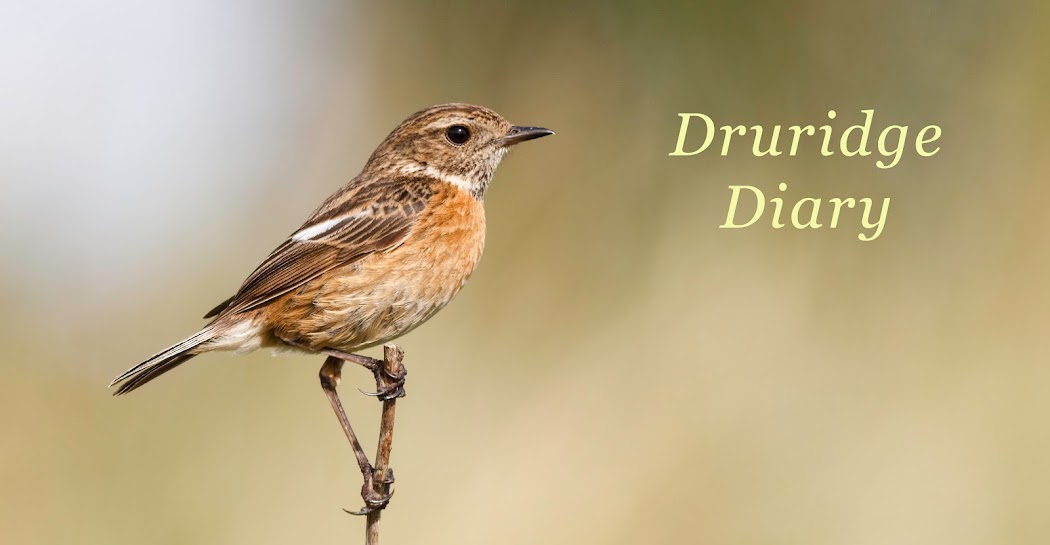
Female Stonechat along the Coal Road
Still about 20 Twite about in the dunes, with pink rumps on show!
A migrant - White Wagtail

Anyhoo, I did what I could and found a my first Lapwing chicks of the year. As I write this, the rain is lashing down, it's blowing a gale and it's freezing. I wish them well!

Finally, this weekend is the City Nature Challenge. ERIC the local records centre is coordinating CNC for the North East of England again. I really enjoyed last years event and got stuck in, submitting lots of records (including my first ashy mining bees and the northernmost in England at the time). This year, a combination of chores and shocking weather has meant less records submitted from me. Others have done well though.