More apologies for the lack of activity on the blog, but I have been down to Tarifa for the Raptor Migration, that's my excuse.
I arrived on the patch this morning with the intention of walking the whole place, not expecting to see much after a run of westerlies. I parked at the entrance and had a quick look in the plantation which was quiet - a few crests. Then I went back to the bushes by the entrance, the elders there are hanging with elderberries and I fancied that they might pull something in.
A few blackbirds, songers and robins and then I got onto a sylvia warbler, well, bits of one as moved low through the elder - I was 'lumbering' about and I fancied it was barred warbler but I needed better views.... Then a message came through about a white-billed diver passed Whitburn and a unidentified diver passed Newbiggin.
I legged it up to the dunes, as I clambered onto the dune ridge a bird flew of the wrack on the beach, calling - snow bunting, a male, flew straight over my head - nice.
Three red-throats came through together, then a minute or two later a larger diver. It was a canny way out and silhouetted against the rising sun - I had no chance. Shape-wise it was either a great-northern or a white-billed - I couldn't do any better with those views so back to the elder bush.
I got quickly on to the warbler, it was plucking elderberries from the front edge of the bush- a juvenile barred warbler. Typically bulky with well-marked 'panels' in the flight feathers, darker undertail and greyish upper and with that typical pose with it's tail held high. My first patch barred warbler since 2010 when I had two in the same autumn.
As I was watching it, a bird heading toward me from the north caught my eye. It was big and had an undulating flight, closing it's wings between flaps...woodpecker...but not a great-spot. It flew between me and the bushes I had been watching, GREEN WOODPECKER! It flew on towards the plantation and swerved into the trees, showing the lovely lemon-yellow rump as it went. I followed it in there but I couldn't find it again. A full-fat patch tick.
Martin Kitching had mentioned that he had seen a green woodpecker at Druridge earlier in the week, so surely the same bird? It makes up for missing the one that was on the feeders at the cottages a few years ago.
The barred was still there when I returned, I went to the car to grab the camera. As always happens with my camera, it disappeared for ages, before showing very briefly a couple of times, deeper in the bushes (a few folk had turned up by this point). I'd seen another sylvia warbler, whilst I was watching the barred which turned out to be a garden warbler, an increasingly scarce species at Druridge and my first on the patch since 2013. Jonathon Farooqi got a couple of shots of the barred warbler.
Since I got back from Spain the other highlight was a yellow-browed warbler on Saturday and Monday behind the Budge screen.
Green Woodpecker is my 245th species for the patch and my fifth new species this year.
Saturday, 7 October 2017


Monday, 4 September 2017
Scarce grebes
It's been a weekend of scarce grebes on the patch.
On Friday a juvenile red-necked grebe was reported on the sea to the south of Chibburn Links. I headed down there in my lunch break and picked up the grebe with a raft of scoter about half way between the Dunbar burn and Chibburn mouth. Red-necked grebes have always been scarce on the patch, my last was in January/February 2014 but most records on the patch have come from September and October. The species was more regular in the early 2000's, I saw them every year from 2002-2006.
Today a report came of a black-necked grebe on Druridge Pool, I trapped in the office so had to head down there when I got home, which I did. Colin and Jimmy were in the hide when I got there and were watching the bird and got me onto it. Another juvenile, it was hanging around with a group of tufties and coot on the edge before making it's way towards the floating island.
Incredibly, this is my first patch black-neck since 2005, when there was juvenile on the pool (there was also a red-necked grebe on the sea that day). I'd only seen two before that, A juvenile for a couple of days in August 2002 and an adult int he May of the same year.
This makes black -necked grebes scarcer than long-tailed skuas, spotted crakes, sabine's gulls and red-breasted flycatchers on the patch!
I've not see much else on the patch at the weekend, I was too busy buffing my marrow for the village show...
Sunday, 20 August 2017
Hard to spot crake
In case you missed it, it's been Birdfair weekend down at Rutland Water. I'm normally there with my work, in fact I haven't missed a Birdfair since 1999... until this year that is. It was becoming like groundhog day, same people, same places, same conversations... So I took a year off.
Quite often, when I've been down at the fair, there's been a fall of birds on the east coast, so it is about right that the year I don't go we have wall-to-wall strong south-westerlies. It wasn't all bad though, I took Friday off work and we were lounging about at home when a message came through that ADMc was watching a spotted crake in front of the little hide at Druridge. I was quickly on the scene and saw the bird for all five seconds through my bins before it darted left into thick grasses and wasn't seen again until much later that evening, by which time i was in the pub. Piss-poor views but enough to year-tick it.
Luckily it was picked up again this afternoon by Hector and I had much better views, brief as they were though as it crossed open ground between the clumps of soft rush.
This is my third 'patch' spotted crake. My first was in September 2002 which was found by Steve Taylor on the edge of the big pool. My second was found, but not identified, by a photographer who has snapped it on the old boardwalk in April 2013, it hung around for a week or so.
Offshore this afternoon there were 10+ red-throated divers, many still with red-throats, three arctic skuas but little else of note.
These butterflies were on the path...
 |
| Wall on knapweed |
 |
| Peacock on teasel |
We did some nocturnal ringing last Saturday for storm petrels. We caught one at 11.25pm - our earliest ever catch so we hoped for great things but it wasn't to be, it was another two and a half hours before we caught the second and final bird of the night. A few folk came down for a look, so it was nice to share these amazing little birds with them. Thanks to Cain Scrimgeour for this photo - if I had known I was in the shot, I might have smiled :-)
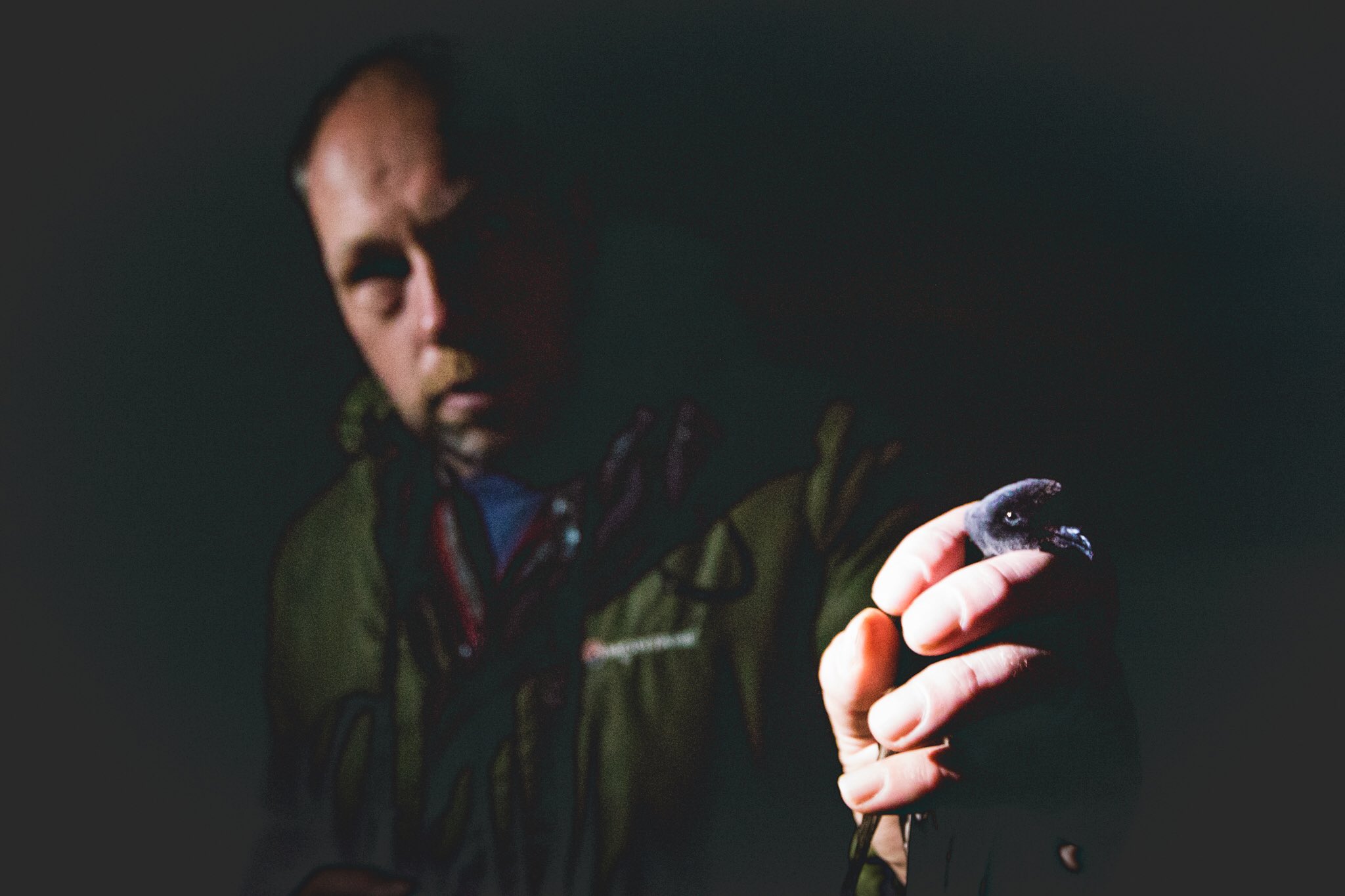 |
| Storm petrel (Photo: Cain Scrimgeour) |
Friday, 11 August 2017
White-rumped Sandpiper new for the patch
Well, 2017 has proved to be a great year for new birds on the patch, with three patch-ticks already this year and white-rumped sandpiper added to my patch list this evening making it four.
White-rumped sandpiper isn't new for the patch however, before my time, back in 1981 a white-rumper was found at Hauxley on 12th September which then relocated to Druridge Pool on 19th. It was only the third county record at the time. Any local birders remember this?
Today's bird was found on the Budge fields this morning by Dave Elliott seemingly who put it out on Twitter, but as he's blocked me I didn't see the tweet. It's the same bird first found at St. Mary's Island which then relocated to Cresswell Pond/beach earlier this week.
I was in my office by the time I heard about it and as no more news came out I didn't go and look for it. I was in the supermarket when I got a message from Jonathon Farooqi to say he was watching it from the Budge screen. Shopping was quickly done but I was held up by the damn self-service isle which wouldn't recognise the weight of my items, the woman who had to reset the machine was being particularly tardy which didn't help.
Shopping dumped at home, I headed for the patch and the Budge screen. It was empty, so I started scanning through the waders. It was all very frustrating with small groups of dunlin spread out, mostly hidden by the juncus. I couldn't find the bird amongst them and was getting worried, the light was awful which didn't help.
Something disturbed the waders and they all got up and resettled and I was joined by some other birders. Eventually I picked out a paler, greyer bird amongst the dunlin, it was asleep and partially obscured. I stuck with it and eventually got better views - it showed a broad off-white supercillium and the upper-parts were greyer than the juvenile dunlins it was with, but it was still head on. I was convinced I had the bird and then it wandered behind the juncus...
When the birds took flight again, we picked up a white-rump in the flock and were able to watch it back. It landed and gave us much better views, it was preening and showed the white rumped when it turned and spread it's tail. We watched it for another half hour or more in better light.
White-rumped sandpiper takes my patch list to 244.
Also on the fields tonight were 60-70 dunlin, 60+ black-tailed godwit, 2 ruff, juvenile spotted redshank and 30+ snipe.
Sunday, 6 August 2017
Waders and warblers
It's been a bit quiet at Druridge so I've not had much to write about. We spent a long weekend in late July in Cambridgeshire exploring the fens, looking for dragonflies and butterflies.
Waders have been a bit of a highlight this week with wood sandpipers, green sandpipers and a nice juvenile spotted redshank on the Budge fields along with plenty of snipe, dunlin and redshank. They can be very frustrating to see because of the rush cover. The birds were still present this morning with at least two of each of green and wood sands.
I didn't have the big lens with me so here is a dodgy-phone-scoped pic of the spotshank
We put some nets up this morning for a ringing session. We had a steady morning catching 30 birds in only three nets. Warblers formed the majority of the catch, with 18 of the 30 being willow warblers and all but four of these were juveniles.
We caught two scarcities for the patch - a lesser whitethroat which is barely an annual here and even more rare - a treecreeper! Only our fourth for the site, the last being in 2012 and previously in 2011 and 2008.
As neither of these species breed at Druridge, it is nice evidence that local breeders are on the move already - post juvenile dispersal.
Lastly, some sad news. In my last post I mentioned checking the egret nests. Well, there were three occupied nests and a fourth that was a probable. Sadly none of the chicks fledged, probably victims of the heavy deluges of rain we had whilst hey were still in the nests. The nests aren't substantial and are open to the sky, so the prolonged and heavy rain we had probably did for them.
Waders have been a bit of a highlight this week with wood sandpipers, green sandpipers and a nice juvenile spotted redshank on the Budge fields along with plenty of snipe, dunlin and redshank. They can be very frustrating to see because of the rush cover. The birds were still present this morning with at least two of each of green and wood sands.
I didn't have the big lens with me so here is a dodgy-phone-scoped pic of the spotshank
 |
| Dodgy phone-scoped shot of the juvvy spotted redshank |
We caught two scarcities for the patch - a lesser whitethroat which is barely an annual here and even more rare - a treecreeper! Only our fourth for the site, the last being in 2012 and previously in 2011 and 2008.
 |
| Treecreeper |
 |
| Lesser Whitethroat |
Lastly, some sad news. In my last post I mentioned checking the egret nests. Well, there were three occupied nests and a fourth that was a probable. Sadly none of the chicks fledged, probably victims of the heavy deluges of rain we had whilst hey were still in the nests. The nests aren't substantial and are open to the sky, so the prolonged and heavy rain we had probably did for them.
Sunday, 9 July 2017
A bit of ringing
Well, the bloody weather forecasters got it wrong again.
With thoughts of ringing this weekend, I've been checking out the forecast for this weekend since Thursday and it was constantly changing. By Friday night it looked like Saturday would be the better morning for ringing, dull with light westerlies, so I left home at 5am to set some nets up. When I pulled out of our street the wind turbines on the horizon were moving too quickly for my liking and it was glorious sunshine.
And so it was... bright and breezy with the wind out of the west. The worst conditions to ring at Druridge. I persevered, but gave up by 9am having only caught 6 birds.
Today was supposed to be bright and breezy again, but the wind was to be stronger and move more southerly. I didn't wake up until 7.30am (it had been a late night) and looked out of the window - still calm and overcast... I was at Druridge and nets up by 8am.
Despite the late start, I caught 20+ birds, mostly juvenile warblers.
There were two highlights. The first was catching a whitethroat that we first caught in July 2014 as an adult female - so the bird was at least five years old. Not a record by any means - the BTO record longevity record is seven years and nine months, but it does man that this little bird, weighing only 13 grams had crossed the Sarah desert at least eight times.
On Friday I popped down to the patch after work. Terns were feeding close into the shore including a handful of roseate terns, I even managed a photo of one of them.
Offshore, a good flock of common scoter has built up in the bay, numbering up to a thousand. They were dispersed into several smaller groups on Friday, here are some of them...
On the Budge fields there were two wood sandpipers, a little ringed plover and 15 black-tailed godwits. These waders were joined by a whooper swan on Saturday that has been knocking about on the bay. A water rail was calling from the corner of the big pool this morning and a few whimbrels were in the silage fields with the curlews
Ian Fisher and I have been checking the egrets and herons in the shelterbelt this year, we did our final check tonight but I'll write about the outcomes next time.
With thoughts of ringing this weekend, I've been checking out the forecast for this weekend since Thursday and it was constantly changing. By Friday night it looked like Saturday would be the better morning for ringing, dull with light westerlies, so I left home at 5am to set some nets up. When I pulled out of our street the wind turbines on the horizon were moving too quickly for my liking and it was glorious sunshine.
And so it was... bright and breezy with the wind out of the west. The worst conditions to ring at Druridge. I persevered, but gave up by 9am having only caught 6 birds.
Today was supposed to be bright and breezy again, but the wind was to be stronger and move more southerly. I didn't wake up until 7.30am (it had been a late night) and looked out of the window - still calm and overcast... I was at Druridge and nets up by 8am.
Despite the late start, I caught 20+ birds, mostly juvenile warblers.
There were two highlights. The first was catching a whitethroat that we first caught in July 2014 as an adult female - so the bird was at least five years old. Not a record by any means - the BTO record longevity record is seven years and nine months, but it does man that this little bird, weighing only 13 grams had crossed the Sarah desert at least eight times.
 |
| Five year-old whitethroat |
The second highlight was controlling ( this means catching a bird that has been ringed elsewhere) a reed warbler. We will have to wait to hear from BTO exactly where it was ringed. Reed warblers are a bit of a success story at Druridge. They started breeding in the little Phragmites reedbed in the south-east corner of the big pool about six years ago with one pair, before that they were a passage migrant.This year we have already ringed six breeding males and three females and today, our first juvenile of the year.
 |
| Controlled reed warbler |
 |
| Sandwich tern |
 |
| Sandwich tern |
 |
| Roseate tern |
Offshore, a good flock of common scoter has built up in the bay, numbering up to a thousand. They were dispersed into several smaller groups on Friday, here are some of them...
 |
| Some of the 1000 common scoter in the bay at the moment |
On the Budge fields there were two wood sandpipers, a little ringed plover and 15 black-tailed godwits. These waders were joined by a whooper swan on Saturday that has been knocking about on the bay. A water rail was calling from the corner of the big pool this morning and a few whimbrels were in the silage fields with the curlews
Ian Fisher and I have been checking the egrets and herons in the shelterbelt this year, we did our final check tonight but I'll write about the outcomes next time.
Wednesday, 5 July 2017
Patch Tick - White-winged Black Tern
A belated post about a patch tick.
A dead computer means I haven't been able to post about the latest addition to my patch list - white-winged black tern.
Saturday gone was a long day...
We were down at Druridge shortly after 5am for a ringing session - our first of the year. We had a good morning catching over 30 birds, mainly resident warblers and remarkably five reed warblers, all by the little the reedbed in the SE corner of the big pool. Reed warbler is recent colonist to Druridge Pools and seem to be doing very well, as they are at other wetland habitats in the county. A green sandpiper flew over the site first thing with swifts !
After packing up the ringing site and checking the heronry with Ian Fisher, I thought a quick check of the sea might be in order as others had reported skua activity. The light was awful and just as I was about to leave, a message about a white-winged black tern at Chevington came through.... Interesting.
I hung around, scanning inland when Twitter said it was at Druridge Pools. But where? Big pool or Budge fields?
I sprinted to the top of the big dune, my heart was pounding when I got there, figuring I could see the while patch from there. I was right and picked up the bird feeding over the Budge fields. And what a stunner it was - an adult white-winger in breeding plumage.
It flitted back and forth between the Budge fields and the big pool for an hour or more. Sadly no photos for me as my camera was in the car but others did well.
A bonus came on Sunday when I was scanning the sea and a message came through from Martin Kerby who was watching a pectoral sandpiper from the Budge screen. I was soon in the hide and watching the bird, albeit occasionally, as it moved through the emergent vegetation and stands of rush.
White-winged black tern takes my Druridge Pools list to 243, creeping ever-so-slowly towards that big 250!
Subscribe to:
Posts (Atom)