Friday, 1 May 2015

Waders, wagtails, wheatears and a weasel

A quick visit to the patch last night to check the Budge fields for waders and garganey with no luck on the latter.

There were a few waders on the mud. There were either four or five ruff, including a new orangey-brown individual (which was on the fields to the south this morning), two dunlin and black-tailed godwit. A whimbrel flew in as I was leaving, but seemingly over 100 whimbrels dropped in after 8pm.

Also of note were four pintail, two drakes and ducks, a pair of little egrets and white wagtail.

Another quick visit this morning produced my first yellow wagtail of the year, a nice bright male which was at on a fence only three posts from a kestrel. On the dunes, there were a few wheatears and this cheeky chap popped his head up before scampering off.

weasel
Willow warbler by the Budge screen
110 Yellow wagtail

Sunday, 26 April 2015

Football or birding?

On Saturday afternoon I had the choice - go to St James' Park and watch the Toon or go out birding. My patience with the regime at SJP is all but worn out, so at the last minute I abandoned my plans to catch the bus and went birding instead.

The birders I met at Druridge were very surprised to see me there I think. It proved to be a profitable visit to the patch - quite the opposite to a visit to SJP!

I stopped at the southern end of the patch to scan for hooded crow that had been reported the previous day. There were lots of carrion crows and jackdaws but no hoody to be seen. All of my Druridge 'hoodies' have been seen in mid-April. A couple of wheatears in the dunes were my first for the year though, so not all lost.

Next I headed for the Budge screen, where a wood sandpiper had been reported. A male blackcap was singing in the bushes on the way to the screen.  As I scanned the mud, I picked out three nice, summer-plumaged 'islandica' race black-tailed godwits and there were at least five ruff, including the striking black and white bird. Six whimbrel dropped in with some curlew.

A little egret flew in towards the Budge screen and began to feed, so I took some video of it ( click the 'turn on HD thingy for better resolution)


Little Egret from Iain Robson on Vimeo.

Whilst I had the camera on the tripod, a wood sandpiper type wader wandered across the mud in front of the little hide, so I had a wander over there.

From the little hide the wood sand could be seen much better, but it was still frustrating because of the amount of rush on the pool.

A walk through the bushes by the big pool produced two or three singing sedge warblers and singing common whitethroat, which was ringed.

There were still 50+ red-throated diver on the sea and at least 20 red-breasted mergansers. 

103 great northern diver (from Wednesday)
104 blackcap
105 wheatear
106 wood sandpiper
107 sedge warbler
108 whitethroat

PWC Score = 129

Sunday, 19 April 2015

One hundred and counting...

A little flurry of migrants lifted my patch year-list to 100 species today.

I was out on the patch for a short ringing session n Friday morning, the first of the year. With only two nets up I caught a few birds including three willow warblers and chiffchaff. 

willow warbler - first bird ringed on the patch in 2015

Whilst checking the nets, I had a whimbrel fly over and a very early reed warbler was singing in the little reed bed in the corner of the big pool. Offshore there were 47 red-throated divers and 26 red-breasted mergansers on the sea - both good counts. There was also a handful of puffins on the sea, a common tern and fulmar as fly-through's were all new for the year.

Today was WeBS count day. I was sure I was going to  a garganey or an avocet, but I was disappointed, however, the first bird I saw was a little egret, just in front of the hide, which was my first of the year on the patch. 

There were only four wigeon left on the Budge fields, still a few teal main though with about 30 or so, they'll be gone soon and at this rate, shoveler will replace them as the commonest duck on the patch - there were 19 today. There was a pair of great-crested grebes on the big pool.

Whilst I was counting ducks, two or three house martins were feeding over the Budge fields - my first of the year.

That little flurry brings my patch list up to 100 for the year.

93 willow warbler
94 reed warbler
95 whimbrel
96 puffin
97 common tern
98 fulmar
99 little egret
100 house martin

PWC Score 118

Saturday, 4 April 2015

Natural Causes or Suspicious Circumstances?

I had a short wander around the patch yesterday afternoon. I walked back along the beach and made a diversion through the plantation.

My pleasant afternoon was spoiled by this gruesome discovery...


A dead barn owl. It looked as though it had been dead a while, it was quite smelly and I disturbed a sexton beetle when I turned it over. It was a second calender year male and was wearing a BTO ring, it had been ringed by me as a nestling in June 2014 at a nearby farm.

I knew that an owl had been using the plantation as there has been pellets under a tree for a few weeks.

So, what caused its demise? Well it could, of course, be natural causes. It may have also ingested some poison destined for something else or it could have been shot.

This isn't the only owl to die in odd circumstances at Druridge recently.

On 5th May, last year, I caught a long-eared owl in a mist net, an adult female with a brood-patch We received information back from BTO that it had been found at 'Druridge Bay' 12 days later, without a head.


It isn't unusual for mammalian predators to remove heads of prey by shaking them, foxes and dogs for example would do this. What would be unusual, would be for a mammalian predator to catch a long-eared owl. My suspicion was that this bird had been shot. I tried to find out more about the circumstances in which the bird was found, but didn't get anywhere.

Lads with guns are regularly seen at Druridge, mostly after rabbits. Some of them, however, fall in to the 'shoot anything that moves' camp. I've always been reluctant to call the police as, because the incident involves a firearm, they send the armed response team. I have spoken to the local Police wildlife crime officer about this and he encouraged me to give them a call, at least with information.

If you are at Druridge and see lads with guns, give the police a call on 101 and take down as much information as you can. They will be on National Trust or the next-door farmers land and they haven't got permission to be on either.

On a more positive note. There were eight yellowhammers at High Chibburn today in a mixed flock with tree sparrows and reed buntings. I only saw one yellowhammer at Druridge last year.

A sand martin was at Hemscotthill on my way home, but none on the patch yet.

sparrowhawk 84
yellowhammer 85

PWC 2015 Score: 98
Friday, 3 April 2015

Good Thursday

I took a day off work yesterday and I'm pleased I did, as the weather today (Good Friday) is awful. It was bright and sunny but the  wind which moved from north-west through north to north-east whilst I was there, was very cold, making it feel like winter.

I set off to Druridge hoping to see some returning migrants..sand martin, black-tailed godwit, garganey, sandwich tern, wheatear maybe? Maybe even some something more scarce like an osprey or ring ouzel?

I was disappointed.

Other than a signing chiffchaff, the only 'migrant' was a smart male white wagtail amongst the beast in the dunes north of the bushes.

There are still about 30 teal and wigeon on the Budge fields and a few shovelers. A single dunlin was 'new-for-the-year' it was with a handful of snipe and a redshank.

Other than canada geese and mute swans, there was only tufted duck and gadwall on the big pool. Nearby, this robin was collecting nesting material - at least the robins think it is spring.

Robin with nesting material
Out in the dunes, the stonechats seemed to be paired up. There was a flock of about 30 linnets in the dunes where the beast are fed, with a few goldfinches and a pair of grey partridges.

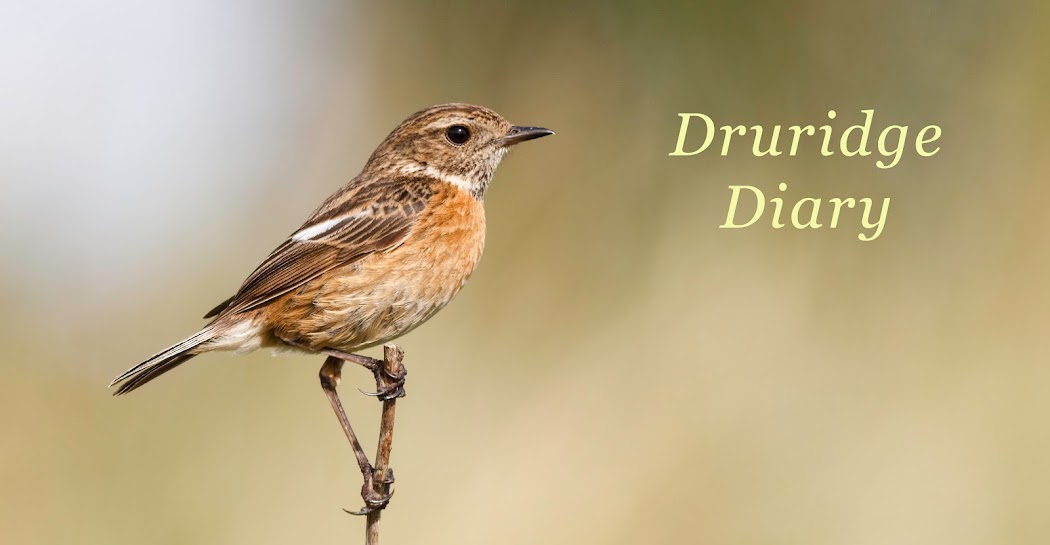
female stonechat
About 15 sanderling were on the beach, these could well be returning birds. Offshore, a pair of eiders were a year-tick but there were not terns and I still haven't seen a lesser black-back!

Looking back toward the preceptory, there was a 'kettle' of four buzzards, they soon split off into their respective pairs and parted company.

82 dunlin
83 eider

PWC 2015 Score: 96


Sunday, 29 March 2015

Old Sqauw

I've managed about an hour on the patch this weekend with a brief stop yesterday and a bit of wander today.

I've been checking the Budge fields for garganey but they're not back yet. Two or three chiffchaffs were back and singing today but no other new migrant passerines were added to the list. There are still 50-60 teal and wigeon on the fields - they'll be off soon.

Offshore, there were 22 red-breasted mergansers in the bay, I'll need to check my database but that could be a patch record count. Even more exciting than the mergs was a drake long-tailed duck, first picked up among some distant mergs then picked up flying north. It was a stunner, in full breeding nick.

Alongside the chiff and the 'old squaw' tree sparrow on Wednesday takes the patch list to 81 species for the year.

Sunday, 15 March 2015

Belated WeBS

I'm still struggling to get down to the patch, too many household chores to be done and now I have car problems.

I popped out on Saturday morning to do a belated WeBS count, the early core-count date caught me out this month.

There are still a about 90 wigeon and 60 teal, mostly on the Budge fields, with about 12 shoveler. The curlew numbers are high with at least 75 on the Budge, so they haven't left for the hills yet.

There are still over 60 lapwing, however one or two of them were well away from the main flock and were looking territorial!A pair of oystercatchers were looking territorial on the floating island on the big pool - as were several Canada geese, I know who will win that!

I was hoping for a signing chiffchaff but was disappointed, There was a pair of goldcrests flitting through the bushes, now this is most unusual. Goldcrest are normally an autumn species at Druridge, rarely seen in winter or spring, but I have seen them on-an-off since January this year. This pair were every 'together',  I am haven't recorded goldcrest breeding on the patch, so if they do breed, it will be a new breeding species for the patch.

Greylag goose was my only addition to the patch list, which now stands at 77