Showing posts with label magpie. Show all posts

Friday, 7 August 2020

Ringing related

Janet and I set some nets up at Druridge this morning to catch and ring birds. An early start at this time of year is required as the birds tend to go quieter mid morning when it warms up. It was already T shirt temperatures at 5am!

We caught steadily until 10am when it tailed off and we were packed up shortly after 11. We caught 46 'new birds', re-trapped eight birds and controlled one bird. 

We mostly caught warblers and they were mostly this years young and were mostly Willow Warblers. The first bird that we caught was a juvenile Lesser Whitethroat, I caught a female with a brood patch back in June so I presume this juvenile was one of hers. Willow Warblers were still singing and that was reflected in the fact that we caught 14 in total including this bird which was already ringed but with a French ring. It was an adult, but really fresh having almost completed its main moult. We'll wait with interest to hear back from the French ringing scheme.

French-ringed Willow Warbler

 Interestingly we didn't catch any Sedge Warblers but they are still around. A single Reed Warbler was carrying a lot of fat indicating it was on migration.  We caught a few of Robins and Wrens which we were sure were all local birds.  A sign that autumn is here was a Redstart - a lovely adult male that was just completing his main moult. 

Male Redstart
Male Restart showing tail

A Cuckoo was seen in flight when I arrived and  I noted a lot of Swifts heading south at first light.   

We've heard back from BTO recently with some news of birds ringed or re-trapped elsewhere. A Whitethroat and Reed Warbler that I ringed at Druridge were later caught at by Ian Fisher at East Chevington and I caught one of 'his' Blue Tits. More interesting was a Reed Warbler that I caught on 9th June that had been ringed at Titchfield Haven Nature Reserve in August last year, it was ringed as an adult  so had already crossed the Sahara at least four times by the time I caught it at Druridge. 

I've had a walk on the patch every morning this week. Willow warblers have been evident all week and I am sure some of these are passage birds. yesterday, particularly, was good for butterflies with eleven species noted before 9am!

Looking south on Thursday morning

And North - zoom in and you will see the flying ant swarm

Fly-by adult Magpie in 'main moult'
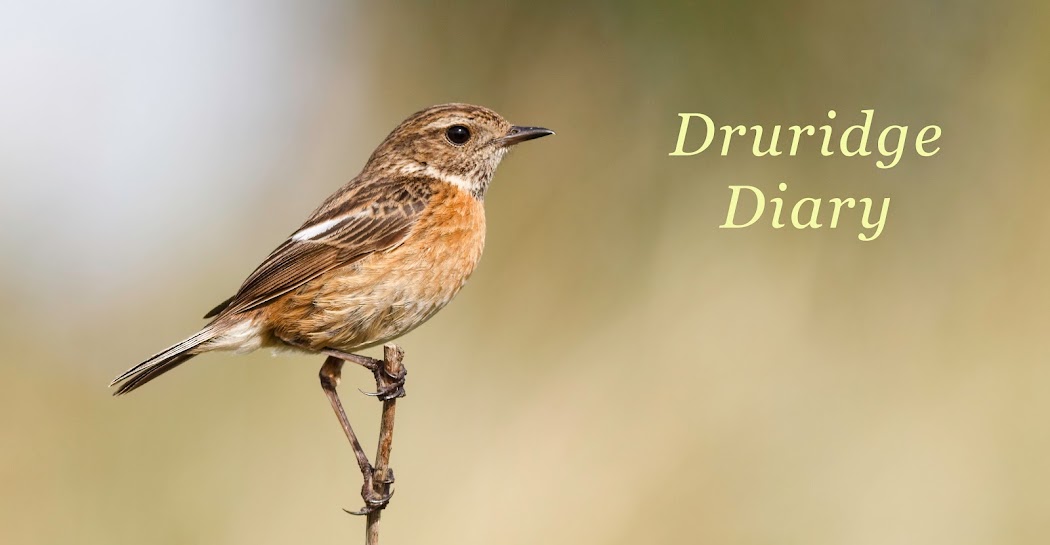
Juvenile Stonechat on the Coal Road


Small White butterfly
Small Copper butterfly

Sunday, 14 October 2018

Long day on the patch

Last night, the forecast for today was rain - all day.

So this morning, we didn't set an alarm, when we got up it wasn't raining and it was calm. The forecast still predicted showers, but we headed down to Druridge and put some nets up, you've got to make the most of any chance in the autumn. Whilst we sorting the nets, the sky was full of pink-footed geese - easily 6000 passed over. A small flock of about eight brambling flew south and a yellow-browed warbler called form the bushes by the car

There were a few showers, but they didn't really come to much, we furled a couple of nets early on but continued ringing with three nets up for the whole day. It was worth the effort, as we caught 60 birds in total of 14 different species.

Of note was a flock of lesser redpolls - we caught 10 in total, all within an hour, I think they were just passing through.

Lesser redpoll - a nice pink male
We caught a very late willow warbler (rare beyond September at Druridge), two chiffchaffs and five blackcaps. One of the blackcaps was female that we first caught in the spring as breeding female, she must've nee ready for the off as she had built up a large amount of fat (migratory birds build up fat ahead of migration).

Late willow warbler
male blackcap
female blackcap
Despite the huge arrival of thrushes yesterday, they must've all gone straight inland as we only caught two song thrush and redwing today - one of the song thrushes was a retrap, Tom Cadwallender and I caught it in October last year as first-year bird. I wonder where it's been since?

Redwing
Also of note was a magpie - Not everyone's favourite species and some it will probably end up in the farmers larsen trap. It was a first-year bird and only the second we've ever caught at Druridge. Despite they're reputation amongst 'country folk' they are incredibly intelligent and very beautiful birds.

Magpie - only the second one we've caught at Druridge
Bizarrely, we also caught our first wren of the year today. Last year we caught more wrens than any other species, but the 'beast from the east' wiped them out and there were no breeding bird at Druridge this year. The five we caught today will be post-breeding dispersers from elsewhere.

wren - first of the year!
Today was also WeBS count day. As the Budge fields are still pretty-much dry it didn't take too long and there wasn't much of note.

As I was packing up the nets at about 4pm, the skies cleared and the sun came out. I stopped by the plantation and birded until nearly 6pm. Most of that time was spent trying to get detail on a grey-looking phylosc in the sycamores. It was really tricky to get decent views, but it was a chiffchaff, very grey/off-white below and grey above apart from green in the wings - it looked like a Siberian chiff,  it eventually called and gave its ID away as just that. I only managed a very poor, arse-end photo.

Monday, 8 October 2018

Two walks

The weather wasn't suitable for ringing at the weekend, which is probably just as well as the bushes seemed to be devoid of birds. It looks as though there might be a hint of an easterly wind by Sunday.

So on both Saturday and Sunday I walked the full length of the patch.

On Saturday there were some signs of autum. Skylarks were almost constantly overhead and when I checked the plantation I found coal tits and goldcrests - both autumn species on the patch and in the dunes to the north there were five or six dunnocks with at least ten reed buntings feeding in the weedy patches.
Coal Tit
Coal Tit
 A single whooper swan flew north as I headed for  the beach and my return to the car. Offshore,  a black-throated diver flew north, quite close in, close enough for photos. There were a few red-breasted merganser close in shore and this guillemot was very close, even for a photo. I think this is the first guillie I've photographed on the patch.

Guillemot
On Sunday I did the same route but in the afternoon, once the rain had cleared, and as a result it felt quieter than Saturday. As I walked north I heard the 'yick-yick' of a great-spotted woodpecker, it was flying over the dunes from the sea as soon as it cleared the dunes, it dived straight into the nearest bushes out of sight and probably to rest, as it is highly likely it had just crossed the North Sea from Scandinavia.

On reaching the dunes at the north of the patch, where the reed buntings were still feeding in the weedy bits, I headed for the beach, which was empty  - of birds and people until I got to the southern end where this common gull was on it's own and a single carrion crow was mooching about.

Common Gull

Carrion Crow
Offshore,  I got onto a raptor high and quite far out, maybe 300 meters or more, it was a peregine and was just circling - someone suggested it could have chased a bird out to sea and it was waiting to pounce when the bird returned to land.

Magpie - Another species I don't often photograph


Tuesday, 14 August 2018

Midweek ringing and news from the BTO

I had a well-earned day of flexi-leave today and as the weather forecast looked good, I decided to put some nets up at Druridge. Despite conditions being good for ringing, ti was a very slow start and by 8.30am I'd only caught four birds. Things did pick up a bit later and by the time I packed up at 11.30 I'd caught 14 birds -  all this year's youngsters:-

Six willow warblers, four blue tits, two great tits one blackcap and most unusual  - a treecreeper.

Treecreeper (iPhone shot)
This is only the fifth treecreeper we've caught at Druridge. The first was in October 2008, then 2011 and 2012 which were both October birds, we caught one last August and then this one. These August birds are a classic example of post-breeding dispersal. Treecreepers often travel about with roving tit flocks at this time of year so it wasn't a surprise to find this one in the net next to a blue tit.

Also of note today, two female-type goosanders flew south and on the Budge fields there were three greenshank, five ruff, two black-tailed godwit and handful of dunlin. A female sparrowhawk came through the waders and carried what looked like a dunlin off for a spot of lunch.

As I was packing up, I heard a strange noise beyond the path to the hides - so I investigated. I got quite close to where it was coming from when, probably the same female sparrowhawk, flew out past my ear. As I approached where she'd came from, a young magpie, looking a bit shaken, flew up from the ground. I investigated further and found a handful of freshly-plucked feathers. That magpie will never be as lucky again.

We had news back from BTO today of the reed warbler I caught in June which was already ringed (read about it here). It had been ringed as a juvenile almost exactly a year earlier by Ian Fisher at East Chevington which, on the face of it, isn't far, that little bird had been to sub-Saharan Africa and back since then.

Monday, 6 June 2011

A nicer day altogether

This morning started bright and sunny and I was up early to do the last but one territory mapping thingy. There was still plenty to record on the breeding front, there were a few family parties of birds and some independent fledged young, some pied wagtails and  these stonechats.

juvenile stonechat - not from the brood we ringed
The grasshopper warblers have started singing again, they sing when they arrive, then go quiet whilst they are on eggs, then, when it is time for a second brood, they start reeling again. I recorded two pairs of grasshopper warblers this morning. This one was doing its dinger.

Doing its dinger - gropper in full reel
quiet..briefly
This magpie was nearby, probably looking for freshly fledged gropper chicks.

hungry-looking magpie
A female yellow wagtail was a nice find. The male linnets are looking very smart at the moment, but it is difficult, nay impossible, to record territories for them as they are hanging about in one big flock of about 35 birds. Still plenty of sedge warbler, whitethroat and blackcap activity.

smart black-headed gull

gratuitous cute bunny shot!

Sunday, 6 March 2011

Magpies are nice - honest!

Sometimes, it is east to glance over some of our more common birds, forgetting how beautiful they are. How many times do you think "Oh, it's just a blue tit/swallow/teal etc"

I was pondering this whilst admiring a rather smart magpie, strutting around the Budge fields this afternoon. Often despised by gamekeeper and conservationist alike, there is no getting away from the fact that magpies are  stunning birds. The sun was catching this particular individual in all the right places, showing its glossy green tail and iridescent blue rump. They are cheeky characters too, which does make them hard to dislike, even if they do eat lapwing chicks.


I spent the morning at Ellington Pond, putting up some tree sparrow nestboxes, so didn't get to Druridge til gone midday. Today was a lovely, sunny, spring day, which brought out lots of people to visit the coast. My short visit brought an unexpected haul of new birds for the year.

Small birds are still thin on the ground, a lone dunnock singing at High Chibburn was the first of the year on the patch and only one wren and one robin were logged. No sign of either meadow pipit or stonechat yet.

A pair of mute swans and a little grebe on the big pool made it on to the year list. There are a few smew in the County at the moment including a couple of drakes so I was hoping for one of them, sadly not. They'll no doubt turn up when I am work during the week!

A quick seawatch was productive as kittiwake and fulmar both flew by and a slavonian grebe was close in, the latter, a scarcity at Druridge, which can be missed in some years.

72 mute swan
73 little grebe
74 kittiwake
75 fulmar
76 slavonian grebe
77 dunnock