Showing posts with label eider. Show all posts

Friday, 17 July 2020

The post that doesn't stop giving

Thought I would mix things up on Thursday evening.

I started at 'The Post'  - and had frustratingly brief views of both Coelioxys elongata and Megachile versicolor but not long enough to photograph them, the latter is going into the back of the post and there is a collection of 'leaf bits' to signify this.

I also had a new wasp on the same post which I think is Ancistrocerus scoticus, intriguingly I also had a ruby-tailed wasp species on the same post which I also failed to capture. The ruby-tailed wasp species Chrysis ignita parasitises on A. scoticus - the plot deepens!. The Fork-tailed Flower Bees were still going about their business. The post that never stops giving.

Ancistrocerus scoticus?
I had a wander up the path to the hides and found some hoverflies and an interesting cranefly, spider and ladybird.

Syrphus ribesii (female)
Platycheirus albimanus (female)
Melanostoma mellinum (male)

Spotted Cranefly Nephrotoma appendiculata -  I think
Spider - ID tbc
14-Spot Ladybird  - Propylea quatuordecimpunctata
I had a wander through the bushes and disturbed a family of roe deer. The 'youths' were funny - making a sneezing, yet squeaky noise to the female who was close by, I made some squeaking noses back and one of the youngsters came a bit closer before scampering off. I also disturbed a roosting Asio owl species, presumably on of the short-eared owls that have been seen regularly recently?

Young Roe deer
The clouds rolled in and the temperature dropped so I dropped the macro lens -  for the 400mm and scope and headed for the dunes (still fantasising about that albatross) . Offshore there were a few hundred common scoter - they seemed disturbed and were constantly on the move, a single drake velvet was among them. I was just about to go home for tea when the clouds parted and the light was superb. Terns were feeding close to the shore so I went for a closer look...

Sandwich  tern
Arctic Tern
Arctic Tern
Common Tern 
Passing eiders
Sanderling - still showing some breeding plumage
Thousands of jellyfish on the beach

Friday, 3 April 2015

Good Thursday

I took a day off work yesterday and I'm pleased I did, as the weather today (Good Friday) is awful. It was bright and sunny but the  wind which moved from north-west through north to north-east whilst I was there, was very cold, making it feel like winter.

I set off to Druridge hoping to see some returning migrants..sand martin, black-tailed godwit, garganey, sandwich tern, wheatear maybe? Maybe even some something more scarce like an osprey or ring ouzel?

I was disappointed.

Other than a signing chiffchaff, the only 'migrant' was a smart male white wagtail amongst the beast in the dunes north of the bushes.

There are still about 30 teal and wigeon on the Budge fields and a few shovelers. A single dunlin was 'new-for-the-year' it was with a handful of snipe and a redshank.

Other than canada geese and mute swans, there was only tufted duck and gadwall on the big pool. Nearby, this robin was collecting nesting material - at least the robins think it is spring.

Robin with nesting material
Out in the dunes, the stonechats seemed to be paired up. There was a flock of about 30 linnets in the dunes where the beast are fed, with a few goldfinches and a pair of grey partridges.

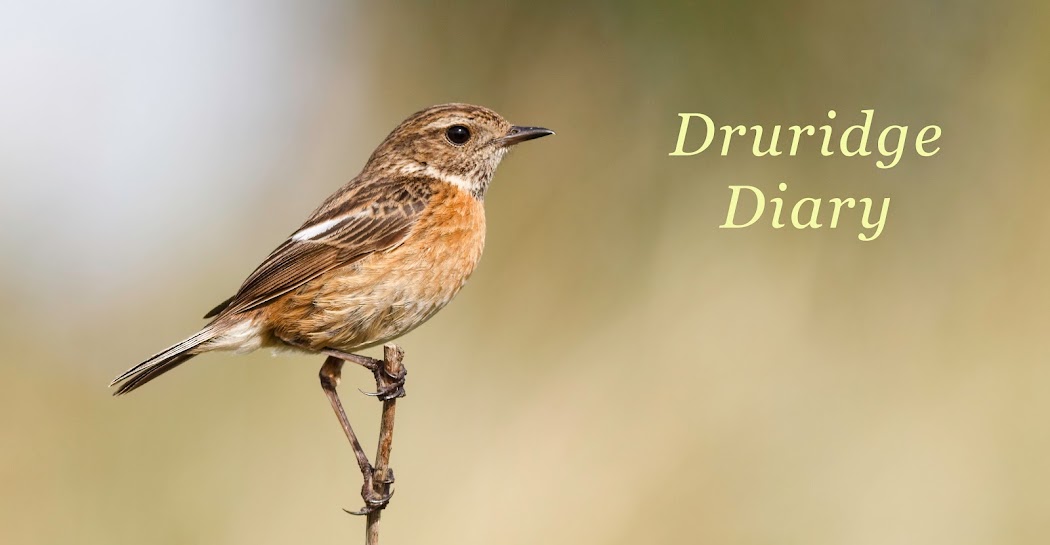
female stonechat
About 15 sanderling were on the beach, these could well be returning birds. Offshore, a pair of eiders were a year-tick but there were not terns and I still haven't seen a lesser black-back!

Looking back toward the preceptory, there was a 'kettle' of four buzzards, they soon split off into their respective pairs and parted company.

82 dunlin
83 eider

PWC 2015 Score: 96


Thursday, 24 February 2011

coppicing

The National Trust had a group of volunteer in coppicing the trees at Druridge recently. Well I say coppicing, to be honest its more like a cross between coppicing and pollarding - a hybrid technique.

Recently coppiced/pollarded alders

The reason we do this semi-pollard/coppice thing is two-fold. Firstly, it stops the rabbits eating the regrowth, secondly, it provides safe nesting 'cups' for birds amongst the new stems, clear of the ground.

It looks brutal at first, all of the trees hacked down, but this is essential work. My territory mapping exercise last breeding season proved this. The number of species and number of territories was higher in the recently coppiced areas. The strip of trees and bushes at Druridge is primarily alder and hawthorn, with ash, willow and some whitebeam with other oddities.

If left, the alders would get quite high, the only birds that would nest would be magpies and crows, the height would further limit the area of the Budge fields for breeding waders. I'm off tomorrow, so were going down to Druridge to a bit more coppicing, it grows so quickly once it is cut, we can't get round it all quick enough!

Alder is quite pale colour straight after it is cut, but it soon turns this lovely orange colour.


Bright orange brightens a grey day at Druridge
 Today wasn't so grey, by far the warmest day of the year so far. My work took me to Seahouses where the drake eiders are looking rather resplendent in their breeding plumage!

drake eider looking rather dapper