Showing posts with label ringed plover. Show all posts

Saturday, 1 January 2022

Tradition dictates

Tradition dictates that on my first visit to the patch of the year, I'll find a species that I hadn't seen on the patch in the previous year. This happens most years. And guess what? It happened again today.

I've not seen yellowhammer on the patch since 24th November 2019 so to find a flock of eight in the hedge behind Druridge Farm was a real surprise.  I was beginning to think that they were locally extinct.

Today was unseasonably mild, 12 degrees C, but it was very windy from the SW. Janet and I had a good wander around the patch and managed to see 53 species in total. Highlights included a southbound great northern diver offshore, two woodcock flushed from the bushes, at least 300 Linnet and 200 chaffinch in the dunes and eight stock doves.

There was a lot of people though. It was like a July Sunday with cars abandoned at the site entrance and hundreds of people on the beach. 
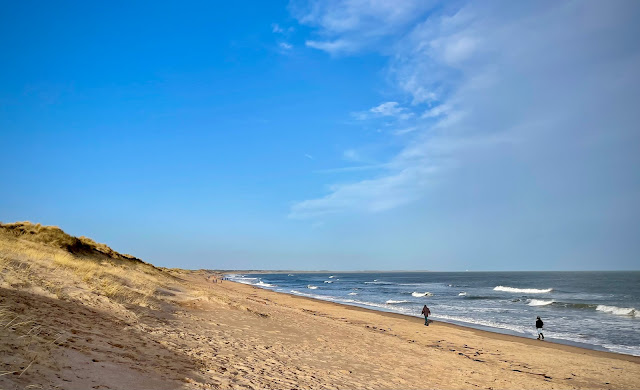
The beach was busier than it looks in this photo!

The ringed plover flock that roosts on the beach at the south of the patch had no chance to settle and just flew back and forth, looking to rest. 
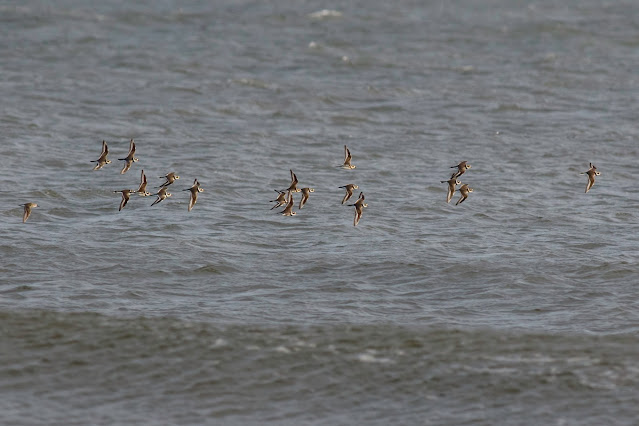
Ringed Plovers looking for somewhere to rest - no chance today.

I finished 2021 on a credible 167 species for the patch, which, given how poor an autumn it was wasn't too bad. Usual autumn stuff like pied and spotted flycatchers, garden warber, yellow-browed warbler, redstart and whinchat all missing from my list.

I also concentrated a bit more on the 5km patch challenge because of covid-lockdown. I saw 191 species within 5km of home which was nine more than the next patches. Ellington is obviously a good place to live if you're a birder. I'll continue with the 5km challenge this year as it does add a bit of variety to my birding.

I'm hoping to keep the blog updated more regularly too. My work/life balance needs some adjustment I think.
Today's list on eBird


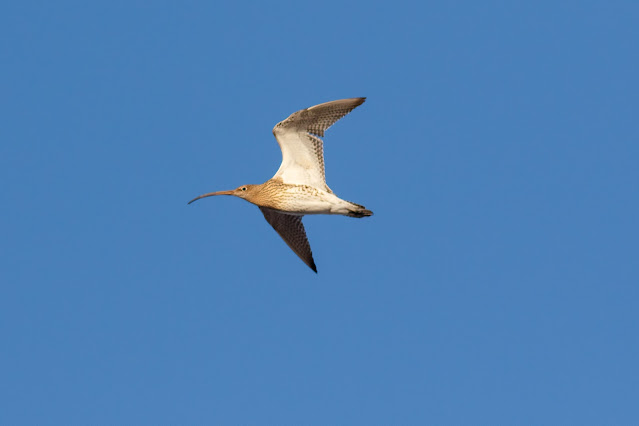
Passing Curlew


Sunday, 17 October 2021

Tystie, tystie, very, very tystie

Twists of fate led to a full-fat patch tick on Friday.

Firstly - I wouldn't have normally been at Druridge on a Friday lunchtime. I'd have been at work. A good friend from Malta, Justin Vassallo, was visiting so I took the day off to take him birding. Justin is a legend - he started the first Maltese Raptor Camps in 1999, when he was only 19. I met him in 2001 when I went to my first of four raptor camps. We've been friends ever since. 

Secondly - We'd spent the first part of the morning seawatching at Snab Point so wouldn't have ordinarily gone back to look at the sea. We were in the little hide at Druridge when a couple of visiting birders told us they had seen two great northern divers with a single red-throated offshore - A chap had put them onto them. We retrieved the scopes from the car and headed up there. The 'finder' wandered off when we arrived. No sign of the GNDs but there was enough to look at so we stayed a while.

And that's how I happened to be in the right place at the right time.

We counted at least 20 red-throats on the sea, 160 common scoters, large auks, red-breasted mergansers, three scaup, great crested grebes. All good stuff for a Maltese birder. After 30 minutes or so of scanning, I picked up an auk headed north, already north of us - big white wing patches stood out immediately on an otherwise black and white 'motley' auk. Justin was looking south when I called it  - Black Guillemot! Despite my best efforts I couldn't get him onto it before it disappeared into a trough and was lost to sight. Given the scaly-dusky-ness of the bird I think it was a first-winter rather than a winter adult. 

I suppose 'tystie' is overdue as a patch bird and I shouldn't have been unexpected but it certainly wasn't on my radar for Friday - given reports from elsewhere, great shearwater or white-billed diver would've been more likely. So,  a pleasant surprise. Tystie takes my patch list to 253 and the patch list to 272.

We retired to the Drift Café for lunch and a celebratory beer.
Justin and me - celebrating a few lifers for him and a patch tick for me with a bottle of Curlew Return each

Elsewhere on the patch, late common darter and migrant hawker dragonflies were on the wing and three mistle thrushes were around the farm. Four barnacle geese were new for the autumn.

One of many common darters

Mistle thrush - not common on the patch

After the excitement of Friday, Saturday was a bit more mundane. 

It was a grey day, no wind, just flat... as was the birding. I decided to have a look on the sea. The sea was flat too. There was steady, northerly, kittiwake passage and three little gulls lingered offshore. A single female scaup came in with a red-breasted merganser and two turnstone flew north. 35 red-throated divers were on the sea, eight flew north and one went south.  

Coal tit in the plantation on Saturday

Today, Janet and I walked north from the plantation and back by the beach. The bushes were VERY quiet. The three mistle thrushes were still about. On the beach, a single rock pipit feeding on the seaweed north of the Dunbar Burn was a year-tick. Rock pipits are tricky at Druridge so it was welcome. 

Rock pipit

Carrion Crow on the beach

Razorbill - still a few auks feeding close inshore


Ringed plovers from last week

A sizeable (250+) flock of finches roamed about the dunes, I think 85-90% of them were linnets. No twite yet. 


Sunday, 15 November 2020

A record-breaking year

Five Scaup flew south during my afternoon seawatch today - nothing unusual there, but these Scaup were a year-tick, 175 for the year and a new patch record!

The previous record of 174 was first set in 2016 and matched again in 2017 and I've been stuck on 174 since 28th October this year. This year has been a record-breaker for a lot of patch-workers and year-listers, it has been a good autumn which will have helped but for me, it's been the COVID restrictions and working from home that have made the difference, despite missing two months on the patch between March and May (and a Hoopoe)

Since lockdown was eased and I could get back to the patch, I've hardly missed a day. Working from home means I can get out for a walk on the patch before work. If I was going into the office, I'd have to have a shower, iron a shirt, have breakfast and commute to the office. Nowadays, I finish birding, grab a slice of toast and switch my computer on. Taking a walk before work also makes me ready for work more than crawling out of bed and straight to work would. I'm not looking forward to next week (or maybe the week after) when it's too dark before work and I switch to lunchtime walks but at least I'll still be on the patch. 

There's still a few possible species and 180 could be achievable?

Black-throated Diver, Little Auk, Water Pipit, Yellowhammer, Collared Dove, Spotted Redshank as well as outsiders like a white-winged gull, Bean goose, Green-winged Teal, Great Egret or even a Waxwing are possible.

Also on my seawatch today I had a dark juvenile Pomarine Skua headed south, A November Pom! It was beautifully-lit in nice light about half way out, the low sun making it look a bit gingery, more like an Arctic but the deep wingbeats, powerful flight and pot-bellied all pointed to Pom. Med Gull, a few Gannets and good count of 26 Red-throated Loons was also notable. 

There has been a good high-tide gathering of Ringed Plovers on the beach opposite the plantation lately, Janet and I counted 41 yesterday and there were about 30 today. The beach was so busy with people and dogs, they could hardly land before being pushed back out, but they always returned to the same place. Seawatch list

Some of the ringed plover on the beach on Saturday

It was also WeBS today, it was quiet though with very few waders or ducks - 163 Wigeon was a canny count   - full list here. 

Birding has moved into winter mode - other than a few Blackbirds and Redwing hanging on, the last-gasps of autumn, it feels like winter now. 

It's been good for Bullfinch this week and this year in general. Three females fed by the road earlier in the week and we had three males beyond the hides today - so that's six different bullies.

Sorry for the lack of photos, it's been so dark in the mornings I've not taken any, other than this dead eel on the beach. 

Dead Eel

The forecast for the tail-end of the week looks like strong northerly winds coming right out of the Barents Sea. I feel a seawatch coming on. 

Wednesday, 17 June 2020

A nice selection of waders


There was nice selection of waders on the Budge Fields this evening. At this time of year I can never work out whether these birds are late migrants, failed breeders returning or non breeders just making the journey.

Wood sandpipers and green sandpipers, two of each, were the highlights and nine black-tailed godwit, 15 redshank, 7 avocet (including chicks), two dunlin and two ringed plover made up the supporting cast.

No photos of anything from tonight as it was very foggy...again.

I had a quick look offshore last night for an hour at dusk. The scoter flock on the sea had swelled to something around 700! I was working my way through them, having picked up two drake velvet scoters when I came across two smaller ducks at the edge of the flock. They were about half to two-thirds of the size of the scoters with pale underparts, they were on their sides, both having a good preen. When they finally stopped preening, I got a better look at them, but only briefly as two very loud scrambler motorbikes arrived on the beach and sped towards the tideline, flushing the entire flock. They were small-billed with pale cheek patches and darker crown. From my limited view of them I can only think that they were two non-breeding 2nd year long-tailed ducks.

If you aren't interested in hoverflies, you can stop reading this now.

Here are some hoverfly photos from Sunday as promised:

Scaeva pyrastri (male)
Eupeodes Sp.(male)

Rhingia campestris
Eupeodes Sp 
Marmalade Hover Fly - Episyrphus balteatus


Marmalade Hover Fly - Episyrphus balteatus

Platycheirus albimanus (female)

Platycheirus sp (female)
Eristalis tenax (m) - head-on. Zoom for detail!
Eristalis tenax (m)

Saturday, 8 March 2014

Still like winter

Despite the news claiming that temperatures would hit 15 degrees today, it still felt very much like winter at Druridge this morning. 

Ornithologically, it still felt like winter too, other than for a singing skylark. Still pink-footed geese in the fields, big flocks of goldfinches in the dunes and good numbers of curlew about.

So no 'real' spring migrants on the patch yet. My earliest ever wheatear at Druridge was on March 10th (2010), so it's not too early for something to turn up.

As well as a good walk about today, I also called in after work yesterday. Ian Fisher had tipped me off about a pale-bellied brent goose in with the pinks in the front field and it was till there yesterday.

I had a look on the sea, there were 100's of black-headed and common gulls, but I couldn't pick anything unusual out amongst them, as I walked back along the beach, five snow buntings flew over, calling. It was gone five o'clock but still plenty of light, they flew north and kept going.

Today, I had a good trudge around. The pale-bellied brent was still in with the pinks. On the Budge fields, there are still lots of wigeon and teal and the grey herons are looking very smart and are building their nests.The highlight here was five black-tailed godwits.

I had a wander onto the Haul Road. The flash pools here are looking good, but I don't think they'll hold water much longer at this rate. There were seven ringed plover and a couple of redshank today.

85 brent goose
86 snow bunting
87 ringed plover

PWC score 106

Saturday, 6 April 2013

Aerial display team

It felt a little bit more like Spring today. There was some warmth in the sun, if you were out of the cool wind coming off the sea and the temperature reached a balmy eight degrees.

The warmth and sunshine was enough to encourage the lapwings on the Budge fields to start displaying again. They were displaying in early March, but the cold spell put thoughts of breeding on hold I think. Today, though, display was in full swing and I spent a nice hour just watching them.

Lapwing acrobatics


And the crow got some stick (deservedly so!)
Elsewhere on the patch, there was a complete lack of new migrants arriving. My 'hoped for' species not made it this far yet. There has been a decrease in the number of winter visitors though, with both teal and wigeon numbers much reduced and only three curlew.

At the 'haul-road flash' there were dozen ringed plovers and redshank and a single dunlin - probably all passage birds. On the beach there were 21 sanderling dodging the crowds of human visitors.

Sanderling - one of 21

A long-tailed duck was on the big pool.

So no new additions to the patch year-list, but a quality days birding nonetheless. 


Friday, 11 May 2012

Three year-ticks

A couple of hours birding the bushes at Druridge tonight from 1800. A text message told me of a whinchat near the entrance, I soon found it, perched on the fence. Whinchat is always a nice spring bonus. (Thanks for the text Dave).

A few wheatears were on the short grass by the road. Sedge warblers have finally arrived (how late?) with at least three singing males tonight. A third year-tick was expected, swift, I'd seen a few today on my travels up the coast so the six or more at Druridge tonight came as no surprise.

Other common migrants included blackcap, whitethroat and chiffchaff. On the beach there were five sanderling, four dunlin and three ringed plover.

After 48 hours of rain, both the Budge fields and the big pool are both brim full. The ditch that drains them was up to the bridge at the Budge screen and running at full-bore onto the beach. I fear most of the sitting lapwings will have been flooded out, hopefully they will re-lay.

If you are planning a visit to the pools this weekend, I would take your wellies.

Wednesday, 17 August 2011

Coitus interruptus

I am not sure who got the biggest shock, but I know who was the most embarrassed!

I called at Druridge tonight on my way home from work, first stop was the Oddie hide to check for waders. As I approached the hide I thought I heard a noise, stopped, nothing, so went straight in....

....to discover a young couple in, shall we say, a compromising position, . It was very amusing as I said "Oops, sorry, did I disturb you? Will you be long?". The poor girl was left to respond, as the chap was lurking behind the boards. "2 minutes she replied sheepishly".

I beat a retreat to the little hide, to allow them time to 'gather their things'. They had obviously come prepared, complete with a blanket on the floor. Even with a blanket on the floor, the Oddie hide isn't the most romantic of spots, it stinks of piss for a start. Maybe they wanted to get caught? It wasn't like it was late at night, it had just gone 6pm! Not the strangest thing I've seen at Druridge over the years, but amusing nonetheless.

They soon fled, leaving the hide smelling of sweat and perfume. Shutters quickly opened to reveal a common sandpiper on the bank, the only wader to be seen.  Also noteworthy was the gathering of little grebes, at least 12.

On the Budge fields, a creamy-crowned marsh harrier was hunting. There must be life on there somewhere, damned if I can see it.

Offshore, the red-throated diver count was up to 19 and there were four Arctic skuas.four ringed plover were on the beach.

I'm off to the British Birdfair for the weekend, If you are heading to the fair, pop along to the Birdwatching Northumberland stand (Marquee 1, 53 & 54)and say hello.