Showing posts with label marsh harrier. Show all posts

Monday, 21 March 2022

March WeBS

We arrived back from a week away in Cornwall (and a brief visit to the Somerset Levels) yesterday evening, twitching the long-staying belted kingfisher in Lancashire on the way home. It was my first time birding in Cornwall and I really enjoyed it. The Avalon Marshes were pretty spectacular too. We saw some good species including Kumlien's gull, yellow-legged gull, firecrest, ring ouzel, chough (13 from our accommodation was the peak count), black restarts, rosy starling and black-necked grebes.

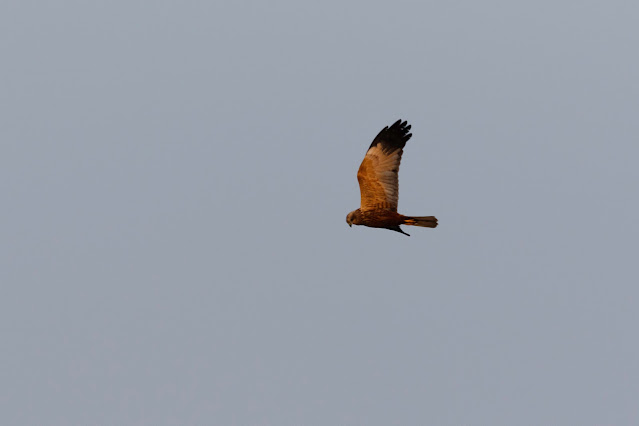
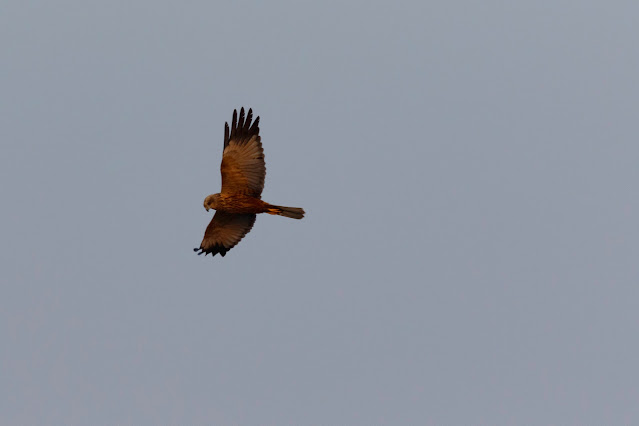
I was back on the patch before work this morning to do the WeBS Count. There was plenty to count on the Budge fields which were full of birds. Wigeon was the numerous duck species with 257 counted. I'd just finished counting what I thought was them all, when this male marsh harrier appeared over the pools and scattered everything. It was soon apparent that there were a lot more wigeon than I had originally counted, so I had to start again.


Male marsh harrier in the morning sunshine

Looking for food

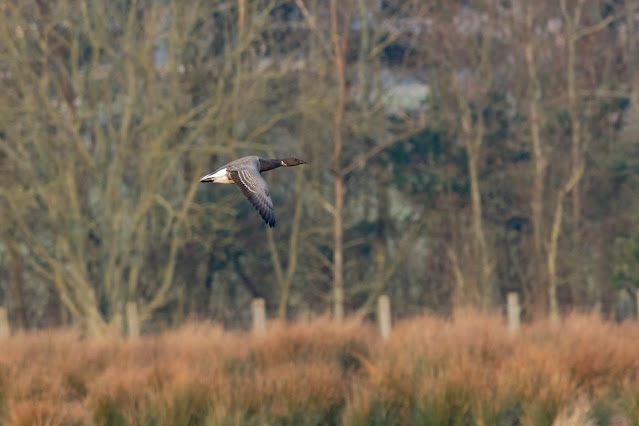
A decent count of 35 shoveler and a single pale-bellied brent goose was on the fields before flying north. 

Pale-bellied brent goose

Avocet had been reported from the patch whilst I was away in Cornwall but there were none this morning. Five ruff, three black-tailed godwit, 31 curlew and 17 snipe were notable. There was no sign of the jack snipe that's been around for a few days. 

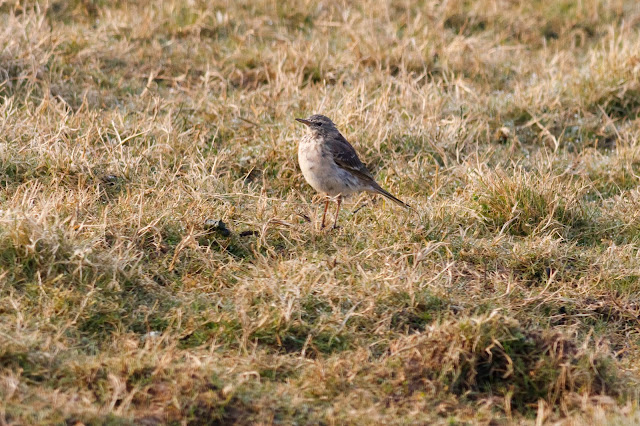
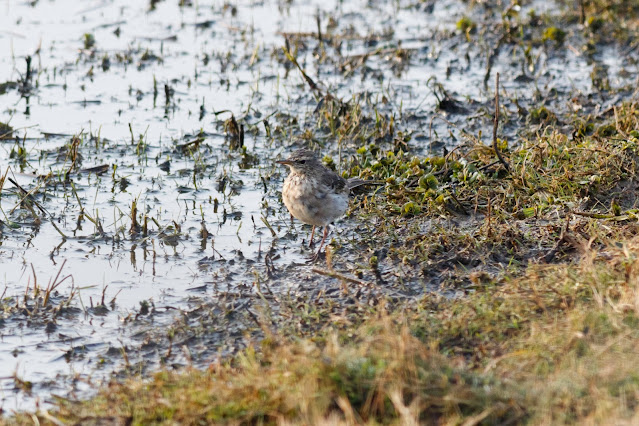
From the little hide I picked up the water pipit that's been seen over the weekend. It had either bee bathing or walking through the frosty grass as it looked a bit bedraggled. It's starting to look a bit 'pinky' on the breast I think.

Water pipit
Looking a bit bedraggled

Chifchaff was the only migrant passerine 'new in' and two siskins by the Budge hide were notable for late March. 

Monday, 21 September 2020

Busy but quiet on the patch

The forecast suggested easterly winds and dry conditions on both Saturday and Sunday and we planned to get some nets up and ring birds on both days. A light mizzly, sometimes drizzly rain overnight and into Sunday morning prevented us doing anything on Sunday but we managed some ringing on Saturday.

It was a bit quiet though,  the wind was out of the east but it was bright and breezy and we only had four nets up so we only caught 19 new birds. A light passage of Meadow Pipits continued and we managed to catch four of them. A single Chiffchaff was the only warbler.

Meadow pipit - all four were juvenile birds

We went birding on Sunday morning as we couldn't put any nets up. Despite the wind being out of the east and overnight drizzle it didn't drop any birds in and was as quiet as Saturday had been. The WeBS count didn't take much doing - for some reason, despite the mud on the Budge fields, it's not attracting waders. There was decent Meadow Pipit and Skylark passage and when we got to the beach, there were 25 Meadow Pipits feeding on the seaweed around the Dunbar Burn - and a Wheatear.

Stonechat in the mizzle
Meadow Pipit on the beach

In the dunes to the north there is still a decent flock of Linnets and Goldfinches. It's not always the same flock as some days there are Linnets than Goldfinches and other days it's the opposite. As we walked along the cycle path, I got onto a bunting on the track, briefly, before it flew. There were a few reed buntings about but this was different - in the second or two I had it in my bins, the rufous cheeks stood out. 

The bunting bugged me all afternoon, at least it took my mind off the awful football game I was watching. I headed back after the footie for a mooch. Nothing on the fenclines or track so I headed into the dunes, there were a lot of finches still and a few Pipits and Reed Buntings. I put a bird up as I walked which gave off the distinctive call of a Lapland Bunting when it flew. It landed in a bare area and I got reasonable views of it before it flew it again I lost it behind a dune-hump. My first on the patch since 2010!

Wheatears were on the fence and on the beach still, but it was nearly dark when I took this.

Wheatear on the beach in the gloom of late evening

My pre-morning walk today was much busier and at times I didn't know where to concentrate on. I stepped out of the car to see a tit flock moving through the whitebeams, there was a few Chiffchaff amongst them and Yellow-browed Warbler - my first of the year and my earliest ever by one day! It was really active, chasing the Chiffs and Blue Tits. It and the tits moved off south as did I.

There were more Chiffs, at least 18,  in the bushes as well as four Blackcap, Lesser Whitethroat and Whitethroat. Overhead small groups of Siskin, Meadow Pipit, Lesser Redpoll and Skylark flew over - eight Skylark appeared to come in-off the sea as did 38 Pink-footed Geese.

One of 18 Chifchaffs

Another Meadow Pipit

Young Stonechat

Chaffinch - not common this year

Save for six Curlew there were no waders or duck on the virtually dry Budge fields, maybe because a juvenile Marsh harrier was sat on the big post? It took off and had a go at one of the many Pheasants and I managed a couple of shots. It appeared to have a metal ring on its right leg.

Juvenile Marsh Harrier over the Budge field

With an eye on a pheasant

No waders here

This evening I had a look on the sea after work, It was high tide and a big spring tide so I hoped for displaced waders passing, none of those but I did have a trio of grebes.

There's been two Great-crested Grebes, an adult and a juvenile for a few weeks, they hang about with the Scoter flock and I've watched the adult moult into winter garb and the juvenile loose a bit of its stripy look in that time.  Just beyond the Scoters, I picked up another, smaller grebe - a Slavonian Grebe in winter plumage - a regular in the Bay but nice to see. As I counted the Red-throated Divers (28 in total), I found another grebe, close to the Slavonian grebe - a Red-necked Grebe, also in winter plumage. 

At times the two grebes were together giving a great opportunity to compare these two similar looking grebes. The red-neck, slightly bigger than the Slav and not as clean, crisp looking, much darker around the face and neck with a more sloping forehead.  

So it's been a busy few days even though the birding has been quiet at times, but some nice birds made up for it. 

All my lists are on eBird

Monday, 29 June 2020

Vizmig and the two bird theory

I've tried a bit of viz-migging this week, but probably missed the vizmig highlight of the year today - a huge southerly movement of swifts, with thousands of birds logged at east coast hot-spots including 28,0000 at Hummanby Gap. I hadn't anticipated it so didn't get down to the patch until lunchtime, by the time I did there were still lots of swift headed south but nothing like the numbers reported earlier.

After reports of crossbill movements, I positioned myself on the big dune at 5.30am on Wednesday morning. When I arrived on site, there were 11 siskins feeding on the alders before moving north. I estimated about another 100+ siskins, all moving south in small groups of 15-25 until 7.30am. Nothing like the 6500 Tom Tams had at Tynemouth and no crossbills - my target for the morning.

I tried for crossbills on another two mornings but no joy.The meadow pipits kept me entertained though and fly-through little egrets on two mornings were welcome sightings of scarce bird this year. The big dune is a good place to scan the budge fields and I picked up both wood and green sandpipers from there.

Meadow pipit song-flighting from the big dune
In the bay, the common scoter flock reached a peak of about 1400 birds midweek. On Friday, I abandoned viz-mig and had walk north and south. A family group of pied wags entertained me at the Dunbar burn and a new moth...

New moth - Pammene aurana (there were at least eight of them)
One of the pied wag youths
New hoverfly for the patch Cheilosia illustrata - one of the bumblebee mimics (iPhone photo)
As is typical, the weather deteriorated just in time for the weekend. I manged a wander between showers on Saturday morning and it was nice to catch up with Bob Biggs and ADMc. Waders from the Budge included  four, maybe five ruff including gingery, black and white/cream coloured birds, 19 black-tailed godwits (most or all Greenland race birds), two knot, two ringed plover and two dunlin. A female marsh harrier was my first since lockdown and an adult cuckoo shot through the dunes - northbound.

Today, Janet and I had a walk to the hides, mostly looking for hoverflies but we found the four spoonbills, that have commuted between Cresswell Pond and the Budge fields, feeding on the doughnut pool from the little hide.

Four spoonbills- an they were all awake!
mating common blue damselflies
This evening, news came through of a female pied flycatcher near the Budge screen. Pied Fly is a scarce bird in any year at Druridge, unheard of in June, so worth a look before the footy I thought.

Graham Sorrie reported north of the path to the screen-hide. The first bird I got my bins on was a spotted flycatcher.

Spotted Flycatcher
I knew Graham wouldn't have mistaken spotted fly for pied, but for two flycatchers of any species to be at Druridge in June would be mega rare, but I couldn't rule out the two-bird theory and I was right not to as shortly after that a female pied flycatcher appeared on the same edge. My first pied fly since 2014!

Pied flycatcher
I'm not sure what is going on here. Is this early returning birds or very late northerly migrants? Someone on Twitter sent me a link to a wind map and a report of high temperatures and forest fires in Arctic Siberia - which is worrying in itself but might explain these birds?


Tuesday, 11 February 2020

Storm Ciara lashes WeBS counters

Two WeBS counters who were stupid enough to go out on Sunday found themselves lashed by Storm Ciara at a nature reserve in Druridge Bay, Northumberland.

Actually , it wasn't that bad...

Okay it was a bit blowy, especially counting hundreds of ducks with precious-little shelter provided by the Budge screen.

I started counting the grazing wigeon which were the most numerous duck, I got to 294 when they shot up in the air - a reaction to a creamy-crowned marsh harrier headed their way. All of the waterfowl had relocated to the middle of the widest part of the pool. Back to counting 1,2,3.... 348 - not a bad count for Druridge but nearly one hundred less than last months count.

A second marsh harrier came through  - this time an adult male.

Other notable counts included 13 grey heron which were seeking shelter behind the trees, nest-building on hold until the storm died down (whenever that will be), 42 shoveler, 168 teal and 57 curlew. Other notable waders included singles of  black-tailed godwit, ruff and dunlin.

A third marsh harrier came through - this time a sub-adult male.

Off to the Oddie hide. There were waves on the big pool and all of the birdlife was seeking shelter at the western end. In the field north of the coal haul road, there was a group of whooper swans, obscured by the hedge, they would require a closer look from the turning circle.

I estimated 44 whooper swans, they were difficult to count as they were also hunkered down out of the wind. They were loosely associated with a flock of 140 Canada geese and 60 pinks.

On our way home we stopped to scan a flock of pinks - over 400 - in the front field and picked up 4 Eurasian white-fronted geese at the back of the flock. There seems to be a few more white-fronts in the county this week.

Full list on eBird


Sunday, 16 August 2015

Quiet start to the Autumn

Autumn has started quietly on the patch. On Wednesday I put some nets up for a ringing session. I caught a mixture of adult and juvenile warblers (chiffchaff, willow and sedge warblers, blackcap), which I presume were all local birds as nothing was carrying any fat. I also caught a grasshopper warbler, a female with the remains of a brood patch, very close to where a male was singing for a few nights four weeks ago. A bullfinch was calling nearby but I didn't catch it.

I also caught a few robins, wrens, a chaffinch and a tree sparrow. I watched a stunning juvenile marsh harrier flying over the Budge fields, right in front of the little hide - no photographers at that hour!

I spent some time on the patch today. A Saturday night out at the Cluny meant it wasn't an early start. I think all of the birds were asleep by the time I arrived.

Little grebe - asleep
Mute swan  - asleep
This common gull must have had no 'craic' as the black-headed gull was obviously bored
There were three juvenile ruff and black-tailed godwit (which was also asleep for much of the time) from the little hide and two common sandpipers on the far bank of the big pool.

There were a few 'wheeting' phylloscs in the bushes and a family of four juvvy blackcaps. I checked the fences and bushes at the north end for whinchats but none were found. I photographed some insects as there were no birds about.

Lime-speck Pug on wield

Noon fly or Noonday fly on knapweed
I headed back to the patch this evening, hoping the high-tide might have pushed some waders off their usual haunts. Six oystercatchers and five turnstones flew south, but not the hoped-for knot or grey plover. Three red-throated divers were on the sea - they were asleep too!

Sunday, 5 July 2015

Blackcap - To Biarritz...and back!

I've got some really interesting news of a returning blackcap, but first a round-up of the weekend on the patch.

On Friday evening there, autumn wader passage was underway with a greenshank and ruff on the Budge fields, an avocet and a single black-tailed godwit were also present and an adult little egret was feeding.

Adult little egret feeding on Budge fields
A grasshopper warbler was 'reeling' from the umbellifers on the dune-back opposite the path to the Budge screen - it was still reeling today from 5am to midday!

Offshore, there were at least five roseate terns fishing, which isn't surprising given that there are over 100 pairs nesting on nearby Coquet Island. I also saw my first Arctic skua of the year, harrying the terns.

Red admiral
There are a lot more butterflies on the wing now that summer has arrived. Ringlet, small skipper, meadow brown, wall, red admiral, small tortoiseshell, speckled wood were all seen and,today, my first dark-green fritillaries of the year.

As it rained for much of yesterday morning, I put my patch-visit off until the evening. On the edge of the patch, between Bell's farm and the plantation, I stopped to watch some swift passage - a steady stream of these early migrants headed south. Whilst scanning them, a strikingly dark swallow flew past me. I watched it for while, it was male, but the underparts were much more chestnut/orange than any other barn swallow I've seen. It almost reminded me of the North American race, but it had a good, dark breast-band. It was certainly a striking bird, but I don't think it was anything other than a darker than average rustica.

A 'bog-standard' swallow taking a feather to line it's nest
On the Budge fields there were 28 black-tailed godwit and yesterdays ruff and a new ringed plover. A male marsh harrier flew in and started hunting over the Budge field, scattering some duck and lapwings.

male marsh harrier hunting over the Budge fields
Also of note were five large shoveler youngsters. I've seen this on previous years at Druridge, where a female shoveler will turn up late in the summer with well-grown young. I am not sure if these birds were capable of flight, but they were nearing adult size, so they probably were.

Today, I got up early and put some nets up to ring birds. I didn't catch much, I presume a lot of the warblers are sat tight on second broods. I caught 14 new birds, all but two of which were juveniles. I would have expected to have caught more young warblers (I caught two backcaps and a chiffchaff), I think the prolonged cold spring and erratic storms may have done for some first broods.

Between net-rounds I had a scan from the dunes and picked up a small falcon flying west. I automatically assumed it would be a kestrel, but when I put my bins on it I was surprised to see a fine adult hobby. It had a small bird of some species in its talons (maybe a sand martin, there were a lot of them), it continued west over the bushes and turned south with it's prey, maybe looking for somewhere suitable to deal with it?

So, to the story of the blackcap. I retrapped a female breeding blackcap today, which we ringed as a juvenile last year. This got me thinking about thinking about the blackcap that we ringed that ended up in France (read the story here http://ipinswildlifeblog.blogspot.co.uk/2015/02/the-french-connection.html ) and whether it may have come back, so I checked our retraps for the year and it has!

Y540945 was ringed as a juvenile male on the 27th August by me and James Common, we caught it again on the 5th September. On 25th September it was caught by a ringer 1251km in Landes near Biarritz in France.

Looking at our retraps for this year I discovered that Y540945 has returned! I caught it on 9th June as breeding male. This is the first time we have ever had a long-distance migrant trapped elsewhere other than Druridge, return to our site. Isn't migration amazing!

130 greenshank
131 Arctic skua
132 hobby
Sunday, 12 October 2014

Long weekend

I took Friday off work so I had a nice long weekend to do some ringing and birding on the patch.

Thursday

An early morning, pre-work visit. There seemed to have been an arrival of birds overnight with more robins, goldcrests and wrens than the previous day. There were also three great-spotted woodpeckers, blackbirds, lesser redpolls and a single blackcap - all new arrivals.

grey heron over

Work beckoned though....

Friday

I spent Friday morning checking the bushes, from the plantation in the south, up to the north end. Robins, wrens (over 32 counted), goldcrests and chiffchaffs were really evident. Thursdays redpolls had been joined by a flock of siskins and blackcap and great-spotted woodpecker were still present.

I finally got my yellow-browed warbler, just off the 'Mike Carr' path. picked up on call and found with goldcrests and a chiff in the willows. It didn't hang about. The birds were moving in waves like you get in the tropics.

One of many  robins
 There was at least nine stonechats in the dunes - showing how good a year this species has had.

Male stonechat
Vizmig was obvious with a constant movement of skylarks (35+) and meadow pipits (24+) moving south in small groups. A juvenile marsh harrier flew south, low over the bushes.

Pink-footed geese were also on the move. I estimated this skein at 150 when they flew over, I counted them on the photo and there were 151 - how's that for accurate guesswork?

151 pink-footed geese headed south

Saturday

We put some nets up on Saturday. It was 3 degrees C when we arrived and there was light frost, first frost of the year on the patch.

We caught 43 new birds, including an incredible 16 wrens. We also caught five song thrushes, which must have been freshly in. We didn't catch any chiffchaffs, but we did ring a single willow warbler, which is quite late. A great tit was a control (meaning that it had been ringed elsewhere, it had a larger 'B' ring on, so it was probably ringed as a pullus from a nestbox.

Goldfinches eating last years alder cone crop - this years very good crop is not quite ripe yet.
Yesterdays yellow-browed warbler called from the bushes. Skylark and mipit migration was still evident.

Today

Today was WeBS count day. My attempt at an early start was thwarted  with car problems. After a jump start and a trip to Kwik Fit for a new battery, I got down to patch at 15.40, £110 lighter.

An interesting wader on the far bank of the big pool had a few of us guessing for a bit. It looked a bit like a dunlin, but the jizz was wrong and some features didn't tally. It looked 'rounded and compact' and small, but difficult to judge size at such range with no comparison. It had no pectoral band, with colouring only reaching the throat. We decided that it was just a odd-looking dunlin. Interesting though.

Notable on the WeBS count was 18 little grebe, 26 gadwall and a great-crested grebe.

164 lesser redpoll
165 siskin
166 yellow-browed warbler

PWC Score - 258

Sunday, 3 August 2014

Mega Patch Tick

The early bird catches the worm, so they say.

Well I was at Druridge early this morning and it certainly paid off when a scan of the waders turned up a STILT SANDPIPER!

Here's the tale..

I bumped into fellow patcher Dave Elliott on the way into the Budge screen (you have to be up very early to beat Dave), he was telling me of a wader that he had seen yesterday but wasn't sure about as the light was terrible...it could have been stilt sandpiper or it could have been a wood sandpiper, he wasn't committal.

I started scanning the mud and amongst the snipe was something different, it was arse-on at first, then it raised it's tail to reveal strong barring on the underside and the dark centres to the feathers stood out really well. We didn't need to see any more - Stilt Sandpiper - the bird that was at Cresswell Pond until Thursday had turned up on my patch. Patch mega!

crappy iPhone-scoped shot of the Stilt Sandpiper.

We had really good views of it for a while, Dave went off to check the rest of his gigantic patch and it slipped off into the rushes. Then one of the Chevington marsh harriers turned up and scattered everything, including the curlews and spoonbills and there was no sign of the stilt sand for nearly 20 minutes. The marsh harrier had another go at it re-appeared back on the mud and was seen on and off for the rest of the day and was enjoyed by a good number of birders.

marsh harrier arrives....
....and causes havoc
This bird is the second record for Northumberland, the first being two years ago on the Stringers patch at Newton. I saw that bird and only one other, ever, in Texas.

This is the second new patch bird this year after May's woodchat shrike, taking the patch list to 234. Seemingly, as this bird was re-found, it counts as find for the patchwork challenge, thus netting me a whopping 15 points.

Elsewhere on the patch three little egrets were on the edge of the shelterbelt, one of them was the colour ringed bird DE had at Chevington, the other two were juveniles. They relocated to the big pool soon after.

Juvenile little egret. The yellow/green legs and yellow tinge to the lores as well as being 'fluffy' give it away as a juvenile.

Also on the big pool was LRP and common sandpiper. This stunning red admiral brightened up the track.

red admiral
Druridge version of oxpeckers
So what chance of another patch tick this year. Well, I reckon so and my money is on red kite.

Patch List 234

Year List 145

PWC Score 205

Thursday, 17 July 2014

Evening birding

I love this time of year, when it is light enough to go out birding for a few hours after work. I got to Druridge at 7pm and left at 9.20pm and there was still plenty of light, by December it will have been dark for five hours at 9.20pm, now there's a sobering thought.

Anyhoo, birding was good tonight. I started with a look on the sea as the tide was high. A scan of the 500 or so scoters produced no oddities, a couple of roseate terns fed close in and on the sea were great-crested grebes, red-breasted mergansers and red-throated divers. Ringed plovers, dunlin and a handful of manx shearwaters were also on the move.

On the Budge fields, it started quiet, with two little egrets roosting on the edge of the shelterbelt,  a third flew in onto the fields and the two roosters joined it, soon to disappear amongst the rush. Soon after, three spoonbills came in from somewhere and settled down to feed. Waders came and went through the rushes including about 12 dunlin, a male ruff in moult, a black-tailed godwit and a handful of snipe.

A barn owl was hunting and then settled on a fencepost in front of the shelterbelt to rip apart a vole and a female marsh harrier flew north.

A very pleasant evening indeed!

Wednesday, 4 June 2014

An inspirational day

Yesterday was a truly inspirational day. I spent the day walking from Hull to Hornsea accompanying a friend and colleague of Janet's, Roy Taylor, on the last leg of his amazing journey.

The end of the journey at Hornsea
I'd not met Roy before, but had heard a lot about him from Janet. Roy was recently diagnosed with Motor Neuron Disease, a terrible, debilitating, terminal illness. He has already lost most of the use of his legs and now needs a wheelchair to get about. Once in his chair, Roy found it very frustrating not being able to visit the countryside he loved to visit as an able-bodied person, never mind the more formal nature-reserves.

So Roy undertook a challenge, to travel coast-to-coast, 215 miles along the Trans Pennine-Trail, in his 4x4 wheelchair. Yesterday we joined him on the final leg of this amazing journey, a truly inspirational but humbling day. All of the money raised will be spent on improving access at RSPB reserves so that people can like Roy can still enjoy getting out into the countryside and be able to see wildlife.

You can read the whole amazing story on Roy's blog

If you can afford it, please consider supporting Roy's cause here http://uk.virginmoneygiving.com/fundraiser-web/fundraiser/showFundraiserProfilePage.action?userUrl=roy215miles

I got home in time to spend an hour at Druridge. Highlights were a drake garganey and an immature spoonbill on the Budge fields and a male marsh harrier headed north.

On Monday evening I managed a visit to the patch after work and added to new species to the year-list - little egret (thanks to ADMc for the tip-off) and greenfinch.

131 little egret
132 greenfinch

PWC Score 172

Saturday, 19 April 2014

Hoodie

A quick update from the patch.

There have been up to five yellow wagtails on the Budge fields, none today, though evenings seem better.

I did the WeBS count today, a drake garganey was a highlight along with a nice red black-tailed godwit. Whilst counting the ducks, a chap called Andy said that he thought he had a hooded crow flying west, he was right, it was! It seemed to come from the sea/dunes and was flying to the north of the Budge fields, headed west, We watched it as it disappeared from view towards Widdrington Village. My first patch hoodie since 2008 when one loitered from the 11th to 13th April.

From the Oddie hide, a male marsh harrier flew south, mobbed by a sparrowhawk. In the bushes, singing sedge warbler and whitethroat are new in and there are lots more willow warblers singing.

109 yellow wagtail
110 garganey
111 hooded crow
112 sparrowhawk
113 sedge warbler
114 whitethroat

Sunday, 9 February 2014

Flighty

It was still blowing a hooley today and as a result everything seemed to be a bit flighty at Druridge.

I had a walk up to the Preceptory, the pink-footed geese were lifted off the fields by a passing tractor and didn't settle again. Whilst they got up a pair of marsh harriers had put everything up on the Budge fields and then flew towards the far, the male settling on the filed the geese had vacated for a while.

Pink-footed Geese
There were thousands of starlings skimming the fields and hedges in big flocks, before settling for a while. This flock had a bathe in a small pool.


About 80 fieldfare were also roaming about the damp fields.The Preceptory was bird-free.

Back towards the cottages, a buzzard was being mobbed by a couple of crows. As it got closer, It looked quite long-winged and I noticed really obvious pale patches in the upperwing which got me interested so I fired off a few shots. It was just a common buzzard, but an interesting bird.Variable things, Buzzards.

Buzzard


There are still two pintail on the Budge fields and the common scoter is still on the big pool. Also of note was two woodcock flushed from the bushes, my first of the winter.

76 long-tailed tit
77 woodcock
78 canada goose
79 marsh harrier
80 fieldfare
81 buzzard

PWC score 100