Showing posts with label great northern diver. Show all posts

Friday, 7 January 2022

Raven - an unexpected patch tick

 A new species for the patch this afternoon and quite unexpected  - Raven!

The circumstances were quite fortuitous. I was on the patch for work this afternoon. Our wonderful Coast Care team were working on behalf of National Trust, doing some coppicing in the bushes and I popped down to meet them and thank them for their hard work. After they left I had a quick look on the sea,  a very late lunch-break. A black-throated diver was way to the south, a great northern diver flew south and a couple of great crested grebes were on the sea - all good stuff. I got a call from Mark Whittingham to say that he had found a white-fronted goose, probably a Greenland race bird, in the pink-footed flock in the front-field at the farm. 

I'd noticed the PFG flock on my way to meet the team and did think they would be worth a look through. 

When I got there, the light was awful, looking straight into the setting sun, but I picked up the white-front in the flock. The bill looked orange, but not a 'huge carrot' and the legs looked stout and orange so I assumed Greenland race, but the light was dreadful.

I scanned through the pink foots further south, into better light, looking for something different, and I found something completely different! A huge corvid in amongst the geese, it looked almost as big as the geese! Raven surely. It was facing away but when it turned it's head, the huge deep bill confirmed it as a full patch tick. Species 253 for the patch. 

The brute

digi-scoped record shots

Not a species I was expecting to see, but maybe it should have been more on my radar? The range is increasing and they're breeding on the coast further north from us now. Janet saw one recently at Snab Point, so maybe this was the same bird?

It was quite funny, as when I had been with the Coast Care team earlier, one of them was using a pair of loppers that sounded like the 'cronk' of a raven, which caught me out a couple of times. I mentioned to him that raven would be a new bird for the patch  - little did I know what was to come!

Photos of the white-fronted goose circulated by Mark are inconclusive so it might be 'un-raced' until I get a better look. hopefully on the bird race tomorrow.


Saturday, 1 January 2022

Tradition dictates

Tradition dictates that on my first visit to the patch of the year, I'll find a species that I hadn't seen on the patch in the previous year. This happens most years. And guess what? It happened again today.

I've not seen yellowhammer on the patch since 24th November 2019 so to find a flock of eight in the hedge behind Druridge Farm was a real surprise.  I was beginning to think that they were locally extinct.

Today was unseasonably mild, 12 degrees C, but it was very windy from the SW. Janet and I had a good wander around the patch and managed to see 53 species in total. Highlights included a southbound great northern diver offshore, two woodcock flushed from the bushes, at least 300 Linnet and 200 chaffinch in the dunes and eight stock doves.

There was a lot of people though. It was like a July Sunday with cars abandoned at the site entrance and hundreds of people on the beach. 

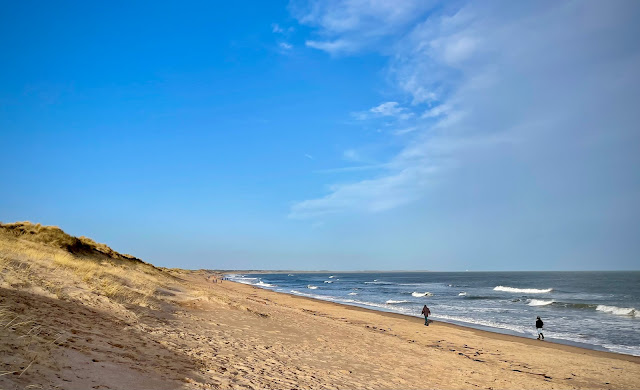
The beach was busier than it looks in this photo!

The ringed plover flock that roosts on the beach at the south of the patch had no chance to settle and just flew back and forth, looking to rest. 

Ringed Plovers looking for somewhere to rest - no chance today.

I finished 2021 on a credible 167 species for the patch, which, given how poor an autumn it was wasn't too bad. Usual autumn stuff like pied and spotted flycatchers, garden warber, yellow-browed warbler, redstart and whinchat all missing from my list.

I also concentrated a bit more on the 5km patch challenge because of covid-lockdown. I saw 191 species within 5km of home which was nine more than the next patches. Ellington is obviously a good place to live if you're a birder. I'll continue with the 5km challenge this year as it does add a bit of variety to my birding.

I'm hoping to keep the blog updated more regularly too. My work/life balance needs some adjustment I think.

Today's list on eBird


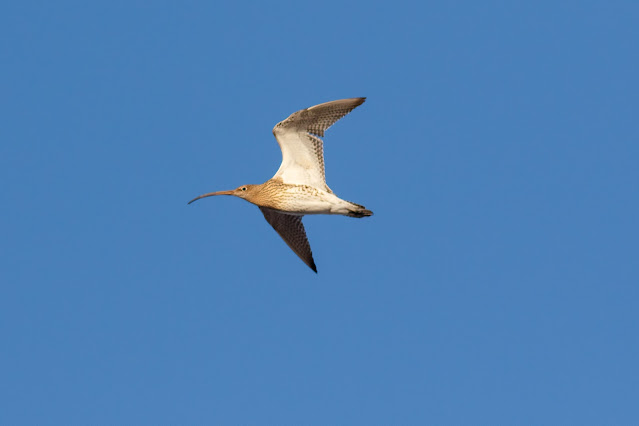
Passing Curlew


Tuesday, 19 October 2021

Thrushes, Little Gulls and Waxcaps

 I was sat at my desk, in my loft-office at home, yesterday afternoon, the velux windows were open as it was mild and by 4pm I could hear redwings over the house, seeeeep, seeeep.

I popped my head out to see a flock of 80 flying just over our rooftop and then another 40 or so. I tried to work but by 4.30 I could concentrate no more and headed for the patch. When I arrived, redwings were coming over but quite high.  I thought I would check the plantation and entrance bushes first for grounded migrants until I read a Whatsapp message from Shaun Robson - 81 little gull off Druridge Links. Surely a typo?

I asked him to confirm and he replied to say 'yes' he had counted 81 little gulls offshore. I headed for the Dune. Shaun and I must've passed as he wasn't there when I arrived (he'd gone to Cresswell) but the little gulls were still there, well at least 50-60 of them, it was hard to keep track as some moved off south, some loafed on the sea whilst others fed. I would guess that 95% were adults. Easily a patch record count for this species.

The thrushes kept coming but in smaller numbers, I was watching them coming ashore from a long way out, mostly redwings with a few blackbirds. At least four brambling also came in-off.  No fieldfares yet. A great northern diver was on the sea. 

I stayed until dark, by which time, thrush movement had stopped, but another brambling came over. As darkness fell, unknown numbers of pink-footed geese arrived on Budge fields.

I love to see this visible migration of winter thrushes arriving over the sea and always find it amazing that after such a long and perilous journey, that they don't make landfall at the first opportunity. I tracked a small group which just kept going towards Widdrington and probably beyond.

No visits to the patch today but yesterdays arrival was still evident in the Goswick and Beal areas with many grounded thrushes, bramblings and robins and a few reed buntings which I presume are incoming birds too?

There are a few waxcaps in the dunes, by the side of the paths, which I think are 'dune waxcap' -  Hygrocybe conicoides

Dune waxcap?


Saturday, 2 January 2021

Following tradition (sort of...)

Tradition dictates that on the 1st January each year (or my first visit to the patch) I see a species that I didn't see in the previous year. It probably doesn't happen that often but it feels as though it does. 

I nearly followed tradition this year - it was the 2nd of January rather than the 1st. 

I saw a respectable 52 species yesterday in two visits on New Years Day, but nothing I hadn't seen in the previous year. Some good January species included Mistle Thrush (13 still in the fields), Bullfinch and Goldcrest on our morning walk and  Mediterranean Gull, Black-throated Diver and Kittiwake on an evening seawatch. The other New Year tradition at Druridge was upheld with near-naked people thinking it a good idea to go into the sea...

No gold at the end of this rainbow but some good species for the year

This morning dawned a colder, greyer day with sleety-snow falling. We didn't have an early start, checking the farm first and adding a flock of nine Redwing and 12 Fieldfare to the list and then setting out on our walk at11.15am, north, into the bitingly-cold wind. We found the finch flock in the dunes, Twite (120), Goldfinch, Linnet, Chaffinch and a few Reed Buntings and Skylarks in the dunes. We headed back along the beach, seeing nothing of note.

Cold and grey with snow clouds on the horizon

As we approached the car, news came through of a Shorelark north of Hemscotthill Farm. Worth a look I thought...

Birdguides reported it in the field immediately south of the patch boundary, which is in a fodder crop and is being stripped-grazed by beast. I got onto a handful of skylark in the fodder-stubble, but the light was against me so I headed south a bit - off-patch, for better light. I soon found the Shorelark feeding in among the Skylarks, but of course, I had to go back onto the patch to see it from there. 

This was my first Shorelark since 2014 when one was on the dunes north of the Dunbar Burn, pursued by photographers. 

Later, an Egyptian Goose was reported from the pool nearer to the farm, but it had gone when I returned in the afternoon.

I had another short seawatch as the wind was in the north. Black-throated Diver was still on the sea and a single Great Northern Diver flew north as did a single Gannet. Auks passage was steady and one with an all-black head stood out from the others, I photographed it  - a Guillemot in breeding plumage already, Stewart Sexton reported that he'd seen a few today.

The highlight of evening seawatches either side of Christmas has been the gull roost. From dusk, no earlier than 3.30pm, gulls arrive in flocks from the fields to the west to roost on the sea - thousands of them! It's a steady passage until dark when there are over 4000 gulls on the sea, about 150m offshore. They're all Black-headed and Common Gulls (about 65-70% BHG, 35-30% CG) with the odd Herring and I've seen up to ten Med Gulls - there could be dozens more as it's impossible to go through them before the light fades - an amazing spectacle. 

I could see the Starling murmuration at Chevington from my dune-top perch, another great spectacle. 

A good start to 2021 with 68 species over two days.  Effort will ease-off when I go back to work next week but it looks as though home-working will be the norm for some time, which gives me more opportunities.

Thursday, 24 December 2020

All Grey

Apologies for the lack of posts recently, it's not that I've not been to the patch, I've been most days, there just hasn't been much to write about.

December is usually a bit spartan but this December seems more so. It's hardly been light enough to bother taking the camera out - sunny days have been few and far between, just day after day of grey and rain.

The wind was out of the north for much of yesterday and strengthened into the evening - strong enough to bring some Little Auks down? - only one way to find out. When I got up this morning it was sleeting hard and just looked miserable, but a check of 'Rain Alarm' suggested a brief window of dry weather from 11ish, which happened to coincide with high tide.

The sleet promptly cleared away at 10:50 and I was set up for a seawatch. The sea was big and the wind still out of the north but it felt quiet - quiet enough to count gulls and auks - mostly unidentifiable dots on the edge of the world but a few came close and the sun had come out providing a really nice light. 

Nice light

About 15 minutes in I picked up a small pale-grey bird, almost looking white in the sunshine, heading north just beyond the breakers, it was disappearing into the troughs but as it drew level I got some good views - it was a Grey Phalarope. This is the third Grey Phalarope I've seen on the patch - and I've always thought how pot-bellied they look, side-on, like a little dove or pigeon - they're a compact little thing too. Virtually white below, with darker-grey upperparts and a really obvious white wing bar on the upper wing. The dark 'eye-mask' stood out in the strong light, I didn't really notice the bill - it must've had one!

It kept going north along the bay, hugging the line just beyond the breakers. I notice that Jonathon Farooqi had one much earlier at Church Point so it's unlikely this was the same bird, unless it stopped-off to feed en route?

Seawatching continued to be quiet in terms of numbers but plenty of variety. I had a skua species heading south, again on the edge of the known world - it was just a shape really, towering constantly as it went south. I thought Pom but more likely a Bonxie as the Newbiggin lads had a few south and Bonxies are usually distant birds at Druridge. Other highlights included both Great Northern and Black-throated Divers and a drake Velvet Scoter with a smattering of Red-throated Divers, Gannets, Kittiwakes etc

I continued until 12:20 when a heavy sleet shower arrived. No Little Auks but the Grey Phal more than made-up for that. Full list here. 

Incoming

Last weekend was a bit frustrating. We'd bumped into Janet's parents just as we were leaving Druridge - they headed off north for a walk. Later in the afternoon, Janet's Dad messaged to say he had seen a male Hawfinch on the fence along the Bridleway north of the turning circle. We spent an hour-and-a-half looking but no joy - it could've been anywhere. Alan knows his birds so little chance of mis-ID. Another patch-tick missed this year. I'll have to insist that he takes his mobile with him when he's on my patch!

Otherwise not much to report - the Water Pipits (up to three) are still on the Budge fields but are difficult to spot, up to two Chiffchaffs are sticking it out but this cold snap might move them on and three Scaup have regularly been seen on the big pool. A few Bullfinches are also hanging about - not a common over-winterer at Druridge.

My year list is now at 178 - is 180 still a possibility? Some wintery weather might be needed.

Here's some photos I've taken since my last post. Happy Christmas everyone.

Sanderling probing for food amongst the froth

I usually don't like 'running' wader photos
Little Grebe on the big pool - one of two

Catching a few fish...


Never get bored of Stonechats

Grey Partridge  - there's been up to 17 in the weedy dunes

Sunday, 6 December 2020

What a pipit!

I was seawatching from the dunes this morning when a message came through on the Whatsapp group to say that Tariq Farooqi was watching one, maybe two Water Pipits from the Budge hide. Seawatching had been quiet so I headed straight there, Tariq was still there but wasn't seeing the birds. Shortly after I got there, a pipit flew - calling, like a water pipit. We got onto it just in front of the hide and watched it for a few minutes before all hell-broke loose when a Sparrowhawk arrived and scattered everything before flying off with a Starling. 

Yesterday, Janet and I were at the timber screen when I heard a pipit calling and I said 'that sounds like Water Pipit'  - we never saw it, then the hailstones came down and we headed home - probably was!

Water Pipit is my 177th species for the year on the patch and my first on the patch since March 2018. They became reasonably common for a couple of years on the Budge fields and then nothing...

I've done a couple of seawatches this weekend - both were pretty quiet. Today a couple of Great Northern Divers went north as did 26 Red-throats including a group of 15! Two Velvet Scoters were with the scoter flock and two flew north and there was a good count of 124 Sanderling on the beach. Two Great Northern Divers went through yesterday too, one in each direction.

No photos this week, it's been too dark!

The vocal Chiffchaff was still calling by the wooden screen this morning and through the week. A December Chiffchaff is always nice. 

Sunday, 27 September 2020

Some seawatching

 The latter part of the week was dominated by very strong northerly winds - and that  means seawatching.

The wind really picked up on Thursday and into Friday morning but with my diary being full, I only had a brief window on Friday morning, I was in position for 07.25, hunkered down in the dunes as the wind was very strong, it was really busy with Auks, Gannets and Kittiwakes streaming north, a lot of them very close in, too close for some which would be under my scope. Just as I got settled I got onto a group of kittis very close-in and among them was something different - a juvenile Sabine's Gull. If I'd been settled in and concentrating on a single spot it would have been under my scope and I'd of missed it. 

I've never seen a Sabine's gull this close at Druridge before (I have at Church Point when I used to go there) and it was great to see it amongst adult and juvenile kittis for contrast. My first Sabine's since 2014 and my fourth for the patch - all September records in 2007, 2009 and 14. What a great bird!

It remained really busy, with hundreds of birds coming through but I only had an hour or so. Other highlights of my hour were:

Arctic Skua 1

Sooty Shearwater 9

Manx Shearwater 7

Red-throated Diver 1

and two Slavonian Grebes being tossed about on the sea.

Full list here

I had planned a sea watch on Saturday but the wind had strengthened and it was raining and reports from nearby spots weren't tempting me out - I think it was just too windy.

Janet and I had walk around the patch on Saturday evening seeing very little in the still-stormy northerly. 18 Pale-bellied Brents struggled north along the beach, just above the waves and 28 Barnacles went over, high. 

By this morning, the wind had really dropped. We'd opened some hooch that we brought back from Taiwan on Saturday night so I didn't get up early and only made it to the patch at 11am for another seawatch. It seemed quiet, nothing like Friday with few Auks, not Kittis and the Gannets well out. I gave it an hour :-

Sooty Shearwater 2

Manx Shearwater 4

Great Northern Diver 1

Bonxie 1

Barnacle Goose 19 (5N 14S)

Wigeon 27

Bar-tailed Godwit 2

Full list here

I also had ten Swallows, mostly going north! I headed for the bushes. It seemed quite quiet with nothing really calling - a single Chiffchaff was my highlight until I found a tit flock.

Chiffchaff

Here it is calling

It's always worth checking roaming tit flocks as migrant birds often join them like the Yellow-browed Warbler I found with them, a dullish looking bird, then a brighter individual which moved off north, I turned around and saw it or another bright bird - I think there was three but I'll only record two as the second bird could've done a U turn.

From the path by the midget screen, I counted 21 Swallows feeding above the bushes and 17 Barnacle Geese went south. Some waders have returned to the Budge fields at last, six Dunlin and three Redshank - it's a start.

Wednesday, 26 August 2020

Unseasonable

The weather this week can best be described as 'unseasonable'. Monday dawned nicely with some sunshine (remember that?) but it didn't last and Tuesday was a complete write-off with torrential rain and gale force winds from the north, which of course at this time of year could produce some good seawatching. Today, the wind was still out of the north and it felt more like November than August. It had dropped a bit by this evening but was still cold.

I was lucky to catch the sunshine on Monday morning before it disappeared (for good?). The sun brought migrant birds and some locals to the sunny edge of the bushes and I counted 12 Willow Warblers and nine Whitehroats including some family parties, Wrens were  also obvious. By the turning-circle there were Reed Buntings, Stonechats, Linnets, Meadow Pipits, a Robin and a Dunnock.

Male Stonechat - all fluffed-up after a good preen

Young Goldfinch on the fence

In the dunes, there were still plenty of the weekends freshly-emerged butterflies. I wonder how many are still alive now? 

Red Admiral - maybe that Stonechat has taken a chunk out of its wing?

Small Tortoiseshell on Mugwort

Less common - a Small Copper

I walked back along the beach and already the clouds intimated what was in store. 

Looking north...

and south

Mondays list

After being stuck at my desk all day in video meetings, I headed out for a seawatch this evening, The wind had dropped and it looked like seabird activity had too going off others' reports from earlier in the day. It wasn't bad for a Druridge seawatch though - I've had worse! Some birds were quite distant. I got onto a Sooty Shearwater almost straight away, flying through the distant pot flags, it was followed by a small group of Manx Shearwaters and then a spoonless Pomarine Skua powered through on the same line as the Sooty.

Another highlight of the afternoon was groups of Brent Geese headed north. The ones I saw I against the sea were all Pale-bellied Brent, I presume the silhouetted birds against the sky were also this race - 67 in total. A couple of Arctic Skuas went north and one hung around to harry passing terns. There was quite a bit if tern activity, I gave up counting them but noted two Roseate amongst the numerous 'commics' and Sandwich terns. 

A nice sight was a bit of a fluke which I could've easily missed. I happened to glance up at the sky from my scope and saw three birds higher in the sky and they weren't gulls - I got the scope onto them, the first two were Bonxies and the third, just behind them was another Pomarine Skua  - an amazing sight to see these three powerful skuas flying together up the Bay. 

Just as I was about to leave, a summer-plumaged Great Northern Diver flew north close in. On the sea, the Scoter flock numbered about 110 and there were three Great-crested Grebes, an Eider and a Red-throated Diver with them.

Full list here

Thursday, 4 June 2020

Pre-work seawatch

After a brief spell of northerly winds I thought I would chance my arm with a pre-work seawatch this morning. I've enjoyed my local local patch during lockdown but I have missed a seawatch. Snab Point is a mile from home and I suppose I could've lugged the scope down there but the conditions were never great.

Anyway, at 06:50 this morning it was nice to be stood on the dune at Druridge looking out to sea. It started quietly, other than the strings of gannets and large auks (95% guillemot I suspect) heading mostly north. The odd puffin and a few sandwich terns and fulmars for something a bit different.

Four manx shearwaters went through and then at about 07.20 it livened up with a close-in summer plumaged great northern diver headed north - a stunning bird, especially as the light had improved. A couple more manx through and a tight flock of 30ish small waders went north, quite far out. Some were darker above and white below, other darker over all but I think they were all the same species - sanderlings - in a range of breeding and non-breeding plumages.

And then something dark flew through my scope, close-in. With the bins, I got onto it - a very dark Arctic skua which almost sauntered along for a while before landing on the sea - nice! A few common scoters went through later and three red-throated divers went north together but far out.

Seawatch eBird list

I called it a day after an hour and had a quick check of the Budge fields but before I did I stopped to take a few pics of a reeling grasshopper warbler in a lone hawthorn.

Grasshopper warbler 'reeling' in the bushes
I didn't have much time at the Budge screen before work but it was nice to catch up with Dave Dack. Two more wigeon have arrived bringing the total to four and there were 11 black-tailed godwit as well as the usual geese, ducks and waders.

Budge and bushes list here

Sunday, 17 November 2019

Winter WeBS

After what seems like weeks of non-stop rain, it finally dried up today... well almost, which was good as it WeBS count day and I was keen to get out on the patch.

The wildfowl numbers have really built up in the last couple of weeks, especially wigeon, which only numbered four on last months count. There were 363 today with 223 teal and 56 mallard. A female pintail was nice to see.

There were also good numbers of waders with 83 curlew and 56 lapwing. Among them were four ruff and two black-tailed godwit and 12 dunlin flew off during the count. I was hoping the Cresswell long-billed dowitcher might put in another appearance but it hasn't yet.

There was a big flock (for Druridge) of 425 black-headed gulls on the Budge fields when we arrived which had two adult Mediterranean gulls amongst them - they all slowly moved off south into the fields by the time we left to go to the 'other side'...

Before we got there a finch flock moved through the alders by the new 'dwarfs screen'  - lesser redpolls, siskins, goldfinch and three bullfinch - a good record for the patch.

On the other side, it was very quiet - brim full and very brown. A sub-adult great-crested was noteworthy.

As we walked up through the dunes to look at the sea, a flock of 90 or so golden plover flew in-off. There wasn't much of note on the sea (which was a long way out) - a great-northern diver headed north was the highlight.

Full bird list here

This spider was on the perspex window in the hide, which I think is Metellina segmentata which has a common name seemingly - Eurasian Armoured Long-jawed Spider. A new one for me.

Metellina segmentata (I think)

Sunday, 20 October 2019

They came from the north

They came from the north... No, not the birds, the birdwatchers.

I gave a talk about my Druridge patch to the north Northumberland Bird Club the other week and they were so impressed (with the patch, not me) that they decided they would make it the next destination for one of their field outings.  When they told me they were coming, I volunteered to show them around.

They arrived yesterday morning - ten of them. Despite the forecast, the morning started off dry and quite calm. I showed them the plantation and the bushes by the entrance where we picked up our first chiffchaffs of the morning with goldcrests and a flock of long-tailed tits. We then headed north along the road. I got quite excited by a fly-over mistle thrush (year tick) and I explained that this one of the great things about patch birding - common species like mistle thrush, collared dove or treecreeper are exciting finds. A great-spotted woodpecker followed the mistler.

A tractor and trailer, full of shooters, passed us, turned around at the turning circle before heading back towards the farm. As we got to the Budge screen and started to admire the large flock (300+) of teal, they arrived in the fields beyond and started shooting pheasants. Up went the teal with most of them heading off to find a quieter pond. I still don't understand how anyone can call pheasant shooting 'sport'..  With nothing much of note on the fields, we continued north towards the path to the Oddie hide. I explained the various habitats on the patch as we went.

Photo: Margaret G
At the start of the path, near the information panel, there were a couple of chiffs associating with a tit flock before they all went mental when a male sparrowhawk shot through.

There was a handful of tufted duck on the big pool and a juvenile great-crested grebe was noteworthy. As we returned back along the path the first raindrops fell. We paused briefly when I thought I heard a yellow-browed warbler but couldn't locate it. By the time we got to the road it was raining heavily and we took the collective decision to call it a day and head back to the cars.

We saw 50 species in just over two hours which isn't bad considering we've had a week of westerly winds. The full list is here.

With strong northerlies overnight and the first little auks being reported from Tyneside, I decided to try a seawatch this morning. It didn't look promising with squally showers making for poor visibility. Thankfully most of the birds were close-in, especially the gannets. I did an hour and failed to find a little auk amongst the passing guillies. Highlights included a drake scaup, seven goosanders, great northern diver, two red-throated divers and four velvet scoters. Full list here

Grim 

Sunday, 9 October 2016

From the east

The wind has been out of the east for the last five days or so, and it is really coming from the east with an airflow coming from from Siberia and beyond.

An easterly wind in October...the perfect combination.

And so it was, White's thrush on Holy Island on Wednesday and a supporting cast of several Pallas's warblers, red-breasted flycatchers  and little buntings and lots of yellow-browed warblers and that was just in Northumberland. Not so much excitement on the patch. There have been at least two yellow-browed warblers in the bushes by the entrance from Sunday.

The start of the week was quite summery, on Sunday speckled wood butterflies were obvious in the rides with 20 noted, common darters and migrant hawkers, including this pair, were still evident.

Speckled Wood
Migrant hawkers


The wind did come out of the north and a seawatch produced three sooty shearwaters and a summer-plumaged great northern diver headed north.

On Thursday morning, thrush passage was evident with mistle thrushes and a few fieldfare passing over, song thrushes, redwings and blackbirds in the bushes. A group of ten swallow passed south - could be the last?

Sunset on Thursday
On Friday and Saturday mornings we put some nets up. We caught about 70 birds on each session. Goldcrests were the most abundant species with 18 on Friday and 26 on Saturday - we also caught a lot of robins and a handful of song thrushes, redwings, chiffchaffs, wrens, dunnocks and blackcaps. Lesser redpoll and siskins were newly arrived on the patch and a couple of great-spotted woodpeckers were new-in.

Great Spotted Woodpecker - this photo shows its incredibly long tongue
Redwing  - one of three
Pink-footed geese were heard regularly overhead and about 500 have settled in the stubble field at High Chibburn and about 65 barnacle geese headed south on Friday

Bright and breezy conditions were forecasted for this morning so a more leisurely start was in order. A wander through the bushes from 11am this morning - there had obviously been a clear out with goldcrests being particularly less obvious. A yellow-browed warbler was very vocal in the willows by the entrance and a few redwing sprung out as I passed by and blackcaps were gorging on elderberries.

As I loitered by the middle bushes, I heard a rustling in the grass and a stoat popped it's head up, I managed a to grab a photos...

Stoat
There were a few waders on the budge fields and I thought I must return with my scope and then a message arrived on my phone 'red-flanked bluetail at Amble Yacht Club'. I was hungry so a drive by the pasty shop and onto Amble but there was no sign of the bird so back to Druridge.

Bob Gadjus was in the Budge screen when I arrived, and had picked up a distant owl. It flew south then closer, I got onto it in the scope and at first I thought it was long-eared but on reflection it was probably a short-eared owl - it never got close. A second Asio owl was much closer, over the bushes by the path to the Oddie hide and was definitely a long-eared owl.

I scanned through the waders and came across a group of dunlin, there was a bird amongst them that was different - about 1/4 bigger than the dunlin with a no markings on the flanks or belly, the streaking on the breast ending abruptly against the white lowerparts. Pectoral sandpiper - my first on the patch since 2007. Seemingly there has been a 'pec' at Chev for much of the week so I am guessing this is the same bird - nonetheless a welcome year-tick.

Two juvenile ruff, four black-tailed godwits, three redshank and 20+ snipe made up the rest.

The easterly airflow is set to continue until at least next Monday. I will be grilling the patch for my first Pallas's warbler, little bunting or maybe...even... a Siberian Accentor....

With the addition of kingfisher (first since 2007) and the above, my year list stands at 166. 171 is my highest ever count in 2013 and 2014. My Patchwork Challenge score is 241.

Sunday, 22 November 2015

From the north

The wind came right out of the north on Friday and through to today, bringing a blast of  proper winter weather after a spell of unseasonably mild weather of late.

The northerly had come from way up north - classic weather to bring some northern specialities down, so obviously a seawatch was in order.

I timed my seawatch with the rising tide, giving me more chance to get some good waders pushed off the rocks by the advancing tide. It was bitterly cold, but as the wind had swung around out of the NNW I managed to find a little shelter in the dunes.

No sooner had I set up my scope when I had the first of many little auks headed north. There was a steady passage of these fantastic little birds throughout the morning. Mostly in small groups, all headed north. Many were very close in, flying between the breaking waves on the shore. At one point I had a 'mixed flock' of two purple sandpipers, two dunlin and two little auk flying up the shore.

It was great to get purple sandpiper on the list for the year, the light was nice so they really stood out from the dunlin.

Other highlights were two great northern divers (sadly no black-throated passed me), an adult little gull flying south, two groups of three long-tailed duck, two velvet scoter and a drake scaup. A flock of 25 twite flew north along the dunes.

Seawatching totals 1120-1250:

little auk 173
goldeneye 24
cormorant 2
little gull 1 (S)
guillemot 34
red-throated diver 3
dunlin 6
long-tailed duck 6
wigeon 49
red-breasted merganser 3
great northern diver 2
pale-bellied brent 3
velvet scoter 2
purple sandpiper 4
kittiwake 80+
common gull 10+
scaup 1
pintail 1
twite 25

Today I had to work, but popped down to Druridge for the last of the light at 3pm. I intended on doing a seawatch but the light was nice and there was some close-by gulls so I did some gull photography instead.

Between gulls I did note long strings of kittiwakes  headed north and some sizeable stings of guillemot. There were a few little auks, but nothing like yesterday and a couple of RTD.

Adult common gull


First-winter herring gull 
Arty gull photo
Second-winter great-black-backed gull. Check out the obvious white tip to the bill
Snowy sky over Cresswell - I'm pleased it missed me!
Nice wintry sky at dusk
Pink-footed geese coming in at sunset
 My seawatch brought me a little haul of year-ticks - brent goose, scaup and purple sandpiper (my first on the patch for six years!) taking my total to 159 which is well down on the last few years. Still a chance of one or two more species before New Year...

Monday, 10 November 2014

Little Auks and Long-tailed Tits

The northerly blow during the middle of last week brought some seabird action. I was at work on the Wednesday, so missed the main action, but I managed a 30 minute seawatch before work on Thursday. Between 0830 and 0905 I counted at least 68 little auks headed north, most quite distant in poor light, but some little flocks came in a  bit closer.

I also saw two great northern divers, one headed not and one south. The other highlight was two small groups of fieldfare coming in-off the sea, 23 in total. I love to see thrushes, or any migrants, coming 'in-off'. Vizmig at its best.

There was evidence of a small fall of birds on Friday afternoon. I only walked a short section of the bushes and counted 40+ blackbirds, a few song thrushes and great-spotted woodpeckers.

By Saturday morning, most of the blackbirds had moved out. There were four black-tailed godwits on the Budge fields and the water rails were very vocal.

In the dunes to the north of the bushes, there were hundreds of finches feeding on thistle, ragwort and burdock seeds, over 350 goldfinches and at least 60 greenfiches with a few chaffinches, linnets and a handful of reed bunting among them.

The only flying thing I managed to photograph all weekend
On Sunday morning we put some nets up to ring some birds, probably for the last time this year. We caught an amazing 75 birds,  25 of them being long-tailed tits, 14 goldfinches, our first two siskins of the year and a great-spotted woodpecker amongst others.

The addition great northern diver puts my patch year-list onto 171, the same as last year and my equal best in eight years. There's still time yet....

170 little auk
171 great northern diver

Saturday, 28 December 2013

The end is nigh

The end of another year on the patch approaches. I don't know why we birders concentrate on our 'year lists' as much as we do. It is just another date in the calendar after all and doesn't really relate to natural seasons at all.

For me, a patch year list gives me a new challenge, an impetus to get off my arse in January and February and go bird watching on the patch. So regularly starting a 'new list' to keep giving me something to aim for needs a start and end date, so I guess January 1st makes sense.

Another way to keep interest fresh would be to change patches every few years. This would be interesting, but I think for it to work, I would have to move house, so that my new patch was closer home. I have mulled over the thought of a on-foot-from-home patch, a triangle between Ellington, the Lyne Burn and Cresswell. It would certainly have the potential to turn up new birds but I think the people and the activities they get up to on this patch puts me off, it would be even be worse than Druridge.

What a new patch might look like
So for 2014 at least, I will stick with what I've got. I've signed up for next years patchwork challenge now, so I may as well.

So back to this year, even with likelihood of adding anything to my year list diminishing, so had yesterday's storm, so I had a mooch around the patch. Nothing stirred in the bushes other than the goldfinch flock and a small roving tick flock and there was nothing new on the Budge fields On the big pool, there were still two long-tailed ducks and a 'female type' common scoter.

Offshore, there were lots of red-throated divers again, easily 45 in the bay. As I scanned through them, a bigger diver was its own and it wasn't a great northern, it was a black-throated. Not a common bird at all at Druridge, but there has been a few around this autumn, there was even one on East Chevington this morning. This is my first patch black-throat since 2010 and a welcome, if late, addition to the year list. A further scan also turned up a great northern further south and a harbour porpoise.

So, they year list rockets to 170, my best total in at least the last seven years. Not much chance of another new bird this year....

This evening I went to East Chevington for the starling murmuration. It was nearly 3.34pm before things got going with a small group of a couple of hundred birds. Small flocks seemed to arrive to join them from all directions and by 4pm there were thousands. It was very windy but the display was still excellent.

count them! some of the murmuration.
Word is out about the murmuration and there was quite a crowd tonight. I took this video, which is just some of the birds. Might try some video on the SLR if the wind drops.


Friday, 11 October 2013

A much better seawatch.

After this mornings dismal seawatching experience, I took a long lunch to squeeze in a two-hour seawatch this afternoon and I am so glad I made the effort.

Before I had even set up my seat, I had bonxies going north just beyond the breakers - a taste of things to come.

Bonxies certainly dominated the afternoon, they mainly came through in little groups, with an amazing 13 in one group alone. The two main highlights though were two Balearic shearwaters, the first one came through at 15.04, quite close in. I had hardly finished writing in my notebook when a pale pomarine skua came past very close, quite high above the breakers. An hour or so later (16:10), a second Balearic flew north, closer than the first, just over the breakers.

A steady run of sooty shearwaters, mainly singles, but a group of five in a line were amazing. Other highlights were a single slavonian grebe, 3 drake velvet scoters together and a great-northern diver. Compared to this morning there were very few duck, with only wigeon and scoters noted.

Posted totals from elsewhere have included leach's petrel - still very much a bogey bird for me...one of these days

The full tally (1440-1640) (all north unless stated)

bonxie 61
gannet 981*
common scoter 102
kittiwake 416*
sooty shearwater 15
great black-backed gull 47N 1S
common gull 3
slavonian grebe1
guilliemot 3
black-headed gull 8
fulmar 8
balearic sheawater 2
pomarine skua 1
wigeon 32
velvet scoter 3
manx shearwater 3
cormorant 2
eider 3
red-throated diver 2
kestrel 1
razorbill 1
great-northern diver 1
shag 1

* under-count as ignored when something more exciting came through! Gulls under-counted too as many flying under eye-level, close to the dunes.

162 balearic shearwater (first on the patch since 2010)
163 pomarine skua (first since 2011)
164 slavonian grebe

Sunday, 9 June 2013

Quick update from the weekend

No photo's I'm afraid and there probably won't be for a while as it looks like my 300mm lens is knackered. I might manage some butterfly shots?

I've inherited the Druridge Links butterfly transect from the National Trust, I had a quick today and had some wall browns and small coppers. Will start it properly next week once I've downloaded the stuff, I actually did this transect for a summer back in 1997 or 1998 when I worked for the National Trust as the seasonal warden at Druridge.

Highlight of today though goes to a STONKING summer-plumage great northern diver, which was loitering close inshore, just of the links. The tide was on it's way out but still a stunning bird. It was made even more better when a fishing roseate tern came into the same scope view. My first 'rozzas' of the year.

Another year-tick came with tonight cold NNE winds - manx shearwaters. A couple of little parties headed north. Also this evening there were at least nine little terns moving between the Budge fields and the big pool.

No sign of any passerine migration either at Druridge or at Lynemouth Sewage Works where I spent this morning ringing.

Both roseate tern and manx shearwater score two points in the Patchwork Challenge taking my species total to 127 and points tally to 159.

126 roseate tern
127 manx shearwater

Sunday, 27 January 2013

Twitch before patch

A twitch took priority over my patch this morning, as I headed north, with what seemed like most of the other birders in the County to Holy Island, to see Northumberland's second ever (and first twitchable) cattle egret.

The bird had roosted in the garden of the bungalow on the Crooked Lonnen overnight and was still in the garden, barely visible, when we arrived. It vacated the garden and flew around for a while, before landing in the adjacent field giving the assembled twitchers good views.

Sizeable twitch (Tom Cadwallenders luminous green hat could be spotted from the mainland!)
As regular readers of the blog will know, I am a reluctant twitcher and rarely travel beyond the County line and I have to admit today's experience isn't high on my list of memorable birding experiences. It was good to catch up with a few folk I've not seen for a while. The addition of cattle egret took my Northumberland list to 306, it was also a British tick for me, but I haven't a clue what that list stands at.

After a quick brew and bacon buttie at home, I was down on the patch. First job was my overdue WeBS count, which took a while as there was lot of birds on the Budge fields, not helped by them being flight for some reason.

Teal numbered 139, wigeon 127, shoveler 9, greylag 112, dunlin 22 and gadwall 10. On the big pool, the long-tailed duck reported yesterday was still present - a good patch bird indeed! This is my first patch 'oldsquaw' since 2007.

Oldsquaw - drake long tailed duck on the big pool
It may be because I have been in Thailand for three weeks, but the strong SW wind made it freezing cold, I retreated to the shelter of the dunes for a quick look at the sea. There wasn't much on it, one red-throated diver and some gulls, I picked up a great northern diver flying north, close in, and a flock of about 60 curlew with a single bar-tailed godwit amongst them.

So today's efforts saw my patch list reach 48 species (52 points in the patch competition). This could well be my last visit of January unless I can sneak in a quick dawn-raid before work.

24 teal
25 coot
26 gadwall
27 wigeon
28 shoveler
29 mallard
30 greylag goose
31 canada goose
32 stock dove
33 dunlin
34 redshank
35 pheasant
36 goldeneye
37 long-tailed duck
38 tufted duck
39 sanderling
40 red-throated diver
41 great-northern diver
42 herring gull
43 great black-backed gull
44 bar-tailed godwit
45 redwing
46 chaffinch
47 house sparrow
48 collared dove