Showing posts with label coppicing. Show all posts

Friday, 7 January 2022

Raven - an unexpected patch tick

 A new species for the patch this afternoon and quite unexpected  - Raven!

The circumstances were quite fortuitous. I was on the patch for work this afternoon. Our wonderful Coast Care team were working on behalf of National Trust, doing some coppicing in the bushes and I popped down to meet them and thank them for their hard work. After they left I had a quick look on the sea,  a very late lunch-break. A black-throated diver was way to the south, a great northern diver flew south and a couple of great crested grebes were on the sea - all good stuff. I got a call from Mark Whittingham to say that he had found a white-fronted goose, probably a Greenland race bird, in the pink-footed flock in the front-field at the farm. 

I'd noticed the PFG flock on my way to meet the team and did think they would be worth a look through. 

When I got there, the light was awful, looking straight into the setting sun, but I picked up the white-front in the flock. The bill looked orange, but not a 'huge carrot' and the legs looked stout and orange so I assumed Greenland race, but the light was dreadful.

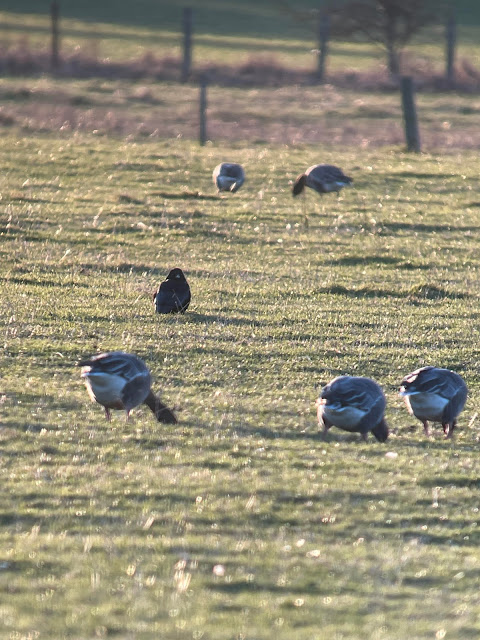
I scanned through the pink foots further south, into better light, looking for something different, and I found something completely different! A huge corvid in amongst the geese, it looked almost as big as the geese! Raven surely. It was facing away but when it turned it's head, the huge deep bill confirmed it as a full patch tick. Species 253 for the patch. 
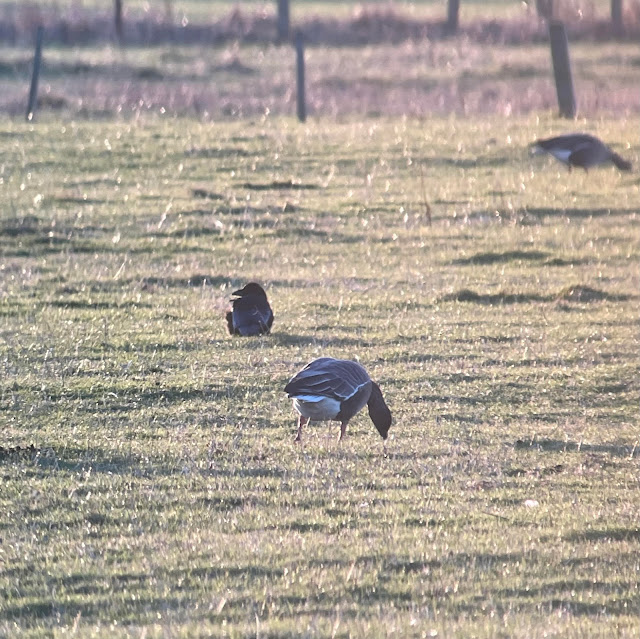
The brute

digi-scoped record shots

Not a species I was expecting to see, but maybe it should have been more on my radar? The range is increasing and they're breeding on the coast further north from us now. Janet saw one recently at Snab Point, so maybe this was the same bird?

It was quite funny, as when I had been with the Coast Care team earlier, one of them was using a pair of loppers that sounded like the 'cronk' of a raven, which caught me out a couple of times. I mentioned to him that raven would be a new bird for the patch  - little did I know what was to come!

Photos of the white-fronted goose circulated by Mark are inconclusive so it might be 'un-raced' until I get a better look. hopefully on the bird race tomorrow.


Sunday, 8 October 2017

A bit about ringing

You wait for ages for a blog post and two come along together ( or maybe not...)

The ups and downs of ringing...

A week past Tuesday, it was late September,  the wind was out of the east, but light and there was fog on the coast, should've been great condition for ringing birds so I took the day off and I ringed 15 birds all morning.

It's been either windy or wet ever since and the wind has been constantly out of the west. Not one to be deterred, the forecast for today predicted light westerlies, so we decided to ring. We weren't going to be inundated with birds so we put six nets up. Janet and I were joined by one of Phil Hanmer's trainees, Sasha. Skeins of barnacle geese flew overhead at first light as the nets went up and about 2000 pink-footed geese lifted off the Budge fields.

Catching was steady, with robins, wrens and blackbirds early on and a female bullfinch and a couple of tree sparrows, which are always nice to catch.

Tree sparrow
Reports came in of yellow-browed warblers elsewhere on the coast and on the next net-round we caught one. We caught another soon after which came in with a flock of twelve long-tailed tits. I think these birds may have just arrived on the coast.

One of today's two Yellow-browed warblers
Yellow-browed warblers are now more common on the patch than both pied and spotted flycatchers, garden warblers, redstarts and even lesser whitethroats.

Tom Cadwallender arrived and we chatted, I was going to pack up the nets then, but he came with me to check them so I decided to wait until next time around - I'm pleased I did.

Tom went and I started to take down the nets, there were a few birds in the second net including a warbler, which, to be honest, at first had me flummoxed - I thought I knew it what it was, but the bubblegum pink legs had me confused. I phoned Tom, who was still on site and took it back to the car.

Tom and I quickly agreed the ID of the warbler and Janet (who had gone to ride the horse) was summoned. We'd caught a Cetti's Warbler! (I'd never taken much notice of their legs before)

Cetti's warbler
Cetti's warbler is a recent colonist to the UK (first breeding in 1973 - the year I was born!), it's range is expanding northwards but is still a very rare bird in the north and even more so in Northumberland with only a handful of records.

I've put my neck on the line and said that Cetti's will be breeding at Druridge within five years - even more reason to keep on top of our coppicing efforts as they like a scrubby habitat. Not that we should need a reason as we know it benefits breeding warblers and other songbirds.

Blackbird's nest in coppiced alder stool
We ringed 69 new birds today.

Cetti's warbler is my 246th species for the patch and my sixth new species for the year and my second new species of the weekend. Happy days.

Sunday, 5 January 2014

More coppicing

We were doing more coppicing at Druridge this morning so had very little time for any birding.


What we actually do is a cross between coppicing and pollarding, leaving a higher stump than traditional coppicing. This creates nesting habitat off the ground as well as giving the 'coppice stool' more chance of surviving amongst the deep grasses that might out-compete it early in the spring.

This is important work. Firstly it keeps the height of the belt of trees down, decreasing the edge effect on the adjacent wet meadows (and pool) which is better for breeding waders. It also creates much better habitat for warblers, my territory mapping exercise that I did a few years showed that warbler territories were a greater density in recently coppiced areas. It is also beneficial for our ringing activities, keeping more of the trees below net height.

Once the work was done, I did manage a brief wander around the patch. A long-tailed duck was on the big pool, but then flew off, maybe the noise from the chainsaw disturbed it? Other than that, only common species were added to the list.

32 long tailed duck
33 robin
34 blue tit
35 coot
36 tufted duck
37 stonechat
38 pheasant
39 feral pigeon

PWC Score: 45

Thursday, 2 January 2014

Some good birds for January

Well my 2014 patch list got to off to a a start today with some good species for January amongst the common stuff.

We did some coppicing, which was going well until the chainsaw died (old fuel we think). I had to resort to more traditional methods to finish the job and then got half an hours birding in.

hard work after the festivities
The first species on the list was predictably magpie. There was lots of waders and ducks on the Budge fields including 4 black-tailed godwits. Blackwits are normally very rare here in winter, there were two on my December WeBS count, so this winter is proving to be exceptional for this species.

later this afternoon, I had a look on the sea. Not arriving until half-three, dusk was setting in but the light was nice. Scanning the sea, I picked up a black-throated diver, presumably the same bird as last week. Near it and close in was a slavonian grebe. Also of note offshore were two gannets heading north and a couple of fulmars, both good species for January.

So the 2014 patch list stands at 31 earning me 36 points in the 2014 Patch Work Challenge.

1 magpie
2 goldfinch
3 linnet
4 wren
5 carrion crow
6 starling
7 lapwing
8 curlew
9 black-tailed godwit
10 redshank
11 wigeon
12 teal
13 shoveler
14 mallard
15 black-headed gull
16 red-throated diver
17 goldeneye
18 black-throated diver
19 common gull
20 common scoter
21 gannet
22 slavonian grebe
23 fulmar
24 herring gull
25 great black-backed gull
26 oystercatcher
27 kestrel
28 pink-footed goose
29 barn owl
30 blackbird
31 Guillemot

PWC 36 points

Sunday, 17 March 2013

Whoopers moving north

We went to Druridge today, the last chance of the year to do some coppicing.

I flooded the chainsaw and then it wouldn't start.

Four whooper swans flew north whilst I swore at the chainsaw. Then seven more.

We gave up and went home, 25 whooper swans flew north over the dunes at Cresswell, I guess they're heading north to the breeding grounds. I'm heading south.... to Mallorca

I'll be back on the patch at Easter

81 whooper swan

Sunday, 26 February 2012

Patch tick conundrum

I saw a Ross's Goose on the patch today. Can I add it to my Druridge patch list?

The goose in question was first picked up lifting off from near East Chevington by Alan Gilbertson and myself as a white goose amongst about 1000 pinkfeets. From a long-way off, it looked like quite big and we guessed it was a snow goose. A better view was required, the geese had landed one field north of the patch boundary, how frustrating.

Alan left and Janet arrived, we went for a better look. Closer inspection proved it to be an adult Ross's goose, but it was still outside the patch.

We spent the rest of the afternoon chainsawing, reducing the height of some alders and ash trees around our net-rides and doing some much-needed coppicing. As we worked, the geese flock got up a again and circled over the northern edge of the patch. The 'white one' was easily picked out.

Now the conundrum. Ross's goose still isn't on the official British list, residing in category D. Identification isn't in question, it's the origin of these birds that hasn't been confirmed. There have been a few Ross's in the UK over the past decade that look for genuine vagrants (timing and arrival with possible carrier species). Alongside this, the world population of Ross's has massively increased from an estimated 3000 individuals in the 1930's to 188,000 in the 1980's making genuine vagrancy more likely.

So what do I do?

Add Ross's Goose to the Druridge List? (I see from BUBO Listing that some Northumbrian birders have added the 2004 Hauxley Ross's goose to their county lists)

Create a 'pending' category and add it as an 'armchair' tick when the BOURC add it to the British list?

or

Forget all about it

Time to ponder. Despite spending the whole afternoon chainsawing, as well as Ross's Geese I managed to add oystercatcher and whooper swan to the year-list and watch two fantastic short-eared owls in the dunes.

79 oystercatcher
80 whooper swan
81 Ross's goose??? (Pending)


Monday, 14 March 2011

Coppicing...Aborted

Another coppicing session this morning, starting where we left off, just north of the Budge screen. Joined by Steve, the three of us made good progress until my chainsaw made strange noises, noises that sounded expensive...if not fatal!

So that was us, no chainsaw and not really fancying tackling some of the bigger trees with a bow saw, what else to do but go birding?

Whilst we were coppicing skylarks, wrens, robins and dunnocks were all singing. In the dunes, it was heartening to see pair of stonechats  back on territory, I feared this species might have succumb to two successive cold winters. Amazingly, the dunes now seemed full of meadow pipits.

No 'true' migrants yet, I had my hopes pinned on an osprey - may as well aim high!

The only other highlight was big female sparrowhawk hunting over the Budge fields and along the edge of the shelterbelt. It flew straight at us in the Budge Screen. Now, if I had two grands worth of dSLR kit, I would've had frame filling flight shots. As I haven't, here it is, miles away, perched in a tree.

Sparrowhawk
Douglas' Island was attracting some attention from a number of species today, I've lost track of the Douglas' Island list.
Douglas' Island

Finally, a word of advice. If you're heading for Druridge Pools and intend going to the Oddie or little hides, do bring your wellies. This poor couple hadn't, but were obviously keen to see what was on the pool, as they scaled the bund and teetered along the edge to get there.
No mountain to high for these two intrepid birders
Nature-based tourism at its finest! Would Norfolk Wildlife Trust would get away with this Cley?

82 stonechat
83 sparrowhawk

Friday, 25 February 2011

A first!

This is my first, and probably last, blog post sent from my mobile phone. I downloaded the blogger app so thought i'd give it whirl.

We were coppicing at druridge today for 6 solid hours, i'm knackered now, not used to hard work these days. We got quite a bit done, just north of the path to the budge screen. So when you hear singing whitethroats there this spring.....

I managed two year ticks whilst fuelling the chainsaw, 4 barnacles over with some pink-feets and a single skylark heading north.


Thursday, 24 February 2011

coppicing

The National Trust had a group of volunteer in coppicing the trees at Druridge recently. Well I say coppicing, to be honest its more like a cross between coppicing and pollarding - a hybrid technique.

Recently coppiced/pollarded alders

The reason we do this semi-pollard/coppice thing is two-fold. Firstly, it stops the rabbits eating the regrowth, secondly, it provides safe nesting 'cups' for birds amongst the new stems, clear of the ground.

It looks brutal at first, all of the trees hacked down, but this is essential work. My territory mapping exercise last breeding season proved this. The number of species and number of territories was higher in the recently coppiced areas. The strip of trees and bushes at Druridge is primarily alder and hawthorn, with ash, willow and some whitebeam with other oddities.

If left, the alders would get quite high, the only birds that would nest would be magpies and crows, the height would further limit the area of the Budge fields for breeding waders. I'm off tomorrow, so were going down to Druridge to a bit more coppicing, it grows so quickly once it is cut, we can't get round it all quick enough!

Alder is quite pale colour straight after it is cut, but it soon turns this lovely orange colour.


Bright orange brightens a grey day at Druridge
 Today wasn't so grey, by far the warmest day of the year so far. My work took me to Seahouses where the drake eiders are looking rather resplendent in their breeding plumage!

drake eider looking rather dapper