Showing posts with label carrion crow. Show all posts

Sunday, 15 May 2022

Putting in a stint or five for the WeBS count

Well, I didn't expect to finish my WeBS count this morning by adding FOUR Temminck's Stints to it - but that's what happened!

John Day, an RSPB friend from Bedfordshire and his pal Darren joined us at Druridge this morning, they are up here for a weekends birding. When we joined them just after 7am they'd already seen more species than you can see in a month in Bedfordshire!

It was WeBS count day, so I counted the ducks whilst they enjoyed watching spoonbill, little stint, avocets, pintail, dunlins, lapwing chicks and other nice species. Little stint was new for the year so I was already happy with that. Count done and all three hides checked we headed back to the cars. They were off to the Harthope Valley whilst Janet and I opted for a look on the sea. Seeing very little, I checked my phone to see a missed call from Steve Holliday, and a text message - 'four Temminck's Stint in front of Budge Screen'. Seemingly they'd just dropped in. 

We called John and Darren who were still faffing at their car and rushed to the hide, where, thankfully, the four birds could be seen on the edge of the pool. The four of them stuck pretty-close together and fed frantically along the muddy edge. I always think the 'gait' of Temminck's is quite diagnostic, they almost creep on their 'knees' as if their legs are set too far back on their bodies. They were chased by a redshank a couple of times, and then, without cause or warning, they were off, zig-zagging at first before flying off high and directly north. Steve and I thought that this might be a record count of this species for the County? These were my first patch Temminck's since two were on a pool by the coal haul road back in 2013. 

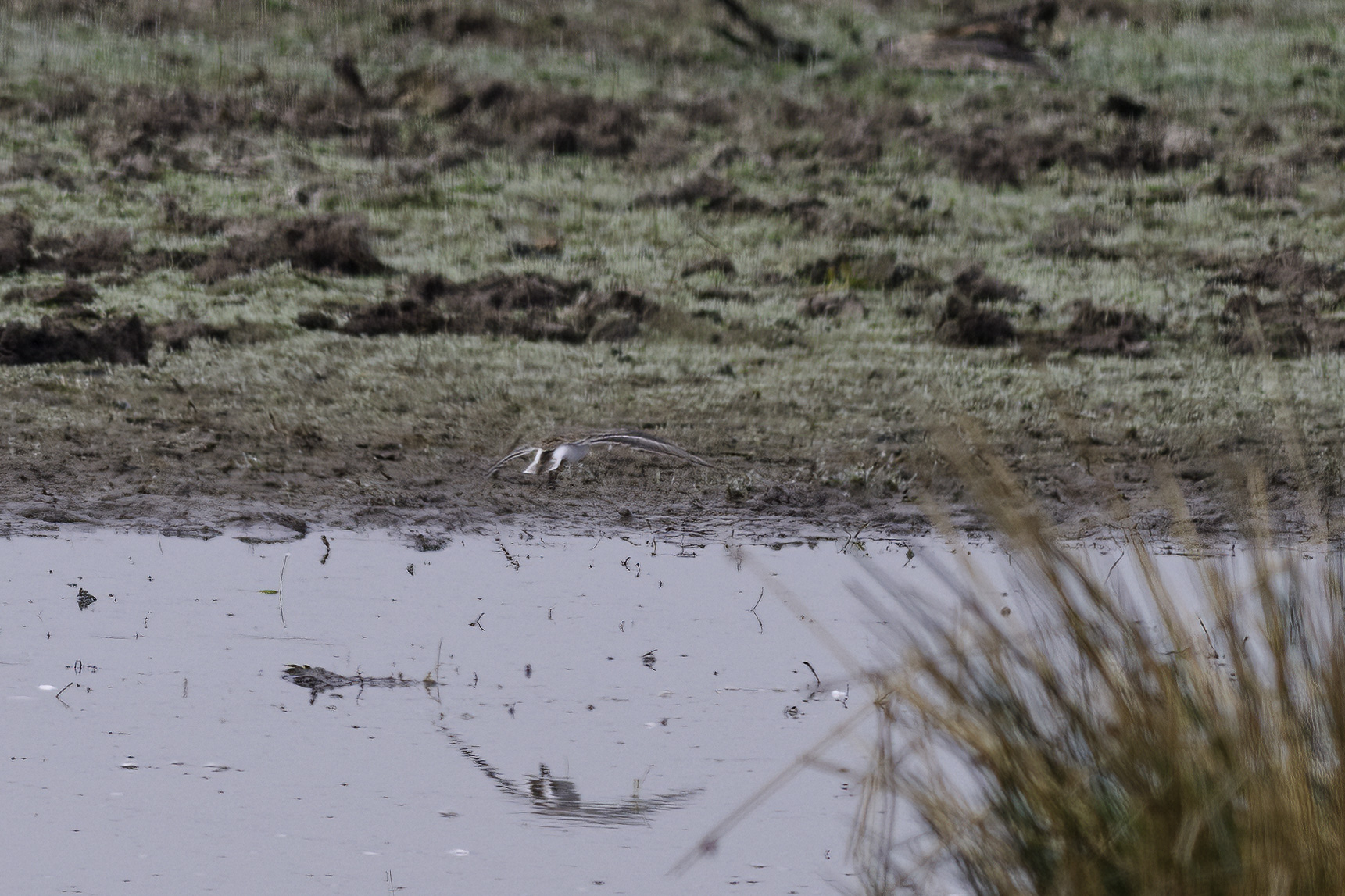
Record shot  - just to prove there were four!

A slightly better shot of two of them

And one flying off

A very pleasant end to a morning's birding. Big thanks to Steve H for the tip-off.

The Budge Fields are looking fab at the moment. Despite the relatively dry spring, the water levels remain very high, something has changed with the hydrology of the site this winter I think. Birds are dropping in all the time, not long after we left a wood sandpiper was reported. The 'Channel' wagtail that I found on Friday was seen again today.

Here are a few more pics from the last couple of days.


Proud parent on guard

And here's the reason why!

You can see why barn swallows were called bluebirds!

Spoonbills are now a common spring and summer species on the patch

Pochard are increasingly uncommon - the four that are on site at the moment are most unusual nowadays
The geese took a dislike to two roe deer who wandered through the pool. Roe deer are on the increase, almost plague-proportions these days.

My Druridge patch year-list is now on 130 and my 5km from home list is on 157. 

Sunday, 17 October 2021

Tystie, tystie, very, very tystie

Twists of fate led to a full-fat patch tick on Friday.

Firstly - I wouldn't have normally been at Druridge on a Friday lunchtime. I'd have been at work. A good friend from Malta, Justin Vassallo, was visiting so I took the day off to take him birding. Justin is a legend - he started the first Maltese Raptor Camps in 1999, when he was only 19. I met him in 2001 when I went to my first of four raptor camps. We've been friends ever since. 

Secondly - We'd spent the first part of the morning seawatching at Snab Point so wouldn't have ordinarily gone back to look at the sea. We were in the little hide at Druridge when a couple of visiting birders told us they had seen two great northern divers with a single red-throated offshore - A chap had put them onto them. We retrieved the scopes from the car and headed up there. The 'finder' wandered off when we arrived. No sign of the GNDs but there was enough to look at so we stayed a while.

And that's how I happened to be in the right place at the right time.

We counted at least 20 red-throats on the sea, 160 common scoters, large auks, red-breasted mergansers, three scaup, great crested grebes. All good stuff for a Maltese birder. After 30 minutes or so of scanning, I picked up an auk headed north, already north of us - big white wing patches stood out immediately on an otherwise black and white 'motley' auk. Justin was looking south when I called it  - Black Guillemot! Despite my best efforts I couldn't get him onto it before it disappeared into a trough and was lost to sight. Given the scaly-dusky-ness of the bird I think it was a first-winter rather than a winter adult. 

I suppose 'tystie' is overdue as a patch bird and I shouldn't have been unexpected but it certainly wasn't on my radar for Friday - given reports from elsewhere, great shearwater or white-billed diver would've been more likely. So,  a pleasant surprise. Tystie takes my patch list to 253 and the patch list to 272.

We retired to the Drift Café for lunch and a celebratory beer.
Justin and me - celebrating a few lifers for him and a patch tick for me with a bottle of Curlew Return each

Elsewhere on the patch, late common darter and migrant hawker dragonflies were on the wing and three mistle thrushes were around the farm. Four barnacle geese were new for the autumn.

One of many common darters

Mistle thrush - not common on the patch

After the excitement of Friday, Saturday was a bit more mundane. 

It was a grey day, no wind, just flat... as was the birding. I decided to have a look on the sea. The sea was flat too. There was steady, northerly, kittiwake passage and three little gulls lingered offshore. A single female scaup came in with a red-breasted merganser and two turnstone flew north. 35 red-throated divers were on the sea, eight flew north and one went south.  

Coal tit in the plantation on Saturday

Today, Janet and I walked north from the plantation and back by the beach. The bushes were VERY quiet. The three mistle thrushes were still about. On the beach, a single rock pipit feeding on the seaweed north of the Dunbar Burn was a year-tick. Rock pipits are tricky at Druridge so it was welcome. 

Rock pipit

Carrion Crow on the beach

Razorbill - still a few auks feeding close inshore


Ringed plovers from last week

A sizeable (250+) flock of finches roamed about the dunes, I think 85-90% of them were linnets. No twite yet. 


Sunday, 14 February 2021

Baltic

It's been really cold this week, with snow and ice dominating and a brisk easterly through to southerly wind making feel even colder.

Continuing restrictions have meant limited trips to the patch and a lot of birding on foot from home for the 5km patch list which is coming along nicely. I have been popping into the patch, if I've been passing that way and a 'change' in rules has meant that surveys like WeBS can continue as long as you stay local and obey social distancing rules. I suppose there had to be a relaxation given that it was legal to stand in a field and shoot birds but not to count them.

The cold weather has brought an influx of birds not usually seen in big numbers at this time of year. Hundreds of winter thrushes, particularly redwings are now on the coast, there are Woodcock, Snipe and Jack Snipe (we saw one today) in decent numbers and I counted 67 Meadow Pipits on the Budge fields today and 18 Stock Dove near the farm yesterday.

Snipe flushed from the Coal Road yesterday
One of many Redwings

Some of the Canada Goose flock yesterday with Pink-footed Geese in the fields behind

The WeBS count was busy with big counts of Wigeon (352) and Mallard (106) but lower numbers of Teal (64) than usual. A Long-tailed Duck on the Big Pool was a bonus. 

All of the wildfowl are looking smart now and this drake Shoveler was particularly dapper

The Budge fields were almost frozen over and devoid of ducks,  a few Lapwing and Curlew needed counting though.

The Lapwing were finding any shelter they could from the cold southerly winds
Carrion Crow looking for food on frozen ground
Moorhen legging it through the snow

Sunday, 16 August 2020

This week it has been mostly foggy

It's felt more like October than August this week, the cloud, got or mizzle has hardly lifted and neither has the temperature. Sadly, despite the murk and the wind having easterly in it, we didn't have the birds of October. 

It's been mostly misty this week - keeps the crowds away though

I've been down to the patch most days this week, some seawatching, looking for migrants, a bit of ringing and culminating in two 3 hour seawatches today.

I had a bit of lie-in this morning, but when I got up the Whatsapp group had news of Long-tailed Skuas heading north along the coast. About time there was some good seawatching as it's been a damp squib so far this week. I headed for the patch, arriving just after 9am. More messages of Long-tailed Skuas  - failed to connect with any of them, had they gone too far out for me? Lots of Manx Shearwaters, a single Bonxie and Arctic Skua and then at 10:40 a closer Skua, almost coming out of the Bay rather than heading north, a Pomarine Skua, no 'spoons' but a superb bird and close, it headed out into the bay.

I called it a day at 11.30 and headed home for coffee, worried I had missed the Long-tails but happy with my Pom. In the dunes I came across my first Wheatear of the autumn, a moulting juvenile.

Juvenile Wheatear

After lunch I was about to head for the allotment when Dave Dack kindly called me to tell me that more Long-tailed Skuas were heading north. I re-parked the wheelbarrow and jumped in the car and back to the dunes. Another report of five!! yes five Long-tailed Skuas past Snab Point - I didn't see them. I was about to hoy me scope into the sea and take up metal detecting. Then at 4pm I got onto a skua heading north, more bouncy and tern like in flight, it was looking good as it came north, about 2/3rds of the way out. As it drew level with me ID was clinched - Long-tailed Skua, the steely grey of the bird against the sea tied in with the jizz as it flew past, it didn't get very far before landing on the sea off Chibburn Links. After that another L-T Skua was reported with two Arctics from Newbiggin. 24 minutes later I got onto three terns - they were distant mind. It was good to compare 'jizz' though  - the first bird much more buoyant and 'aerobatic' than the two that followed, the cold-steely grey could be picked up at that distance -honest!

Two more Long-tails were reported past Newbiggin Church Point at 17.15. Thirteen minutes later I was watching them, closer than the previous skuas, amongst the pot flags this time. Amazing  - four Long-tailed Skuas. 

At 17.34 a Pomarine Skua went north at Church Point and amazingly exactly ten minutes later I picked it up, powering north. It got here quicker than the Long-tails and Arctics which is surprising when you watch them fly!

Manx Shearwater passage was heavier in the morning than the afternoon and even Gannets were thinner on the ground after lunch. A couple more Bonxies came through and an Arctic Skua was 'resident' in the Bay, harrying terns. 

Black-headed Gull headed north

Six hours well spent!

On Monday my walk produced a flock of 14 Goosander headed north and a pair of juvenile Buzzards over the dunes and perched in the bushes. This Grasshopper Warbler was by the Dunbar Burn.

Grasshopper Warbler skulking as they do

Goosanders headed north

I tried a ringing session on Tuesday morning before work but it was very quiet, I only caught 14 birds and 5 of them were retraps. It was almost as if the resident warblers had mostly cleared out, leaving a few willow warblers behind. Wednesday was very quiet too so I walked back by the beach and saw my first Turnstone of the year when three flew north and Whimbrel called overhead. 

Carrion Crow on the beach
One of 14 Cormorants over
Juvenile Blue Tit in the dune bushes

Seawatching on Friday evening produced a single Sooty Shearwater among a handful of Manx. About 250-300 Common Scoter are hanging around offshore with a few guillemots and couple of  Great-crested Grebes in amongst them. 

The week definitely ended on a high. It looks like the northerly will switch south on Tuesday, I hope we get another one before the winter. 

The easterly winds have deposited huge numbers of Jellyfish on the beach. This is a Lion's Mane Jelly. 

Sunday, 5 July 2020

Blustery Day

Today was sunny and bright but blustery with a gusting s'westerly, strong enough to encourage most birds to seek cover. Janet and I had walk around the patch but didn't see a lot of birds until we got to the Budge fields. A pair of stonechat were with a single juvenile north of the of the bushes.

Stonechat amongst the mugwort
Even with the hides as shelter, viewing conditions were difficult as the SW wind was blowing straight in through the windows of the little hide. There were lots of waders including at least 56 black-tailed godwits and three ruff.

Some of the 56 black-tailed godwits
We tried viewing from the Budge screen but that was worse. I didn't have my scope with me but it was probably just as well. The three avocet chicks from the first brood are getting big now and should fledge, I couldn't see the two from the latest brood or the redshank chicks.

Despite the wind, it was warm in the sun which brought quite a few insects out. I didn't have the macro lens with me so just some iPhone shots to identify the species - a job for later in the week.

Yesterday started-off awful with thick fog followed by a mixture of mizzle and drizzle. By late afternoon, visibility had really improved so I headed down to the patch. I thought I might have a look offshore, just on the off chance of a passing albatross. After a few minutes scanning the sea, I realised that the strengthening SW wind had brought the terns closer inshore to feed, so despite the awful light, I had a go at photographing them. The sandwich terns were the only species that fed within range, the common and roseate terns were a bit further out and the Arctic terns stayed well out of reach as did the pair of adult great-crested grebes.

Here's a few of the shots

Action shot


Contortionist

Common scoters - there were about 550-600 in the bay

Having a shake

This one was colour-ringed with black letters on a yellow ring - I've tried blowing it up to read the number, but it's the wrong way around.

On my way back to my car through the dunes, the cuckoo that has been around the dunes the last few days flew by me and I grabbed a record shot.

Heavily-cropped cuckoo
This young carrion crow entertained itself picking among the detritus of a bonfire - they are so inquisitive, even at a young age.


This looks fun!
Despite the pubs being reopened, I had no fancy for going to one. The Drift Cafe were open 'til 7pm with an American Burger menu so we went there instead - my first beer away from the homestead since lockdown.


Friday, 6 March 2020

Could it be spring?

Could it be Spring?

It felt like it this afternoon but down on the patch first thing it was a cold and frosty start. -1 degrees C but hardly a breeze and a lovely white frost.

Frosty start
Despite the cold, spring was in the air for the stonechats as they chased each other around the turning circle and for the skylarks who sang out above my head. Towards Chibburn lapwings were tumbling - it is spring y'know!

One  the stonechats - pausing for a while before resuming his courtship
Out in the fields about 780 pink-footed geese grazed - it's still winter...

I continued down to the Budge screen where it was nice to catch up with ADMc who was counting the grey herons, he'd got to 29 which is an impressive count for the patch and might indicate a good breeding season ahead - they'll be on eggs soon.

The other 'Budge' highlights included the three almost resident ruff, one of which is very lucky to be still with us. Andy called out a peregrine speeding low, north, it flushed the waders and ducks before gaining some height to stoop on one of the ruff, the ruff darted left and avoided being breakfast.

The three ruff coming back in to land - one of them very lucky to be there!
There weren't many wader s on the Budge in contrast to Saturday when there 153 redshank, 16 dunlin and 53 curlew.

One of Saturday's 153 redshank
In the fields beyond the Budge were more geese, pink-foots mostly but a scan through them produced three Eurasian white-fronts. Disturbed by something, all of the geese got up and estimated 1000 or so, added to my 780 earlier by the haul road,  I jotted down 'c1700'.

Shoveler numbers are still good - I estimated 41.

With chores to do I, I left Andy chatting to Marty Anderson and headed home. One of my more enjoyable chores was to clean out and check our 30 or so tree sparrow boxes at Ellington Pond Nature Reserve. Two water rails weren't put out by my presence and chased each other around the pond-margins squealing like pigs!


Two views of carrion crows
Coot from Saturday