Showing posts with label pochard. Show all posts

Sunday, 15 May 2022

Putting in a stint or five for the WeBS count

Well, I didn't expect to finish my WeBS count this morning by adding FOUR Temminck's Stints to it - but that's what happened!

John Day, an RSPB friend from Bedfordshire and his pal Darren joined us at Druridge this morning, they are up here for a weekends birding. When we joined them just after 7am they'd already seen more species than you can see in a month in Bedfordshire!

It was WeBS count day, so I counted the ducks whilst they enjoyed watching spoonbill, little stint, avocets, pintail, dunlins, lapwing chicks and other nice species. Little stint was new for the year so I was already happy with that. Count done and all three hides checked we headed back to the cars. They were off to the Harthope Valley whilst Janet and I opted for a look on the sea. Seeing very little, I checked my phone to see a missed call from Steve Holliday, and a text message - 'four Temminck's Stint in front of Budge Screen'. Seemingly they'd just dropped in. 

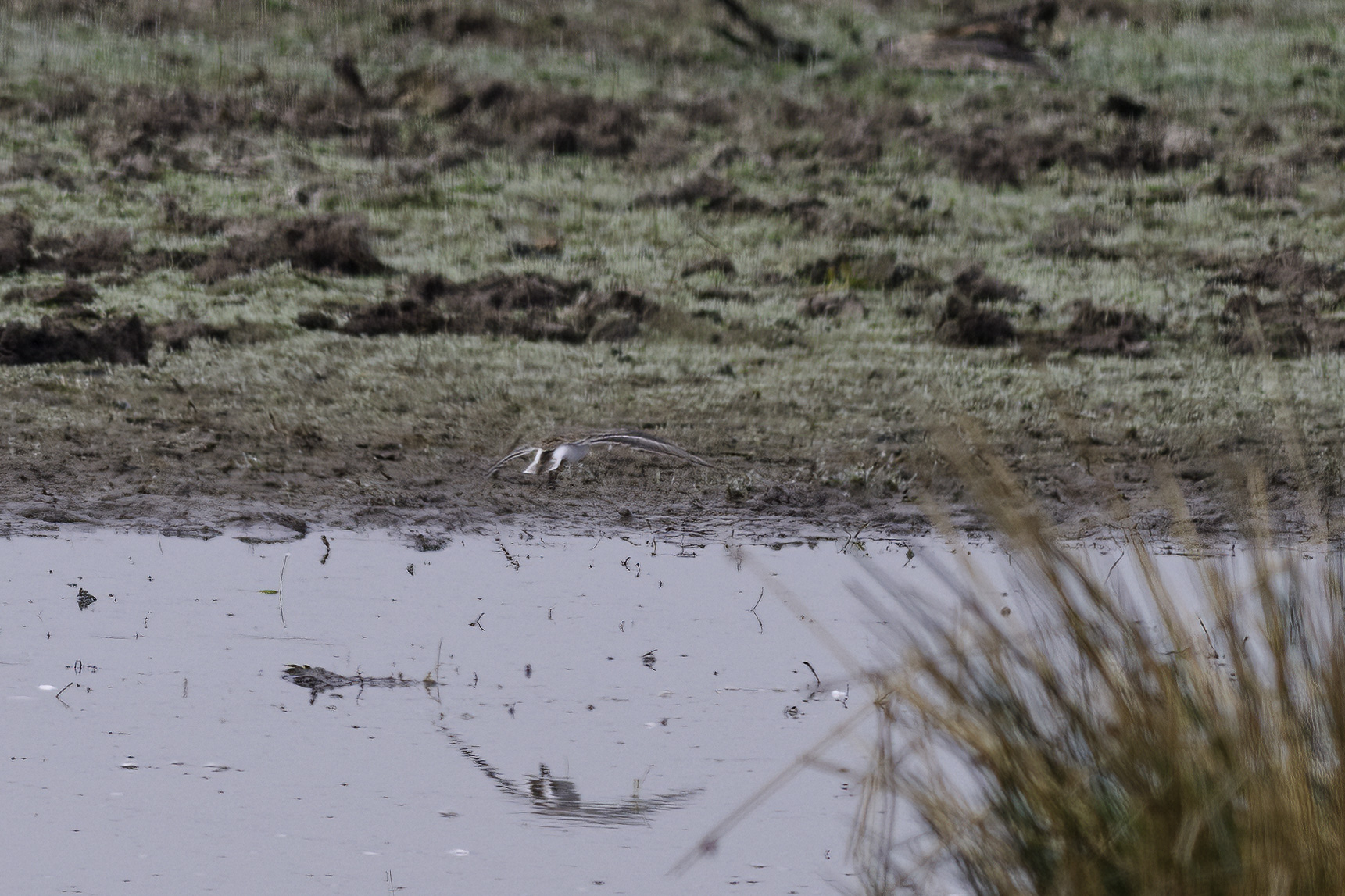
We called John and Darren who were still faffing at their car and rushed to the hide, where, thankfully, the four birds could be seen on the edge of the pool. The four of them stuck pretty-close together and fed frantically along the muddy edge. I always think the 'gait' of Temminck's is quite diagnostic, they almost creep on their 'knees' as if their legs are set too far back on their bodies. They were chased by a redshank a couple of times, and then, without cause or warning, they were off, zig-zagging at first before flying off high and directly north. Steve and I thought that this might be a record count of this species for the County? These were my first patch Temminck's since two were on a pool by the coal haul road back in 2013. 

Record shot  - just to prove there were four!

A slightly better shot of two of them

And one flying off

A very pleasant end to a morning's birding. Big thanks to Steve H for the tip-off.

The Budge Fields are looking fab at the moment. Despite the relatively dry spring, the water levels remain very high, something has changed with the hydrology of the site this winter I think. Birds are dropping in all the time, not long after we left a wood sandpiper was reported. The 'Channel' wagtail that I found on Friday was seen again today.

Here are a few more pics from the last couple of days.


Proud parent on guard

And here's the reason why!

You can see why barn swallows were called bluebirds!

Spoonbills are now a common spring and summer species on the patch

Pochard are increasingly uncommon - the four that are on site at the moment are most unusual nowadays
The geese took a dislike to two roe deer who wandered through the pool. Roe deer are on the increase, almost plague-proportions these days.

My Druridge patch year-list is now on 130 and my 5km from home list is on 157. 

Wednesday, 14 October 2020

A bit of a damp squib

With the wind of the northeast and rain overnight, today could have been mega or as the winds were only originating from the near continent it could've been very disappointing. 

It wasn't a mega by any means, but it wasn't without some highlights. One bird could've made all the difference, I just couldn't find it despite spending the best part of eight hours on the patch. 

Janet joined me and we started at the Plantation and worked our way north, checking all suitable habitat. The male Blackcap that has been guarding his patch of elderberries by the entrance was joined by two or three more - we saw at least nine Blackcaps this morning so a small arrival.

Young male Blackcap guarding his Elderberries

Other than a few Goldcrests, Redwings and flyover Skylarks, things were quiet until we reached the patch to the hides and heard a Yellow-browed Warbler calling, it flitted about in the willows and Whitebeam, showing well for a Yellow-brow. It was nice for Welsh Joe to get some pics as he's been complaining he hasn't managed to photograph one well - they are so tricky. Whilst we watched this bird a second Yellow-browed called beyond it and then a real patch Mega showed briefly - Treecreeper! Not even a year tick after the one in the plantation earlier this month.

Yellow-browed Warbler with a caterpillar

Same Yellow-brow, side-on. They don't normally stay still long enough for photos like this

Look, I'm not an Eastern-crowned Warbler

By the bridge, it was sheltered and a couple of Speckled Wood butterflies were on the wing and this stunning Comma sunned itself.

Comma - a very uncommon butterfly on the patch, especially in October!

A common autumn butterfly nowadays - Speckled Wood

We wandered north. Up at the turning circle, in the Blackthorn thicket, we had at least three Chiffchaffs and another Yellow-browed Warbler. We also saw another Phylloscopus warbler briefly that remains unidentified. Five Pochards were on the big pool which are notable as they are increasingly scarce species at Druridge. 

Patch scarcities - five Pochard on the big pool

Hunting Kestrel

After lunch, I headed back to look for the mystery phylosc but with no luck. A flock of Long-tailed Tits came through, which we hadn't seen  in the morning, with a Yellow-brow in tow. In the dunes to the north, the finch/bunting flock was restless, when they did land, there was at least five Twite with them, my first of the Autumn as well as 30+ Lesser Redpolls and handful of Tree Sparrows, Goldcrests and other finches, otherwise they were mostly Linnets. Over 30 Reed Buntings fed independently of the flock.

One of over 30 Reed Buntings in the weedy dunes - ISO3200 so it's turned out bad!

At 4.30 I gave up and tried a seawatch. It started quietly and then it pissed-it-down. I stuck it out for an hour seeing very little. Two Goldeneye with a Slavonian Grebe on the sea were noteworthy. 

Cold and wet I headed home after over eight hours on the patch and 65 species. 


I'll be back tomorrow.

Wednesday, 19 August 2020

Black-neck

A quick post-work visit to the patch this evening to catch up with Black-necked Grebe that had been reported on Druridge Pool earlier in the day. Black-necked Grebe is a tricky bird to see on the patch and this was my first since a summer-plumaged bird in May 2018. No chance of any photos as the bird kept a distance from the shore. A Pochard was another scarcity.

The recent rain has re-wetted the Budge fields and this had attracted a decent smattering of waders including three Knot, two Ruff, a single Turnstone (rare on the Budge), Little Ringed Plover, Black-tailed Godwit, three Ringed Plovers and a few Dunlin and Redshank. A single first-summer Little Gull was in front of the little hide. 

The wind has strengthened out of the south-east and it's raining. Could be good in the morning...


Thursday, 2 January 2020

Two things are guaranteed...

Two things are usually guaranteed on New Years Day on the patch:

1) I will see a species that I didn't see in the previous year. Over the years this list has included merlin, peregrine and slavonian grebe amongst others. This year it was pochard.

Two drake pochards heading south
I half-expected it to be long-tailed duck as one was reported on New Years Eve and it was LTD I was looking for when I saw the two drake pochards on the big pool.

2) Some mentalists will be in the sea

Brrrrr
At least this girl kept her bikini top on, the two in 2018 didn't!

New Years Day was beautiful day and Janet and I had a good wander around the patch, taking in the big pool, Budge fields, bushes, sea and dunes to the north and saw 56 species - not a bad start to the year list. Other than the two pochards, other highlights were two velvet scoters flying south offshore, 60 twite in the dunes, a goldcrest (very rare in winter), a pair of pintail, a kestrel (first since July!), 250 golden plover and two of the four ruff from last week. We scanned through the pink-footed geese in the front field but couldn't find the white-fronts.

Busier than a summer day
By the time we headed home just before 2pm, the place was rammed, everyone and their dog(s) had descended on Druridge Bay. When we left, we had to queue to get out because people had parked on both sides of the road, leaving no room for cars to pass. It was like August Bank Holiday Monday!

Link to eBird list for NYD

Today was colder with a stiff breeze from the SW. I quickly checked through the geese (still no white-fronts) and the Budge fields where the four ruff had returned and had been joined by a dunlin. I also added blue tit and shelduck to the year list

List from today

Sunday, 12 August 2018

Wet WeBS

Today has been mostly wet.

Once the rain eased after lunch, I popped down to the patch to do the monthly WeBS count. Nothing startling on the count, six black-tailed godwits, 20 dunlin dropped in and there were three snipe on the Budge fields.

On the big pool it was nice to see the great-crested grebe with its youngster, still sporting some stripes looking less like a humbug, there were also two pochard. Moorhen seem to have had a good year, there were 26 on the patch today.

I had been talking to a couple of visiting birders up here on holiday from Warwickshire, as I was about to leave the hide, the lady says "Is this a bird in the tree or just a branch sticking out? I got it in the bins, then the scope  - it was a bird. It was stunning juvenile cuckoo sitting out on some branches. I am presuming it was locally reared but could've been a passage bird I suppose.

I managed a quick look on the sea before the fret rolled in - three red-throated divers, about 80 common scoter and four roseate terns were the highlights. An amazing sight though, was flocks of cormorants heading north. I counted 54 in ten minutes or so, with one group numbering 24 birds. Where have they all come from?

There were a few warblers flitting through the bushes, mostly willow warblers with chiffchaffs, blackcaps and sedge.

No photos today because of the poor light and rain so here are some macro shots from last weekend.

seven-spot ladybird Coccinella septempunctata on nettle

22-spot ladybird  Psyllobora vigintiduopunctata

The Heineken hoverfly Rhingia campestris


The most distinguishing feature of the Heineken hoverfly is the long snout.  Heineken used to advertise their beer by saying it could reach the parts other beers couldn't reach.  With it's long snout the Heineken hoverfly can reach the nectar which other hoverflies can't reach - hence the name.


Eupeodes Sp
Turnip Sawfly - Athalia rosae
Not sure what this one is

Eupeodes sp
Tree wasp Dolichovespula sylvestris


Smoky Wainscot Mythimna impura
Scaeva pyrastri
Scaeva pyrastri
 These Scaeva pyrastri hoverflies seem to be quite common at the moment.

Small copper butterfly Lycaena phlaeas on sorrel

Sunday, 6 December 2015

Recovered Stormy

We only caught two storm petrels in a single session this summer, the weather getting the better of us.  One of them was already ringed (a control in the language that ringers speak).

We've just heard back from BTO with details of where it was ringed; Eilean nan Ròn which is off the Kyle of Tongue on the north coast of Scotland, only 26 days before we caught it.

A distance of 403km. It is amazing the distances these tiny seabirds travel!

Here is a google map of storm petrels we've 'controlled' 

https://www.google.com/maps/d/edit?mid=z4Qkjic5Jjcs.kEcXq64P2UoA&usp=sharing


Nothing much to report from Druridge today. The long-staying 'Cresswell' long-billed dowitcher put in another appearance on the Budge fields again this morning before heading back south to it's favoured spot. It obviously doesn't think much of Druridge - it doesn't hang around for long.

There are now six pochards on the big pool, a handful of goldeneye and a red-breasted merganser - there were 15 'mergs' on the sea.


Sunday, 15 November 2015

Forecasters wrong again...

The weather forecasters got their predictions wrong for this weekend. Heavy rain from yesterday lunchtime (it rained at 4pm) which would last until the early hours of Monday. It rained over-night but there's hardly been a drop since.

Even our local WeBS organiser sent an advisory message out yesterday to recorders not to take risks in the weather. The only risk today came from wearing too many layers and over-heating. Light winds increased but it was 15 degrees C, dry, and quite pleasant.

Perfect weather for WeBS counting. Whilst I was counting from the Budge screen, a couple arrived and we chatted about the long-billed dowitcher that has been at Cresswell (and briefly at Druridge...grrr) for the last few days. They told me the tale of seeing it two weeks ago on the Budge fields but weren't confident of the identification (they knew it was something different), so they didn't say anything.

I encouraged them, that if they should find anything 'different' again, to let someone know. We all get things wrong, me especially, and we are always learning. That bird could have easily moved on and nobody would have seen it, let alone at Druridge.

My disappointment was soon gone when I picked up a female merlin sat out on the Budge field, it seemed to pull apart some prey before flying over and landing on a post for a while. My first merlin at Druridge for a long while.

Shortly after that a splendid short-eared owl put on a good show for us, quartering the fields in front of the hide. It was also right next to the path when I went to the Oddie hide - of course I had left my camera behind because of the forecast of rain. 29 whooper swan flew south.

Four pochard were still on the big pool (I saw them yesterday). My first record of pochard this year, they are certainly very uncommon at Druridge nowadays.

Yesterday I walked back along the beach, looking for snow buntings, which I didn't see. I did see a swallow though, a male, feeding over the dunes and beach. There were still plenty of insects about in this spell of warm weather. November 14th is very late for swallow and is my latest patch sighting. I have had a later 'Druridge Bay' record with one on 4th December many years ago, flying north at Chibburn Mouth.

Pochard and merlin put me on 156 for the year, which is very disappointing. If I don't see anything else new, this will be my worst year on the patch since 2012 and my second-worst since 2005. There are still some possibilities - snow bunting, white-fronted goose, brent goose, black redstart, bullfinch, red-legged partridge...maybe even the dowitcher will come back. That would be nice!


Sunday, 28 July 2013

Weekend round-up

I should have spent this weekend at a wedding do in London, so all three visits to the patch and a 'County-tick' at Alnmouth were all a bonus.

Saturday started with a ringing session at Druridge. With only half of the usual nets up, we didn't catch many birds. Warblers dominated the catch again with whitethroat, reed warbler, sedge warbler, chiffchaff and a family party of blackcaps, the amount of whitethroats we've caught this year is unprecedented and we are doing well for reed warblers to.

juvenile reed warbler
The female mandarin duck is still on the big pools and two drake pochard were unusual.

During the ringing session, news broke of a spotted sandpiper at Foxton. So as soon as we packed the nets away we headed up there for a look. A fine 'spotted' adult gave the assembled twitch good views as it pottered about on the banks of the River Aln. A 'county-tick' for, taking my county (low) list to 309.

An brief evening visit to Druridge didn't produce much, the highlight was a dark-phase arctic skua pursuing a common tern well inland over the big pool.

Sunday was a day of two-halves. The day began with strong winds and heavy rain, by tea-time it was warm and sunny but a bit breezy. So an afternoon visit to the patch. At long-last, I found a common sandpiper on the edge of the big pool a very belated year-tick. There were still two little gulls on the big pool and a family of yellow wagtails were in front of the hide.

two little gulls


For scale - little gull and black-headed gull
juvenile black-headed gull passes in front of the hide
common tern on their favourite spot
yellow wagtail
I'm struggling for waders this year. What mud there is at Druridge has either vegetated over or is hidden behind massive clumps of rush. I am relying on the regular passage of marsh harriers to flush something up.

I think a lot of the warblers are second-brooding at the moment, hence our low ringing catch and general lack of activity. These sedge warblers are certainly feeding a second brood.

Sedge warbler feeding young

same bird
137 knot
138 common sandpiper

Sunday, 3 February 2013

February gets of to a flying start

With the toon at home yesterday and a belated birthday night out on Friday, I only managed one visit to the patch this weekend and that was delayed due to much celebrating last night, after the toon's magnificent victory.

A flock of about 450 pink-footed geese on the filed in front of the hamlet were grilled, they were all pink-foots. In the same field, three male grey partridges were competing for the attentions of a female - quite an impressive display, spring must be in the air.

The Budge fields are holding a lot of water, which has attracted a lot of dabbling ducks and few diving ducks too. Mostly wigeon and teal but also today were mallard, gadwall, shoveler, tufted duck, pintail and pochard. There were singles of each of the latter two, both new for the year list. There were also lots of curlew. On the big pool there were still two long-tailed ducks.

I saw a couple of species that I really didn't expect to see until the autumn today, great-spotted woodpecker and goldcrest. The goldcrest was in with a flock of ten or so long-tailed tits and a great tit. A passing sparrowhawk rattled them a bit!
Long-tailed tit
Elsewhere, at the north end, there was a small flock of mixed finches, mostly twite with linnet and goldfinch and on the beach, a female stonechat poked around amongst the flotsam and jetsam.

A couple of birders had seen a short-eared owl, but I didn't.

So today's effort takes the patch total up to 61 species and 65 points on the patchwork challenge.

49 grey partridge
50 pintail
51 pochard
52 great-spotted woodpecker
53 long-tailed tit
54 great tit
55 goldcrest
56 sparrowhawk
57 linnet
58 twite
59 stonechat
60 mute swan
61 cormorant