Showing posts with label pheasant. Show all posts

Monday, 3 May 2021

More surveys

Saturday dawned  - the new month of May. I didn't expect to be scraping thick ice from my car windscreen in May but that's exactly what I had to do at 6am before heading Druridge for my fourth territory mapping visit. 

As well as the cold start, a wintery shower passed through as I arrived, I sat in the car and let it pass. Once cleared, the sun came out and it was quite pleasant but there were dark clouds on the horizon.

The cold weather has blocked a few arrivals I think, other than Reed Warblers, of which there a few singing away in the small patch of Phragmites in the corner of the big pool, warbler numbers are pretty-much what they were seven days ago with the addition of an extra Grasshopper Warbler maybe.

There are three scarce breeding species at Druridge already this year:

I've already mentioned the Long-tailed Tits, they are now feeding young. One of the adults is ringed, almost certainly by us last Autumn. I can't remember the last breeding Lottis at Druridge.

There is also a male Song Thrush that has been singing his heart out for at least four weeks. I'm assuming that if he hadn't attracted a mate by now, he would've been off and that she is sitting on eggs somewhere. Again, I can't recall Song Thrush breeding at Druridge.

And thirdly, a new find. A pair of Great Tits gathering nesting material. Great Tit isn't an uncommon species on the patch, but not as a breeder. They are hole-nesters and the trees and bushes aren't really old enough to have developed holes yet. They have bred in boxes around the farm and in the buildings at High Chibburn before.

I think this shows that the narrow belt of scrub is maturing and attracting different species. Lesser-Whitethroat and Bullfinch both bred last year. 

I managed to dodge the showers. The only new bird for the year was a single House Martin.

Male Reed Bunting - common in  the dunes
A white hen Pheasant - she's been around a while and is nesting in the middle of the grass field north of the big pool - I assume she thinks she is camouflaged?
Cock pheasant

My second survey was the Breeding Waders of Wet Meadows Survey for BTO. It is all a bit odd,  as the big pools is mapped as suitable (!!), but the field to the north, which is a wet(ish) meadow isn't. And then, most of East Chevington Reserve is included, again with no wet meadows.

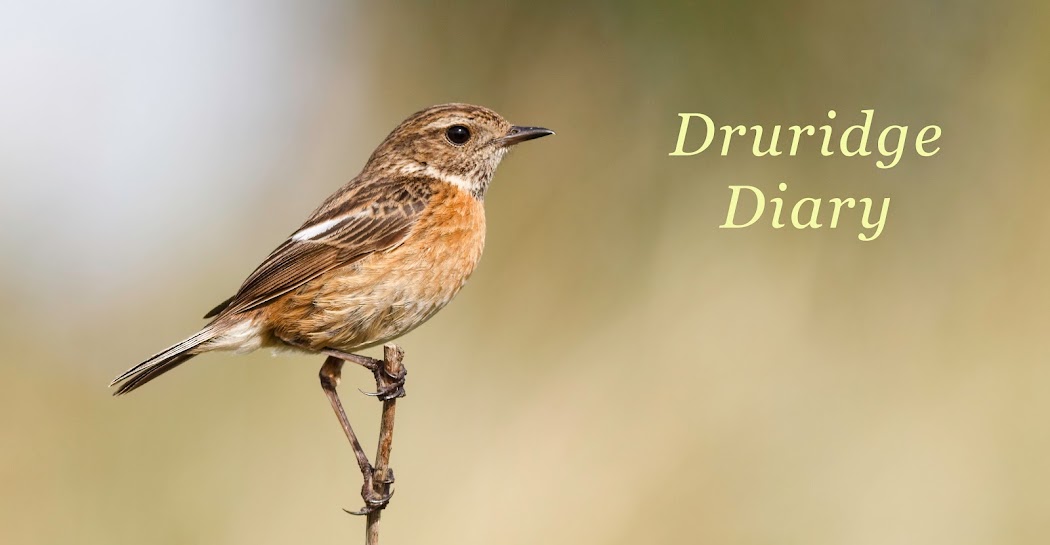
Female Stonechat along the Coal Road
Still about 20 Twite about in the dunes, with pink rumps on show!
A migrant - White Wagtail

Anyhoo, I did what I could and found a my first Lapwing chicks of the year. As I write this, the rain is lashing down, it's blowing a gale and it's freezing. I wish them well!

Finally, this weekend is the City Nature Challenge. ERIC the local records centre is coordinating CNC for the North East of England again. I really enjoyed last years event and got stuck in, submitting lots of records (including my first ashy mining bees and the northernmost in England at the time). This year, a combination of chores and shocking weather has meant less records submitted from me. Others have done well though. 

Sunday, 4 October 2020

Top Banana

Today had promise.

A northerly moving into the east yesterday evening with heavy rain overnight and it's October - Janet and I were on the patch for first light. We thought about ringing but decided just to go birding instead. 

We started at the entrance to the reserves with the idea of doing the plantation and working our way north from there. Before we even got to the plantation, we checked the small clump of bushes by the entrance - the Elderberry is always good for a Sylvia warbler.

The sun hadn't hit the bushes when I got onto a non-descript warbler, moving low through the base of the bushes. A phylosc was soon ruled out and we stated to eliminate other species on the limited views we had and decided it was an un-streaked acro - but which one? The bird hopped up onto a branch in the first rays of sunshine and I fired off a couple of shots. One of the photos showed the bird with head and tailed held high and I remembered Punkbirders description of Blyth's Reed Warblers having this 'Banana shape'. 

First views just as the sun hit the bushes (ISO 3200!) - Classic Blyth’s Reed posture. You could stick a Fyfe’s sticker on it and sell it for 39p.

We working on the other features when ADMc and Ashington Gary turned up, another opinion was welcome and we agreed that the bird look good for Blyth's Reed Warbler. I got a couple more record shots in better light as it skulked about the low vegetation, never more than a meter from the ground. The bird was 'colder' than Eurasian reed , sandy white underparts and olivey-brown, but not warm, upperparts and the tertials were plain. 

This record-shot shows the shape and colour better as well as short primary-projection, supercillium extending behind the eye and 'grey' leg colour

This photo shows the two-toned bill colour and supercillium as well as the colour of the breast and flanks

Whilst I was birding the plantation, Janet saw the Blyth's Reed come right out onto a umbellifer stem and gave the 'tcheck' call. It wasn't heard to call before that.

What a bird! And it finally puts to rest the bird Janet and I saw back on the 5th October 2013which we were convinced was Blyth's Reed but we never got enough to clinch it.  A new bird for the patch then taking my total to 251 and the second addition this year after another rare acro - Great Reed Warbler.

We headed north checking all of the bushes from the Plantation to the Dunbar Burn. Goldcrests (110+) and Robins (45+) were the most numerous species. We also noted

Yellow-browed Warbler  - 7 (conservative estimate allowing for double-counting)

Chiffchaff - 2

Garden Warbler - 1

Blackcap -8

(Eurasian) Reed Warbler- 1

Siskin - 5

Dunnock - 12

Redwing -1

Song Thrush - 8

One of over 100 Goldcrests 

One of seven Yellow-browed Warblers

And another Yellow-browed Warbler

This photo shows the central crown-strip which some Yellow-brows show

One of five Siskins

Record-shot of the Eurasian Reed Warbler

Also of note was the almost constant calls of Skylark overhead and several skeins of Barnacle Geese with an under-count of 107 over and a single Swallow.

Barnies over

Plenty of these feckers this autumn...

Yesterday,  Janet and I braved the rain and birded the patch in rough conditions. We did from the Plantation to the Dunbar Burn. Top bird was Treecreeper in the Plantation  - only my sixth for the patch and my fist not from a net! Also of note were:

Long-eared Owl - sat on the fence opposite the Little Hide in the rain

Swallow -2

Pink-footed Geese - 1550

Yellow-Browed Warbler - 1

This evening I headed back to the patch, for high-tide to check out the Scoter flock for a possible sub-adult male Surf Scoter reported yesterday. It was impossible with a massive sea and the Scoters being well beyond the breakers. Some gull photos will follow later this week, but here is one to whet the appetite. Three Swallows were feeding in the lee of the dunes. 

Just a tempter for later in the week


Thursday, 17 September 2020

Aborted Seawatch

After yesterday's northerly winds I though I would try a seawatch this morning -early reports from coastal watchpoints looked favourable. I arrived just after sunrise and headed for my spot in the dunes.

It was a beautiful morning - too beautiful for seawatching. 

Stunning morning but no good for seawatching

The bright early sun was low in the eastern sky, already lighting up the sea and there was a slight haziness. All the birds, even those close-in were just silhouettes, it was hopeless, my notes would've read Skua sp, Shearwater sp, even Gull sp. I did manage to ID three Red-throated Divers on their silhouettes before packing in and heading for the bushes. 

I headed south, picking up a couple of Chiffs, but not much else. A few Meadow Pipits headed south including a flock of about 20, 77 Pink-footed Geese went south in two groups and 11 Skylark went North!. This glakey Pheasant nearly flew into me before crash landing into a Swedish Whitebeam tree.

Glake

There are so many Pheasant around at the moment - 34 is my top count this week. A Chiffchaff was chiff-chaffing in the tree at the farmhouse. In the plantation, I picked up on a calling Pied Flycatcher  - my first of the Autumn but not a year-tick after the very unseasonable bird in late June. 

By the entrance,  a couple of Blackcaps and a Whitethroat fed on Elderberries and Goldcrest - a true Autumn bird at Druridge - flitted around. 

Heading north back to the car, I found a second Pied Flycatcher in the small wood. 

Pied Flycatcher - one of two

Pied Flycatchers aren't even annual birds at Druridge, averaging about every third year, so to see two made up for the lack of a seawatch. Full list here

I did try a brief seawatch this evening, but the wind had switched SE and it was quiet. About 120 Kittiwake fed distantly offshore and a handful of Manx Shearwaters went north with a similar number of Red-throated Divers headed South. 


Sunday, 22 January 2017

Travelling tree sparrow and moving geese

We had news of an interesting ringing recovery from the BTO this week.

Back in late October, just before I headed off to Fuerteventura, I caught a tree sparrow by the feeders near to the Budge hide. It had a ring on it which wasn't on of ours - this interesting things about the ring that it was a 'B' ring. 'B' rings are only put onto tree sparrows when they are pullis, adult birds take an 'A' ring - which meant this bird had been ringed in the nestbox - and more likely a nest box.

I presumed that it would not have travelled too far and I was right. It was ringed back in June this year out of a box of five chicks at Whinney Hill, near Longhorsley, by my friend Phil.

An easterly movement of 16km, which isn't bad for a tree sparrow.

I've been off work but have only managed one more visit to the patch - on Friday 20th, household chores have prevented any more birding...

As i arrived on the patch I spotted a small flock of 250 or so Pink-footed geese in the field in front of Druridge Farm, so I had a scan through them and found a single 'tundra' bean goose (soon to be regarded as a species in its own right when the BOU move to the IOC list) in amongst them. No sooner had I found this bird when they all got up - a pheasant shoot was going on in the shelterbelt to the west. I watched the hunters for a while blamming (or trying to - the chap I was watching wasn't a great shot) the pheasants as they were kicked out of the wood by the beaters - hardly sport I thought to myself. There was a pheasant walking around behind him, he could of walked up and shot that, would have been as much sport!

So I never found out if there were any more beans in amongst them.

It was cold, grey and damp again - the type of cold that get's to your bones! There was still plenty of wildfowl and waders on the Budge fields, no sign of the recently report pintail or ruff but two black-tailed godwits were new-in. A nice female sparrowhawk was sat out on the side of the shelterbelt. There were a few pheasant on the Budge fields looking a bit lost - I wonder where they had come from?

In the field to the north of the big pool where the usual flock of canada geese, a quick scan with my bins found a Eurasian white-fronted goose and a handful of pinks in with them.

Interestingly on our way back from twitching the pacific diver at Chevington on Saturday, we spun by Druridge and neither the white-front or the pinks were with a depleted canada flock. There were 2500+ PFGs in the front field at Druridge Farm but we couldn't pick up a bean goose - just goes to show that these geese are moving around a lot.

Off shore on Friday, a single great-crested grebe was an interesting patch record - they are rare in winter here. Dave Elliott's huge flock of 2500+ wigeon were still off Chibburn mouth.


Sunday, 2 December 2012

It's been a while......

My first blog post since November 4th. That's because today was my first (proper) visit to Druridge since November 4th.

I've been busy with other things at weekends since then and until February I go to work in the dark and come home in the dark. To be honest I was lucky to make it out today, felled by a dose of manflu over the weekend but I just had to get out.

Predictably at this time of the year, Druridge threw up no suprises... no great grey shrikes, no hume's warblers, nowt of note at all really.

Even offshore there was nowt, one red-throated diver and a pochard flew north with a gang of mallard.

This pheasant was a highlight....


male pheasant - smart, isn't he?


This first winter or female kestrel was knocking about. You can just make out a ring on it's leg, even zooming up the RAW file I couldn't make the number out.


Kestrel


At Cresswell over 4500 pink-footed geese in the winter cereal field behind the Drift Inn Cafe (now deceased) were a sight to behold.

Just some of the 4500 pink feet at Crfesswell this afternoon

Next weekend has promise if I survive the manflu. No work, no football so hangovers aside I might get some birding or ringing in.

Sunday, 28 October 2012

Dovekies, a patch record and the 'Bush of Plenty'

I managed two visits to the patch this weekend

Saturday

Saturday's highlights were out to sea. An afternoon visit once the worst of the weather had passed, I went straight to the dunes for a look on the sea, little auks had been much reported and I was keen to see some, I wasn't disappointed.

I saw four, probably five 'dovekies' in an hour, one of them was really close, just beyond the breakers. These were my first little auks on the patch in five years! This doesn't mean there hasn't been little auk passage in the last five years, just that I have aversion to standing on the dunes in freezin cold north-easterly to look for them.

Other highlights from my one hour seawatch were seven pochard flying north and a great-northern diver on the sea. Gannets were scarce, shag numbered seven and there were a few kittiwakes.

Away from the sea a patch record was broken, for the maximum pheasant count in a visit. A huge tally of 31 of gormless individuals in a stubble field in front of High Chibburn Farm, they must've been on by shooting somewhere nearby. A small flock of 12 golden plover were by the haul road flash with 2 bar-tailed godwit.

Sunday

I had a good bash around the patch today, it was grey, cold and miserable and the birding reflected the day. This silhouette of curlews sums the day up.

grey skies with two curlews
The outstanding highlight was a merlin, lifting a flock of starling of the fields by the haul road flash before bombing on through the dunes and out of sight. Passerines had been thin on the ground until I got to the 'Bush of Plenty'!

A small, somewhat isolated bush by the fence on the edge of dunes. Hardly worth a second glance normally, but there was stonechat perched on-top, always worth a check for a sibe.

Stonechat 

It was soon joined by a male stonechat, then a chiffchaff popped out, pursued by a great tit, giving it some grief. A wren soon appeared, followed by two dunnocks and a robin. They thought this mediocre bush too small for them all and flitted over the road to make way for a couple of meadow pipits and another stonechat. This small, innocuous hawthorn bush had just about doubled my passerine tally and shall, from this day hence, be known as the 'Bush of Plenty'.

145 little auk
146 pochard

Friday, 8 April 2011

Contrast

There was lots of contrast on show at Druridge today, the first to catch my eye was amongst the red-throated divers loitering offshore, at least 45 of them!

I scanned through them for one of the big divers with no luck, but the contrast in plumages was striking, from almost breeding plumage including the red throat through to perfect winter plumage birds and everything in between.

Also offshore were two slavonian grebes, one was virtually in breeding plumage with nearly complete golden-yellow tufts, whilst the other one had just started moulting, which, at distance, had me thinking it might have been a black-necked grebe initially (that would be nice - not see one of those for while!)

There was even contrast amongst the much maligned pheasants. The really dark male that has been frequenting the area around the Budge screen was out in full view tonight. He is a dark iridescent green, nearly black in some lights - quite striking!
very dark iridescent green cock pheasant
The shore-lark hasn't been seen today, it was still showing well in the same spot yesterday evening, it's quite sad to hear numerous tales of twitcher/photographer rage whilst it has been there. I dread to think what might happen when something really rare turns up. Good views of the twite flock on the same grass tonight, they are also in breeding plumage and showing quite a lot of contrast, especially in the pinkness of their rumps.

Only one year-tick today, a fly-over bar-tailed godwit.

95 bar-tailed godwit