Showing posts with label golden plover. Show all posts

Sunday, 22 November 2020

Winter birding

The last of the Blackbirds from the huge invasion earlier in the month are hanging on, making their way through the remaining Hawthorn berries are the last remnant of Autumn. Otherwise it feels like winter. 

Wintering duck numbers have started to build up on the Budge fields, with Wigeon numbering about 160 but there's fewer Teal. The big pools is virtually bereft of life, I've not seen one, but I fancy there's an Otter about which will deter wildfowl from settling.

Elsewhere on the patch the 'front field' at Druridge Farm is attracting big flocks of Lapwing and Golden Plover with a maximum of 560 and 320 respectively this week. Scanning through plover flocks - proper winter birding. 

Some of the Golden Plover flock this morning

I took Thursday off work on the strength of a strengthening northerly wind which ended up as a bit of a damp squib - it came from the right place, just not for long enough. Me decision paid-off though as my flexi-day-off meant I could go to Amble to see the (American) Buff-bellied Pipit that was found the previous day. Janet and I joined a few hardy-souls at first light and after an hour or so of searching, the bird was re-found on the beach giving the assembled (socially-distant) twitchers good views. A new bird for Northumberland and the Western Palearctic for me.

Heavily-cropped shot of the Buff-bellied Pipit
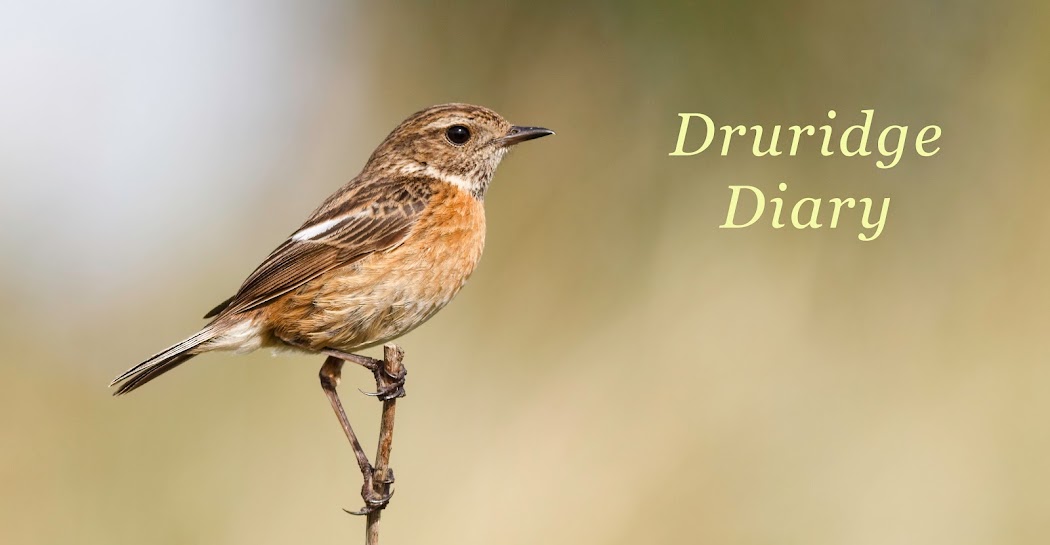
Female-type Stonechat at Amble
Rock Pipit

I did go seawatching in the afternoon from 1pm to dusk. A Black-throated Diver headed north was new for the year (176), other highlights were two Velvet Scoter north and a lovely Sooty Shearwater, really close in nice light, through the breakers, before heading off north. There was decent auk passage, a few Gannets and Kittiwakes including a single flock of 37 of the latter. Full list here.

Seawatching was quiet so I was distracted by these horses

Janet and I walked the length of the patch and back on both Saturday and Sunday morning. Highlights include a Snow Bunting over, 110 Twite in the dunes (they were on the beach on Friday when it was quieter), Great-spotted Woodpecker and a late Chiffchaff which was calling like mad in the bushes - a nice reminder of Autumn.

Black-headed Gull on the sea today
Guillemot on the sea
Red-throated Loon on the sea

I'm changing my work regime from tomorrow to make better us of the daylight hours so my weekday patch visits will be at lunchtime until February. 

Some more winter birds from this week...

male Stonechat

Wren

Friday, 28 August 2020

Seawatching and some thoughts on it.

With strong northerlies forecast overnight and early morning I suspected I might be seawatching today especially as I had the day off work. When I woke at 6am it was lashing it down with rain, I turned over and went back to sleep, If I'd had to go to work, I would've got up and gone anyway but I had the luxury of more time.

I eventually arrived at my dune watchpoint at 9am, it was too windy to stand on the dune ridge so I hunkered down in the dunes on a useful perch as I could be sometime.

The first bird I saw was a Bonxie, close in too. There wasn't a lot of action until pretty much the second notable bird I got onto was a skua,  a bit further out than the Bonxie, quite distant. A grey bird against the sea with a more languid tern-like flight - Juvenile Long-tailed Skua! My fifth of the year incredibly. 

It was steady after that, Manx Shearwaters coming through in little groups or singles and a few Sooty Shearwaters including a single group of six together about half-way out. There were a few distant Skuas that went unidentified - that's one of the problems with Druridge but a couple Arctic skuas were closer and one came into the bay to harass terns and a couple more Bonxies came through. A drake Velvet Scoter came in very close, north,  on its own and a group of ten Pale-Bellied Brent were also really close.

By 9.45am I was regretting not getting up earlier, the sky brightened and the sun even threatened to come out and the sea went 'silvery' - not good, anything more than half way out was unidentifiable. I was temped to pack up but visibility improved a bit as a cloud came over so I hung on. I was pleased that I did as the bird of the day, and one of my best seawatching experiences at Druridge happened soon after. 

A bird flew north, close-in and therefore low in my scope-view, so it passed through quickly, but it looked interesting and I tried tracking it through the troughs in the breakers, a shearwater, pale on the undersides but 'dumpy looking'. It was flying really slowly, moving back and forth, passing over and through the scoter flock, looking like it was feeding amongst them. It wasn't a Sooty, it had a pale belly anyway but the jizz was altogether wrong and it didn't have the contrast dark/white of a Manx and it just didn't look right.I was sure it was Balearic Shearwater. It landed among the Scoters briefly, before making a short flight and landing again, it did this three or four times, only landing for a few seconds before taking another short flight.These short flights gave good views when it wasn't in a trough and the dusky underwing, darker 'armpits' and dumpy appearance confirmed my initial ID. Eventually it moved off north, slowly again, feeding as it went. In hindsight I probably could have had a record shot of it, but I was too busy 'enjoying the bird'. This was my fifth Balearic at Druridge but by far the best views I've had of one here and my first since I saw two on 5th September 2013.

By 10:40, the light had really gone. I kept going until 11:05 to get the two-hours in and saw a few more birds including some Teal and a Golden Plover picked up on call just over the breakers, but it was high-tide. 

It was interesting to compare my figures with  headland watchpoints to the north and south of me. Obviously being in the middle of a bay I miss out on birds but I seem to miss out on some species more than others, Bonxies are a good example. I saw five in two hours today, Mark Eaton had 13 at Boulmer, Jack Bucknall had 13 (3 1/2 hours) at St. Mary's and Ben Steel had 19 in two and a half hours at Howick. 

I think powerful birds like Bonxies and to some degree Poms (I didn't see one today) don't drift into the Bay, they just take a straight line from Snab Point to Coquet Island so are too distant for me. I do better for Arctics than some headlands because the terns feeding in the bay draw them in and largely comparable for Long-tailed Skuas which seem to hug the coast more, or even curt off headlands (I've seen them do this at Church Point). Likewise, I do okay for Manx (and today for Balearic) shearwaters but struggle with the bigger Shears, with only one Cory's (in 2005) and no Great Shears ever. 

Despite the disadvantages of being in a bay, I'd swap a dozen of any of those species at Church Point for jut one on the patch. Above all, I love a good seawatch!

Highlights 09:05-11:05 (all N) (Full list here)

Pale-bellied Brent 12 (10N 2S)

Teal 56

Velvet Scoter 1 (drake)

Bonxie 5

Arctic Skua 4

Skua sp 6

Long-tailed Skua 1 (juv)

Golden Plover 1

Sooty Shearwater 11 

Manx Shearwater 24+

Balearic Shearwater 1

Two photos taken as I was packing up.

Adult Lesser Black-backed Gull

and juvenile

Sunday, 24 November 2019

A proper 'back-end day'

Today was a proper 'back-end' day or as the Scots would say 'driech'. Unlike yesterday when it rained non-stop, it didn't really rain today but it wasn't dry if you know what I mean. A day typical of the 'back-end' of the year.

Having been confined to barracks yesterday, by lunchtime today cabin-fever had begun to set in so I headed out for a walk around the patch. It was so grey and with the threat of heavier mizzle, I left the camera at home, so there are no photos on the blog today.

I walked a loop out to the Preceptory, returning by High Chibburn Farm and Druridge. Before I did, I stopped to check the front field at Druridge for geese as a white-fronted geese had been reported earlier. There were no geese but there were two snow buntings in with the beast at the top end of Hemscotthill Links.

Back to my walk - lots of wigeon and teal on the Budge fields with other ducks and a herd of canada geese. The waders were all on the recently resown grass ley beyond, 134 curlew, 149 lapwing and 160 golden plover and three roe deer.

There was little of interest until I go to the farm where five grey partridge flew out. I stopped to chat to Richard the farmer and got on to three yellowhammers in a hawthorn. A scarce bird at Druridge these days and 'new for the year' for me.

Pheasants were everywhere, I estimated 64 on my route but could easily have been double that. Widdrington Farm have been putting them down for the shoot but they seem to favour the coast it seems.

Not much else of note. It's that time of year.

Full list and route here


Sunday, 13 October 2019

Autumn migration, vizmig and skinny dippers

The pace of migration and birding as tailed-off a little bit since last weekend when easterly winds brought some interesting passerines onto the patch.

The highlight for me was a little influx of lesser whitethroats, which are a really scarce bird at Druridge these days. Janet and I found a couple on the Saturday morning before we went to twitch the hoopoe at Amble links.

Post and pre-work visits on Monday and Tuesday brought the maximum count of lesser-whitethroats to four, including a very pale looking individual which I only saw for seconds before flitted off. On Monday two of the lesser-throats were joined by at least five chiffchaffs one of which one looked and called like a Sibe chiff  tristis.

I added some other Autumn goodies to my list including yellow-browed warbler, bullfinch, greenfinch, siskin, lesser redpoll, brambling, redwing, grey wagtail and fieldfare. A late flurry of swallows and house martins headed south over the same days and there was good passage of skylarks.

The wind turned westerly for the latter part of the week and a work trip meant it was it was Saturday morning before I got back to the patch.

I paused by the 'front field' at Druridge Farm as there were some pink-footed geese, about 300, feeding, but mostly sleeping, there. I scanned them all, but noting unusual stood out, other than couple of neck-collared birds which I couldn't get the full code from. They got up and flew around when a small came over.

Pink-footed geese
In the same field were about 250 golden plover, 280 lapwing and 62 curlew.

Some of the golden plovers
Whilst I was scanning geese, a flock of 31 whooper swans flew south and along with the two in the adjacent rape field, were my first of the autumn. I managed to get some photos as they flew over.

Three adults and two juveniles


Juvenile

Overhead, a near constant stream of common gulls flew west from the sea to agricultural fields - they return each evening at dusk to either roost on the sea or the beach depending on the state of the tide.

One of the common gulls
 No scarce passerines were found, just a chiffchaff or two travelling with the long-tailed tit flock.
Long-tailed Tit
 On the Budge fields there was another flock of 18 whooper swans - 15 adults and three juveniles.

Whooper Swans
 Today started overcast and grey. Janet and I headed down to the patch for just after first light. It felt quite quiet with few passerines moving other than a roving tit flock.

From the plantation, I spotted a large bird flying strongly south just above the dunes - it was an adult ruddy shelduck. I've seen ruddy shelduck on the patch on the patch before but many years ago. I'm not sure where this species stands on the official British list now, I must check...

There were a few cars parked together near the blockhouse which was unusual, by the time we reached the cars there was a group of a dozen or so folk standing around them. As we approached one of them said;

"You're too late"
me - "For what?"
him- "Skinny Dip"
me - "Thank god for that!"
Another chap (very excitedly)  - " We've been in the sea...naked!"
me - "rather you than me!"

They asked us join them next month or on 21st December - we politely declined and wandered on.

It rained heavily just before 9am which was quite handy as we had an appointment with friends and a large breakfast at the Drift Cafe.

I'd completely forgotten it was WeBS day. The rain had eased a little after 5pm so I went back and did my WeBS count -it was pretty grey and miserable and the rain became heavier. The highlights were a little egret and a kingfisher, my second of the year, over the big pool.

My year-list now stands at 156. A few species are still feasible but it ain't gonna be a record-breaker.
Sunday, 3 February 2019

Snow days

It's been a bit wintery this week.

I managed a midweek excursion to the patch on Wednesday (one benefit of working at home), frosty ground made it an ideal day to walk through the fields towards the Preceptory and back via High Chibburn and Druridge Farm.

A song thrush was on the path towards the hides and the usual selection of duck were on the big pool which remained unfrozen. Towards the Preceptory a handful of lapwing and golden plover were feeding in the pasture field - they sat tight as a peregrine passed over heading north, it was high so they probably did the right thing.

Down to the farm and a large flock of about 25 chaffinches where in the small copse with three coal tits - it's so unusual to see coal tits at this time of year at Druridge, they are normally just an autumn bird.
One of the coal tits at the farm
House sparrows and skemmie pigeons were numerous around the farm buildings but I was hoping for yellowhammers - I was out of luck there. Stock doves were notable in the fields as I returned along the road to Druridge and a large female sparrowhawk flew past me and landed on the fence.

In the hawthorns a robin sat out - my first of the year.

Robin in the hawthorns
On Saturday Janet joined me and we walked the same route - only this time there was snow underfoot and all around us - the song thrushes on the track had multiplied to four.

Snowy track to the hides where song thrushes flew
The field that held the goldies now had over 70 curlew feeding with a few lapwing, goldies and black-headed gulls for company, with a couple of hundred starling.

As we walked to the farm, two skylark flew up calling, 'the cold weather has brought them in' I said to Janet.

snowy track

frozen fields with a flock of pink-feet flying over
Ten tree sparrows were flitting about the farm with the chaffinches and house sparrows and as we approached the cottages two fieldfare flew over the fields - another bird of hard weather.

In front of Druridge Farm at least 800 pink-footed geese grazed, a single greylag was the only exception. We cut through to the beach hoping for snow buntings which we didn't see but we did see five meadow pipits in the dunes - another species brought in by the cold.

With no home-working this week, it will be the weekend before I am back.. but the evenings are getting lighter now and some post-work birding isn't far off.


Tuesday, 17 January 2017

Grey days

Yesterday was supposed to be 'Blue Monday' - the gloomiest day of the year. Well, it was certainly gloomy when I arrived on the patch - overcast and misty with drizzly rain setting in. Today wasn't much better but it was my birthday and the day was brightened up with a little bit of sunshine...

On Sunday I did the WeBS count. Not a great variety species on the Budge fields, but plenty of what was there, particularly wigeon and teal with both species numbering over 400. I couldn't see the ruff that has been recently reported.

The big pool was very quiet, a couple of goldeneye and red-breasted mergansers and then I spotted why... two otters were swimming across the pool from east to west. It's ages since I last saw otter on the patch, probably over two years. These two looked the same size and the way that they were playing when they reached the west shore of the pool suggested they were siblings. This might also explain why coot and moorhen aren't on my year list yet.

Coot killers - record shot of the two otters making their way across the big pool.
On the path to the Oddie hide, one of last weeks bullfinches remained and a weasel legged it from one side to the other. 

female bullfinch feeding on dock seeds
Also of note were over 1000 golden plover on the field by the haul road, 30 sanderling, 18 turnstone and 12 ringed plover on the beach and 150 common scoter offshore.

Yesterday was very grey, Janet joined me for a walk through the patch and up to Chibburn mouth to look for the shorelarks as she hadn't seen them. They weren't to be seen (they were reported today) so we walked back along the beach in the mizzle. 

Today was my birthday. I headed out for walk to Chibburn Preceptory and back via High Chibburn and the cottages. The walk was largely uneventful. House sparrow and stock dove were added to the year list at the farm. The highlight came at the end of my walk, just by the cottages, when I found a little flock of yellowhammers with reed bunting in the isolated hawthorn on the roadside. 

Yellowhammer are a very scarce bird on the patch these days, in fact I only saw one in the whole of last year.
A little bit of sunshine to brighten up a grey day
I am doing the Patchwork Challenge again this year - they have a new fancy-dan website, check it out  - http://patchworkchallenge.com/ I am on 71 species and 78 points. 

I've got the rest of the week off work so might get out again between chores...


Sunday, 23 October 2016

Easterlies that did not deliver

After the excitement of the last couple of weeks on the back of a run of easterly winds, the forecast of more easterlies for this weekend got me going again, I was even contemplating an emergency flexi-day from work. It was too windy to ring so I made do with a later start and a wander through the bushes.

It soon became apparent that it was all very quiet, nothing at all in the plantation, a few robins, tits and crest in the entrance willows and other than the area by the feeders, nothing behind the Budge screen - same further north - bar a couple of great-spotted woodpeckers. There had obviously been no arrival of birds.

Grey-looking robin
A great white egret was on the Budge fields when I checked from the screen-hide. A bonus of three finders points for the PWC.

Dejected, I headed home.

Golden plovers funneling back to the ground
Some of the golden plover flock
On the way north later in the day, Janet and I stopped to see a flock of about 1800 golden plover in ploughed field opposite High Chibburn. I returned later in the day to have a scan through them as there had recently been an American golden plover at Low Newton. The light was fading fast and the birds were restless, nothing stood out as being unusual in any way. By 1740 the light had gone and so had my eyes.

I hope that I don't regret not taking that that flexi-leave day tomorrow...


Sunday, 4 January 2015

quickie

A brief visit to the patch today.

I stopped on the road to scan some curlew and lapwing and found five golden plover in with them, always a tricky bird at Druridge. Whilst nattering to Tom Cadwallender, we had a flock of 30 or so twite in the dunes but they wouldn't settle for a good scan through then for colour rings.

A look on the sea was less-rewarding and the bushes were quiet. The ducks had left the frozen Budge fields for the big pool but I couldn't spot yesterdays green-winged teal.

53 golden plover
54 twite

PWC score will appear in my next post.

Sunday, 26 October 2014

Wild Westerlies

Strong westerly winds dominated the weekend's weather, not conducive to good autumn birding. A slow start on Saturday morning following a night at the Cluny, we met up, over a cup of tea and a bacon buttie, with Steve Taylor and Dave Elliott at the Drift Cafe, to swap gen on Poland and Spain.

Onwards to Druridge, Janet and I had a good wander around the patch seeing not very much. From the Oddie hide, lapwings, golden plovers and curlews were put up by a passing helicopter from RAF Boulmer. The lapwings gave some nice views from the hide, the goldies were much higher (later settling in winter wheat at Hemscotthill). A late swallow flew south and a buzzard was floating around to the north - it was well-grilled, given the recent records of rough-leg nearby.


Two views of passing lapwings
We decided to walk to the Preceptory, to check it for roosting owls. It was empty, not even a skemmie or jackdaw. We walked back via High Chibburn, I had my heart set on year-ticking bullfinch - the long shelterbelt by the farm is often good for them, but not today...

Cows at High Chibburn
On the way back to the car, a great-spot called from the bushes. A quick look on the sea yielded nothing - the strong westerly had whipped it up and nothing was passing.

With even stronger westerlies today, I didn't even venture out.

Saturday, 11 January 2014

A bit of a wander roond the patch

I had a bit of a wander to the far flung ends of the patch today.

After seeing twite and pied wag on the dunes to the south, my route took me firstly to the Oddie hide, but not before I had stopped to look at a lone whooper swan on the Budge fields. Initially the big pool looked empty (for some reason when the pool is full (the outflow is blocked with flotsam and jetsam) there are never any birds on it - an edge thing?) other than a handful of tufted duck and teal, then a long-tailed duck popped up in the middle of the pool. Then, when I scanned the seaward side, a red-throated diver had appeared. It didn't hang around long before it flew off towards the south.


red-throated diver. A rare visitor to the big pool
My route then took me to the preceptory, which was owl-free, and then down to High Chibburn Farm where a flock of 200 or so golden plover lifted off the fields. At the farm  house sparrow, collared dove and dunnock were added to the year list. At the cottages, tree sparrows and a great tit were coming to the feeders.
Low Chibburn Preceptory

In front of the cottages, a skein of over 2000 pink-footed geese dropped in. I scanned them later in the scope, they were all pink-feets.

Whiffling
Pink-footed geese settled for a graze
Four pintail were on the Budge fields and two black-tailed godwits with the usual teal, wigeon and shoveler.

Offshore there were at least 77 red-throated divers in the bay, among them was a red-necked grebe, a good patch bird. Also on the sea were at least 25 guillemots and a couple of razorbills, mergansers and shags. A single sanderling was on the beach.

40 chaffinch
41 twite
42 pied wagtail
43 rook
44 gadwall
45 grey heron
46 jackdaw
47 golden plover
48 dunnock
49 house sparrow
50 woodpigeon
51 tree sparrow
52 great tit
53 collared dove
54 pintail
55 red-necked grebe
56 shag
57 cormorant
58 razorbill
59 red-breasted merganser
60 sanderling
61 eider
62 whooper swan

PWC score 74

Sunday, 28 October 2012

Dovekies, a patch record and the 'Bush of Plenty'

I managed two visits to the patch this weekend

Saturday

Saturday's highlights were out to sea. An afternoon visit once the worst of the weather had passed, I went straight to the dunes for a look on the sea, little auks had been much reported and I was keen to see some, I wasn't disappointed.

I saw four, probably five 'dovekies' in an hour, one of them was really close, just beyond the breakers. These were my first little auks on the patch in five years! This doesn't mean there hasn't been little auk passage in the last five years, just that I have aversion to standing on the dunes in freezin cold north-easterly to look for them.

Other highlights from my one hour seawatch were seven pochard flying north and a great-northern diver on the sea. Gannets were scarce, shag numbered seven and there were a few kittiwakes.

Away from the sea a patch record was broken, for the maximum pheasant count in a visit. A huge tally of 31 of gormless individuals in a stubble field in front of High Chibburn Farm, they must've been on by shooting somewhere nearby. A small flock of 12 golden plover were by the haul road flash with 2 bar-tailed godwit.

Sunday

I had a good bash around the patch today, it was grey, cold and miserable and the birding reflected the day. This silhouette of curlews sums the day up.

grey skies with two curlews
The outstanding highlight was a merlin, lifting a flock of starling of the fields by the haul road flash before bombing on through the dunes and out of sight. Passerines had been thin on the ground until I got to the 'Bush of Plenty'!

A small, somewhat isolated bush by the fence on the edge of dunes. Hardly worth a second glance normally, but there was stonechat perched on-top, always worth a check for a sibe.

Stonechat 

It was soon joined by a male stonechat, then a chiffchaff popped out, pursued by a great tit, giving it some grief. A wren soon appeared, followed by two dunnocks and a robin. They thought this mediocre bush too small for them all and flitted over the road to make way for a couple of meadow pipits and another stonechat. This small, innocuous hawthorn bush had just about doubled my passerine tally and shall, from this day hence, be known as the 'Bush of Plenty'.

145 little auk
146 pochard