Showing posts with label woodcock. Show all posts

Saturday, 1 January 2022

Tradition dictates

Tradition dictates that on my first visit to the patch of the year, I'll find a species that I hadn't seen on the patch in the previous year. This happens most years. And guess what? It happened again today.

I've not seen yellowhammer on the patch since 24th November 2019 so to find a flock of eight in the hedge behind Druridge Farm was a real surprise.  I was beginning to think that they were locally extinct.

Today was unseasonably mild, 12 degrees C, but it was very windy from the SW. Janet and I had a good wander around the patch and managed to see 53 species in total. Highlights included a southbound great northern diver offshore, two woodcock flushed from the bushes, at least 300 Linnet and 200 chaffinch in the dunes and eight stock doves.

There was a lot of people though. It was like a July Sunday with cars abandoned at the site entrance and hundreds of people on the beach. 
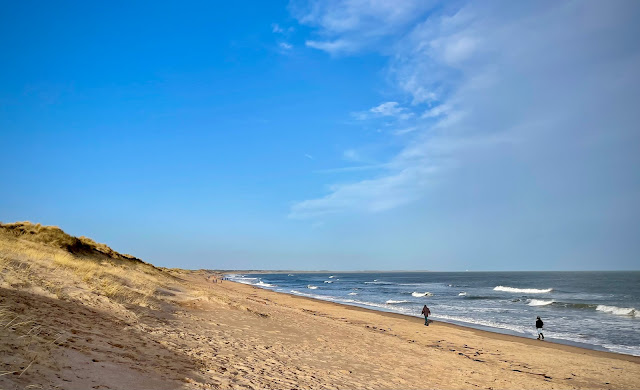
The beach was busier than it looks in this photo!

The ringed plover flock that roosts on the beach at the south of the patch had no chance to settle and just flew back and forth, looking to rest. 
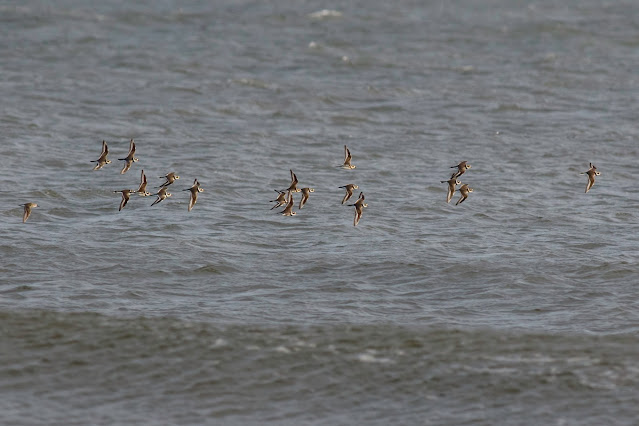
Ringed Plovers looking for somewhere to rest - no chance today.

I finished 2021 on a credible 167 species for the patch, which, given how poor an autumn it was wasn't too bad. Usual autumn stuff like pied and spotted flycatchers, garden warber, yellow-browed warbler, redstart and whinchat all missing from my list.

I also concentrated a bit more on the 5km patch challenge because of covid-lockdown. I saw 191 species within 5km of home which was nine more than the next patches. Ellington is obviously a good place to live if you're a birder. I'll continue with the 5km challenge this year as it does add a bit of variety to my birding.

I'm hoping to keep the blog updated more regularly too. My work/life balance needs some adjustment I think.
Today's list on eBird


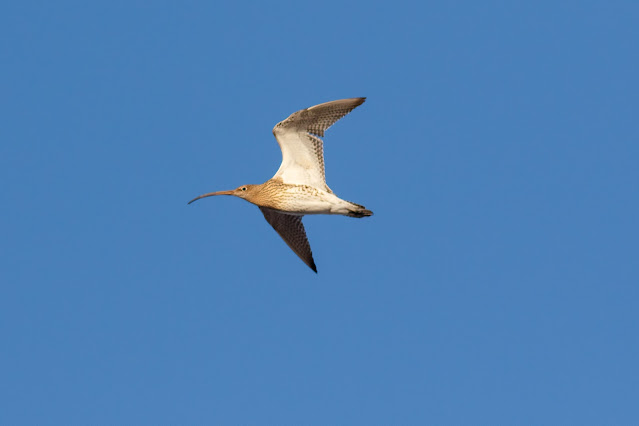
Passing Curlew


Sunday, 14 February 2021

Baltic

It's been really cold this week, with snow and ice dominating and a brisk easterly through to southerly wind making feel even colder.

Continuing restrictions have meant limited trips to the patch and a lot of birding on foot from home for the 5km patch list which is coming along nicely. I have been popping into the patch, if I've been passing that way and a 'change' in rules has meant that surveys like WeBS can continue as long as you stay local and obey social distancing rules. I suppose there had to be a relaxation given that it was legal to stand in a field and shoot birds but not to count them.

The cold weather has brought an influx of birds not usually seen in big numbers at this time of year. Hundreds of winter thrushes, particularly redwings are now on the coast, there are Woodcock, Snipe and Jack Snipe (we saw one today) in decent numbers and I counted 67 Meadow Pipits on the Budge fields today and 18 Stock Dove near the farm yesterday.

Snipe flushed from the Coal Road yesterday
One of many Redwings

Some of the Canada Goose flock yesterday with Pink-footed Geese in the fields behind

The WeBS count was busy with big counts of Wigeon (352) and Mallard (106) but lower numbers of Teal (64) than usual. A Long-tailed Duck on the Big Pool was a bonus. 

All of the wildfowl are looking smart now and this drake Shoveler was particularly dapper

The Budge fields were almost frozen over and devoid of ducks,  a few Lapwing and Curlew needed counting though.

The Lapwing were finding any shelter they could from the cold southerly winds
Carrion Crow looking for food on frozen ground
Moorhen legging it through the snow

Thursday, 26 March 2020

Covid not Corvids

Well it looks as though it might be sometime before I get back onto the patch. With the Covid-19 pandemic forcing the country into lockdown current restrictions prevent me from driving to my patch. It doesn't seem to prevent the masses of dog-walkers who still think it's okay to drive down there to empty their dogs.

I've not been on my bike for a couple of years, but I might have to get it sorted so I can bike down to Druridge - obviously being sensible and not using hides and keeping as safe distance from everyone.

In the meantime I'm pottering around, taking short walks from home which has been quite nice. All around our house are fields and wooded denes where you can walk for hours be unlucky to meet others. It's been nice to see woodland birds that I don't usually see like jays, nuthatches and willow tits. Strangely no great-spotted woodpeckers though... but sadly, plenty of grey squirrels.

I did get to the coast this morning by walking down to Snab Point which is only a mile from home.

My last visit to the patch was Sunday. We'd driven for six hours back from the Scottish Highlands where we'd been staying in a cottage for a week near to Tain on the Moray Firth so went down to Druridge to stretch our legs. We didn't get there until 5pm and it was still like a Bank Holiday weekend, wall to wall cars by the entrance. It was like people had one last freedom and they were going to use it.

We avoided the crowds by wandering through the bushes. We flushed a roosting barn owl, it's unusual to find barn owls in those bushes but not unheard of, we also flushed a woodcock. I haven't seen a woodcock on the patch since the 18th January last year! This must be a bird resting before continuing it's eastward migration.

Full list here

There'll be a lot less blog posts for a while unless I get the bike sorted.

Red kite from Scotland - maybe I'll see one at Druridge this Autumn?

Stay safe out there.


Sunday, 31 January 2016

Close...but no cigar

I'd been down to the patch for a couple of hours this morning before heading home via the Country Barn at Widdrington for a pasty. As I was leaving the farm shop, my phone pinged - a message to say that there were two waxwings on the road north of Druridge - Did this mean the haul road? Not much like waxwing habitat that. I panicked a bit - waxwing would be a new bird for the patch.

I phoned the chap who had put out the message and he explained that the birds were just off Druridge Lane. I was there in seconds, leapt out of the car and was put onto the birds, on a wire over the fields, with a lot of starling and fieldfare - great birds but they nor me were on my patch.

I jumped back into the car and headed for the nearest patch boundary, which is just before High Chibburn Farm. But it was no use, I could hardly see the wires for the high hedge, I took my wellies off and climbed onto the car, extending my tripod as far as it could go, but I couldn't pick out the birds. Frustrated I headed back the original spot, but there was no sign of the birds. I ate my pasty and headed home.

Before all of this kerfuffle, I had spent a pleasant couple of hours on the patch. When I arrived there was a short-eared owl hunting along the grass by the road - nice.

I had a walk south through the bushes. I disturbed a small male sparrowhawk from a  fencepost, it flew off causing alarm amongst the long-tailed tits. When I reached the path to the Budge screen, I disturbed the same bird again, this time off the ground, I went to have a look for a kill and found this...

The kill

Not what I was expecting. A woodcock! The bird was minus its head, but I found both mandibles nearby. The sparrowhawk had already had a decent meal of it, but I do hope it returned to finish its lunch. Woodcock would be no problem for a female sprawk, but quite a big bird to handle for small male like this one.

I still need woodcock for my year list...

As I arrived in the Budge screen, a water pipit took off from the right and flew, calling, a short way before settling down to feed.

There is plenty of wildfowl on the Budge fields, particularly wigeon, teal and mallard. There are also about 350 lapwing and a few curlew. Two drake pintail were still there too.

A quick look offshore produced a year-tick in the form of two razorbills but little else. At the farm, yellowhammer was my second patch year tick of the day.

So at the end of January I am on 88 species netting me 102 points in the Patchwork Challenge - not a bad start, but I think February could be a slow month, although I did see some signs of spring today.

Hawthorn bursting in to leaf

Sunday, 1 February 2015

February has started well

Re-roofing my outhouse has prevented any birding trips to the patch of late, so with the wind too strong to work up the ladder today and frost preventing any mortar-work, I took the opportunity to get down to Druridge.

And...it was bloody freezing! Nice and sunny, but the strong northerly wind, coming straight from the Arctic, made it feel very cold indeed.

The well-stocked feeders that are around the hides attracted a decent crowd of chaffinches, goldfinches and greenfinches, I am predicting a brambling in the next week or so and hopefully some redpolls.

Looking out through the gaps in the Budge screen, straight into the biting northerly, brought tears to my eyes, it was nitheringly cold, so I didn't stop there long. Just enough time to make sure there were no pintail or other interesting ducks. We walked back through the bushes flushing a woodcock as we went.

Choppington's second-best wildlife guide was out and tipped us off that there nowt of note on the big pool, so we just checked it from the bushes - he was right.

So to the dunes, for a look on the sea. It was quite sheltered, hunkered down behind the dune ridge. The northerly has blown some little auks into the North Sea and one of them was the first bird I saw, headed north, quite close in. Several more were noted in the half -hour we spent watching. A good year-bird on the 2105 list.

Also on the sea was a great-crested grebe and a smashing drake velvet scoter with four common scoter.

We retreated to the Drift Cafe for a warming lunch.

63 little auk
64 great-crested grebe
65 velvet scoter
66 red-breasted merganser
67 kittiwake

PWC Score 77

Wednesday, 31 December 2014

Pura Vida

I was back on the patch today after a three-week birding trip to Costa Rica.

Not the most colourful of species, but clay-coloured thrush is the national bird of Costa Rica 

We had a fantastic time, seeing lots of great birds in brilliant, friendly and very beautiful country. As they would say in Costa Rica  - Pura Vida!

Some photo's might appear on Ipin's Birding Trips at some stage..if I ever catch up.

Back to reality today though, back on the patch, hoping for one more addition to he patch year-list. I tramped around the whole patch and of note were;

a small flock of goldcrest in the bushes (good winter record)

a dog otter, showing really well on the big pool

a woodcock in the plantation

and, a pair of pintail on the Budge fields

So nothing new added to the year list leaving me on 171 species, the same total as last year. As ever, some species that I would have expected were missed, notably:

garden warbler
merlin
scaup
cuckoo
grey plover

I did see five new species in 2014, which is way more than I would have predicted:

Egyptian goose in April

Woodchat Shrike in May

Stilt Sandpiper in August

Stilt Sandpiper - Image (c) Ian Fisher
Wood Warbler in August

Fea's Petrel in September

These 2014 additions take my patch list to a respectable 236 species.

I've enjoyed the Patchwork Challenge again this year, a good bit of harmless fun.

So all in all, a very good year on the patch. I would love to see another five new species in 2015...surely a red kite at least?

I wish all of my readers a very happy, prosperous and bird-filled 2015!

Happy New Year!


Tuesday, 7 October 2014

A lark on the shore

I was at work today, which is a thing that less and less birders appear to be doing, when I saw some tweets, from those without jobs, about a shore lark at Druridge.

Luckily, I wasn't far away from Druridge and had eaten my lunch on the hoof, so could afford a quick dash to the patch.

When I arrived, some more birders without jobs were walking along the road "You'd better be quick, it's on the beach but the tide is coming into the base of the dunes"....

I had the forethought to put my wellies on, and legged it to the beach, when I got to the top of the dune, the tide was well and truly in - I feared the worst. 

Further north, at the Dunbar burn, I spotted some photographers, lenses pointed down the dune front, they kept moving and I presumed the bird was too. At this rate they'd chase it to Chevington. 

I staggered along the beach, wading the burn (thank god for the wellies), the incoming waves lapping at my feet as I set up my scope. And there it was, the shore lark on the front of the dune, about level with the Druridge bushes.

Shore lark on the dune front - iPhone scoped shot
I watched it for a while, it was going down onto the beach to feed between waves, flying back up to the dune when a breaker rolled in. I managed to get some video of it, just hand-held the iPhone up to my scope.


Shorelark druridge from Iain Robson on Vimeo.


This is my first shore lark since the spring bird on 5th April 2011

The tide was huge (5.2m at Amble), with a big swell. Quite impressive - could be good for grey phalarope somewhere tomorrow.

Big seas  - looking south
And looking north
On my way back to the car, I popped into the bushes (as you do) and flushed a woodcock, my first of the Autumn.

163 Shore lark

PWC Score = 250

Sunday, 9 February 2014

Flighty

It was still blowing a hooley today and as a result everything seemed to be a bit flighty at Druridge.

I had a walk up to the Preceptory, the pink-footed geese were lifted off the fields by a passing tractor and didn't settle again. Whilst they got up a pair of marsh harriers had put everything up on the Budge fields and then flew towards the far, the male settling on the filed the geese had vacated for a while.

Pink-footed Geese
There were thousands of starlings skimming the fields and hedges in big flocks, before settling for a while. This flock had a bathe in a small pool.


About 80 fieldfare were also roaming about the damp fields.The Preceptory was bird-free.

Back towards the cottages, a buzzard was being mobbed by a couple of crows. As it got closer, It looked quite long-winged and I noticed really obvious pale patches in the upperwing which got me interested so I fired off a few shots. It was just a common buzzard, but an interesting bird.Variable things, Buzzards.

Buzzard


There are still two pintail on the Budge fields and the common scoter is still on the big pool. Also of note was two woodcock flushed from the bushes, my first of the winter.

76 long-tailed tit
77 woodcock
78 canada goose
79 marsh harrier
80 fieldfare
81 buzzard

PWC score 100

Friday, 29 March 2013

Back on the patch

I was back on the patch today after my trip to Mallorca.

Before I set off, I had envisaged returning to the patch to find wheatears, sand martins, chiffchaffs and sandwich terns....maybe even a swallow or a ring ouzel.

Instead I return to sub-zero temperatures and spring well and truly on hold! Talking to Alan Tilmouth and ADMc, it sounds as if there has been no migrant action at all yet, anywhere up north.

Chatting to Andy and Alan, it was good to catch up with an old friend - Tijan Kanteh. I first met with Tijan when he guided a group of us around the Gambia in 2004 and then later a couple of Birdfairs. Tijan is a really nice, funny guy and great guide, it was good to see him again. He had been out birding with Steve and Dave, I wonder what he thought of the cold as they walked along the beach?

Tijan with ADMc in the Budge Screen
There were a few signs of spring. Meadow pipits in the dunes and by the flash, skylarks singing and pied wagtails (also by the flash). Also of note was a woodcock, which came out of the shelterbelt as I wandered through.

skylark
I've heard all about the 'wreck' of seabirds on the East coast, particularly involving auks, so I had a wander along the beach to see for myself the devastation. Between the north end of the patch and the big dune, I found 22 puffins, seven guilliemots, one razorbill and a kittiwake. All very sad, but I am sure it won't have too much of an impact on the population - we'll have to wait and see.

dead puffin - one of 22

razorbill
There were also lots of cuttlefish 


Two loony-tunes found a way to keep out the cold - dancing and doing star jumps on top of the dunes. Not a bad idea!

Loony-tunes

82 ringed plover
83 oystercatcher
84 buzzard
85 woodcock
86 pied wagtail

Sunday, 12 February 2012

No Pecker

Well, since hearing about the Druridge green woodpecker ( a patch mega) from Dave Elliott, I have put in about 7 hours in search of the illusive creature to no avail. I've tried staking out the feeders at the cottages and the Budge Screen where Dave heard it calling and saw it flying south with no success.

I wonder if it's moved on?

I have managed a few year-ticks in my woodpecker search though. A male bullfinch at the feeders was nice and a flock of siskin moving through the alders was new for the year. A male goldcrest, sporting a metal ring (one of ours?) was interesting. I don't normally see winter/spring goldcrests at Druridge, they normally get added to the year-list in the autumn.

On Friday, the national influx of woodcock was mirrored at Druridge with five lifting out of the bushes as I walked through. I wonder what they would've thought today when we started the chainsaw to do some net-ride maintenance and coppicing?

Today was also WeBS day. I did my count before we started the chainsaw work for obvious reasons. duck numbers weren't high with only 133 teal and 75 wigeon. three drake pintail on the Budge fields were the highlight. 53 curlew on the field next to the big pool was a good count for that species.

drake goldeneye, one of two on the WeBS count
 Whilst we were working on the rides, a short-eared owl was quartering the Budge fields, it, or another, had moved on to the dunes by the time we were packing up. I headed up there for a better view and was very impressed by the way the sun made the sea silvery, turning pinker as it set.

Pink, silvery sea at Druridge tonight

I've a busy week ahead so little chance of getting down to the patch before Sunday.....bring on March for some  after work birding!

71 bullfinch
72 goldcrest
73 siskin
74 woodcock


Monday, 3 January 2011

A New Year, same old patch...

Back on the patch today for the first time this year.

Birding on new years days is never really an option for me and with the Toon away to Wigan yesterday today was my first chance to get out.

I did promise a short report of 2010, I ran out of time on NYE, too busy preparing tapas and making  my 'Captain Chaos' outfit. It might still happen.... Amazingly last years bird species total was exactly the same as 2009  - 157! One short of 158 in 2008 and well short of my best ever total of 168. Two new species were added to the patch list, great-white egret back in April and red-legged partridge on Christmas Day.

Hopefully 2011 will bring a few more patch ticks, there are still some commoner species I still need such as bluethroat, pallas's warbler, icterine warbler, wood warbler and tree pipit.

Today, the 2011 list got of to a fair start given the very cold weather we have been experiencing. It was still cold at Druridge with a biting NW wind, the ponds and fields still frozen. I walked up to the Preceptory and down to High Chibburn and back via the hamlet.

A quick look on he sea produced five nice drake red-breasted mergansers in full summer garb and a single red-throated diver. Passerines were thin on the ground, with the winter thrushes present last week apparently retreated back inland, robin, dunnock and wren also notable by their absence.

My first raptor of the year was a buzzard, out from the back of the big pool, I caught up with Bob Biggs and he picked up a distant peregrine on the patch boundary - nice one Bob!

Other good patch birds to get the list rolling were stock dove, woodcock (still plenty about), long-tailed tit, yellowhammer (still good numbers on the roof of the farm) and collared dove, once a rare bird at Druridge, have now taken up residence at the farm.

Rabbit and hare were the only mammals of the day.

here's the list:


1 shag
2 red-breasted mersander
3 cormorant
4 guilliemot
5 sanderling
6 carrion crow
7 herring gull
8 great black-backed gull
9 common gull
10 black-headed gull
11 teal
12 wigeon
13 red-throated diver
14 curlew
15 redshank
16 starling
17 skemmie pigeon
18 mallard
19 grey partridge
20 greylag goose
21 stock dove 
22 long-tailed tit
23 common buzzard
24 lapwing
25 rook
26 pheasant
27 blackbird
28 magpie
29 chaffinch
30 yellowhammer
31 coal tit
32 collared dove
33 blue tit
34 house sparrow
35 moorhen
36 mistle thrush
37 pied wagtail
38 oystercathcer
39 woodpigeon
40 tree sparrow
41 great tit
42 dunlin
43 woodcock
44 peregrine
45 pink-footed goose

Friday, 24 December 2010

Christmas Greetings from a bright, white, Druridge

Not much snow on the land today, but as I slid my way to Druridge today it was certainly snowing offshore from Cresswell.
Dramatic snow storm out to sea (best place for it)
Druridge was white and bright, a crisp, cold day. There wasn't many people about either, though it sure to be busy over the next few days, the road is well dicey near Cresswell Pond so that might have a few people turning back.
Bright and White - Druridge today
I walked along the road via the Budge screen and back along the beach. There were a few thrushes about and I soon had all the common winter thrushes in the bag, including this fieldfare gulping down haws.

fieldfare gulping down berries

There was a large flock of siskins moving through the bushes, feeding on the bountiful alder mast, I counted about 40 and grilled them for redpolls without any luck. There were a few goldfinches in with them though, this one was obviously bored with alder seeds and feasted on a teasel instead.

siskin - one of about 40


Goldfinch - enjoying some teasel seeds

There were still lots of woodcock about, it was almost comical to see several trying to feed in amongst the sheep like the grey partridges were doing not far away, plenty of them too with coveys of 10, 11 and 25.

One of several woodcock in among the sheep

The beach was almost devoid of birdlife sparing a pied wag and a handful of sanderling.

It just leaves me to say "Merry Christmas" to you all and enjoy your festive birding!

I'll be at Druridge for our traditional Christmas Day walk tomorrow, I am not sure the blog will get updated though!

Saturday, 4 December 2010

Nice to be back

I was so pleased to get out and go birding today, having fought my way to work and back every day and stuck at home all last weekend it was great to be back on the patch. What made it even better? Quality winter birding!
Cold
To kick off - lots of geese between Druridge and Hemscotthill, approaching 1000 pink-foots with nine pale-bellied brents in with them. I didn't get the scope for out for fear of scaring them, so I didn't get a chance to grill them for any other species.

Pink-footed geese near Druridge Hamlet
I had a good walk around the patch, the most obvious and amazing thing was the number of woodcocks, they were everywhere! I din't need to walk through the bushes, there were four in the willows by the Budge screen, twelve in the pine plantation by the entrance, four in the scabby blackthorns at he north end and even one in the mugwort valley of death. There was shooting going on in the surrounding shelterbelts all day - I wonder if it was woodcock they were after?

The only woodcock  curlew photo I managed to get - I think a fox may have got it first
 Whilst looking for woodcocks to photograph, I saw a stoat prancing about after something, no photo's sadly but great to watch.

The big pool had lots of wildfowl on it, nothing unusual, just common winter ducks, wigeon was the most numerous at 250.
Winter wildfowl on the big pool
There were lots of small birds on the move too. A flock of 50 or so skylarks were put up by a sparrowhawk, 60 twite where in the dunes to the north, two flocks of long-tailed tit and a flock of 55 goldfinch were roving about.
goldcrest on teasel
Nothing of note on the beach other than this gruesome dead grey seal minus its eyes and a peregrine over the dunes.
Not looking good.....

At High Chibburn Farm an incredible 29 yellowhammers were keeping their feet warm on top of the cowsheds and 20 or so skylark fed on spilled grain by the barn.
One of 29 yellowhammer son the roof of the barn at High Chibburn Farm
So not a bad days winter birding - 51 species without even trying.